
SIP Intercom Equipment Market Insights
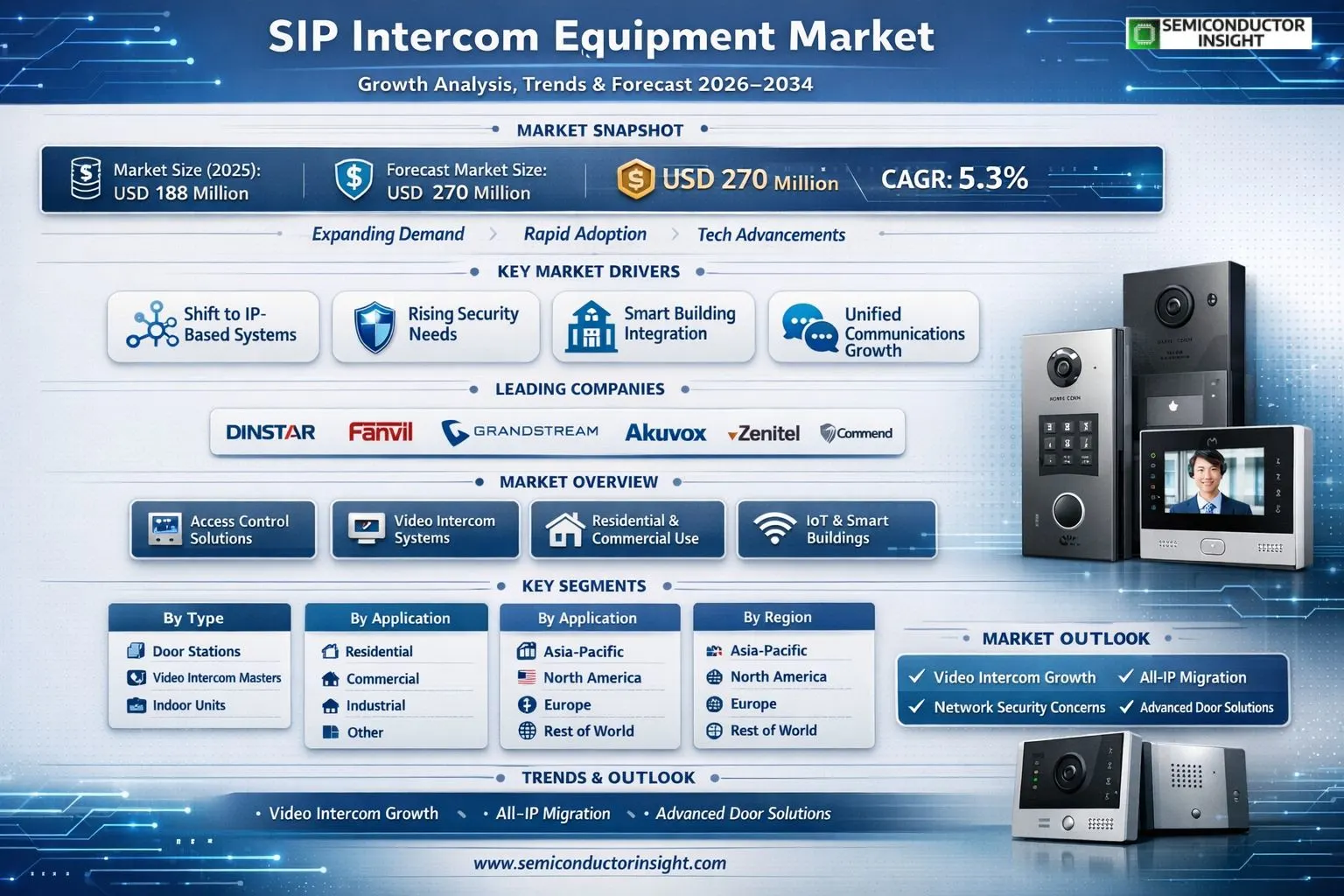
Global SIP intercom equipment market size was valued at USD 188 million in 2025. The market is projected to grow from USD 198 million in 2026 to USD 270 million by 2034, exhibiting a CAGR of 5.3% during the forecast period.
SIP (Session Initiation Protocol) intercom equipment comprises specialized communication devices that utilize the SIP standard for initiating, managing, and terminating voice and video sessions over Internet Protocol (IP) networks. These systems are crucial for modern, integrated communication, enabling efficient one-to-one and one-to-many interactions in environments demanding high reliability and seamless connectivity. Key product categories include Door Stations for access control, Video Intercom Masters for central management, and Indoor Units for end-user communication.
The market is experiencing steady growth driven by several key factors, including Global transition from traditional analog systems to IP-based infrastructure and the rising demand for unified communications solutions. Furthermore, increasing investments in smart building technologies and security across commercial, residential, and industrial sectors are significant contributors to market expansion. Initiatives by leading players are also propelling innovation; for instance, companies are integrating advanced features like facial recognition, mobile app integration, and interoperability with broader building management systems. Key players operating in this competitive landscape with diverse portfolios include DINSTAR, Fanvil Technology, Grandstream Networks, Inc., Akuvox, Zenitel, ALGO, and Commend.
MARKET DRIVERS
Convergence on IP and Unified Communications
The foundational driver for the SIP Intercom Equipment Market is Global, enterprise-wide transition from legacy analog systems to Internet Protocol (IP) architectures. This shift enables seamless integration with broader Unified Communications (UC) platforms, allowing for a single, manageable network for voice, video, and data. Organizations leverage SIP-based equipment not just for basic audio communication but as intelligent endpoints within a collaborative ecosystem. This convergence significantly reduces operational complexity and infrastructure costs while enabling advanced features and improved mobility for users, directly fueling market growth.
Heightened Security and Safety Imperatives
Security remains a paramount concern across sectors such as government, healthcare, education, and manufacturing, driving investment in reliable, purpose-built communication tools. SIP intercoms provide enhanced physical security and emergency response capabilities, often integrating with access control, video surveillance, and mass notification systems. Features like priority call routing, presence detection, and direct links to security personnel make SIP intercom equipment a critical component of modern safety protocols. The demand for robust, auditable, and resilient communication networks in critical environments is a persistent and powerful driver for the SIP Intercom Equipment Market.
➤ The adoption of SIP standards ensures multi-vendor interoperability, giving buyers greater choice and flexibility while protecting their investments against vendor lock-in, a key factor in procurement decisions.
Finally, the expanding scope of applications has accelerated demand. Beyond traditional office and building lobbies, SIP Intercom Equipment Market growth is propelled by deployments in smart cities for public address and information, in healthcare for nurse call and patient communication, in retail for customer assistance, and in industrial settings for process control. The versatility and programmability of SIP endpoints are enabling these new use cases, creating sustained, diversified demand across vertical industries.
MARKET CHALLENGES
Technical Complexity and Integration Hurdles
While the promise of integration is a key driver, it also presents a significant challenge. Deploying and configuring a SIP intercom system requires specialized knowledge of networking protocols, Quality of Service (QoS) configurations, and cybersecurity. Successful integration with existing PBX systems, UC platforms, and third-party security hardware demands careful planning and technical expertise. Smaller organizations or those without dedicated IT staff often struggle with this complexity, potentially leading to implementation failures, security vulnerabilities, and increased total cost of ownership, which can hinder broader SIP Intercom Equipment Market adoption.
Other Challenges
Persistent Legacy System Investment
A considerable installed base of traditional analog and proprietary digital intercom systems represents a major barrier. The high perceived cost of a full-scale “rip-and-replace” migration, coupled with the operational reliability of legacy systems, leads many organizations to defer upgrades despite the long-term benefits offered by SIP intercom equipment.
Concerns Over Network Security and Reliability
The convergence of critical communication onto data networks introduces risks. Potential threats include eavesdropping, toll fraud, denial-of-service attacks, and system outages tied to wider network failures. Enterprises must invest in robust cyber hygiene, session border controllers, and redundant infrastructure, adding layers of cost and management overhead that were not required for isolated legacy systems.
MARKET RESTRAINTS
Economic and Budgetary Pressure on Capital Expenditure
A primary restraint on the SIP Intercom Equipment Market is the sensitivity to macroeconomic conditions and capital expenditure budgets. During periods of economic uncertainty or contraction, enterprises and public sector entities often delay or cancel non-essential infrastructure upgrades. The procurement of SIP intercom hardware, associated licenses, and professional services is frequently categorized as a capital-intensive project. This makes it vulnerable to budget freezes, especially when competing with other critical IT and operational investments, thereby slowing down the replacement cycle and constraining near-term market expansion.
Subheading Text Here
This restraint is compounded by the increasing price competition and feature commoditization at the lower end of the SIP Intercom Equipment Market. An influx of low-cost solutions, while expanding access, can also create a perception of the technology as a commodity, intensifying price-based competition and pressuring profit margins for established vendors, potentially impacting long-term R&D investment.
MARKET OPPORTUNITIES
Expansion into IoT and Smart Building Ecosystems
The most significant opportunity for the SIP Intercom Equipment Market lies in transcending its role as a standalone communication device to become an intelligent node within the Internet of Things (IoT). SIP endpoints with integrated sensors and programmable logic can be used to trigger automated actions. For example, a lobby intercom could grant access, log the entry, adjust lighting and HVAC in the visited area, and notify the host,all from a single interaction. This deep integration into smart building platforms creates higher-value solutions and opens lucrative new revenue streams for vendors offering advanced, programmable SIP hardware and software.
Growth in Hybrid Work and Advanced UC Integration
The normalization of hybrid and remote work models has created a robust opportunity for SIP intercoms that bridge physical and digital spaces. Next-generation SIP Intercom Equipment Market products are evolving to serve as room controls and one-touch join endpoints for video conferencing platforms like Microsoft Teams and Zoom. This integration ensures seamless meeting experiences and extends the utility of the intercom. Furthermore, the rising adoption of cloud-based UCaaS (Unified Communications as a Service) presents a major channel for growth, as vendors can offer SIP intercom solutions as part of bundled, subscription-based service packages, lowering the entry barrier and scaling more easily.
SIP Intercom Equipment Market Trends
Integration with Unified Communications and IoT Ecosystems
The SIP Intercom Equipment Market is increasingly characterized by a primary trend of deep integration with broader Unified Communications (UC) platforms and Internet of Things (IoT) ecosystems. Rather than functioning as isolated audio systems, modern SIP-based intercoms are now designed as communication endpoints within larger digital infrastructures. This trend drives demand for equipment that can seamlessly interface with video conferencing tools, corporate messaging apps, and facility management systems. Consequently, manufacturers are prioritizing advanced software features and open APIs. This shift elevates the strategic value of SIP intercom systems from simple paging tools to integral components for smart building operations, security automation, and enterprise-wide communication workflows, enhancing overall operational intelligence and responsiveness.
Other Trends
Rising Demand for Advanced Door Station Solutions
Within the SIP Intercom Equipment Market, the door station segment represents a significant growth vector. These systems are evolving beyond basic audio communication to incorporate high-definition video, facial recognition, mobile app integration, and secure access control functionalities. The trend is most pronounced in both residential and commercial security applications, where there is a clear demand for solutions that offer remote visitor management and audit trails. Integration with SIP protocols ensures these door stations can be managed and scaled over existing IP networks, reducing cabling complexity and offering a future-proof pathway for security system upgrades.
Market Expansion Driven by Healthcare and Education Sectors
Specific verticals are acting as strong catalysts for the SIP Intercom Equipment Market, particularly healthcare and education. In large hospitals and educational campuses, the need for reliable, instant, and zone-based broadcast communication is paramount. SIP-based paging and intercom systems meet this demand by enabling clear, priority-based announcements, emergency notifications, and hands-free communication across vast facilities. The protocol’s compatibility with Voice over IP (VoIP) networks allows these institutions to leverage their existing data infrastructure, leading to cost-effective deployment and ease of integration with nurse call systems or classroom notification protocols.
Competitive Landscape and Strategic Focus
The competitive landscape of the SIP Intercom Equipment Market is defined by key players like DINSTAR, Grandstream Networks, and Akuvox focusing on product differentiation through enhanced security features, superior audio quality, and user-friendly management interfaces. A notable trend is the industry’s focus on providing scalable solutions suitable for both small installations and large, multi-site enterprise deployments. Companies are also expanding their product portfolios to cover all major segments, including video intercom masters and indoor units, ensuring they can offer comprehensive solutions for diverse applications from commercial offices to residential complexes.
COMPETITIVE LANDSCAPE
Key Industry Players
Market Leadership Concentrated Among Integrated IP Communication Providers
Global SIP Intercom Equipment market is a competitive arena, with the top five players accounting for a notable revenue share. This market structure is defined by a blend of specialized intercom system manufacturers and diversified IP communication technology companies. The leadership group, including players like Grandstream Networks, Inc. and Zenitel, leverages extensive experience in SIP protocols and VoIP technologies to offer robust and versatile intercom solutions. These leaders hold a strategic advantage through established global sales channels, a wide portfolio of compatible devices, and strong integration capabilities with existing IP-PBX and unified communication platforms. Their dominance is further solidified by providing end-to-end solutions for security, paging, and emergency communication across diverse verticals such as commercial enterprises, healthcare, and education.
Beyond the top tier, a significant number of dedicated and agile players occupy critical niche segments. Manufacturers like Akuvox, DINSTAR, and Fanvil Technology are key drivers in the residential and SME segments, offering cost-effective and user-friendly door stations and indoor units. Companies such as CyberData Corporation specialize in ruggedized and niche-specific solutions, including outdoor SIP paging speakers, which are vital for industrial and campus environments. Other notable participants like ALGO and Flyingvoice focus on specific applications like SIP-enabled alarm notification and compact intercom endpoints. This diverse competitive field fosters continuous innovation in audio quality, video integration, and network security features, compelling all players to enhance their offerings to capture growth in a market projected to expand significantly by 2034.
List of Key SIP Intercom Equipment Companies Profiled
- Grandstream Networks, Inc.
- Zenitel
- Commend
- DINSTAR
- Fanvil Technology
- CyberData Corporation
- Akuvox
- Flyingvoice
- ALGO
- Panasonic Corporation
- ATEÏS
- TOA Corporation
- Barix AG
- Axis Communications
- Siedle
Segment Analysis:
| Segment Category | Sub-Segments | Key Insights |
| By Type |
|
Door Station is a pivotal driver due to its role as the primary access control and visitor interface point for many systems. Its demand is fueled by the need for enhanced security and convenience across both residential and commercial properties. Manufacturers focus on integrating advanced features like high-definition video, facial recognition, and compatibility with smart home ecosystems, which elevates user experience and system value. The ongoing shift from traditional analog to IP-based solutions further propels innovation and adoption in this core hardware segment. |
| By Application |
|
Commercial Use represents the leading and most dynamic application segment, encompassing enterprises, hospitals, educational institutions, and hospitality. This dominance is driven by the critical need for scalable, reliable, and unified communication for paging, emergency alerts, and facility management. The transition to SIP protocol allows seamless integration with existing VoIP and IT infrastructure, offering superior flexibility and cost management. Furthermore, the demand for advanced features like zone paging, inter-department communication, and integration with access control and security systems continues to stimulate sophisticated deployments in this sector. |
| By End User |
|
Enterprises & Corporate Offices constitute a primary end-user group due to their extensive requirements for internal communication, security, and operational efficiency. The adoption is driven by the need for a professional communication system that supports desk phones, paging, and lobby management while reducing telephony costs through SIP trunks. This segment values solutions that offer easy management, scalability for multi-site operations, and integration with collaboration tools. The trend towards hybrid work models also encourages investment in robust, networked communication infrastructure that supports both on-site and remote connectivity. |
| By System Integration |
|
Integrated Security & Access Systems is the leading integration pathway, reflecting the market’s shift towards comprehensive building management solutions. SIP intercoms are increasingly valued as a component within broader ecosystems that include video surveillance, door access control, and alarm systems. This integration delivers a unified user interface, centralized management, and enhanced situational awareness for security personnel. The demand for such interconnected solutions is particularly strong in high-security environments and smart buildings, where interoperability and data synergy are critical for effective operations and incident response. |
| By Deployment Model |
|
On-Premises Deployment remains a dominant model, especially among established organizations and in sectors with stringent data control and security requirements. This preference is driven by the desire for direct control over the communication infrastructure, customization to specific operational workflows, and perceived reliability of localized systems. However, the market is witnessing a significant parallel growth in cloud-based interest, which appeals to organizations seeking lower upfront costs, remote management capabilities, and easier scalability, indicating an evolving landscape where model preference is closely tied to organizational size and IT strategy. |
Regional Analysis: Global SIP Intercom Equipment Market
North America
Compliance with strict security and safety regulations, particularly in the US, accelerates the replacement of legacy analog systems with secure, auditable SIP Intercom Equipment. This is especially critical in sectors like finance and critical infrastructure.
Large-scale enterprise deployments for facility management, access control, and internal communication are prevalent. The trend towards hybrid work models is also prompting investment in sophisticated SIP-based communication systems for office spaces.
A dense concentration of leading SIP Intercom Equipment manufacturers and software providers fosters intense competition and rapid technological advancement, focusing on cloud-based management, AI analytics, and enhanced audio/video quality.
Strong alignment with smart city initiatives and IoT deployments in urban centers drives demand for SIP intercoms that integrate seamlessly with broader digital ecosystems, including access control, surveillance, and building automation.
Europe
The European SIP Intercom Equipment Market is characterized by high adoption driven by data privacy regulations like GDPR and a strong focus on security across both public and private sectors. Countries such as the United Kingdom, Germany, and France are major contributors, with demand fueled by modernization projects in transportation hubs, healthcare, and historical building retrofits. The market benefits from a well-defined regulatory environment that emphasizes secure communication protocols, making SIP-based systems a preferred choice. However, the region’s diverse language and technical standards create complexity, requiring vendors to offer highly customizable and compliant solutions. The push for energy-efficient and sustainable buildings also influences product development, integrating SIP Intercom Equipment into green building certifications.
Asia-Pacific
Asia-Pacific is the fastest-growing region for the SIP Intercom Equipment Market, propelled by rapid urbanization, massive infrastructure development, and increasing security awareness. China, Japan, South Korea, and Australia are key markets, with significant investments in smart cities, commercial real estate, and public safety projects. The growth is supported by the widespread deployment of high-speed internet and 5G networks, which provide the necessary backbone for reliable SIP communication. Local manufacturers are becoming increasingly competitive, offering cost-effective solutions tailored to regional needs. The market’s expansion is further accelerated by the rising adoption in the residential sector within affluent urban areas, integrating intercoms with home automation systems.
South America
The South American SIP Intercom Equipment Market is in a growth phase, with adoption concentrated primarily in major urban centers and commercial sectors in Brazil, Argentina, and Chile. Market expansion is driven by increasing investments in commercial infrastructure, such as corporate offices, shopping malls, and gated communities, where security is a paramount concern. The gradual shift from traditional analog systems to IP-based solutions is underway, though price sensitivity remains a key factor influencing purchasing decisions. Economic fluctuations can impact the pace of large-scale deployments. Nonetheless, a growing awareness of the long-term benefits and total cost of ownership of SIP Intercom Equipment is steadily driving market penetration.
Middle East & Africa
The Middle East & Africa region presents a diverse landscape for the SIP Intercom Equipment Market. The Gulf Cooperation Council (GCC) countries, particularly the UAE and Saudi Arabia, are high-growth areas fueled by mega-projects, luxury real estate, and smart city initiatives like NEOM. These projects demand advanced, integrated security and communication solutions, creating robust demand for high-end SIP intercom systems. In contrast, adoption in other parts of Africa is more nascent and fragmented, often limited to specific verticals like mining, large enterprises, and high-security government installations. The overall market potential is significant but requires solutions that can address varied infrastructure reliability and budget constraints across the region.
Report Scope
This market research report provides a comprehensive analysis of the SIP Intercom Equipment Market , covering the forecast period 2026–2034. It offers detailed insights into market dynamics, technological advancements, competitive landscape, and key trends shaping the industry.
Key focus areas of the report include:
- Market Overview: The report begins with an overview outlining its current market scenario, key growth indicators, and industry transformation drivers. It discusses macroeconomic factors, demand–supply balance, regulatory landscape, and the strategic role of communication systems in powering advancements across industries such as enterprises, healthcare, education, and commercial security.
- Market Size & Forecast: Historical data and future projections for revenue, unit shipments, and market value across major regions and segments, including the forecasted CAGR.
- Segmentation Analysis: Detailed breakdown by product type (Door Station, Video Intercom Master, Indoor Units), application (Residential, Commercial, Others), and end-user industry to identify high-growth segments.
- Regional Insights: Insights into market performance across North America, Europe, Asia-Pacific, Latin America, and the Middle East & Africa, including country-level analysis of key markets like the US and China.
- Competitive Landscape: Profiles of leading market participants, including their product offerings, market share, revenue, and recent developments such as mergers, acquisitions, and partnerships.
- Technology Trends & Innovation: Assessment of SIP protocol advancements, integration with IP networks, and evolving standards for voice and video communication.
- Market Drivers & Restraints: Evaluation of factors driving market growth along with challenges, supply chain constraints, and market-entry barriers.
- Stakeholder Insights: Insights for component suppliers, OEMs, system integrators, investors, and policymakers regarding the evolving ecosystem and strategic opportunities.
Primary and secondary research methods are employed, including interviews with industry experts and data from verified sources like MARKET MONITOR GLOBAL, INC (MMG), to ensure the accuracy and reliability of the insights presented.
FREQUENTLY ASKED QUESTIONS:
What is the current market size of SIP Intercom Equipment Market?
-> Global SIP Intercom Equipment Market was valued at USD 188 million in 2025 and is projected to reach USD 270 million by 2034, growing at a CAGR of 5.3% during the forecast period.
Which key companies operate in SIP Intercom Equipment Market?
-> Key players include DINSTAR, Fanvil Technology, Grandstream Networks, Inc., Cyber Data Corporation, Akuvox, Flyingvoice, Zenitel, ALGO, and Commend, among others.
What are the key growth drivers?
-> Key growth drivers include the widespread adoption of IP-based communication, demand for efficient one-to-many communication in large enterprises, hospitals, and schools, and ongoing technological advancements in SIP protocols.
Which region dominates the market?
-> The report provides detailed analysis for North America, Europe, Asia, South America, and the Middle East & Africa. Specific country-level insights cover markets like the US and China, which are significant contributors.
What are the emerging trends?
-> Emerging trends include the integration of video capabilities in intercom systems, the shift towards all-IP communication networks, and the development of advanced door station and indoor unit solutions for residential and commercial security.

Get Sample Report PDF for Exclusive Insights
Report Sample Includes
- Table of Contents
- List of Tables & Figures
- Charts, Research Methodology, and more...
 Download Sample Report PDF




