MARKET INSIGHTS
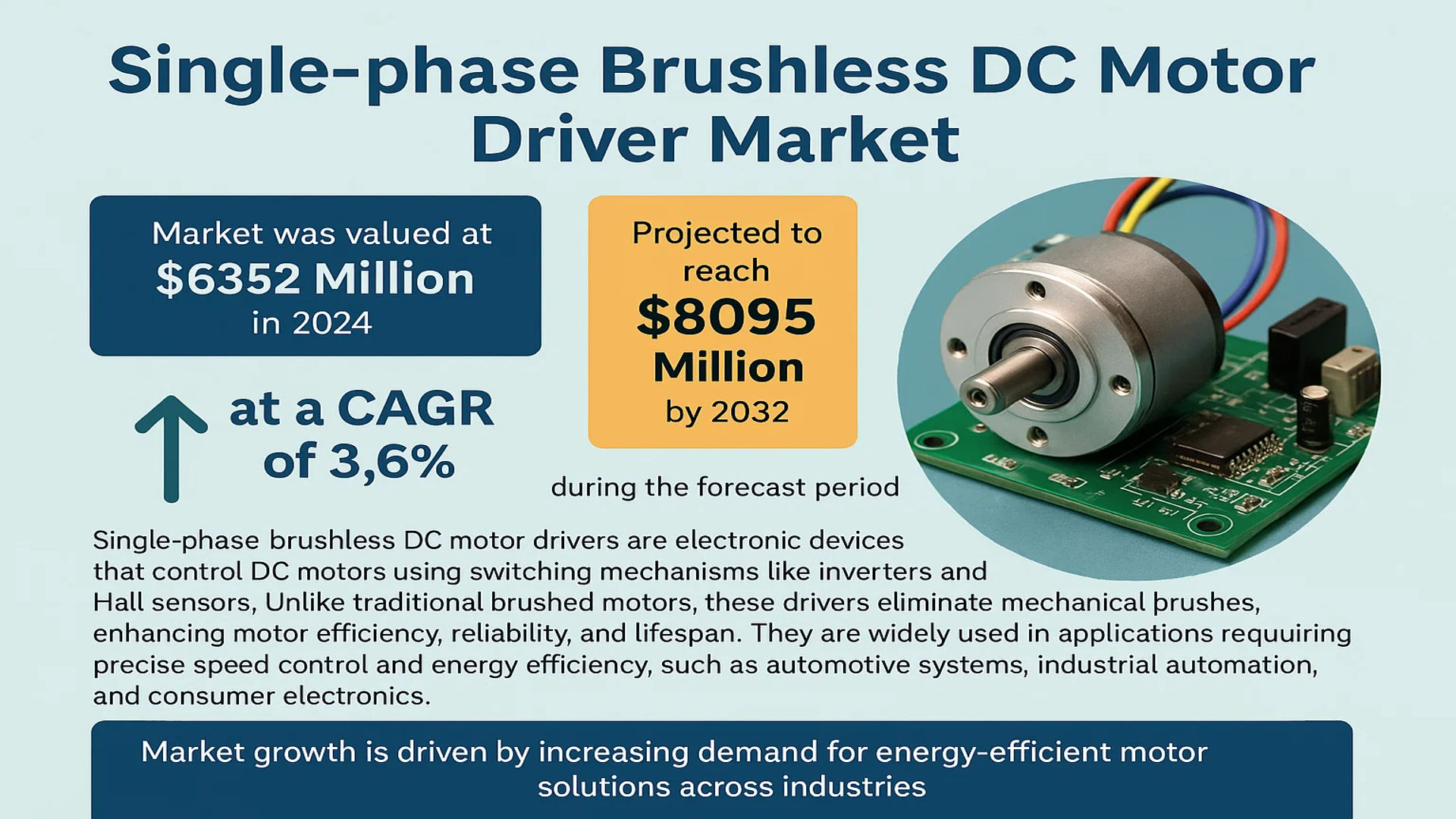
The global Single-phase Brushless DC Motor Driver Market was valued at 6352 million in 2024 and is projected to reach US$ 8095 million by 2032, at a CAGR of 3.6% during the forecast period.
Single-phase brushless DC motor drivers are electronic devices that control DC motors using switching mechanisms like inverters and Hall sensors. Unlike traditional brushed motors, these drivers eliminate mechanical brushes, enhancing motor efficiency, reliability, and lifespan. They are widely used in applications requiring precise speed control and energy efficiency, such as automotive systems, industrial automation, and consumer electronics.
The market growth is driven by increasing demand for energy-efficient motor solutions across industries. The automotive sector, particularly electric vehicles (EVs), is a major contributor due to strict energy regulations and the shift toward electrification. Meanwhile, industrial automation trends and rising adoption of UAVs further fuel demand. Key players like Texas Instruments, ROHM, and Microchip are investing in advanced driver ICs to capture market share, with Asia-Pacific emerging as the fastest-growing region due to manufacturing expansion in China and India.
MARKET DYNAMICS
MARKET DRIVERS
Rising Demand for Energy-Efficient Motors Accelerates Market Growth
The global push toward energy efficiency continues to drive adoption of single-phase brushless DC motor drivers across industries. These motors offer up to 30% higher efficiency compared to traditional brushed motors, significantly reducing energy consumption in applications ranging from automotive systems to industrial automation. Regulatory initiatives worldwide mandating energy-efficient solutions have further accelerated this transition, with the industrial sector accounting for over 45% of total motor energy consumption globally. The elimination of brushes reduces mechanical wear while improving reliability, making these drivers particularly valuable in mission-critical applications where downtime is costly.
Electric Vehicle Revolution Fuels Expansion Across Automotive Sector
With electric vehicle production projected to reach 35 million units annually by 2030, brushless DC motor drivers have become essential components in EV auxiliary systems including cooling fans, power steering, and HVAC compressors. The automotive sector now represents the fastest-growing application segment, with single-phase solutions particularly favored for their compact design and precise control in 12V-48V vehicle systems. Recent advancements in semiconductor technology have enabled motor drivers to achieve higher power density while reducing electromagnetic interference, addressing key challenges in automotive integration.
Industry 4.0 Adoption Spurs Smart Motor Integration
The ongoing Industry 4.0 transformation has significantly increased demand for intelligent motor control solutions that can interface with IoT ecosystems. Modern single-phase brushless DC drivers integrate advanced features including predictive maintenance algorithms, real-time performance monitoring, and network connectivity—enabling remote diagnostics and optimization. This technological evolution has been particularly impactful in industrial automation, where smart motor systems contribute to operational efficiency improvements exceeding 25% in material handling and processing applications.
MARKET RESTRAINTS
Complex Design Requirements Challenge Widespread Adoption
While brushless DC motors offer superior performance, their complex electronic control systems present significant design and implementation challenges. The requirement for precise sensor feedback, advanced commutation algorithms, and electromagnetic compatibility measures adds both cost and development time compared to conventional motor solutions. This complexity becomes particularly pronounced in cost-sensitive applications, where engineers must balance performance requirements with stringent budget constraints. Many small and medium manufacturers consequently face difficulties transitioning their product lines to incorporate brushless DC technology.
Supply Chain Vulnerabilities Impact Production Stability
The semiconductor-intensive nature of brushless DC motor drivers makes the market particularly susceptible to component shortages and price volatility. Recent disruptions in the global supply of power MOSFETs and driver ICs—critical components comprising up to 60% of motor driver BOM costs—have forced manufacturers to either accept extended lead times or expensive component substitutions. These supply chain challenges have become more acute for single-phase variants, where cost optimization leaves less flexibility for alternative component selection without compromising performance.
MARKET CHALLENGES
Thermal Management Issues Constrain Power Density Improvements
As applications demand higher power from increasingly compact motor drivers, thermal dissipation has emerged as a critical design challenge. Single-phase configurations are particularly susceptible to uneven heat distribution due to inherent current imbalances during operation. Modern motor drivers must incorporate advanced thermal interface materials and innovative packaging techniques to maintain reliability, adding both cost and design complexity. In automotive and industrial applications where ambient temperatures often exceed 85°C, these thermal challenges can reduce operational lifespans by as much as 40% if not properly addressed.
Other Challenges
Electromagnetic Compatibility Requirements
Strict EMC regulations governing motor drivers add significant testing and certification costs, particularly for consumer and automotive applications. Meeting CISPR 25 Class 5 requirements for conducted emissions often necessitates expensive filtering components and carefully designed PCB layouts.
Software Development Complexity
The shift toward software-configurable motor drivers requires manufacturers to maintain sophisticated firmware teams, increasing R&D expenditures. Complex motor control algorithms demand specialized expertise that remains in short supply across the industry.
MARKET OPPORTUNITIES
Emerging IoT Applications Open New Growth Frontiers
The proliferation of IoT-enabled devices is creating substantial opportunities for miniaturized, connected motor drivers in applications ranging from smart home appliances to medical devices. Single-phase brushless DC solutions are particularly well-suited for these applications due to their silent operation, reliability, and precise speed control capabilities. Industry analysts project smart home motor applications will grow at over 15% CAGR through 2030, with brushless DC drivers capturing an increasing share of this expanding market.
Advancements in Wide Bandgap Semiconductors Enable Next-Generation Designs
The adoption of silicon carbide (SiC) and gallium nitride (GaN) power devices is revolutionizing motor driver efficiency and power density. Early implementations show potential for 40% reductions in switching losses and 30% smaller form factors—critical benefits for space-constrained applications. These technological advancements are particularly impactful for single-phase configurations where component count reduction directly translates to cost savings. Leading manufacturers are now developing purpose-built driver ICs optimized for wide bandgap compatibility, creating new performance benchmarks for the industry.
SINGLE-PHASE BRUSHLESS DC MOTOR DRIVER MARKET TRENDS
Rising Demand for Energy-Efficient Motors Drives Market Expansion
The global single-phase brushless DC motor driver market is witnessing strong growth due to increasing demand for energy-efficient motor solutions across industries. As stricter energy regulations come into effect, manufacturers are shifting from traditional brushed motors to brushless DC (BLDC) alternatives, which offer higher efficiency, reduced maintenance, and longer operational life. Automotive applications, particularly in electric vehicle (EV) components like power windows and HVAC systems, account for over 30% of total demand. Meanwhile, industrial automation continues to adopt these drivers for precision control in conveyor systems and robotic arms.
Other Trends
Technological Advancements in Motor Control Algorithms
Recent developments in sensorless control technologies are eliminating the need for Hall-effect sensors in some single-phase BLDC applications, reducing system complexity and costs by an estimated 15-20%. Leading manufacturers are integrating advanced microcontrollers with real-time current sensing and AI-driven predictive maintenance features. These innovations are particularly impactful in consumer electronics, where space constraints make compact driver solutions essential for devices like drones and smart home appliances.
Asia-Pacific Emerges as Manufacturing Hub
The Asia-Pacific region now represents nearly 45% of global single-phase BLDC driver production, with China dominating both manufacturing and consumption. This concentration stems from robust electronics and automotive supply chains, coupled with government incentives for electrification initiatives. India’s market is growing at 8.3% annually as local manufacturers replace imports with domestically produced motor drivers. Meanwhile, Southeast Asian countries are becoming preferred locations for new production facilities due to competitive labor costs and free trade agreements.
COMPETITIVE LANDSCAPE
Key Industry Players
Market Leaders Leverage Technological Advancements to Drive Growth
The global single-phase brushless DC motor driver market features a mix of established semiconductor manufacturers and specialized motor control solution providers. Texas Instruments (TI) holds a dominant position, capturing approximately 18% of the 2024 market share, thanks to its extensive portfolio of motor driver ICs and strong partnerships with automotive manufacturers.
ROHM Semiconductor and Monolithic Power Systems (MPS) follow closely with 12% and 10% market shares respectively, driven by their energy-efficient driver solutions optimized for industrial applications. These companies continue to invest in integrated circuit miniaturization, offering higher power density in compact form factors that appeal to electronics manufacturers.
The competitive landscape is intensifying as companies expand their production capacities in Asia to meet growing EV demand. Nisshinbo Micro Devices recently opened a new fabrication facility in Japan focused on motor driver ICs, while Onsemi has committed $200 million to expand its manufacturing capabilities in Southeast Asia. Such expansions are expected to significantly strengthen these players’ positions through 2032.
Meanwhile, Microchip Technology and Diodes Incorporated are differentiating themselves through software-defined motor control solutions, combining hardware with intelligent algorithms for predictive maintenance capabilities. This technological edge helps them secure premium pricing and strengthen customer retention in industrial automation applications.
List of Key Single-phase Brushless DC Motor Driver Manufacturers
- Texas Instruments (U.S.)
- ROHM Semiconductor (Japan)
- Monolithic Power Systems (U.S.)
- Microchip Technology (U.S.)
- Power Motor (China)
- Nisshinbo Micro Devices (Japan)
- Onsemi (U.S.)
- Diodes Incorporated (U.S.)
Segment Analysis:
By Type
Control Integrated Drive Segment Leads Due to High Efficiency and Compact Design
The market is segmented based on type into:
- Device-level Drive
- Subtypes: Low voltage, Medium voltage, and others
- Modular Drive
- Control Integrated Drive
- Subtypes: Sensorless control, Hall sensor-based, and others
- Others
By Application
Automotive Segment Dominates Owing to Rising EV Adoption
The market is segmented based on application into:
- Automotive
- Electronics
- UAV
- Industrial
- Others
By Power Range
Low Power Segment Holds Major Share for Consumer Applications
The market is segmented based on power range into:
- Below 100W
- 100-500W
- 500-1000W
- Above 1000W
By End-User Industry
Manufacturing Sector Drives Market Growth
The market is segmented based on end-user industry into:
- Automotive Manufacturing
- Consumer Electronics
- Industrial Automation
- Aerospace & Defense
- Others
Regional Analysis: Single-phase Brushless DC Motor Driver Market
Asia-Pacific
The Asia-Pacific region dominates the single-phase brushless DC motor driver market, accounting for over 42% of global demand in 2024. This leadership position is driven by China’s massive manufacturing sector and India’s rapidly expanding electric vehicle industry, where motor efficiency requirements are becoming increasingly stringent. Government initiatives like China’s “Made in China 2025” policy actively promote the adoption of energy-efficient motor technologies in industrial automation and consumer appliances. While cost sensitivity remains a factor, Japan and South Korea are focusing on high-performance motor drivers for precision applications in robotics and aerospace. The region’s strong electronics manufacturing ecosystem also supports continuous innovation in compact, integrated driver solutions.
Europe
European markets prioritize energy-efficient motor solutions, with strict EU regulations pushing the adoption of single-phase brushless DC motor drivers in appliances and industrial equipment. The region’s well-established automotive sector, particularly in Germany and France, is transitioning toward brushless technologies for auxiliary systems as part of broader electrification strategies. Research institutions and manufacturers collaborate closely on developing next-generation driver ICs with improved thermal management and EMI performance. However, the market faces challenges from complex certification processes and competition from Asian manufacturers, prompting European players to focus on high-value, customized solutions for specialized applications.
North America
North America’s mature industrial base and advanced technological landscape create steady demand for premium single-phase brushless DC motor drivers, particularly in medical devices, HVAC systems, and aerospace applications. The U.S. leads in innovation, with companies developing smart motor control solutions integrating IoT capabilities for predictive maintenance. Growing investments in renewable energy systems and electric vehicle charging infrastructure present new opportunities for brushless motor drivers. However, the market faces pricing pressure from imported alternatives, driving local manufacturers to emphasize reliability, technical support, and compliance with stringent safety standards.
Middle East & Africa
This emerging market shows gradual but promising growth, primarily fueled by infrastructure development and diversification efforts in Gulf Cooperation Council (GCC) countries. The focus remains on rugged, durable motor drivers for oil & gas equipment and construction machinery rather than high-tech applications. While adoption rates are currently low compared to other regions, increasing electrification across industries and improving technical education systems suggest long-term potential. Market expansion is constrained by limited local manufacturing capabilities and reliance on imports, though joint ventures with international suppliers are beginning to address this gap.
South America
South America represents the smallest but steadily growing market segment, with Brazil and Argentina showing increased adoption in industrial automation and automotive components. Economic volatility and inconsistent policy frameworks challenge market development, but local manufacturers are finding niche opportunities in agricultural equipment and renewable energy applications. The region benefits from proximity to North American supply chains while facing competition from Asian suppliers in price-sensitive segments. Investments in smart city projects and sustainable infrastructure could accelerate adoption in coming years.
Report Scope
This market research report provides a comprehensive analysis of the Global Single-phase Brushless DC Motor Driver Market, covering the forecast period 2025–2032. It offers detailed insights into market dynamics, technological advancements, competitive landscape, and key trends shaping the industry.
Key focus areas of the report include:
- Market Size & Forecast: Historical data and future projections for revenue, unit shipments, and market value across major regions and segments. The market was valued at USD 6,352 million in 2024 and is projected to reach USD 8,095 million by 2032 at a CAGR of 3.6%.
- Segmentation Analysis: Detailed breakdown by product type (Device-level Drive, Modular Drive, Control Integrated Drive), application (Automotive, Electronics, UAV, Industrial, Others), and end-user industries to identify high-growth segments.
- Regional Outlook: Insights into market performance across North America, Europe, Asia-Pacific, Latin America, and Middle East & Africa, including country-level analysis of key markets like China, Japan, and the U.S.
- Competitive Landscape: Profiles of leading market participants including Microchip, Texas Instruments, ROHM, and Onsemi, covering their product portfolios, market share, and strategic developments.
- Technology Trends & Innovation: Assessment of emerging motor control technologies, integration with IoT systems, and advancements in power efficiency.
- Market Drivers & Restraints: Evaluation of factors such as growing EV adoption, industrial automation trends, along with supply chain challenges and regulatory constraints.
- Stakeholder Analysis: Strategic insights for motor manufacturers, component suppliers, system integrators, and investors in the ecosystem.
The research employs both primary and secondary methodologies, including interviews with industry leaders and analysis of verified market data, to ensure accuracy and reliability.
FREQUENTLY ASKED QUESTIONS:
What is the current market size of Global Single-phase Brushless DC Motor Driver Market?
-> Single-phase Brushless DC Motor Driver Market was valued at 6352 million in 2024 and is projected to reach US$ 8095 million by 2032, at a CAGR of 3.6% during the forecast period.
Which key companies operate in this market?
-> Key players include Microchip, Texas Instruments, ROHM, Onsemi, Nisshinbo Micro Devices, and Monolithic Power Systems.
What are the key growth drivers?
-> Growth is driven by increasing EV production, industrial automation, and demand for energy-efficient motor solutions across sectors.
Which region dominates the market?
-> Asia-Pacific leads the market, accounting for over 45% of global demand, driven by manufacturing growth in China and India.
What are the emerging trends?
-> Emerging trends include integration of smart motor control, miniaturization of drivers, and adoption in UAV applications.

Get Sample Report PDF for Exclusive Insights
Report Sample Includes
- Table of Contents
- List of Tables & Figures
- Charts, Research Methodology, and more...