MARKET INSIGHTS
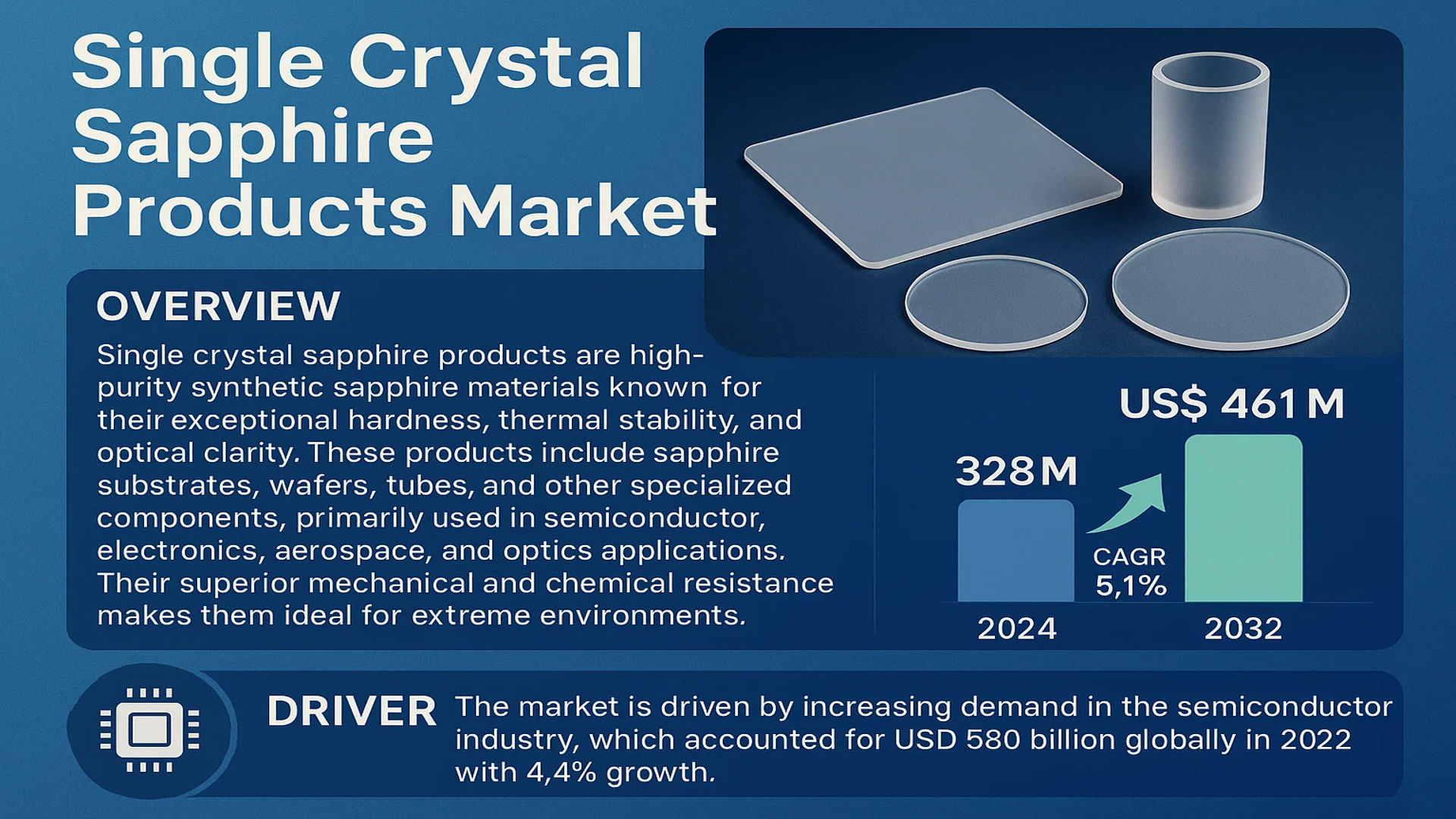
The global Single Crystal Sapphire Products Market was valued at 328 million in 2024 and is projected to reach US$ 461 million by 2032, at a CAGR of 5.1% during the forecast period.
Single crystal sapphire products are high-purity synthetic sapphire materials known for their exceptional hardness, thermal stability, and optical clarity. These products include sapphire substrates, wafers, tubes, and other specialized components, primarily used in semiconductor, electronics, aerospace, and optics applications. Their superior mechanical and chemical resistance makes them ideal for extreme environments.
The market is driven by increasing demand in the semiconductor industry, which accounted for USD 580 billion globally in 2022 with 4.4% growth. While the Americas and Europe saw double-digit growth (17.0% and 12.6% respectively), Asia-Pacific faced a 2.0% decline. Furthermore, advancements in LED technology and the rising adoption of sapphire in consumer electronics are accelerating market expansion. Key players like Kyocera, Saint-Gobain Crystals, and Rubicon are investing in production capacity to meet growing demand, particularly for sapphire wafers used in GaN-based devices.
MARKET DYNAMICS
MARKET DRIVERS
Growing Semiconductor Industry Demand Fuels Sapphire Product Adoption
The global semiconductor industry, valued at over $580 billion in 2022, continues to drive demand for single crystal sapphire products as essential components in chip manufacturing. Sapphire’s exceptional hardness, thermal stability, and optical clarity make it indispensable for semiconductor wafers and substrates. With the semiconductor market projected for continued growth despite economic headwinds, manufacturers are increasingly turning to sapphire-based solutions to meet the stringent requirements of next-generation electronics. The Asia-Pacific region, accounting for nearly 60% of global semiconductor sales, remains a critical growth engine for sapphire product adoption.
Expanding LED and Optoelectronic Applications Create New Growth Avenues
Single crystal sapphire’s unique properties are revolutionizing LED lighting and optoelectronic devices, representing one of the fastest-growing application segments. The material’s high light transmittance (over 80% in visible spectrum) and chemical inertness make it ideal for LED substrates, optical windows, and laser components. With the global LED market exceeding $75 billion and compound annual growth rates above 10%, sapphire manufacturers are strategically expanding production capacities to meet this surging demand while maintaining the strict quality standards required for optoelectronic applications.
Furthermore, advancements in manufacturing processes have reduced sapphire production costs by nearly 30% over the past five years, making it more competitive against alternative materials. Several leading manufacturers have announced capacity expansions, with one major player investing over $200 million in new production facilities to capitalize on these market opportunities.
MARKET RESTRAINTS
High Production Costs and Technical Barriers Limit Market Penetration
While sapphire boasts superior material properties, its high production costs remain a significant market restraint. The complex crystal growth process requires specialized equipment and consumes substantial energy, with single crystal sapphire boules costing 40-60% more than comparable silicon substrates. This cost differential creates barriers to adoption in price-sensitive applications, particularly in consumer electronics where manufacturers constantly seek to reduce bill-of-materials expenses.
Other Key Challenges
Processing Difficulties
The extreme hardness of sapphire (rated 9 on Mohs scale) makes machining and polishing labor-intensive, often requiring diamond tools and specialized expertise. These processing challenges can lead to higher defect rates and lower production yields compared to alternative materials.
Technical Limitations
While sapphire offers excellent thermal stability, its relatively lower thermal conductivity compared to silicon carbide creates design constraints in high-power electronic applications. These material limitations continue to drive research into composite solutions and alternative wide-bandgap semiconductors.
MARKET CHALLENGES
Supply Chain Vulnerabilities and Raw Material Dependencies Pose Risks
The sapphire industry faces ongoing supply chain challenges stemming from concentrated raw material sourcing. Over 70% of global alumina feedstock originates from a limited number of suppliers, creating potential bottlenecks in the production pipeline. Recent geopolitical tensions and trade restrictions have highlighted these vulnerabilities, with some manufacturers reporting lead time extensions of 30-45 days for critical raw materials.
Additionally, the industry continues to grapple with yield consistency issues in large-diameter crystal growth. While 6-inch sapphire wafers have become industry standard for many applications, achieving consistent quality in 8-inch and larger formats remains challenging, with defect rates increasing significantly with wafer size. These technical hurdles must be overcome to meet the evolving demands of semiconductor and optical applications.
MARKET OPPORTUNITIES
Emerging Applications in Aerospace and Defense Create New Growth Potential
The aerospace and defense sectors present significant opportunities for single crystal sapphire products, with demand growing for transparent armor, sensor windows, and aerospace optics. Sapphire’s combination of scratch resistance, impact strength, and optical clarity make it ideal for these demanding applications, where performance often outweighs cost considerations. The global aerospace composite materials market, projected to exceed $60 billion by 2030, represents a prime vertical for sapphire product expansion.
Strategic Partnerships Accelerate Technological Innovation
Leading sapphire manufacturers are increasingly forming technology partnerships with end-users to co-develop customized solutions. One notable collaboration involves a major aerospace manufacturer working with sapphire producers to develop next-generation infrared windows with enhanced durability. These partnerships not only drive product innovation but also help align sapphire production capabilities with emerging market requirements across multiple industries.
Furthermore, advancements in thin-film sapphire deposition technologies are opening new possibilities for flexible electronics and protective coatings. While still in early stages, these developments could dramatically expand the addressable market for sapphire-based solutions beyond traditional bulk crystal applications.
SINGLE CRYSTAL SAPPHIRE PRODUCTS MARKET TRENDS
Semiconductor Industry Demand Drives Single Crystal Sapphire Market Growth
The global single crystal sapphire market is experiencing significant growth, primarily driven by its increasing adoption in the semiconductor industry. Valued at $328 million in 2024, the market is projected to reach $461 million by 2032, growing at a CAGR of 5.1%. Single crystal sapphire’s superior properties—such as high thermal conductivity, mechanical strength, and chemical resistance—make it ideal for semiconductor substrates, particularly in high-power LED and RF applications. The rapid expansion of 5G networks and the growing demand for IoT devices further amplify this trend, as these technologies rely heavily on high-performance semiconductor components.
Other Trends
Rising Applications in Aerospace & Defense
Beyond semiconductors, single crystal sapphire products are gaining traction in aerospace and defense due to their durability and optical clarity. Advanced aircraft, space exploration equipment, and missile guidance systems increasingly incorporate sapphire components for their scratch resistance and infrared transparency. The global aerospace sector’s growth, projected to surpass $400 billion by 2027, underscores the expanding opportunities for sapphire-based optical windows, sensor housings, and armor systems. Additionally, military modernization programs in North America and Asia-Pacific are accelerating demand for high-performance materials like single crystal sapphire.
Technological Advancements in Sapphire Production
Innovations in crystal growth techniques, including the Kyropoulos and Edge-defined Film-fed Growth (EFG) methods, are enhancing the quality and cost-efficiency of single crystal sapphire production. These advancements allow manufacturers to produce larger sapphire substrates with fewer defects, meeting the stringent requirements of the semiconductor and optics industries. Furthermore, companies are exploring hybrid processes combining chemical vapor deposition (CVD) with traditional methods to improve yield and reduce lead times. Investment in R&D continues to intensify, with key players like Kyocera and Saint-Gobain allocating substantial resources to optimize sapphire manufacturing for emerging applications in electric vehicles and renewable energy systems.
COMPETITIVE LANDSCAPE
Key Industry Players
Innovation and R&D Investments Drive Market Leadership in Sapphire Technology
The global single crystal sapphire products market features a competitive yet collaborative ecosystem, where players across North America, Europe, and Asia-Pacific vie for market share through technological differentiation. Kyocera Corporation and Saint-Gobain Crystals dominate the landscape with their vertically integrated manufacturing capabilities and diverse product portfolios—from sapphire substrates to precision optics. These leaders collectively accounted for over 35% of the market share in 2024, leveraging their expertise in high-purity crystal growth and finishing technologies.
Meanwhile, Rubicon Technology and BIEL Crystal have carved niches in semiconductor and LED applications, respectively. Rubicon’s patented thermal conditioning process gives it an edge in wafer uniformity, a critical factor for semiconductor fab clients. BIEL, on the other hand, reported a 12% revenue increase in 2024 from its large-diameter sapphire ingot production, capitalizing on Asia’s booming LED industry.
Smaller but technologically agile players like Tera Xtal Technology are disrupting the market with specialty products. Their anti-reflective coated sapphire optics gained traction in aerospace applications, contributing to a projected 8% annual growth through 2032. Such innovation underscores the industry’s shift toward application-specific solutions rather than commoditized offerings.
Strategic Moves Shaping the Market
Recent M&A activity highlights the race for capability expansion. Saint-Gobain’s 2023 acquisition of Poland-based Juropol strengthened its European production footprint, while Adamant Namiki partnered with Japanese research institutions to develop strain-resistant sapphire for next-gen photonics. These strategic plays reflect the dual focus on scaling production while advancing material science.
The competitive intensity is further evidenced by R&D investments—top players allocate 6-8% of revenues to developmental programs. Shinkosha, for instance, recently unveiled a low-defect-density sapphire growth technique that reduces manufacturing costs by 15%, a game-changer for price-sensitive consumer electronics segments.
List of Key Single Crystal Sapphire Product Companies Profiled
- Kyocera Corporation (Japan)
- Saint-Gobain Crystals (France)
- Rubicon Technology, Inc. (U.S.)
- BIEL Crystal (China)
- Adamant Namiki Precision Jewel Co. (Japan)
- Hansol Technics (South Korea)
- Procrystal Technology (Taiwan)
- Rotem Industries (Israel)
- Shinkosha Co., Ltd. (Japan)
- Tera Xtal Technology (Taiwan)
Segment Analysis:
By Type
Sapphire Substrate Segment Leads Due to Widespread Use in Semiconductor and LED Industries
The market is segmented based on type into:
- Sapphire Substrate
- Subtypes: C-Plane, R-Plane, M-Plane, and others
- Sapphire Wafer
- Subtypes: 2-inch, 4-inch, 6-inch, and others
- Sapphire Tube
- Other
- Including sapphire rods, lenses, and custom components
By Application
Semiconductor Segment Dominates Owing to Rising Demand for High-Performance Electronic Components
The market is segmented based on application into:
- Electronic
- Semiconductor
- Aerospace
- Optics
- Other
By Product Form
High Transparency Sapphire Products in Demand for Optical Applications
The market is segmented based on product form into:
- Transparent
- Semi-Transparent
- Opaque
By End-Use Industry
Technology Sector Emerges as Key Consumer of Sapphire Products
The market is segmented based on end-use industry into:
- Technology
- Industrial
- Defense
- Medical
Regional Analysis: Single Crystal Sapphire Products Market
Asia-Pacific
The Asia-Pacific region dominates the global single crystal sapphire market, accounting for over 45% of total consumption in 2024. This leadership stems from massive semiconductor manufacturing clusters in China, Taiwan, South Korea, and Japan. China alone contributes approximately 30% of regional demand, fueled by government initiatives like “Made in China 2025” that prioritize advanced materials for electronics. While Japan’s traditional leadership in wafer production remains strong (with players like Kyocera and Shinkosha), newer Chinese manufacturers are rapidly catching up through aggressive capacity expansions. The region benefits from integrated supply chains connecting sapphire growers with downstream LED and display manufacturers, though recent US trade restrictions on advanced semiconductors pose some demand-side uncertainties.
North America
North America maintains technological leadership in high-end sapphire applications, particularly for aerospace and defense systems requiring extreme durability. The US semiconductor industry’s 17% YoY revenue growth in 2022 significantly boosted demand for sapphire substrates in RF and power electronics. Major players like Rubicon Technology and Saint-Gobain Crystals focus on specialized applications including missile domes and hyperspectral imaging windows. Recent CHIPS Act funding ($52.7 billion) towards domestic semiconductor production is expected to further stimulate sapphire wafer demand, especially for 5G and electric vehicle power modules. However, higher production costs compared to Asian suppliers limit market penetration in consumer electronics segments.
Europe
European market growth centers on sustainability-driven innovation, with EU Horizon Europe programs funding sapphire applications in renewable energy systems. Germany and France collectively account for 60% of regional demand, driven by automotive LiDAR sensors and medical imaging equipment. Companies like Juropol specialize in ultra-high-purity sapphire tubes for pharmaceutical processing. The region shows particular strength in R&D-intensive niches – Swedish manufacturer Ascut Ltd. recently developed a breakthrough method for producing curved sapphire components for next-gen endoscopic probes. However, energy price volatility post-Ukraine war has temporarily constrained production capacity expansions among European crystal growers.
Middle East & Africa
This emerging market is witnessing strategic investments in sapphire production infrastructure, particularly in Saudi Arabia and Israel. The UAE’s $1.4 billion semiconductor initiative launched in 2023 includes sapphire wafer fabrication facilities to support regional IoT and smart city projects. Israel’s Rotem Industries supplies specialized radiation-resistant sapphire components for nuclear and space applications. While current volumes remain modest, partnerships with Asian technology providers and abundant energy resources position the region as a potential future production hub. Challenges include limited local technical expertise and competitive pressure from established global suppliers.
South America
The South American market remains in early development stages, with Brazil accounting for 75% of regional sapphire product consumption. Primary applications focus on industrial windows and optical components for mining/oil/gas equipment. Argentina shows nascent activity in sapphire-based sensor components for agricultural technology. The region benefits from available quartz raw materials but lacks advanced crystal growth facilities, resulting in heavy import dependence. Political instability and currency fluctuations continue to deter major investments, though some Chinese manufacturers are exploring joint ventures to access Mercosur markets.
Report Scope
This market research report provides a comprehensive analysis of the global Single Crystal Sapphire Products market, covering the forecast period 2024–2032. It offers detailed insights into market dynamics, technological advancements, competitive landscape, and key trends shaping the industry.
Key focus areas of the report include:
- Market Size & Forecast: Historical data and future projections for revenue, unit shipments, and market value across major regions and segments. The global market was valued at USD 328 million in 2024 and is projected to reach USD 461 million by 2032, growing at a CAGR of 5.1%.
- Segmentation Analysis: Detailed breakdown by product type (sapphire substrate, wafer, tube), application (electronics, semiconductor, aerospace, optics), and end-user industry to identify high-growth segments.
- Regional Outlook: Insights into market performance across North America, Europe, Asia-Pacific, Latin America, and Middle East & Africa, with Asia-Pacific accounting for the largest share in 2024.
- Competitive Landscape: Profiles of 11 key players including Kyocera, Saint-Gobain Crystals, and Rubicon, covering their market share (top 5 companies held XX% in 2024), product portfolios, and strategic developments.
- Technology Trends: Assessment of advanced fabrication techniques and emerging applications in semiconductor and LED industries.
- Market Drivers & Restraints: Evaluation of semiconductor industry growth (global market reached USD 580 billion in 2022) versus supply chain challenges and high production costs.
- Stakeholder Analysis: Strategic insights for material suppliers, manufacturers, OEMs, and investors in the sapphire products value chain.
The research methodology combines primary interviews with industry experts and analysis of verified market data from manufacturers, ensuring reliable and accurate market intelligence.
FREQUENTLY ASKED QUESTIONS:
What is the current market size of Global Single Crystal Sapphire Products Market?
-> Single Crystal Sapphire Products Market was valued at 328 million in 2024 and is projected to reach US$ 461 million by 2032, at a CAGR of 5.1% during the forecast period.
Which key companies operate in this market?
-> Leading players include Kyocera, Saint-Gobain Crystals, Rubicon, BIEL Crystal, and Adamant Namiki, among others.
What are the key growth drivers?
-> Growth is driven by semiconductor industry expansion (USD 580 billion market in 2022), LED demand, and aerospace applications.
Which region dominates the market?
-> Asia-Pacific holds the largest market share, while North America shows the fastest growth at 17% YoY in 2022.
What are the emerging trends?
-> Key trends include larger diameter wafers, improved crystal growth techniques, and integration in 5G and IoT devices.

Get Sample Report PDF for Exclusive Insights
Report Sample Includes
- Table of Contents
- List of Tables & Figures
- Charts, Research Methodology, and more...
 Download Sample Report PDF