Key Statistics
Key Takeaways
- Global trajectory: the automotive silicon carbide power-device market stands at USD 3,291.32 million in 2026 and advances toward USD 18,430.39 million in 2036, reflecting 18.8% annual growth over the 2027–2036 projection window. The boundary includes merchant finished MOSFETs, diodes and qualified power modules rather than whole traction inverters or vehicles.
- Main inverter applications: represent an estimated ~64% of 2026 factory-gate revenue because traction conversion requires the highest-current switching stage on the vehicle, especially on 800V battery platforms. The main-inverter estimate is a share of automotive semiconductor device sales, not a share of vehicle powertrain spending or electric car purchases.
- SiC MOSFET modules: form the largest product category with a modeled ~54% share, while discrete MOSFETs account for ~37% and Schottky barrier diodes ~9%. The distinction matters commercially: modules incorporate multiple dies and packaging, and their invoice value must not be added to the value of internal semiconductor dies.
- Asia-Pacific: is the largest modeled regional market at ~49% of 2026 revenue, supported by Chinese EV production, Japanese semiconductor suppliers and a growing Korean electric vehicle supply chain. North America remains material at ~24%, calibrated against the publisher’s older regional monetary anchor rather than an independently audited 2026 split.
- Commercial qualification: requires automotive reliability evidence, power-cycling durability, short-circuit behavior and stable wafer sourcing. Announced designs by Toyota, Xiaomi, NIO, Geely and Schaeffler demonstrate actual SiC integration, but none of those announcements independently validates the global revenue estimate or modeled regional shares.
Silicon Carbide Power Devices for Automobiles Market Overview
Silicon carbide power devices for automobiles market was valued at USD 3,291.32 million in 2026 and is projected to reach USD 18,430.39 million by 2036, expanding at a CAGR of 18.8% over 2027–2036. Asia-Pacific held the largest modeled share of ~49% in 2026, reflecting concentration of electric-car assembly and high-voltage automotive power electronics.
Automotive silicon carbide power devices are semiconductor switches and rectifiers used to transfer energy between an electric vehicle battery, traction motor, charger and low-voltage electrical network. Silicon carbide permits high electric fields and fast switching, allowing lower conversion losses and more compact passive components than comparable silicon power stages in suitable designs. This market includes automotive-grade MOSFET modules, discrete SiC MOSFETs and SiC Schottky barrier diodes sold for vehicle conversion applications. It does not include the full value of battery packs, motors, completed inverters, chargers, semiconductor substrates or external charging stations.
The original monetary anchors are USD 1,963 million in 2023 and USD 6,555.95 million in 2030, an endpoint-implied annual rate of 18.80001%, consistent with the published 18.80% label. Applying that exact rate to the same defined series produces the 2026 base, 2027 estimate and 2036 projection. The terminal year extends six years beyond the publisher forecast endpoint, so the long-run value is a mathematical scenario rather than a manufacturer-confirmed shipment or purchase commitment. The 2023 North American anchor of USD 511.50 million represents 26.1% of that year’s global figure.
The International Energy Agency recorded more than 20 million electric-car sales in 2025, equivalent to one in four new cars worldwide, and its 2026 outlook anticipates 23 million units. Yet vehicle production does not translate one-for-one into silicon carbide demand: battery voltage, traction-inverter architecture, semiconductor content per vehicle and the penetration of silicon-based alternatives determine component purchases. SiC is most valuable when losses at high current and voltage materially affect cooling, charging speed or driving range. Automotive customers may still retain silicon IGBTs for cost-sensitive platforms and use SiC only in the on-board charger or high-voltage converter.
Recent design evidence spans several distinct automotive sockets. Infineon disclosed that Toyota adopted CoolSiC MOSFETs in the new bZ4X on-board charger and DC/DC converter in February 2026. onsemi announced EliteSiC technology in selected Xiaomi YU7 800V traction systems in August 2025, while its April 2026 collaborations with NIO and Geely address 900V vehicle architectures. STMicroelectronics described its fourth-generation 750V and 1200V SiC platform for traction applications, and ROHM lists a 750V, 506A automotive-grade half-bridge module. These examples support a broad product market but do not identify audited industry revenue.
Factory-gate valuation counts a completed semiconductor module once at its external selling price; separately sold discrete transistors and diodes are counted only when they are not also represented as internal content of those modules. An automotive-grade MOSFET die transferred inside a vertically integrated group is not a second external sale, and an inverter manufacturer’s finished powertrain price is outside the device boundary. This distinction is essential when comparing the automotive segment with broad SiC module, photovoltaic device or wide-bandgap device markets, because those datasets can describe overlapping physical components at different points in the value chain.
Segment Analysis: By Type
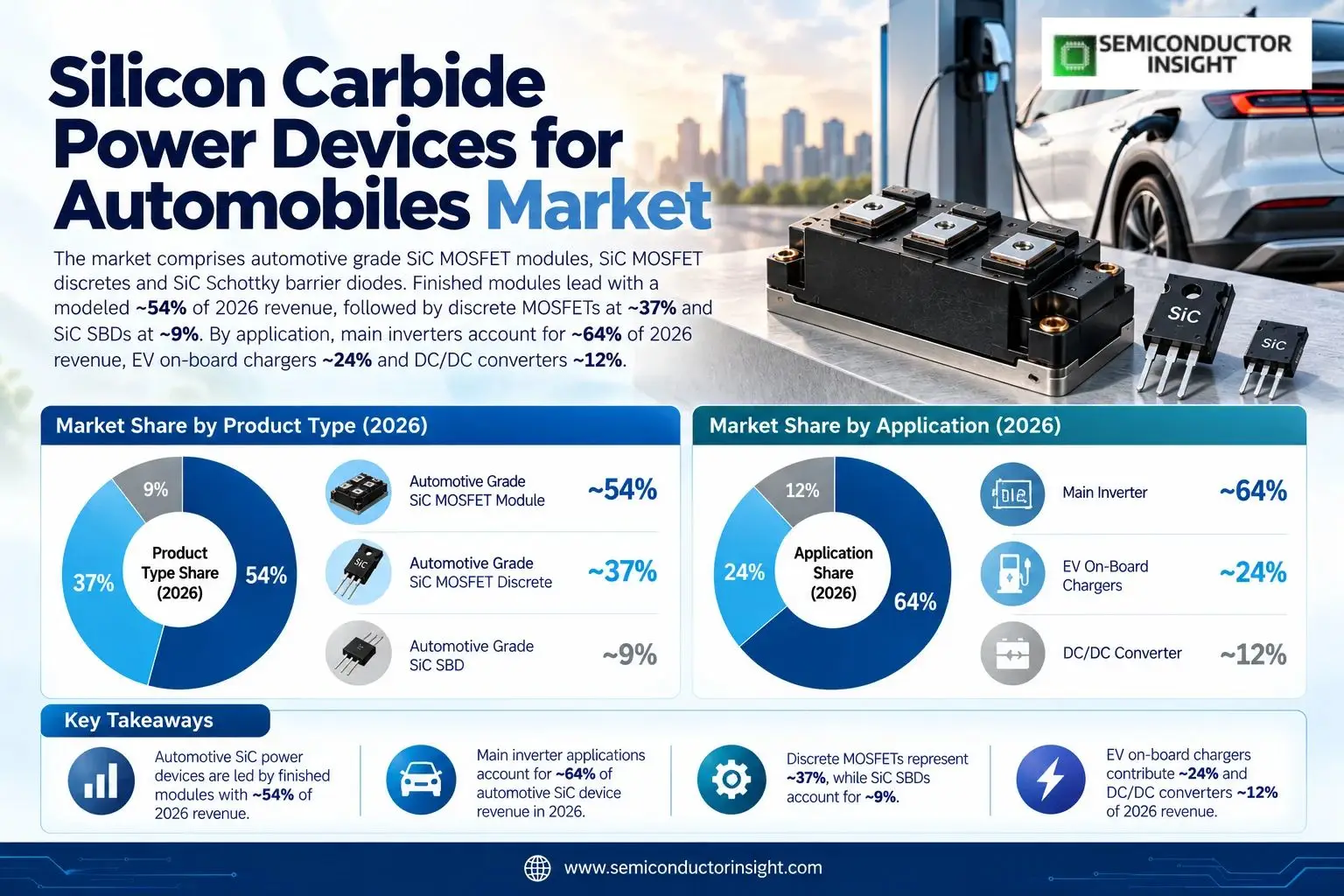
By product type, the market comprises Automotive Grade SiC MOSFET Module, Automotive Grade SiC MOSFET Discrete and Automotive Grade SiC SBD. Finished modules lead with a modeled ~54% share of 2026 revenue, discrete MOSFETs account for ~37% and SiC Schottky barrier diodes ~9%. The three categories describe nonoverlapping external invoices when a completed module is valued once rather than counting its constituent dies separately.
| Product type | Electrical and commercial function | Modeled market position |
|---|---|---|
| Automotive Grade SiC MOSFET Module | An automotive MOSFET module packages multiple SiC switching dies, interconnects, substrates and thermal paths in a qualified assembly for high-current traction or auxiliary conversion. ROHM specifies a 750V, 506A half-bridge TRCDRIVE pack, while Mitsubishi lists automotive SiC modules between 750V and 1300V. Module selection is tied to inverter current, cooling design, parasitic inductance and lifetime cycling, making a module a higher-value external semiconductor product than one bare switch. | The module category holds an estimated ~54% of 2026 revenue and gains from 800V traction platforms, integrated liquid cooling and the need to reduce assembly steps at vehicle factories. Wolfspeed’s November 2025 1200V six-pack announcement illustrates a second packaging route for e-mobility propulsion. Revenue is booked for the completed merchant module, with embedded SiC dies excluded from the separately counted discrete category to prevent double valuation. |
| Automotive Grade SiC MOSFET Discrete | Discrete automotive SiC MOSFETs are individual qualified switching packages selected for on-board charging, high-voltage to low-voltage DC/DC conversion and selected traction designs. Infineon’s 750V G2 line includes Q-DPAK and D2PAK options, while Navitas has announced 650V and 1200V GeneSiC top-side-cooled packages. Designers compare conduction resistance, gate charge, short-circuit endurance and thermal interface performance rather than simply choosing the highest voltage printed on a data sheet. | Discrete MOSFETs represent a modeled ~37% of 2026 revenue. They benefit from increasing electronic content per electric vehicle, including charger and DC/DC sockets that can be served by individual packages rather than large traction modules. The revenue series excludes silicon MOSFETs, gallium-nitride switches and separately sold gate-driver integrated circuits; those devices may appear in the same vehicle but are not part of this SiC product class. |
| Automotive Grade SiC SBD | SiC Schottky barrier diodes rectify current without the reverse-recovery characteristics of conventional silicon pn diodes, making them useful in certain charger and converter topologies. Their use depends on whether the architecture needs an independent rectifier or employs a MOSFET body diode and synchronous switching instead. The product group covers qualified automotive diodes sold externally and excludes industrial-only rectifiers installed in charging stations outside the vehicle. | SiC SBD devices are modeled at ~9% of 2026 automotive semiconductor revenue, below MOSFET modules and discrete MOSFETs because modern bidirectional and synchronous topologies increasingly concentrate value in active switches. Some on-board chargers still use diodes for rectification or protection, and suppliers such as ROHM list SiC SBD products alongside their MOSFET families. The share is an analyst allocation, not a verified shipment split from manufacturer financial statements. |
Additional classification: vehicle electrical architecture and buyer channel
The voltage-platform axis distinguishes 800V-and-higher vehicles, modeled at ~56% of automotive SiC revenue, from 400V-class vehicles at ~38% and transitional or specialty systems at ~6%. These labels describe the vehicle electrical platform, not the device blocking-voltage rating; a switch rated at 1200V may be chosen for an 800V system to preserve transient margin. Direct OEM and Tier-1 supply accounts for an estimated ~68% of revenue, powertrain integrators ~26%, and specialist distribution ~6%, reflecting long automotive qualification cycles.
Vehicle-class allocation provides a separate view: passenger battery-electric vehicles carry an estimated ~69% of SiC semiconductor value, plug-in hybrids ~23%, and commercial or specialty electric vehicles ~8%. These are model shares, not vehicle sales shares, because SiC content per vehicle varies with motor power, battery voltage and charging architecture. The six segmentation axes describe the same global revenue pool from different perspectives and must never be added to one another.
Annual modeled revenue trajectories by nonadditive segmentation axis
The table presents an internally reconciled scenario for 2026 through 2036, in USD million, with one row for each mutually exclusive member of each segmentation axis. Every axis separately reconstructs the same annual total, so adding values across axes would count the same devices multiple times. Segment-specific growth assumptions differ to reflect architecture adoption and product mix, and the displayed figures are modeled allocations rather than independently audited company sales.
| Axis and segment | 2026 | 2027 | 2028 | 2029 | 2030 | 2031 | 2032 | 2033 | 2034 | 2035 | 2036 |
|---|---|---|---|---|---|---|---|---|---|---|---|
| Region: Asia-Pacific | 1,612.7 | 1,927.3 | 2,303.2 | 2,752.5 | 3,289.3 | 3,930.9 | 4,697.6 | 5,613.9 | 6,708.9 | 8,017.5 | 9,581.3 |
| Region: North America | 789.9 | 931.4 | 1,098.1 | 1,294.7 | 1,526.5 | 1,799.9 | 2,122.1 | 2,502.1 | 2,950.1 | 3,478.3 | 4,101.1 |
| Region: Europe | 691.2 | 813.5 | 957.6 | 1,127.1 | 1,326.7 | 1,561.6 | 1,838.0 | 2,163.5 | 2,546.5 | 2,997.4 | 3,528.0 |
| Region: South America | 131.7 | 158.1 | 189.9 | 228.1 | 274.0 | 329.0 | 395.2 | 474.6 | 570.1 | 684.7 | 822.3 |
| Region: Middle East & Africa | 65.8 | 78.8 | 94.3 | 112.9 | 135.2 | 161.8 | 193.7 | 231.8 | 277.5 | 332.2 | 397.7 |
| Type: Automotive Grade SiC MOSFET Module | 1,777.3 | 2,129.7 | 2,552.0 | 3,057.9 | 3,664.2 | 4,390.7 | 5,261.3 | 6,304.4 | 7,554.4 | 9,052.2 | 10,847.0 |
| Type: Automotive Grade SiC MOSFET Discrete | 1,217.8 | 1,433.7 | 1,687.8 | 1,987.0 | 2,339.2 | 2,753.9 | 3,242.1 | 3,816.8 | 4,493.4 | 5,290.0 | 6,227.7 |
| Type: Automotive Grade SiC SBD | 296.2 | 344.9 | 401.5 | 467.5 | 544.3 | 633.7 | 737.8 | 859.0 | 1,000.1 | 1,164.4 | 1,355.7 |
| Application: Main Inverter | 2,106.4 | 2,516.6 | 3,006.7 | 3,592.2 | 4,291.7 | 5,127.4 | 6,125.9 | 7,318.7 | 8,743.9 | 10,446.6 | 12,480.9 |
| Application: EV On-Board Chargers | 789.9 | 930.3 | 1,095.7 | 1,290.4 | 1,519.7 | 1,789.8 | 2,107.9 | 2,482.6 | 2,923.8 | 3,443.4 | 4,055.4 |
| Application: DC/DC Converter | 395.0 | 462.0 | 540.4 | 632.1 | 739.4 | 864.9 | 1,011.7 | 1,183.4 | 1,384.3 | 1,619.3 | 1,894.1 |
| Vehicle Voltage Platform: 800V and above | 1,843.1 | 2,208.8 | 2,646.9 | 3,172.0 | 3,801.3 | 4,555.3 | 5,459.0 | 6,541.9 | 7,839.7 | 9,394.8 | 11,258.5 |
| Vehicle Voltage Platform: 400V-class | 1,250.7 | 1,466.3 | 1,719.0 | 2,015.4 | 2,362.8 | 2,770.0 | 3,247.5 | 3,807.3 | 4,463.6 | 5,233.0 | 6,135.0 |
| Vehicle Voltage Platform: Specialty and transitional | 197.5 | 233.1 | 275.1 | 324.8 | 383.4 | 452.5 | 534.1 | 630.5 | 744.2 | 878.4 | 1,036.9 |
| Vehicle Class: Passenger BEV | 2,271.0 | 2,703.8 | 3,219.2 | 3,832.7 | 4,563.2 | 5,432.9 | 6,468.3 | 7,701.1 | 9,168.8 | 10,916.3 | 12,996.8 |
| Vehicle Class: Plug-in Hybrid | 757.0 | 890.7 | 1,048.0 | 1,233.0 | 1,450.8 | 1,707.0 | 2,008.4 | 2,363.0 | 2,780.3 | 3,271.3 | 3,849.0 |
| Vehicle Class: Commercial and specialty EV | 263.3 | 315.1 | 377.0 | 451.1 | 539.8 | 645.9 | 772.9 | 924.9 | 1,106.7 | 1,324.2 | 1,584.6 |
| Buyer Channel: OEM and Tier-1 direct | 2,238.1 | 2,666.0 | 3,175.8 | 3,783.0 | 4,506.3 | 5,368.0 | 6,394.4 | 7,617.0 | 9,073.4 | 10,808.3 | 12,874.9 |
| Buyer Channel: Powertrain system integrators | 855.7 | 1,011.7 | 1,196.0 | 1,413.9 | 1,671.5 | 1,976.1 | 2,336.1 | 2,761.8 | 3,265.0 | 3,859.9 | 4,563.2 |
| Buyer Channel: Specialist distribution | 197.5 | 232.1 | 272.7 | 320.5 | 376.7 | 442.7 | 520.2 | 611.4 | 718.5 | 844.4 | 992.3 |
Segment Analysis: By Application
By application, Main Inverter is the largest socket with an estimated ~64% of 2026 automotive SiC device revenue, followed by EV On-Board Chargers at ~24% and DC/DC Converter at ~12%. Each category is defined by the vehicle subsystem receiving the semiconductor, not by the total price of the finished inverter or charging unit. The three application shares form one complete, nonoverlapping revenue allocation.
| Application | Demand characteristics |
|---|---|
| Main Inverter | Main traction inverters convert battery direct current into controlled multi-phase power for the electric motor. They handle the highest sustained switching power in a battery-electric passenger car, so loss reduction and thermal headroom create a strong case for SiC modules on 800V architectures. onsemi’s Xiaomi YU7 selection and Schaeffler PHEV design win are direct application evidence. This segment carries a modeled ~64% share and includes modules or discrete devices delivered into the traction power stage. |
| EV On-Board Chargers | On-board chargers convert grid alternating current to regulated battery charging power within the vehicle. SiC devices can support high-frequency power-factor correction and isolated conversion stages, reducing magnetic component size while demanding careful electromagnetic compatibility design. Infineon’s Toyota bZ4X selection and its 750V G2 package portfolio document commercial use. The charger segment represents an estimated ~24% of semiconductor revenue; external charging infrastructure, wall boxes and charger cabinets are excluded even when they also employ SiC devices. |
| DC/DC Converter | High-voltage DC/DC converters move energy between traction battery voltage and lower-voltage vehicle networks or between battery domains. Packaging flexibility, high-frequency operation and fault handling matter more than maximum continuous motor current. Infineon identified the bZ4X DC/DC converter as a CoolSiC application, while 1200V top-side-cooled parts target emerging 800V battery systems. The modeled ~12% share covers eligible finished SiC power switches and rectifiers only, not the full DC/DC assembly or its controllers. |
Applications are separated by the subsystem in which the externally sold SiC device is installed, while product types describe the semiconductor package itself. A 1200V MOSFET can appear in an inverter or a charger, but its invoice belongs to one application in the model. The 2026 application mix is not a claim that every electric car uses SiC in all three locations; silicon IGBTs and silicon MOSFETs remain viable in less demanding voltage and power classes. Supplier selection depends on platform economics, reliability qualification and production scale.
Regional Analysis
Asia-Pacific is the largest modeled destination for automotive SiC devices with ~49% of 2026 revenue, followed by North America at ~24%, Europe at ~21%, South America at ~4% and Middle East & Africa at ~2%. These five regions form one complete allocation. The 2023 publisher North American monetary anchor provides a calibration point, while IEA vehicle production and official semiconductor design wins provide directional evidence; regional device revenue shares remain modeled rather than independently audited.
How do electric-vehicle production and SiC semiconductor qualifications shape the five regional markets?
The location of a semiconductor fabrication plant is not necessarily the region where its automotive output is used. A Japanese SiC module can be delivered to a European Tier-1 inverter plant for a vehicle assembled in Mexico and ultimately sold in the United States. This model allocates revenue to vehicle destination and applies one consistent geographic convention, with Mexico in North America and Brazil in South America. Modeled regional growth rates differ because battery-voltage mix and EV penetration evolve at different speeds.
| Region | Position | Growth outlook | Demand profile | What decides supplier selection |
|---|---|---|---|---|
| Asia-Pacific | Modeled ~49% share | ~19.5% CAGR | Vehicle-platform and automotive qualification demand | China and Japan anchor volume, with Korea and India expanding |
| North America | Modeled ~24% share | ~17.9% CAGR | Vehicle-platform and automotive qualification demand | Automotive engineering and qualification are stronger than vehicle volume |
| Europe | Modeled ~21% share | ~17.7% CAGR | Vehicle-platform and automotive qualification demand | OEM qualification and higher-voltage architecture remain decisive |
| South America | Modeled ~4% share | ~20.1% CAGR | Vehicle-platform and automotive qualification demand | Imported electric cars and localized assembly create selective demand |
| Middle East & Africa | Modeled ~2% share | ~19.7% CAGR | Vehicle-platform and automotive qualification demand | Fleet programs and early EV infrastructure determine uptake |
Key Automotive SiC Power-Device Manufacturers and Competitive Landscape
Automotive silicon carbide competition combines semiconductor fabrication capability, module packaging, device reliability and access to long-cycle OEM powertrain programs. Infineon, STMicroelectronics, onsemi, ROHM, Wolfspeed, Mitsubishi Electric, Semikron Danfoss and Navitas have identifiable automotive SiC product or collaboration evidence. A company’s total semiconductor revenue is not an automotive SiC market share, and a future engineering memorandum is not the same as a production award.
Infineon offers 750V and 1200V CoolSiC automotive MOSFET technologies and disclosed adoption in Toyota’s bZ4X on-board charger and DC/DC converter in February 2026. Its 750V G2 packaging updates address compact power conversion, where top-side cooling and low conduction resistance affect system integration. The product evidence is direct, but the announced Toyota application does not provide shipment counts, semiconductor invoice values or global ranking information for Infineon in this narrowly defined market.
onsemi provides unusually explicit customer evidence for traction SiC: a Schaeffler plug-in-hybrid inverter program announced in July 2025, selected Xiaomi YU7 800V electric SUVs in August 2025, and separate NIO and Geely collaborations in April 2026. These projects cover both battery-electric and plug-in-hybrid architectures and illustrate the importance of vehicle-voltage qualification. They do not justify treating every Xiaomi, Geely or NIO vehicle as carrying the same EliteSiC content or the same semiconductor selling price.
STMicroelectronics’ fourth-generation 750V and 1200V SiC MOSFET technology targets EV traction, with a roadmap for later process generations. ROHM offers automotive TRCDRIVE packs, including a 750V, 506A half-bridge product, and Mitsubishi Electric lists automotive SiC modules in the 750V to 1300V range. The Mitsubishi J3 module cited in its product documentation is marked under development, so that item is not counted as confirmed current high-volume shipment. These distinctions prevent catalog visibility from being mistaken for audited commercial sales.
Wolfspeed’s November 2025 1200V six-pack module announcement emphasizes durability for e-mobility propulsion, while Navitas described automotive-qualified GeneSiC packages and a VREMT engineering collaboration in 2025. Semikron Danfoss’ June 2026 memorandum with Nexperia proposes future SiC traction module co-development. Together these show a broad technology pipeline, but market concentration cannot be calculated from product announcements, and companies supplying SiC wafers alone are excluded unless they sell eligible finished devices.
Tier structure
| Tier | Companies | Basis of competition |
|---|---|---|
| Direct automotive device suppliers | Infineon; STMicroelectronics; onsemi; ROHM; Wolfspeed; Mitsubishi Electric | These manufacturers disclose automotive-grade SiC switching products, qualified modules or specific customer applications. Competition is based on device loss, power-cycling life, short-circuit robustness, package inductance and the ability to support production over a vehicle model lifecycle. The grouping describes product fit rather than an audited market-share rank, and the relative volume of each manufacturer is not inferred from the number of press releases. |
| Focused device and module participants | Navitas GeneSiC; Semikron Danfoss; Nexperia | Focused suppliers and packaging specialists address automotive SiC through MOSFET portfolios, module integration and collaborative design. Navitas has published automotive device packages and a VREMT relationship, while Semikron Danfoss and Nexperia described a proposed 2026 traction-module collaboration. The latter agreement is a development intention rather than proof of completed production deliveries, so the commercial roles are differentiated rather than aggregated into one supplier ranking. |
| Adjacent or qualification-dependent participants | Microchip; Toshiba; Fuji Electric; BYD Semiconductor; BASiC Semiconductor | These companies appear in wider SiC power-device ecosystems or publisher rosters, but product breadth alone is insufficient to assign a merchant automotive device share. Some suppliers emphasize industrial conversion, upstream wafer materials or captive vehicle electronics, which fall partly outside the revenue boundary. Automotive-qualified finished products should be separated from industrial-only devices, internal group transfers and future technology roadmaps before assigning commercial value. |
Key companies profiled
- Infineon Technologies
- STMicroelectronics
- onsemi
- ROHM
- Wolfspeed
- Mitsubishi Electric
- Semikron Danfoss
- Navitas Semiconductor (GeneSiC)
- Nexperia
- Microchip Technology
- Toshiba Electronic Devices & Storage
- Fuji Electric
- BYD Semiconductor
- BASiC Semiconductor
- SemiQ
Automotive Silicon Carbide Power-Device Production and Qualification Capacity
Automotive SiC supply is constrained less by nominal factory announcements than by the availability of low-defect semiconductor wafers, device fabrication yield, automotive packaging lines and successful long-duration qualification. The upstream substrate industry and the finished-device market are different revenue stages. In October 2025 Mitsubishi Electric reported completion of a new 200mm SiC wafer production building in Kumamoto, while automotive modules continue to require separate assembly, testing and customer approval.
Silicon carbide substrate growth and epitaxy establish the defect population that downstream MOSFET fabrication must manage. Scaling from 150mm to 200mm wafers can increase the number of die sites per substrate, but the economics depend on yield, device size, edge exclusion and defect control rather than diameter alone. The production cost of an automotive-qualified module also includes ceramic substrates, copper interconnects, die attach, encapsulation and repeated electrical and thermal tests. The market counts only the final external device invoice, avoiding addition of upstream substrate sales to downstream module value.
Automotive module capacity requires traceability, statistical process control and thermal-cycling validation across a long vehicle service life. ROHM’s TRCDRIVE pack specifies a 750V, 506A half-bridge assembly and describes low stray inductance, integrated temperature sensing and power-cycling features. Mitsubishi’s automotive portfolio spans 750V to 1300V modules, but one J3 1300V product page labels the device under development. Manufacturing capability and product qualification therefore cannot be inferred from wafer plant square footage or engineering sample announcements alone.
Geographic supply chains cross multiple regions: a substrate can be grown in the United States, processed into a MOSFET elsewhere, packaged in Asia and delivered to a European Tier-1 for an electric car sold in North America. Supplier risk is influenced by concentration at every stage, but revenue allocation follows the defined external finished-device sale. The 2026 model assumes ~68% of value is purchased through direct OEM or Tier-1 relationships, compared with ~26% through powertrain integrators and ~6% through specialist distribution, reflecting automotive purchasing practices.
Automotive SiC Power-Device Market Dynamics and Growth Opportunities
The modeled 2027–2036 market expansion reflects electric-vehicle production, adoption of higher-voltage traction systems, increased SiC content in chargers and converter stages, and improved semiconductor packaging. These tailwinds face wafer yield, automotive qualification and cost competition from silicon. The impact ranking allocates positive and negative percentage-point influences to the reconciled growth rate; the entries are scenario weights, not independently measured causal effects.
MARKET DRIVERS
Drivers Impact Analysis
| Market Drivers | Impact Rank | CAGR Contribution (%) | 2027–2029 | 2030–2032 | 2033–2036 |
|---|---|---|---|---|---|
| Higher EV and PHEV platform volumes | High | +7.00% | High | High | Medium |
| 800V and 900V vehicle architecture adoption | High | +6.00% | High | High | High |
| SiC traction module performance and integration | Medium-High | +4.50% | High | High | Medium |
| On-board charger and DC/DC semiconductor content | Medium | +3.50% | Medium | High | High |
| Qualified packaging and automotive reliability gains | Low-Medium | +2.50% | Medium | Medium | High |
| Others (commercial fleets, supplier localization and new design wins) | Low | +2.00% | Low | Medium | High |
Electric-vehicle production establishes the addressable switching base
IEA data show global electric-car sales exceeded 20 million in 2025 and are projected to reach 23 million in 2026, creating a large base of traction and charging power stages. However, the semiconductor content of each vehicle depends on platform voltage and architecture, not only vehicle registrations. As more vehicles adopt high-current electric powertrains, SiC suppliers gain potential sockets in main inverters, on-board chargers and high-voltage converters, provided they meet automaker cost and reliability thresholds.
Higher-voltage architectures favor wide-bandgap switching
onsemi announced SiC use in selected Xiaomi YU7 800V traction systems and collaborations for NIO and Geely 900V architectures, while Infineon supplies 1200V automotive MOSFETs for 800V charging-related conversion. Raising vehicle voltage can reduce current for a given power level, but places demands on switch blocking margin, insulation and electromagnetic behavior. SiC can reduce switching and conduction losses in appropriate designs, strengthening the case for qualified MOSFET modules as high-voltage platforms broaden beyond premium models.
Module packaging improves usable current and durability
ROHM’s 750V TRCDRIVE pack integrates a 506A half-bridge and Wolfspeed introduced 1200V six-pack modules in November 2025 with power-cycling improvements. Packaging matters because thermal impedance, parasitic inductance and interconnect fatigue can constrain an inverter even when the semiconductor die has favorable electrical characteristics. Better modules can increase value per qualified socket, shorten assembly steps for Tier-1 suppliers and support commercial vehicles that operate under severe duty cycles.
Charging and DC/DC functions add independent device sockets
Infineon’s February 2026 Toyota bZ4X announcement identifies on-board charging and DC/DC conversion rather than the main traction inverter, demonstrating that automotive SiC demand extends beyond propulsion. Its 750V G2 package family also targets auxiliary high-voltage conversion. More power stages can increase device content per vehicle, but counting must remain at the semiconductor invoice level: an on-board charger’s complete assembly price cannot be treated as the value of its contained MOSFETs.
MARKET RESTRAINTS
Restraints Impact Analysis
| Market Restraints | Impact Rank | CAGR Contribution (%) | 2027–2029 | 2030–2032 | 2033–2036 |
|---|---|---|---|---|---|
| SiC substrate yield and device cost premium | High | -2.80% | High | Medium | Medium |
| Long automotive qualification and reliability cycles | Medium-High | -2.00% | High | High | Medium |
| Silicon IGBT and MOSFET competition in cost-sensitive vehicles | Medium | -1.20% | High | Medium | Medium |
| Others (vehicle demand volatility, program delays and packaging capacity) | Low | -0.70% | Medium | Medium | Low |
Defect control and manufacturing yield influence component economics
Semiconductor-grade SiC substrates require tight defect control and epitaxial quality, while finished automotive MOSFETs must pass high-voltage electrical tests and package reliability screening. Even if 200mm wafers increase theoretical die count, wafer conversion and test yield determine the economic benefit. Cost-sensitive automakers may select silicon-based alternatives where switching losses are acceptable, limiting the fraction of the vehicle fleet that adopts SiC traction devices and pressuring device average selling prices.
Vehicle qualification can delay technology transitions
Automotive powertrain programs involve long design cycles, component traceability and repeated thermal and electrical stress tests. STMicroelectronics’ 2024 fourth-generation announcement distinguished completed 750V qualification from expected later 1200V qualification, illustrating why a technology launch is not the same as immediate volume shipment. Module vendors must demonstrate short-circuit robustness, power-cycling lifetime and compatibility with existing inverter cooling and control designs before a platform change can create dependable sales.
Conventional silicon remains viable in lower-cost architectures
Not every electric car needs a 1200V SiC MOSFET or a high-current SiC module. Silicon IGBTs remain competitive in some 400V traction systems, and silicon MOSFETs serve lower-voltage DC/DC functions where switching losses and thermal density are manageable. Manufacturers therefore balance total powertrain efficiency against semiconductor cost, gate-driver complexity and redesign effort. The model assumes growing SiC penetration, not universal replacement of silicon power electronics by 2036.
Program timing and supplier concentration add volatility
A vehicle launch can be delayed by consumer demand, charging economics, software integration or manufacturing readiness, changing the timing of semiconductor purchases. IEA reporting shows U.S. electric-car sales weakened in late 2025 after policy changes even while other regions grew. Upstream SiC capacity is also concentrated among relatively few substrate and device makers, so supply-chain changes may alter customer qualification choices and inventory behavior without changing the technical case for SiC.
MARKET OPPORTUNITIES
800V passenger-car platforms move toward mainstream segments
STMicroelectronics described fourth-generation 750V and 1200V devices intended to extend SiC benefits beyond premium electric cars, while onsemi customer announcements cover multiple Chinese vehicle platforms. Suppliers that lower package and die cost while preserving power-cycling durability can capture new mainstream traction inverter sockets. The commercial opportunity is not merely more EV registrations but a higher share of qualified 800V vehicles choosing SiC switches rather than conventional silicon solutions.
On-board charging and bidirectional energy conversion diversify sockets
Automakers are adopting sophisticated on-board charging and high-voltage DC/DC designs, and Infineon’s Toyota bZ4X disclosure identifies SiC in both functions. Suppliers can offer compact top-side-cooled discrete MOSFETs or integrated modules depending on the converter power level. Bidirectional energy transfer can create additional switching demands, but semiconductor vendors must validate efficiency, electromagnetic performance and functional safety before these architectures translate into recurring device orders.
Commercial vehicle duty cycles reward durable module packages
Heavy-duty buses, trucks, agricultural machinery and construction vehicles operate under high thermal loads and frequent torque transients, making power-cycling durability a key differentiator. Wolfspeed’s 1200V six-pack modules target e-mobility propulsion and describe enhanced power-cycling capability. Suppliers with robust thermal interfaces, high-current packaging and long-life qualification can win specialized programs even if unit volumes remain below passenger-car production.
Regionalized module assembly supports OEM sourcing resilience
The SiC supply chain includes substrate production, wafer fabrication, packaging and automotive system integration across several continents. European module collaboration between Semikron Danfoss and Nexperia and Japanese investment in 200mm capacity illustrate different approaches to supply security. Automotive buyers may qualify multiple device sources and package footprints to manage geopolitical and operational risk, creating opportunities for suppliers able to provide traceability and stable long-term manufacturing capacity.
Automotive Silicon Carbide Power-Device Supply Chain Analysis
The automotive SiC device chain begins with single-crystal substrate and epitaxial wafer inputs, proceeds through MOSFET and diode fabrication, continues into discrete packaging or power-module assembly, and ends with Tier-1 inverter and charger manufacturers. External device revenue is recognized at the finished switch, diode or module sale. Captive die transfers, wafer sales, finished inverters and vehicle retail revenue are separate economic layers that cannot be added to this defined market.
Upstream materials. High-quality SiC substrates and epitaxial layers influence device yield, blocking voltage and reliability. Wolfspeed and other material producers participate upstream, but a wafer invoice is not the same revenue as the finished automotive MOSFET manufactured from it. The 2026 market scope excludes those upstream sales when devices are later sold externally, preventing double counting across the silicon carbide materials and power electronics stages.
Device manufacturing. Automotive-grade MOSFETs require precise cell geometry, gate oxide reliability, high-voltage screening and traceability to manufacturing lots. STMicroelectronics’ fourth-generation SiC platform spans 750V and 1200V classes, and Infineon’s 750V G2 family shows continued device refinement. Wafer fabrication yield and electrical qualification influence cost more directly than raw wafer diameter alone, while a supplier’s total company revenue includes many products outside this automotive market.
Module assembly. Power modules connect multiple switching dies to high-current terminals, insulating substrates and cooling interfaces. ROHM’s 750V TRCDRIVE module and Wolfspeed’s 1200V six-pack illustrate different package choices for automotive and e-mobility duty cycles. The module price reflects packaging and testing value as well as semiconductor content; therefore, the contained MOSFET dies are not also booked as independent discrete-device revenue unless sold separately to another customer.
OEM purchasing and integration. Automakers and Tier-1 suppliers qualify SiC devices as part of complete powertrain programs, with sourcing commitments shaped by vehicle platform life and reliability requirements. onsemi’s Xiaomi and Schaeffler disclosures show direct commercial design relationships, while Semikron Danfoss’ Nexperia memorandum is still exploratory. A finished inverter’s motor-control software, gate drivers, housing and cooling system remain outside the factory-gate semiconductor boundary, even though those features determine which power devices are selected.
Recent Developments in Automotive Silicon Carbide Power Devices
- 9 June 2026 Announced
Semikron Danfoss and Nexperia signed a memorandum to explore automotive SiC traction modules, combining semiconductor technology with module packaging and integration capabilities. The agreement addresses future electric drivetrain design and supplier diversification, but it is an exploratory collaboration rather than a verified high-volume device shipment contract. Automotive revenue implications depend on subsequent qualification, manufacturing agreements and production awards. Source - 28 April 2026 Announced
onsemi and Geely described an expanded EliteSiC collaboration involving the SEA-S-based Super Electric Power system and next-generation higher-voltage electric vehicles. The companies highlighted integration of silicon carbide into electric drive systems, supporting the importance of efficiency and power density at elevated battery voltages. The announcement does not disclose the number of power devices shipped or a market-share figure. Source - 27 April 2026 Announced
onsemi announced an expanded NIO collaboration for 900V vehicle platforms, identifying EliteSiC power technology as part of next-generation EV architecture development. The disclosure is direct evidence of automotive design activity at voltages above conventional 400V systems, where semiconductor loss and thermal performance are important. It does not establish an independently audited 2036 automotive SiC sales forecast. Source - 9 February 2026 Selected
Infineon reported that Toyota selected CoolSiC MOSFETs for the new bZ4X on-board charger and DC/DC converter. This is a concrete automotive application outside the main traction inverter, showing how vehicle electrification can create several eligible semiconductor sockets. The release identifies the components and vehicle but does not quantify aggregate Toyota SiC purchasing or regional market share. Source - 17 November 2025 Launched
Wolfspeed introduced 1200V six-pack SiC power modules for e-mobility propulsion and demanding inverter duty cycles. Its announcement described improved power-cycling performance and an early-2026 distributor availability target. The development highlights how module packaging and durability can differentiate automotive semiconductor suppliers, although sampling availability should not be confused with completed production volume or audited market revenue. Source - 4 August 2025 Selected
onsemi disclosed that selected Xiaomi YU7 electric SUVs use EliteSiC M3e technology in an 800V traction platform. The design illustrates a direct automotive semiconductor application with specific battery-voltage context and demonstrates that Chinese EV manufacturers source SiC switching technology for performance-oriented models. It does not establish universal SiC use across all Xiaomi vehicles or a measured global supplier ranking. Source - 24 July 2025 Selected
onsemi announced a Schaeffler plug-in-hybrid traction inverter design win using next-generation EliteSiC MOSFETs for an unnamed automaker platform. The project demonstrates that SiC can serve PHEV systems as well as battery-electric vehicles, broadening the addressable powertrain mix. The disclosure is a customer program announcement rather than an independently verified sales volume or global market-share audit. Source - 5 May 2025 Launched
Navitas announced automotive AEC-Plus qualified GeneSiC MOSFETs in top-side-cooled HV-T2Pak packages, covering 650V and 1200V product classes. The portfolio targets reliability and thermal design challenges in high-voltage vehicle electronics, including power conversion systems. Product qualification is relevant to commercial readiness, but the announcement alone does not prove adoption by every OEM or specify global automotive SiC revenue. Source
REPORT SCOPE & SEGMENTATION
| Attribute | Details |
|---|---|
| Study Period | 2021–2036 |
| Base Year | 2026 |
| Estimated Year | 2027 |
| Forecast Period | 2027–2036 |
| Historical Context | 2021–2025 |
| Market Size 2026 | USD 3,291.32 million |
| Market Size 2027 | USD 3,910.09 million |
| Market Size 2036 | USD 18,430.39 million |
| Growth Rate | CAGR of 18.8% from 2027–2036 |
| Unit | Revenue in USD million; modeled segment shares |
| Segmentation | Type, Application, Vehicle Voltage Platform, Vehicle Class, Buyer Channel and Region |
| By Type | Automotive Grade SiC MOSFET Module · Automotive Grade SiC MOSFET Discrete · Automotive Grade SiC SBD |
| By Application | Main Inverter · EV On-Board Chargers · DC/DC Converter |
| By Vehicle Voltage Platform | 800V and above · 400V-class · Specialty and transitional |
| By Vehicle Class | Passenger BEV · Plug-in Hybrid · Commercial and specialty EV |
| By Buyer Channel | OEM and Tier-1 direct · Powertrain system integrators · Specialist distribution |
| By Region | Regional device demand is allocated by automotive destination, not semiconductor wafer fabrication location. Asia-PacificChina, Japan, South Korea, India, Southeast Asia and rest of Asia-Pacific North AmericaUnited States, Canada and Mexico EuropeGermany, France, Italy, United Kingdom, Nordic countries and rest of Europe South AmericaBrazil, Argentina, Chile and rest of South America Middle East & AfricaSaudi Arabia, UAE, South Africa, North Africa and remaining markets |
| Key Companies Profiled | Infineon Technologies, STMicroelectronics, onsemi, ROHM, Wolfspeed, Mitsubishi Electric, Semikron Danfoss, Navitas Semiconductor, Nexperia, Microchip Technology, Toshiba Electronic Devices & Storage, Fuji Electric, BYD Semiconductor, BASiC Semiconductor, SemiQ |
| Customization Scope | Custom automotive platform and regional splits can be supplied subject to validation of eligible semiconductor invoices and product scope. Existing modules, their embedded dies and complete vehicle systems are never additive. |
Frequently Asked Questions
How large is the automotive silicon carbide power-device market?
The global automotive SiC power-device market was valued at USD 3,291.32 million in 2026 and is projected to reach USD 18,430.39 million by 2036, growing at a CAGR of 18.8% during 2027–2036. The projection uses a 2023–2030 monetary anchor and extends beyond that endpoint, so it should be read as a consistent scenario rather than an independently audited semiconductor shipment forecast.
What counts as an automotive silicon carbide power device?
Eligible products are automotive-grade SiC MOSFET modules, separately sold discrete SiC MOSFETs and SiC Schottky barrier diodes used in main inverters, on-board chargers or vehicle DC/DC converters. The revenue boundary excludes wafers, semiconductor dies already counted inside externally sold modules, gate drivers, finished inverters, charging stations and complete vehicles. Counting the finished module once is necessary to avoid double valuation across semiconductor supply stages.
Which product type has the largest share?
Automotive Grade SiC MOSFET Modules represent the largest modeled type at ~54% of 2026 factory-gate revenue, compared with ~37% for discrete MOSFETs and ~9% for SiC Schottky diodes. Module value includes packaging and high-current integration, so its selling price is greater than the value of one internal transistor die. These shares are modeled allocations and are not audited manufacturer segment disclosures.
Which vehicle subsystem uses the most SiC semiconductor value?
Main traction inverters lead the application split with an estimated ~64% of automotive SiC semiconductor revenue, followed by on-board chargers at ~24% and DC/DC converters at ~12%. Traction inverters handle the largest sustained motor power, particularly in 800V architectures, but SiC devices can also improve charging and auxiliary conversion. The percentages describe semiconductor sales rather than the full cost of the corresponding vehicle assemblies.
Which region leads demand for automotive SiC devices?
Asia-Pacific leads the modeled 2026 destination allocation at ~49%, supported by Chinese electric-car production and Asian automotive semiconductor ecosystems. North America follows at ~24% and Europe at ~21%, while South America and Middle East & Africa represent ~4% and ~2%. These five shares total 100%; they are analyst estimates informed by vehicle production and older publisher anchors, not audited regional semiconductor revenue statements.
How does an 800V battery architecture affect SiC adoption?
An 800V vehicle architecture can lower current for a given power level and increase the value of efficient high-voltage switching, but the actual SiC content depends on inverter topology, charger design, thermal targets and cost. onsemi disclosed SiC technology in selected Xiaomi YU7 800V vehicles and 900V collaborations with NIO and Geely. Such announcements demonstrate design activity, not universal SiC penetration across all high-voltage cars.
Who manufactures automotive SiC MOSFETs and modules?
Direct automotive product or program evidence exists for Infineon, STMicroelectronics, onsemi, ROHM, Wolfspeed, Mitsubishi Electric, Navitas and Semikron Danfoss, with additional participants in the wider device ecosystem. Supplier roles differ: some sell discrete MOSFETs, others package high-current modules, and some participate through collaborations or planned products. A roster of product makers should not be mistaken for an independently verified revenue ranking.
What are the principal barriers to wider SiC deployment?
The main constraints are substrate and device manufacturing yield, the cost premium over silicon, long automotive qualification cycles and uncertainty in vehicle platform timing. Silicon IGBTs and MOSFETs remain competitive in some cost-sensitive 400V powertrains and low-voltage auxiliary converters. Automotive buyers also require proven thermal cycling, short-circuit behavior and long-term supply, which can delay adoption even when a SiC device offers better electrical efficiency.
How is the 2036 projection different from the original publisher horizon?
The original global monetary series covers 2023 to 2030 and implies a growth rate of about 18.80001% annually. The 2026, 2027 and 2036 values apply that same endpoint-consistent rate rather than mixing inconsistent periods. Because 2036 is six years beyond the original endpoint, the projection is a mathematical continuation and is not a separately audited automaker procurement or semiconductor factory guidance figure.
Can automotive SiC totals be added to general SiC module or photovoltaic totals?
No. Automotive SiC MOSFET modules overlap broader finished SiC module markets, and the photovoltaic market is another application-specific subset of wide-bandgap power-device demand. Adding these totals would double count some of the same semiconductor products. Within this automotive report, the six segmentation axes also describe one shared revenue pool; region, type, application, voltage platform, vehicle class and buyer channel must be interpreted separately rather than summed together.
Research Sources & Evidence Base
Get Sample Report PDF for Exclusive Insights
Report Sample Includes
- Table of Contents
- List of Tables & Figures
- Charts, Research Methodology, and more...
 Download Sample Report PDF