MARKET INSIGHTS
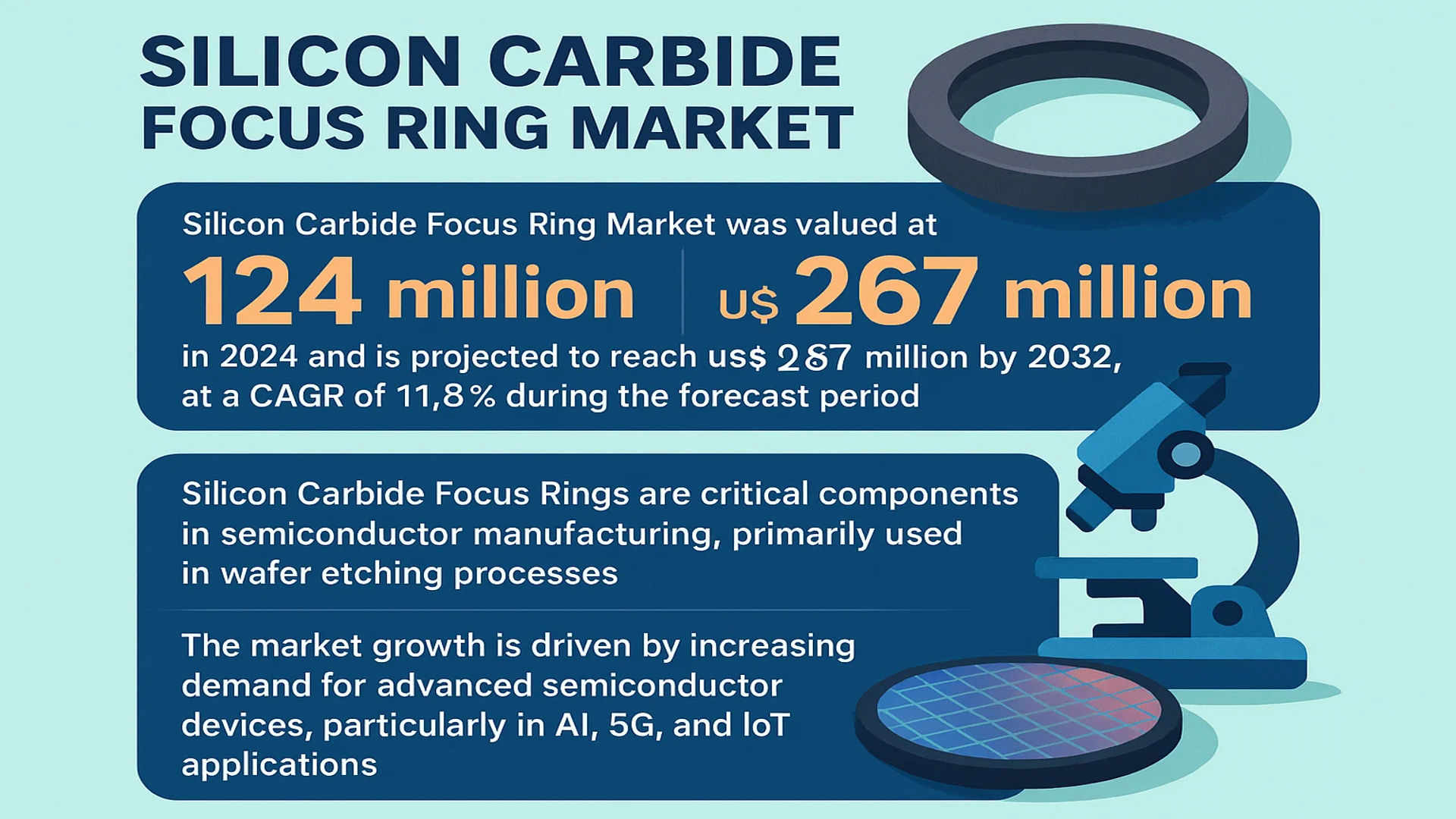
The global Silicon Carbide Focus Ring Market was valued at 124 million in 2024 and is projected to reach US$ 267 million by 2032, at a CAGR of 11.8% during the forecast period.
Silicon Carbide Focus Rings are critical components in semiconductor manufacturing, primarily used in wafer etching processes. These rings play a vital role in maintaining plasma uniformity during etching, ensuring precision and efficiency in chip production. The material’s high thermal conductivity and chemical resistance make it ideal for extreme semiconductor fabrication environments.
The market growth is driven by increasing demand for advanced semiconductor devices, particularly in AI, 5G, and IoT applications. While the U.S. remains a key market, China is rapidly expanding its semiconductor manufacturing capabilities, contributing significantly to demand. The 300mm wafer segment dominates the market due to its widespread adoption in high-volume production. Key players like CoorsTek, Tokai Carbon, and FerroTec are investing in material innovations to meet evolving industry requirements.
MARKET DYNAMICS
MARKET DRIVERS
Expanding Semiconductor Industry Accelerates Adoption of Silicon Carbide Focus Rings
The global semiconductor industry, valued at over $600 billion, is driving unprecedented demand for silicon carbide (SiC) focus rings used in wafer etching processes. As chip manufacturers transition to more advanced nodes below 10nm, the need for highly precise etching components has intensified. Silicon carbide’s exceptional thermal conductivity (over 120-170 W/m·K) and plasma resistance make it indispensable for maintaining process stability in high-energy plasma environments. The ongoing shift toward 300mm wafer processing—projected to account for 78% of total wafer area by 2025—further amplifies this demand, as larger wafers require more durable focus ring solutions.
Rising Investments in Power Electronics to Fuel Market Expansion
Silicon carbide’s superior material properties are becoming increasingly vital for next-generation power electronics, especially in electric vehicles and renewable energy systems. The EV market, projected to grow at 20% CAGR through 2030, relies heavily on SiC components for efficient power conversion. This cross-industry demand has led to substantial capacity expansions among leading manufacturers. For instance, multiple semiconductor foundries have announced $100+ billion investments in new fabrication facilities globally, each requiring hundreds of SiC focus rings annually for their etching tools. This parallel growth across semiconductor and power electronics sectors creates a robust demand pipeline for high-performance focus rings.
➤ The U.S. CHIPS Act’s $52 billion in semiconductor manufacturing incentives has accelerated domestic production capabilities, directly benefiting suppliers of critical components like SiC focus rings.
Furthermore, the development of advanced packaging technologies such as 3D IC integration is driving innovation in etching processes, requiring focus rings that can withstand more aggressive chemistries and higher process temperatures exceeding 600°C. This technological evolution presents significant growth opportunities for manufacturers capable of meeting these stringent requirements.
MARKET RESTRAINTS
High Production Costs and Complex Manufacturing Limit Market Penetration
The superior performance of silicon carbide focus rings comes with substantial manufacturing challenges that restrain market growth. Producing high-purity SiC components requires specialized equipment and controlled environments, with production costs often 3-5 times higher than conventional quartz or alumina alternatives. The sintering process alone demands temperatures above 2000°C in inert atmospheres, resulting in significant energy expenditures. These cost factors make SiC rings impractical for price-sensitive applications, particularly in emerging markets where manufacturers prioritize initial equipment costs over long-term operational benefits.
Technical Constraints
Material purity requirements pose another significant barrier. Semiconductor-grade SiC must maintain impurity levels below 1ppm to prevent wafer contamination, requiring rigorous quality control throughout production. Even minor deviations in crystalline structure or density can cause particle generation during plasma etching, potentially ruining entire wafer batches. This narrow tolerance for defects leads to yield rates below 60% for some manufacturers, further increasing unit costs.
Supply Chain Complexities
The specialized nature of SiC raw materials creates vulnerability in supply chains. Over 85% of high-purity silicon carbide powder originates from just three global suppliers, creating bottlenecks during periods of peak demand. Recent geopolitical tensions have exacerbated these challenges, with export controls on advanced materials causing lead times to extend beyond 6 months for some manufacturers.
MARKET CHALLENGES
Material Degradation Issues Threaten Long-Term Reliability
While silicon carbide offers excellent plasma resistance, real-world operational conditions present persistent challenges. Focus rings experience gradual erosion during etching processes, with typical service lives ranging between 500-1,500 wafer cycles depending on process parameters. This degradation not only increases maintenance costs but can also cause process drift—where subtle changes in ring geometry alter plasma characteristics enough to affect etch uniformity. Such variances become particularly problematic for advanced nodes where feature dimensions approach atomic scales.
Competitive Material Alternatives
Emerging materials like boron nitride composites and coated alumina formulations are gaining traction as potential SiC alternatives. These materials offer comparable plasma resistance at lower costs, though with tradeoffs in thermal conductivity. Several major equipment manufacturers have begun qualifying these alternatives for certain applications, threatening SiC’s market dominance in medium-performance etching processes. The success of these substitutes could fragment the focus ring market and cap pricing power for traditional SiC solutions.
Standardization Deficiencies
The lack of industry-wide standards for focus ring specifications complicates procurement and compatibility. Each semiconductor tool manufacturer maintains proprietary designs with subtle variations in dimensions and material requirements, forcing component suppliers to maintain extensive inventories of similar but non-interchangeable products. This fragmentation increases R&D costs and limits economies of scale, presenting a structural challenge to market efficiency.
MARKET OPPORTUNITIES
Advanced Coating Technologies Unlock New Applications
Innovations in surface engineering are creating transformative opportunities for silicon carbide focus rings. Proprietary coating systems developed by industry leaders can extend component lifespan by 40-60% while reducing particle contamination. These coatings, typically nanostructured layers of refractory metals or ceramics, provide enhanced erosion resistance in aggressive plasma environments. As semiconductor manufacturers push for longer maintenance intervals to improve fab productivity, demand for these premium solutions is expected to grow significantly.
Expansion into Emerging Semiconductor Hubs Presents Growth Potential
The strategic geographic shift in semiconductor manufacturing creates fertile ground for market expansion. Southeast Asia and India are emerging as major investment destinations, with governments offering substantial incentives for local chip production. India’s $10 billion semiconductor incentive package and Malaysia’s renewed focus on advanced packaging present particular opportunities. Suppliers establishing local manufacturing or service capabilities in these regions can gain first-mover advantages as new fabs come online through 2030.
➤ Leading manufacturers are aggressively pursuing vertical integration—acquiring upstream SiC material producers to secure supply and reduce costs while improving quality control throughout the production chain.
Additionally, the rise of alternative semiconductor materials like gallium nitride and silicon carbide substrates for power devices opens new avenues for focus ring applications. These materials require modified etching processes that benefit from SiC’s thermal and chemical stability, potentially creating specialized market segments with premium pricing potential. Early engagement with developers of these next-generation semiconductors could yield lucrative long-term partnerships.
SILICON CARBIDE FOCUS RING MARKET TRENDS
Increasing Semiconductor Demand Fuels Silicon Carbide Focus Ring Adoption
The global demand for silicon carbide (SiC) focus rings is experiencing substantial growth, primarily driven by the expanding semiconductor industry. Silicon carbide focus rings play a crucial role in maintaining plasma uniformity during wafer etching processes, ensuring high precision in semiconductor manufacturing. With the global semiconductor market projected to exceed $600 billion by 2025, the need for reliable and durable components like SiC focus rings has intensified. Advanced etching techniques in 300mm wafer fabrication, which account for over 60% of semiconductor production, further boost demand for these high-performance components. Additionally, the shift toward next-generation semiconductor nodes below 7nm necessitates superior process control, where SiC focus rings provide critical stability.
Other Trends
Expansion of the 300mm Wafer Segment
The 300mm silicon carbide focus ring segment is gaining significant traction due to the rising production of larger wafers that offer higher yield efficiency. This segment is expected to contribute over $180 million by 2032, with a CAGR of 12.5%, outpacing 200mm wafer applications. Semiconductor manufacturers are increasingly adopting automated wafer handling systems, placing greater emphasis on the wear resistance and thermal stability of SiC focus rings. Enhanced etching uniformity in 300mm wafer processing, coupled with reduced downtime, positions SiC focus rings as a critical component in high-volume semiconductor fabs.
Growing Adoption in Chinese and U.S. Markets
Regional market dynamics reveal rapid adoption in China and the U.S., where semiconductor fabrication capacity expansions are underway. China’s aggressive investments in domestic semiconductor production aim to reduce reliance on foreign suppliers, driving localized SiC focus ring demand. Meanwhile, the U.S. market continues to lead in advanced semiconductor R&D, with companies increasingly integrating these components into next-gen foundries. In 2024, U.S. production accounted for nearly 25% of global SiC focus ring revenue, while China is projected to grow at a 14% CAGR, surpassing $50 million by 2030. The strategic push toward self-sufficiency in semiconductor supply chains in both regions reinforces long-term market expansion.
COMPETITIVE LANDSCAPE
Key Industry Players
Market Leaders Expand Manufacturing Capabilities to Meet Rising Semiconductor Demand
The global silicon carbide focus ring market features a moderately consolidated competitive landscape, with established material science companies and specialized semiconductor component manufacturers vying for market share. Kallex has emerged as a dominant player, leveraging its vertically integrated production facilities and patented sintering technologies to maintain approximately 18% of the 2024 market revenue. Their strategic partnerships with major semiconductor equipment OEMs in Taiwan and South Korea have reinforced this position.
CoorsTek and Tokai Carbon collectively account for nearly 27% of market share, benefiting from decades of advanced ceramics expertise. CoorsTek’s proprietary SiC purity enhancement process gives it significant advantages in the 300mm wafer segment, which is projected to grow at 13.2% CAGR through 2032. Meanwhile, Tokai Carbon’s recent capacity expansion in Malaysia positions it to better serve the Southeast Asian semiconductor hub.
Smaller but technologically agile players like Max Luck Technology and Worldex are gaining traction through innovative focus ring designs that promise extended service life. Max Luck’s 2023 introduction of nano-coated SiC rings demonstrated 40% improvement in erosion resistance during plasma etching – a crucial advancement as chipmakers push for higher wafer throughput.
The competitive intensity is further heightened by FerroTec‘s strategic acquisitions in Europe and Greene Tweed‘s R&D investments in alternative material composites. With the market projected to reach $267 million by 2032, companies are prioritizing both technological differentiation and geographic expansion to secure long-term growth.
List of Key Silicon Carbide Focus Ring Manufacturers
- Kallex (South Korea)
- Daewon (South Korea)
- CoorsTek (U.S.)
- Greene Tweed (U.S.)
- Tokai Carbon (Japan)
- Worldex (Taiwan)
- Max Luck Technology (China)
- FerroTec (Japan)
Silicon Carbide Focus Ring Market: Segment Analysis
By Type
300mm Silicon Carbide Focus Rings Lead Market Due to High Demand in Advanced Semiconductor Fabrication
The market is segmented based on type into:
- 300mm Silicon Carbide Focus Rings
- 200mm Silicon Carbide Focus Rings
By Application
Wafer Etching Segment Dominates as Focus Rings are Critical Components in Semiconductor Production
The market is segmented based on application into:
- Wafer Etching
- Other Semiconductor Manufacturing Processes
By End User
Semiconductor Foundries Account for Major Share Due to Continuous Manufacturing Expansion
The market is segmented based on end user into:
- Semiconductor Foundries
- Integrated Device Manufacturers (IDMs)
- Research & Development Facilities
Regional Analysis: Silicon Carbide Focus Ring Market
Asia-Pacific
The Asia-Pacific region dominates the global silicon carbide focus ring market, driven primarily by the semiconductor manufacturing boom in countries like China, Japan, South Korea, and Taiwan. With major semiconductor fabrication plants expanding their capacities—particularly for 300mm wafer production—demand for high-purity silicon carbide components has surged. China alone accounts for a significant market share due to government-backed initiatives like the “Made in China 2025” plan, which prioritizes semiconductor self-sufficiency. However, supply chain disruptions and trade restrictions on advanced semiconductor equipment pose challenges. Japanese manufacturers remain crucial for supplying high-performance rings, leveraging decades of materials engineering expertise.
North America
Silicon carbide focus ring adoption in North America is propelled by advanced semiconductor R&D and production facilities, particularly in the U.S. States like Arizona and Texas are seeing multibillion-dollar investments from leading chipmakers, creating sustained demand for etching process components. The region benefits from strong partnerships between academic institutions, national labs, and manufacturers to enhance material properties and operational lifespans. Environmental regulations on semiconductor manufacturing emissions are moderately stringent but haven’t significantly constrained market growth due to silicon carbide’s inherent durability and reusability advantages over alternative materials.
Europe
Europe’s market growth is steady but slower compared to Asia-Pacific, limited by the region’s smaller semiconductor production footprint. Germany and France lead in specialty applications, including RF and power semiconductor manufacturing, where silicon carbide rings demonstrate superior plasma resistance. Collaborative EU projects like the “Important Project of Common European Interest” (IPCEI) for microelectronics are stimulating local innovation, though dependency on Asian and American suppliers for bulk components persists. Sustainability initiatives favor silicon carbide rings over more consumptive alternatives, given their extended service life.
Middle East & Africa
This emerging market shows nascent potential, particularly in Israel and Turkey, where selective investments in semiconductor test and assembly facilities are underway. The lack of local focus ring production capabilities makes the region entirely import-dependent, primarily sourcing from Asia. While government technology transfer programs aim to build semiconductor-related industries, progress is gradual due to capital intensity and expertise gaps. Partnerships with established manufacturers like CoorsTek and Greene Tweed are helping bridge this divide.
South America
The market remains underdeveloped, with sporadic demand from Brazil’s electronics manufacturing hubs and Argentina’s niche semiconductor packaging operations. Economic instability and minimal local wafer fabrication capacity restrict growth. Some international suppliers maintain distribution networks for aftermarket replacements, but orders are low-volume and price-sensitive. Long-term prospects hinge on regional trade agreements that could attract semiconductor investment, though this remains speculative.
Report Scope
This market research report provides a comprehensive analysis of the global and regional Silicon Carbide Focus Ring markets, covering the forecast period 2025–2032. It offers detailed insights into market dynamics, technological advancements, competitive landscape, and key trends shaping the industry.
Key focus areas of the report include:
- Market Size & Forecast: Historical data and future projections for revenue, unit shipments, and market value across major regions and segments.
- Segmentation Analysis: Detailed breakdown by product type (300mm, 200mm), application (wafer etching, others), and end-user industry to identify high-growth segments.
- Regional Outlook: Insights into market performance across North America, Europe, Asia-Pacific, Latin America, and the Middle East & Africa, with country-level analysis for key markets like the U.S., China, Japan, and Germany.
- Competitive Landscape: Profiles of leading market participants, including their product offerings, R&D focus, manufacturing capacity, pricing strategies, and recent developments such as mergers and acquisitions.
- Technology Trends & Innovation: Assessment of emerging semiconductor fabrication technologies and material advancements in silicon carbide components.
- Market Drivers & Restraints: Evaluation of factors driving market growth along with challenges, supply chain constraints, and regulatory issues.
- Stakeholder Analysis: Insights for semiconductor equipment manufacturers, component suppliers, and investors regarding the evolving market ecosystem.
Primary and secondary research methods are employed, including interviews with industry experts and data from verified sources, to ensure the accuracy and reliability of the insights presented.
FREQUENTLY ASKED QUESTIONS:
What is the current market size of Global Silicon Carbide Focus Ring Market?
-> Silicon Carbide Focus Ring Market was valued at 124 million in 2024 and is projected to reach US$ 267 million by 2032, at a CAGR of 11.8% during the forecast period.
Which key companies operate in Global Silicon Carbide Focus Ring Market?
-> Key players include Kallex, Daewon, CoorsTek, Greene Tweed, Tokai Carbon, Worldex, Max Luck Technology, and FerroTec, among others.
What are the key growth drivers?
-> Key growth drivers include increasing semiconductor manufacturing activities, rising demand for 300mm wafers, and advancements in etching technologies.
Which region dominates the market?
-> Asia-Pacific dominates the market due to strong semiconductor manufacturing presence, while North America shows significant technological advancements.
What are the emerging trends?
-> Emerging trends include development of high-purity silicon carbide materials, automation in semiconductor manufacturing, and increasing adoption of 300mm wafer processing.

Get Sample Report PDF for Exclusive Insights
Report Sample Includes
- Table of Contents
- List of Tables & Figures
- Charts, Research Methodology, and more...
 Download Sample Report PDF