Key Statistics
Key Takeaways
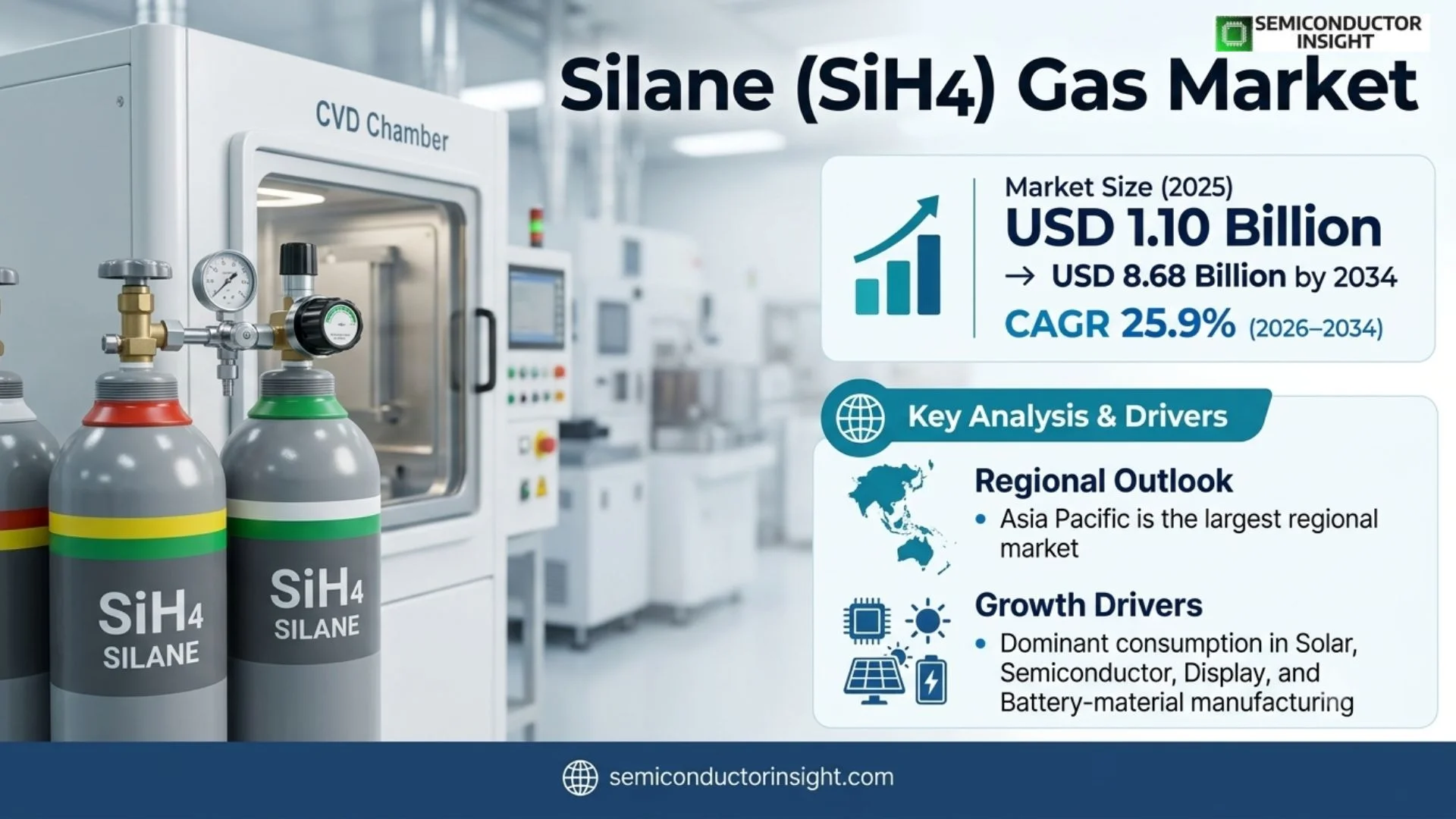
- Market size and growth: the market is estimated at USD 1.38 billion in 2026 and is projected to reach USD 8.68 billion by 2034, representing a 25.9% CAGR during 2026–2034.
- Purity ≥6N dominates value because semiconductor, photovoltaic and advanced battery applications require ultra-low contamination in the silicon precursor stream.
- Solar cells and battery silicon-anode materials are the two strongest volume engines: solar remains a large installed use, while silicon-rich anodes create a fast-growing new demand source.
- China is the largest consuming market, supported by the world’s deepest solar-module, electronics and battery-material manufacturing base; the wider Asia Pacific region also includes large semiconductor demand in South Korea, Japan and Taiwan.
- Supply security is strategically important because silane is pyrophoric, requires specialized purification and packaging, and is produced by a relatively small group of electronic-gas and silicon-material suppliers.
Silane (SiH4) Gas Market Overview
Silane (SiH4) Gas market was valued at USD 1.10 billion in 2025 and is estimated at USD 1.38 billion in 2026. The market is projected to reach USD 8.68 billion by 2034, representing a CAGR of 25.9% during 2026–2034. Asia Pacific is the largest regional market, with China representing the dominant consumption center because of its solar, semiconductor, display and battery-material manufacturing scale.
Base year: 2025 · Estimated year: 2026 · Forecast period: 2026–2034 · Values in USD million unless otherwise stated
Silane, or SiH4, is a colorless pyrophoric gas used as a high-purity silicon precursor in chemical vapor deposition and related manufacturing processes. Semiconductor fabs use it to deposit silicon-containing films, solar manufacturers use it in thin-film and selected photovoltaic processes, display makers use it in thin-film transistor production, and battery-material developers increasingly use silane to create silicon-rich anode structures. Its value comes from the ability to deliver silicon in a gaseous precursor form with extremely tight impurity control.
The market is differentiated primarily by purity, supply reliability and safety. High-purity 6N-and-above grades dominate advanced electronics because trace metallic or moisture contamination can directly affect film quality and device yield. REC Silicon describes SiH4 as a core technology platform and has long produced high-purity silane at industrial scale. Large industrial-gas companies also supply electronic and specialty gases into semiconductor clusters, where customers value on-site support, redundant supply and strict cylinder or bulk-container handling procedures.
Demand is being pulled simultaneously by semiconductor capacity, solar manufacturing and next-generation battery development. The most disruptive growth opportunity is silicon anode material, where silane can be used to deposit or synthesize silicon structures that increase energy density beyond graphite-only anodes. This broadens the customer base from fabs and photovoltaic plants into battery-material producers, but it also raises the strategic importance of new silane capacity because battery demand can be much larger in tonnage than specialty electronics applications.
Segment Analysis: By Type
By type, the market is segmented into purity ≥6N and purity <6N. Ultra-high-purity material leads because semiconductor and photovoltaic manufacturing require extremely low concentrations of metallic, oxygen-bearing and other contaminants. Lower-purity silane remains relevant in industrial and less contamination-sensitive applications, but growth is increasingly concentrated in electronic-grade products and specialized battery-material supply where customers qualify the gas against demanding process specifications.
| Type | Technical / commercial role | Market position |
|---|---|---|
| Purity ≥6N | Electronic-grade silane for semiconductor, solar, display and high-performance battery processes. | Largest value segment; qualification, contamination control and supply continuity support premium pricing. |
| Purity <6N | Industrial or less contamination-sensitive silane grades. | Smaller share; selected for applications where extreme electronic-grade purity is unnecessary. |
Segment Analysis: By Application
Applications include semiconductor fabrication, solar cells, display panels and battery silicon-anode materials. Solar has historically been a major volume consumer, while semiconductor fabrication provides a high-value electronic-grade base. Battery silicon-anode materials are the strongest emerging application because silicon can increase lithium-ion energy density and silane offers a controllable gaseous route to silicon deposition or synthesis. Display demand remains important in thin-film transistor manufacturing but grows more slowly than batteries or advanced semiconductors.
| Application | Demand characteristics |
|---|---|
| Semiconductor Fabrication | CVD and related deposition steps require electronic-grade silane with tight impurity specifications. |
| Solar Cell | Large-volume use in thin-film and silicon-containing photovoltaic processes. |
| Display Panel | Used in thin-film transistor and related deposition processes for display backplanes. |
| Battery Silicon Anode Material | Fast-emerging use where silane supports high-silicon anode structures and next-generation battery materials. |
Segment Analysis: By End-User Industry
End-user demand spans renewable energy, electronics and semiconductors, automotive battery materials and specialized deposition-service providers. Renewable energy remains a large tonnage market through photovoltaic manufacturing, while electronics and semiconductor customers purchase the highest-purity grades. Automotive demand is increasingly indirect through battery-material suppliers developing silicon-rich anodes for electric vehicles. This end-user diversification reduces dependence on a single technology cycle but also forces suppliers to support very different volume, purity and logistics requirements.
| End-User Industry | Demand logic |
|---|---|
| Renewable Energy | Photovoltaic manufacturing and related silicon deposition. |
| Electronics & Semiconductors | Highest purity requirements and tightly qualified electronic-gas supply. |
| Automotive | Indirect growth through silicon-anode battery materials for EV cells. |
| CVD Services | Specialized deposition and materials companies using silane as a precursor. |
| Others | Research, coatings and specialty chemical applications. |
Segment Analysis: By Supply Format
Supply format is determined by customer scale, gas consumption and safety requirements. Smaller semiconductor and specialty users rely on cylinders or bundled packages, while large-volume consumers can use ton containers or integrated supply systems. On-site and dedicated supply arrangements become attractive when demand is large enough to justify capital investment and when customers need redundancy, lower logistics exposure and continuous availability. Because silane is pyrophoric, packaging and delivery infrastructure are integral parts of the commercial product.
| Supply Format | Commercial role |
|---|---|
| Cylinder & Bundle Supply | Flexible delivery for semiconductor, research and moderate-volume applications. |
| Bulk / Ton Container Supply | Higher-volume delivery for large photovoltaic or battery-material users. |
| On-Site / Integrated Supply | Dedicated supply arrangements where continuity and scale justify installed infrastructure. |
Regional Analysis
Asia Pacific is the largest regional market, with China representing the dominant consumption center because it combines photovoltaic manufacturing, battery-material investment, electronics production and expanding semiconductor capacity. South Korea, Japan and Taiwan add high-purity semiconductor and display demand. North America and Europe remain strategically important because they host electronic-gas suppliers, new semiconductor fabs and battery-material investments that value supply resilience and local production.
The silane market is more geographically concentrated than many commodity gases because both production and consumption cluster around high-technology manufacturing. China’s manufacturing scale drives the largest tonnage, while South Korea, Japan and Taiwan require highly qualified electronic grades. North American growth is supported by semiconductor localization and battery-material projects, while European demand is linked to semiconductor, photovoltaic research and energy-transition investment. Regional logistics matter because transporting pyrophoric gas requires specialized containers, handling and regulatory compliance.
| Region | Position | Growth outlook | Demand profile | Supplier-selection factor |
|---|---|---|---|---|
| Asia Pacific | Largest | Very high | Solar, battery, semiconductor, display | Purity, scale and local supply |
| North America | Strategic growth | High | Semiconductor localization and battery materials | Supply security and qualification |
| Europe | Established | Moderate-High | Semiconductor, specialty chemicals, energy | Compliance and continuity |
| South America | Small | Selective | Solar and industrial projects | Import logistics |
| Middle East & Africa | Emerging | Selective | Solar and industrial diversification | Project scale and safe supply |
Competitive Landscape
Competition in the Silane (SiH4) Gas market is shaped by technology performance, customer qualification, application engineering and continuity of supply. Leading companies use product breadth and global support to win large programs, while specialist suppliers can defend attractive niches through deeper technical performance in specific applications. As the market expands, customers increasingly evaluate total system value and lifecycle support rather than relying only on initial component price.
The leading suppliers compete through a combination of proprietary technology, manufacturing scale and customer relationships. In the Silane (SiH4) Gas market, design wins can remain in place for several product generations because switching suppliers often requires requalification, software changes or manufacturing adjustments. This creates durable revenue positions for vendors that deliver reliable performance and responsive technical support.
Regional suppliers can still gain share where local availability, cost and fast engineering response matter. Their strongest opportunities are generally in standardized or mature applications, while the highest-performance segments remain concentrated among companies with deeper intellectual property, process control and qualification histories. This creates a market structure with both global platform leaders and specialized regional competitors.
Competitive strategy is increasingly moving toward integrated solutions. Customers prefer suppliers that can combine the core product with software, interface components, testing, support or adjacent technologies because integration reduces project risk and development time. Companies able to solve a broader customer problem therefore have more pricing power than vendors competing only on a single specification.
| Competitive tier | Representative companies | Competitive basis |
|---|---|---|
| Global technology leaders | REC Silicon, SK Materials, OCI Holdings, Air Liquide | Scale, broad product portfolios, strong R&D and global customer support. |
| Established specialists | Linde, Inner Mongolia Xingyang Technology, CNS, Henan Silane Technology Development | Application-specific engineering and strong qualification in selected segments. |
| Regional / emerging suppliers | Wacker Chemie, Mitsui Chemicals | Local service, competitive pricing and focused customer relationships. |
Key Participants
The profiled competitive set includes REC Silicon, SK Materials, OCI Holdings, Air Liquide, Linde, Inner Mongolia Xingyang Technology, CNS, Henan Silane Technology Development, Wacker Chemie, Mitsui Chemicals. Supplier position depends on engineering performance, customer qualification, manufacturing continuity and the ability to support design changes over long product cycles. Larger vendors benefit from broad portfolios and application teams, while specialists can retain strong positions in narrow, technically demanding subsegments where historical qualification and process know-how create meaningful switching costs.
Production Capacity Analysis
Production capacity for Silane (SiH4) Gas is constrained by the combination of specialized equipment, qualified materials, process know-how and customer-specific validation. Nominal factory output can overstate commercial supply because a new line or material source must often demonstrate consistent performance before it can serve high-value customers. This makes qualified capacity more important than raw nameplate capacity.
Regional manufacturing and service capacity influence lead time and resilience. Customers increasingly prefer suppliers that can support major production clusters from more than one site, reducing exposure to logistics disruption and single-factory events. At the same time, duplicating specialized processes can be difficult because equipment recipes, trained engineers and quality systems must be transferred without changing product performance.
The strongest capacity investments are aligned with structural demand drivers rather than short-term cycles. Suppliers expanding around AI, advanced semiconductor manufacturing, automotive electronics or industrial automation seek to secure positions before customer volumes scale. Effective capacity therefore includes engineering resources, test capability and local technical support in addition to physical manufacturing equipment.
| Capacity factor | Market implication |
|---|---|
| Specialized manufacturing | Determines qualified output and technical performance. |
| Critical materials / components | Can constrain supply despite available factory floor space. |
| Qualification and test | Controls how quickly new capacity becomes usable by customers. |
| Regional support | Improves lead time, resilience and customer retention. |
Market Dynamics
The Silane (SiH4) Gas market is driven by higher system performance, automation, digitalization and expanding use in high-value applications. Growth is moderated by development cost, qualification requirements and supply-chain concentration. The strongest opportunities occur where new architectures or applications create a clear performance advantage and where suppliers can reduce integration complexity for customers.
MARKET DRIVERS
| Driver | Relative impact | Commercial mechanism |
|---|---|---|
| Structural end-market growth | High | Expanding deployments increase unit demand and installed-base requirements. |
| Technology upgrade cycle | High | Higher performance raises value per product and accelerates replacement. |
| Customer integration needs | Medium-High | Validated solutions reduce engineering time and project risk. |
| Regional capacity expansion | Medium | New manufacturing clusters create local supplier demand. |
Structural end-market expansion
Growth in the Silane (SiH4) Gas market is supported by rising deployment across its principal applications. Customers are investing because the technology improves performance, efficiency, automation or product capability in ways that are difficult to replicate with older approaches. This expands both new-system demand and the installed base that later requires replacement, upgrades or related services.
Higher technical requirements increase value per system
New product generations demand tighter performance, greater integration and better reliability. These requirements can increase selling prices even when unit volumes grow more slowly, because customers are willing to pay for solutions that protect yield, uptime or user experience. Suppliers with stronger engineering capability therefore benefit disproportionately from technology transitions.
Regional investment broadens customer access
Manufacturing and infrastructure investment in North America, Europe and Asia is creating additional customer clusters outside traditional centers. Local engineering support and shorter supply chains help suppliers qualify products earlier in new projects, creating an opportunity to win design positions before production reaches full scale.
MARKET RESTRAINTS
| Restraint | Relative impact | Commercial mechanism |
|---|---|---|
| Development and qualification cost | High | Raises barriers to entry and lengthens customer adoption. |
| Supply-chain concentration | Medium-High | Critical components or materials can limit output. |
| Price pressure | Medium | Customers seek lower total system cost as volumes increase. |
| Technology substitution | Medium | Alternative architectures can replace incumbent solutions in selected uses. |
Qualification slows supplier switching
Customers in technical markets cannot change suppliers based only on purchase price. New products must demonstrate performance, reliability and compatibility in the actual application, which can require months of engineering work. This limits the pace at which new entrants gain share and can delay commercialization of technically promising products.
Specialized inputs can constrain supply
Advanced products depend on a limited number of qualified materials, components or manufacturing tools. Shortages or long lead times at one upstream stage can restrict finished-product output even when downstream assembly capacity is available. Suppliers therefore carry strategic inventory or qualify alternate sources, but those actions increase cost.
Customer cost pressure remains persistent
As a technology becomes more widely adopted, customers expect lower unit costs and may redesign systems to use standardized components. Suppliers must offset this pressure through better performance, lower manufacturing cost and additional software or service value. Vendors that cannot maintain differentiation can face margin erosion even in a growing market.
MARKET OPPORTUNITIES
Silicon-rich battery anodes
Battery developers are increasing silicon content to improve energy density beyond graphite-only anodes. Silane can provide a gaseous silicon precursor for deposition and particle synthesis, creating a demand stream that can exceed traditional electronic-gas volumes when commercial battery plants scale. Suppliers that secure long-term battery-material contracts can diversify beyond semiconductor and photovoltaic cycles.
Regional high-purity supply
New semiconductor fabs in the United States and Europe need qualified electronic gases with reliable local logistics. Silane suppliers can capture premium value by adding purification, cylinder filling and bulk delivery close to fab clusters. Regional redundancy is especially important for pyrophoric gases because customers cannot substitute unqualified material quickly when a supply line is disrupted.
Solar manufacturing upgrades
Photovoltaic manufacturing continues to evolve toward higher-throughput and more efficient deposition processes. Silane suppliers can benefit where thin-film and silicon-containing processes expand or where factories modernize gas handling to improve utilization and safety. The opportunity is strongest in Asia, where solar production is concentrated and large plants can justify bulk or integrated supply.
Integrated safety and delivery services
Silane is sold together with logistics, gas cabinets, monitoring and handling expertise. Suppliers that provide turnkey delivery, emergency response and cylinder-management services can deepen customer relationships and reduce the risk of pure commodity pricing. This service layer becomes more valuable as battery and electronics customers expand into new locations with less internal experience handling pyrophoric gases.
Supply Chain Analysis
Specialized materials and components
Core product manufacturing
Qualification and system integration
End-user deployment, service and replacement
The upstream supply chain provides the specialized materials, semiconductor devices, mechanical components or substrates that determine baseline product performance. Qualified inputs are important because changes in composition or manufacturing source can alter reliability, electrical behavior or process compatibility. Suppliers therefore maintain close technical relationships with upstream partners and often approve alternate sources before a disruption occurs.
Manufacturing converts these inputs into finished products using process-specific equipment, inspection and test. Quality systems are central because customers expect lot-to-lot consistency and traceability, particularly in semiconductor, automotive and industrial applications. High-value suppliers differentiate through process control rather than simple assembly scale, and they invest heavily in metrology or validation to protect yield.
Downstream value is created when the product is integrated into the customer system and validated under real operating conditions. Application engineers support installation, software, calibration or process optimization, while service teams maintain the installed base. This lifecycle relationship creates recurring revenue through replacement, updates, refurbishment or expansion and makes customer support an important part of the market structure.
Recent Developments
29 Apr 2025 – Linde expands ultra-high-purity gas supply to Samsung in South Korea
Linde announced an eighth on-site air-separation unit and expanded hydrogen supply for Samsung’s Pyeongtaek semiconductor complex, illustrating the scale and strategic importance of dedicated electronic-gas infrastructure around advanced fabs. Source
26 Mar 2026 – REC Silicon publishes 2025 annual report
REC Silicon’s 2025 reporting continues to position SiH4 production and silicon-gas technology as a core capability, providing a current reference point for high-purity silane supply and strategic capacity decisions. Source
2026 – Electronic-gas customers continue prioritizing local supply and redundancy
Semiconductor and battery customers increasingly structure gas procurement around dedicated infrastructure, qualified purity and regional continuity because pyrophoric-gas logistics are operationally critical. Source
REPORT SCOPE & SEGMENTATION
| Base Year | 2025 |
| Estimated Year | 2026 |
| Forecast Year | 2034 |
| 2025 Market Size | USD 1.10 billion |
| 2026 Market Size | USD 1.38 billion |
| 2034 Market Size | USD 8.68 billion |
| CAGR | 25.9% during 2026–2034 |
| Largest Market / Leading Geography | Asia Pacific |
| By Type | Purity ≥6N; Purity <6N |
| By Application | Semiconductor Fabrication; Solar Cell; Display Panel; Battery Silicon Anode Material |
| By End-User Industry | Renewable Energy; Electronics & Semiconductors; Automotive; Chemical Vapor Deposition Services; Others |
| By Supply Format | Cylinder & Bundle Supply; Bulk / Ton Container Supply; On-Site / Integrated Supply |
Frequently Asked Questions
What is the size of the Silane (SiH4) Gas market?
The market is estimated at USD 1.38 billion in 2026 and is projected to reach USD 8.68 billion by 2034, representing a 25.9% CAGR during 2026–2034. The 2025 market size is USD 1.10 billion.
Which purity grade leads the market?
Purity of 6N and above leads because semiconductor, photovoltaic and advanced battery processes require extremely low impurity levels and tightly controlled gas quality.
Which application is growing fastest?
Battery silicon-anode materials are the strongest emerging application, while solar cells and semiconductor fabrication remain large established demand bases.
Which region leads the market?
Asia Pacific leads, with China providing the largest consumption base and South Korea, Japan and Taiwan adding major high-purity semiconductor and display demand.
Why is supply security important?
Silane is pyrophoric and must be produced, packaged and transported through specialized systems. High-tech manufacturers therefore value qualified suppliers, redundant capacity and reliable logistics.
What are the main market restraints?
Safety requirements, specialized production capacity, high-purity qualification and dependence on a concentrated supplier base are the main constraints.
Research Sources & Evidence Base
Get Sample Report PDF for Exclusive Insights
Report Sample Includes
- Table of Contents
- List of Tables & Figures
- Charts, Research Methodology, and more...
 Download Sample Report PDF