Signal Adapter Market Insights
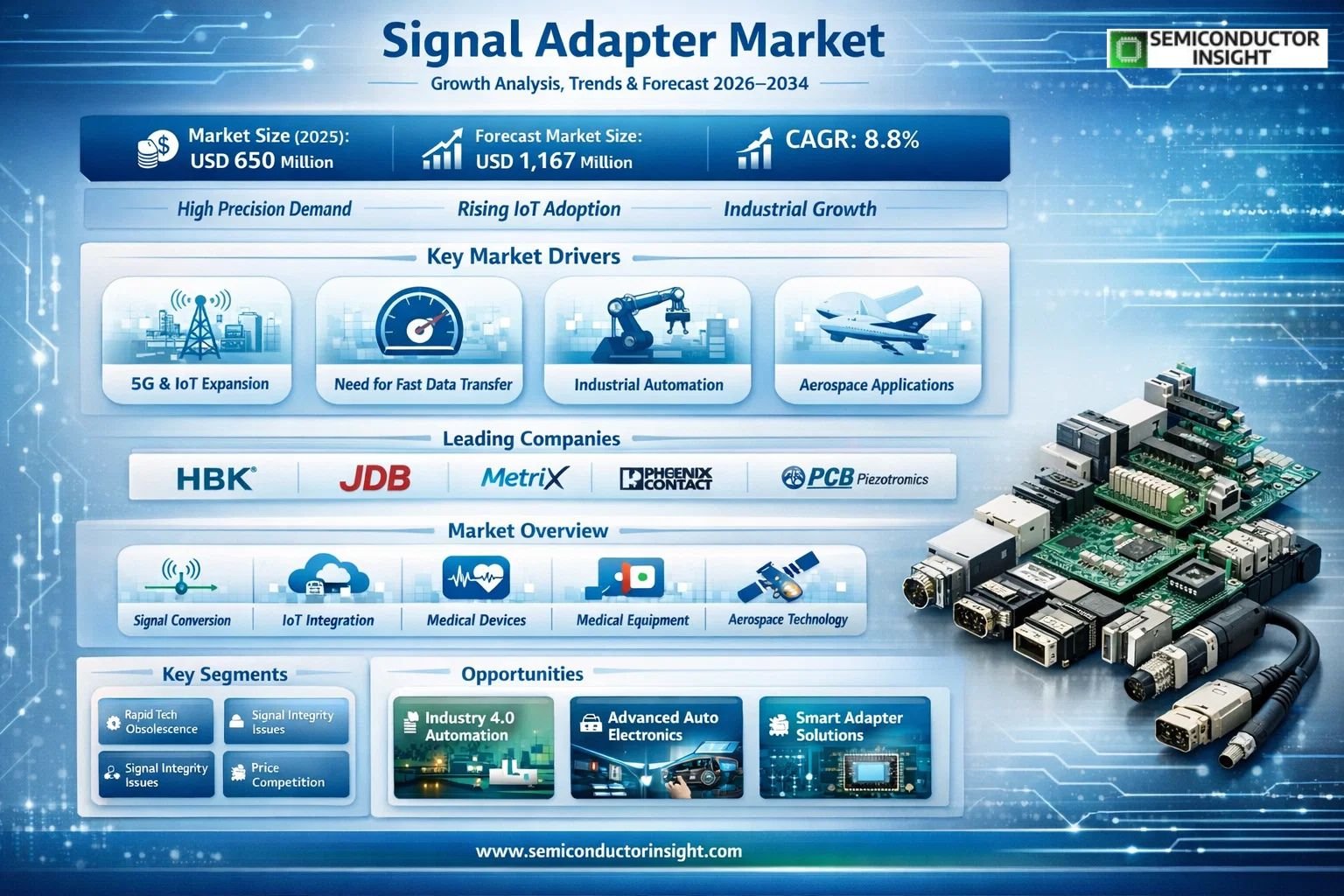
Global signal adapter market size was valued at USD 650 million in 2025. The market is projected to grow from USD 707 million in 2026 to USD 1,167 million by 2034, exhibiting a CAGR of 8.8% during the forecast period.
Signal adapters, also known as signal conditioners, are critical interface devices positioned between a signal source and a readout or control system. Their primary function is to receive an input signal,often from sensors like thermocouples or strain gauges,and convert it into a clean, proportional, and compatible output signal for data acquisition or machine control. This process is essential for high-precision measurement, as these devices provide isolation, amplify weak signals, filter out noise, and support functions like signal conversion and distribution. Key components within a typical unit include signal converters, amplifiers (such as voltage and charge amplifiers), filters, and integrators.
The market’s robust growth is driven by accelerating industrial automation and the proliferation of IoT sensors requiring reliable signal interfacing. Furthermore, stringent requirements in sectors like medical equipment and aerospace for accurate data acquisition are significant contributors. The competitive landscape features established players such as HBK (Hottinger Brüel & Kjær), Phoenix Contact, PCB Piezotronics, and Vishay Micro-Measurements, who continuously innovate to meet evolving industry standards. For instance, advancements towards more compact, intelligent adapters with integrated diagnostics are becoming a key development focus among leading manufacturers.
MARKET DRIVERS
Expansion of 5G Infrastructure and IoT Proliferation
Global deployment of 5G networks and the exponential growth of the Internet of Things (IoT) are primary drivers for the Signal Adapter Market. These adapters are critical for ensuring compatibility between legacy systems with older signal protocols and modern, high-speed 5G and IoT networks. As industries from manufacturing to telecommunications upgrade their infrastructure, the demand for reliable signal conversion and interfacing solutions surges, directly fueling market growth. The need for seamless data transition across diverse communication standards is non-negotiable for operational efficiency.
Increasing Demand for High-Speed Data Transmission
Businesses and data centers are relentlessly pursuing higher bandwidth and lower latency. This trend necessitates advanced signal adapters that can convert and amplify signals without data loss, supporting protocols like HDMI 2.1, DisplayPort, and USB4. The growth in cloud computing, video streaming, and real-time analytics creates a robust demand environment for adapters that facilitate high-fidelity signal conversion in professional AV, IT, and industrial settings.
➤ A key driver is the shift towards universal connectivity, compelling the Signal Adapter Market to innovate in form factors like USB-C hubs that consolidate multiple signal conversion functions into a single device.
Furthermore, the rise of hybrid work models has accelerated the adoption of docking stations and adapters for laptops, ensuring connectivity with various peripherals and displays. This sustained demand from the commercial and consumer electronics sectors provides a steady growth trajectory for the Signal Adapter Market.
MARKET CHALLENGES
Rapid Technological Obsolescence and Standard Fragmentation
The Signal Adapter Market faces significant challenges due to the fast pace of technological change and the lack of unified global standards. As new video, audio, and data protocols are introduced frequently, adapter manufacturers must continually invest in R&D to keep products relevant. This leads to shorter product life cycles and inventory risks. Additionally, the coexistence of multiple competing standards (e.g., various proprietary industrial protocols) creates complexity, requiring a vast portfolio of niche adapters, which strains supply chains and increases costs.
Other Challenges
Signal Integrity and Performance Degradation
Maintaining signal integrity over conversions, especially for high-resolution video or critical data, is a persistent technical hurdle. Poor-quality adapters can introduce latency, signal noise, or complete failure, eroding user trust. Ensuring consistent performance across different cable lengths and environmental conditions requires sophisticated engineering and quality components, increasing production costs.
Price Sensitivity and Intense Competition
The market is highly competitive, with numerous players ranging from established electronics firms to low-cost manufacturers. This creates intense price pressure, particularly in the consumer segment. Balancing advanced features, compliance certifications, and material costs while remaining price-competitive is a major operational challenge for companies in the Signal Adapter Market.
MARKET RESTRAINTS
High Costs of Advanced, Certified Adapters
A primary restraint on the Signal Adapter Market is the significant cost associated with developing and manufacturing high-performance, certified adapters. Adapters that meet stringent industry standards for data integrity, power delivery, and electromagnetic compatibility require premium components and rigorous testing. These costs are often passed to end-users, potentially limiting adoption in price-sensitive markets and among smaller businesses, thereby restraining overall market growth to some extent.
Increasing Integration into Source Devices
The trend towards greater native connectivity in smartphones, laptops, and TVs acts as a market restraint. As more devices incorporate multiple port types (e.g., HDMI, USB-C) directly, the need for external adapters for basic functions diminishes. This integration directly impacts the volume sales of simpler, single-function adapters, pushing the Signal Adapter Market towards more specialized, high-value applications to maintain growth.
MARKET OPPORTUNITIES
Growth in Industrial Automation and Industry 4.0
The ongoing revolution in industrial automation under Industry 4.0 presents a substantial opportunity for the Signal Adapter Market. Modern factories rely on interconnected machinery using diverse industrial communication protocols like PROFIBUS, Modbus, and Ethernet/IP. Signal adapters and converters are essential for creating a unified network, enabling legacy equipment to communicate with new IoT-enabled systems. This integration demand in manufacturing, energy, and logistics offers a high-growth, value-driven segment for specialized industrial adapters.
Emergence of Advanced Automotive Electronics
The automotive industry’s transition towards electric and autonomous vehicles is a key opportunity. Modern vehicles are complex electronic systems requiring adapters for infotainment, diagnostics, and in-vehicle networking. The need for adapters that interface with Advanced Driver-Assistance Systems (ADAS) sensors, convert signals for high-resolution displays, and enable vehicle-to-everything (V2X) communication creates a new and rapidly expanding application area for the Signal Adapter Market.
Development of Smart and Active Adapter Solutions
There is a significant opportunity in transitioning from passive adapters to smart, active, and programmable solutions. Adapters with built-in signal conditioning, protocol translation software, and network management capabilities offer higher value. The demand for such intelligent solutions in professional AV setups, broadcast environments, and complex IT infrastructure is growing, allowing companies to command premium prices and foster customer loyalty in the Signal Adapter Market.
Trends
Transition to Intelligent Systems Integration
Trends within the Signal Adapter market are increasingly defined by the drive toward intelligent integration. Modern adapters are evolving beyond basic signal conditioning and conversion, incorporating functionalities like onboard diagnostics, digital communication protocols, and software-configurable parameters. This shift enables seamless data flow within Industrial IoT (IIoT) ecosystems and complex automation systems. The role of the signal adapter is expanding from an interface component to a critical node for data preprocessing and system health monitoring, which is vital for predictive maintenance and operational efficiency.
Other Trends
Application-Specific Product Specialization
Manufacturers are developing specialized signal adapter solutions tailored for high-growth verticals. For instance, designs for aerospace and medical equipment applications emphasize ultra-high reliability, precision, and compliance with stringent regulatory standards. In industrial automation, the focus is on ruggedness, noise immunity, and compatibility with a wide array of sensor types and fieldbus networks. This trend towards application-specific engineering addresses unique signal integrity challenges and simplifies system integration for end-users.
Consolidation and Competitive Strategy
The competitive landscape is marked by both collaboration and consolidation. Leading players such as HBK, Phoenix Contact, and PCB Piezotronics are leveraging their extensive portfolios and R&D capabilities to offer comprehensive signal conditioning solutions. Concurrently, strategic mergers and acquisitions are occurring as companies seek to expand their technological expertise and geographic reach. This trend underscores the market’s maturity and the importance of providing integrated, high-value solutions rather than standalone components to secure market position.
COMPETITIVE LANDSCAPE
Key Industry Players
A dynamic and technology-driven market with leading multinationals and specialized innovators
Global signal adapter market is moderately concentrated, with the top five manufacturers accounting for a significant share of global revenue, indicating the presence of established players with strong technological and distribution capabilities. The market is led by multinational conglomerates with extensive portfolios in test, measurement, and industrial connectivity. HBK (Hottinger, Brüel & Kjær), as a leading player, leverages its deep expertise in measurement technology and data acquisition to offer high-precision active and passive signal conditioning solutions, serving critical industries like aerospace and automotive testing. Similarly, global industrial automation giants like Phoenix Contact maintain a dominant position through their broad range of industrial interface modules and signal converters, capitalizing on the demand for robust connectivity in process and factory automation. The competitive landscape is characterized by a focus on precision, reliability, and the ability to provide integrated solutions for complex data acquisition systems.
Beyond the dominant leaders, the market features several significant niche and regional players competing on specialized applications, technological innovation, and cost-effectiveness. Companies like PCB Piezotronics, Endevco, and Diversified Technical Systems (DTS) are critical in high-stakes dynamic measurement sectors such as defense, aerospace, and crash testing, where their specialized signal conditioners for sensors like accelerometers and strain gauges are essential. Technological specialists like DEWETRON and Vishay Micro-Measurements compete with advanced, high-channel-count data acquisition systems and precision strain measurement solutions, respectively. In the Asia-Pacific region, manufacturers such as Shanghai Ruishen Technology and Beijing Deco Chuangli Thermoelectric Technology are gaining traction by serving local industrial automation and equipment manufacturing sectors with cost-competitive offerings. This tiered competitive structure ensures both high-end innovation and broad market accessibility.
List of Key Signal Adapter Companies Profiled
- HBK (Hottinger, Brüel & Kjær)
- JDB
- Metrix
- Phoenix Contact
- Diversified Technical Systems (DTS)
- PCB Piezotronics
- Vishay Micro-Measurements
- Endevco
- DEWETRON
- Shanghai Ruishen Technology
- Beijing Deco Chuangli Thermoelectric Technology
- SOYO Technology Development
- National Instruments
- TE Connectivity
- OMEGA Engineering
Segment Analysis:
| Segment Category | Sub-Segments | Key Insights |
| By Type |
|
Active signal adapters are the leading segment, primarily due to their superior functional capabilities in complex industrial and high-precision environments. Their ability to work with a separate power supply, such as DC24V or universal AC/DC sources, enables robust signal amplification, conversion, and isolation features that are indispensable for modern data acquisition systems. This segment benefits from rising demand in advanced industries that require consistent, high-fidelity signal conditioning. The ongoing trend towards smart manufacturing and the Industrial Internet of Things (IIoT) further solidifies the preference for active adapters, as they provide the necessary power and intelligence for sophisticated monitoring and control networks, ensuring data integrity and system reliability across harsh operational conditions. |
| By Application |
|
Industrial automation constitutes the dominant application segment, driven by the critical need for precise signal conditioning in process control and manufacturing systems. Signal adapters are fundamental components that enable accurate communication between sensors, programmable logic controllers, and data acquisition systems within automated environments. Their role in converting, isolating, and distributing signals directly enhances operational efficiency and minimizes downtime caused by signal interference or degradation. The proliferation of advanced sensors and the push for higher production quality and energy efficiency in sectors like automotive, chemicals, and electronics continue to fuel sustained demand. This application’s leadership is further reinforced by the expansion of digital factories and the integration of legacy equipment with modern networked control architectures. |
| By End User |
|
Original Equipment Manufacturers (OEMs) represent the leading end-user segment, as they incorporate signal adapters directly into their production machinery, medical devices, and aerospace systems. For OEMs, selecting reliable signal conditioning components is paramount to ensuring the overall performance, safety, and longevity of their final products. Their substantial, consistent procurement volumes and stringent quality requirements establish them as highly influential buyers within the market. Collaborations between adapter manufacturers and OEMs for product customization and design-in phases are common, creating long-term supply relationships and driving innovation tailored to specific application challenges. This segment’s dominance is linked to the continuous manufacturing of new, technologically advanced equipment across all key application areas. |
| By Power Supply |
|
Universal AC/DC power supply adapters are gaining significant traction and are a key growth segment. Their design flexibility to accept a wide input voltage range (e.g., 85-265V) makes them exceptionally versatile for global deployments and varied electrical infrastructures. This universality reduces inventory complexity for manufacturers and distributors while offering end-users greater installation ease and compatibility in diverse geographic locations and industrial settings. The demand for these adapters is closely tied to Globalization of supply chains and the need for equipment that can be easily deployed and commissioned without extensive electrical modifications. They are increasingly favored in applications requiring robust performance across different regions and in mobile or temporary industrial setups. |
| By Function |
|
Signal conversion and isolation is the core functional segment driving market value. This function is essential for protecting sensitive readout and control devices from electrical noise, ground loops, and high-voltage transients commonly found in industrial environments. By ensuring signal integrity and system safety, these adapters prevent costly equipment damage and data corruption. The critical nature of these functions in mission-critical applications like medical diagnostics, aerospace testing, and automated safety systems underpins their leading position. Market innovation is particularly focused on enhancing isolation performance and supporting a wider array of signal types, from traditional analog to modern digital protocols, to meet evolving industry standards for safety and data accuracy. |
Regional Analysis: Global Signal Adapter Market
North America
The region’s focus on Industry 4.0 and smart manufacturing drives demand for industrial-grade signal adapters that connect legacy PLCs and sensors to modern data acquisition systems and IoT platforms, ensuring seamless data flow in complex factory environments.
As a center for consumer electronics innovation, there is a continuous cycle of new device launches requiring specific adapters for display connectivity, audio/video conversion, and device charging, keeping the consumer signal adapter segment highly dynamic and innovative.
Ongoing upgrades to 5G network infrastructure and data centers necessitate specialized signal adapters for fiber optic interfaces and high-speed data transmission equipment, supporting the backbone of the region’s digital economy.
A strong network of R&D centers from both established corporations and startups fuels the development of next-generation signal adapter technology, focusing on miniaturization, higher bandwidth, and enhanced power delivery capabilities.
Europe
Europe maintains a significant and steady position in the signal adapter market, characterized by a strong emphasis on quality, durability, and energy efficiency across its industrial and automotive sectors. The region’s advanced manufacturing base, particularly in Germany, Italy, and France, requires sophisticated digital-to-analog and protocol-conversion adapters for precision machinery and automation systems. Strict EU regulations regarding electronic waste and energy consumption drive demand for adapters that are compliant with the latest eco-design directives. Furthermore, Europe’s thriving automotive industry, with its shift towards electric vehicles and advanced driver-assistance systems, creates specialized needs for in-vehicle signal adapters and connectivity solutions. The market also benefits from substantial investments in upgrading public and private IT infrastructure, supporting demand for professional AV and IT connectivity products.
Asia-Pacific
The Asia-Pacific region presents the most dynamic and high-growth landscape for the signal adapter market, primarily driven by its massive electronics manufacturing ecosystem. Countries like China, Japan, South Korea, and Taiwan are global hubs for the production of consumer electronics, semiconductors, and telecommunications hardware, generating immense demand for cost-effective and high-volume signal adapter components. Rapid urbanization and digitalization in emerging economies such as India and Southeast Asian nations are accelerating the deployment of IT and telecom networks, fueling the need for associated connectivity hardware. While price sensitivity is a key characteristic, local manufacturers are increasingly focusing on improving product quality and reliability to serve both domestic markets and global supply chains, making the region a critical center for both supply and consumption.
South America
The signal adapter market in South America is in a developing phase, with growth primarily linked to gradual industrial modernization and the expansion of telecommunications services. Brazil and Argentina are the focal points, where investments in mining, oil & gas, and agriculture are prompting the integration of modern sensor and control systems, creating niche demand for industrial signal conditioning adapters. The consumer segment is growing steadily, fueled by the proliferation of smartphones, laptops, and gaming consoles, necessitating basic connectivity adapters. Market development is paced by economic fluctuations and infrastructure investment cycles, but the ongoing need to connect new technologies with existing systems offers consistent, long-term opportunities for signal adapter providers in the region.
Middle East & Africa
The Middle East and Africa region exhibits a diverse and emerging demand for signal adapters, largely tied to major infrastructure and smart city projects, particularly in Gulf Cooperation Council countries. Large-scale developments in construction, transportation, and energy sectors require specialized signal interfaces for building management and control systems. In Africa, the growth is more grassroots, driven by the rapid adoption of mobile technology and the need to connect various devices in areas with inconsistent legacy infrastructure. The market is characterized by a mix of high-end requirements for oil & gas and industrial applications in the Middle East and a demand for robust, affordable solutions in African consumer and SME markets, presenting a dual-strategy opportunity for market participants.
Report Scope
This market research report provides a comprehensive analysis of the Signal Adapter Market , covering the forecast period 2026–2034. It offers detailed insights into market dynamics, technological advancements, competitive landscape, and key trends shaping the industry.
Key focus areas of the report include:
- Market Overview: The report begins with an overview outlining its current market scenario, key growth indicators, and industry transformation drivers. It discusses macroeconomic factors, demand–supply balance, regulatory landscape, and the strategic role of semiconductors in powering advancements across industries such as automotive, telecommunications, consumer electronics, and industrial automation.
- Market Size & Forecast: Historical data and future projections for revenue, unit shipments, and market value across major regions and segments.
- Segmentation Analysis: Detailed breakdown by product type, technology, application, and end-user industry to identify high-growth segments and investment opportunities.
- Regional Insights: Insights into market performance across North America, Europe, Asia-Pacific, Latin America, and the Middle East & Africa, including country-level analysis where relevant.
- Competitive Landscape: Profiles of leading market participants, including their product offerings, R&D focus, manufacturing capacity, pricing strategies, and recent developments such as mergers, acquisitions, and partnerships.
- Technology Trends & Innovation: Assessment of emerging technologies, integration of AI/IoT, semiconductor design trends, fabrication techniques, and evolving industry standards.
- Market Drivers & Restraints: Evaluation of factors driving market growth along with challenges, supply chain constraints, regulatory issues, and market-entry barriers.
- Stakeholder Insights: Insights for component suppliers, OEMs, system integrators, investors, and policymakers regarding the evolving ecosystem and strategic opportunities.
Primary and secondary research methods are employed, including interviews with industry experts, data from verified sources, and real-time market intelligence to ensure the accuracy and reliability of the insights presented.
FREQUENTLY ASKED QUESTIONS:
What is the current market size of Signal Adapter Market?
-> Global Signal Adapter Market was valued at USD 650 million in 2025 and is projected to reach USD 1167 million by 2034, growing at a 8.8% CAGR during the forecast period.
Which key companies operate in Signal Adapter Market?
-> Key players include HBK, JDB, Metrix, Phoenix Contact, Diversified Technical Systems, PCB Piezotronics, Vishay Micro-Measurements, Endevco, DEWETRON, and Shanghai Ruishen Technology, among others.
What are the key growth drivers?
-> Key growth drivers include increasing demand for high-precision data acquisition and machine control, the essential role of signal conditioners in signal isolation, conversion, and accuracy improvement, and advancements across key industries such as industrial automation and aerospace.
Which region dominates the market?
-> Global market analysis covers North America, Europe, Asia, South America, and the Middle East & Africa. Market size estimations highlight the U.S. and China as significant country-level markets.
What are the emerging trends?
-> The market is segmented by Type (Active, Passive) and Application (Industrial automation, Medical equipment, Aerospace, Other). Product innovation focuses on signal conversion, distribution, and providing working power to transmitters.

Get Sample Report PDF for Exclusive Insights
Report Sample Includes
- Table of Contents
- List of Tables & Figures
- Charts, Research Methodology, and more...
 Download Sample Report PDF