MARKET INSIGHTS
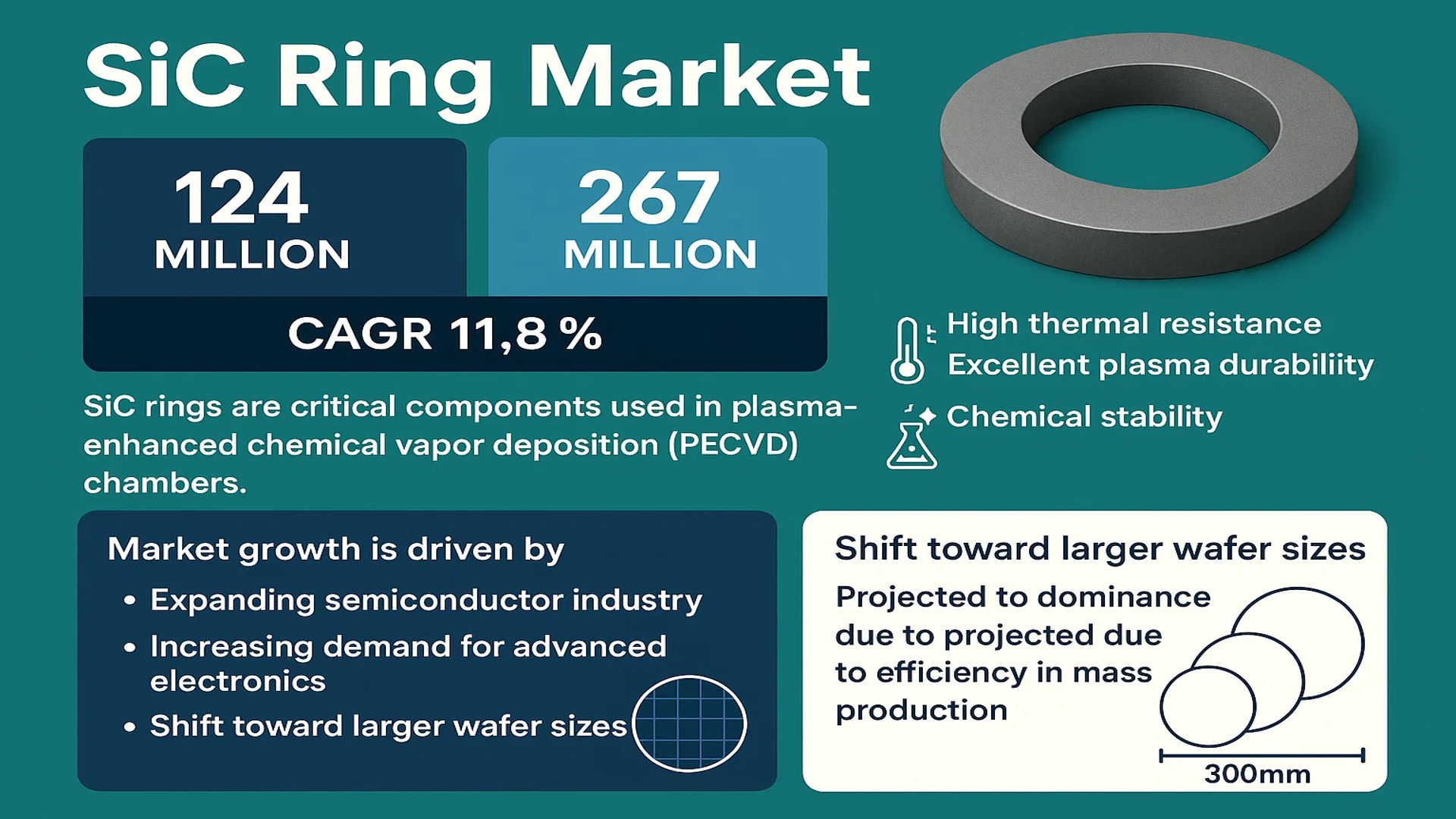
The global SiC Ring Market was valued at 124 million in 2024 and is projected to reach US$ 267 million by 2032, at a CAGR of 11.8% during the forecast period.
SiC rings are critical components used in plasma-enhanced chemical vapor deposition (PECVD) chambers. These rings, made from silicon carbide (SiC), are prized for their high thermal resistance, excellent plasma durability, and chemical stability, making them ideal for semiconductor manufacturing processes. They are widely utilized in applications such as wafer etching and other semiconductor fabrication steps where extreme conditions demand robust material performance.
The market growth is driven by the expanding semiconductor industry, increasing demand for advanced electronics, and the shift toward larger wafer sizes, particularly the 300mm segment, which is projected to dominate due to its efficiency in mass production. However, challenges such as high production costs and material supply constraints may impact market dynamics. Key players like Kallex, CoorsTek, and Tokai Carbon are investing in R&D to enhance product performance, while regional markets such as the U.S. and China remain focal points for expansion.
MARKET DYNAMICS
MARKET DRIVERS
Expansion of Semiconductor Industry Accelerates SiC Ring Demand
The global semiconductor industry is witnessing robust growth, with projections indicating it will surpass $1 trillion in value by 2030. This expansion directly fuels demand for silicon carbide (SiC) rings, critical components in plasma-enhanced chemical vapor deposition (PECVD) chambers used for semiconductor manufacturing. As chipmakers transition to more advanced nodes below 7nm, the superior plasma resistance and thermal stability of SiC rings become increasingly vital. Leading manufacturers are investing heavily in capacity expansion, with several new semiconductor fabrication plants (fabs) announced across North America and Asia.
Electrification of Automotive Sector Creates New Application Horizons
The automotive industry’s rapid shift toward electric vehicles (EVs) presents a significant growth opportunity for SiC ring manufacturers. EV power electronics require advanced semiconductor components that utilize SiC-based deposition processes. With EV production expected to account for over 30% of total vehicle output by 2030, semiconductor suppliers are scaling up production of power devices. Major automotive chipmakers have announced capacity expansions exceeding $50 billion collectively, all requiring PECVD equipment fitted with high-performance SiC rings.
➤ Leading SiC ring manufacturer CoorsTek recently secured a multi-year supply agreement with a top-tier semiconductor equipment provider to support production scaling for automotive power modules.
Furthermore, government initiatives supporting semiconductor localization and the CHIPS Act in the U.S.are driving substantial investments in domestic fabrication capabilities, creating a ripple effect across the supply chain including critical components like SiC rings.
MARKET CHALLENGES
High Manufacturing Costs and Complex Production Processes Limit Market Penetration
The manufacturing of SiC rings involves specialized processes including high-temperature sintering and precision machining, resulting in production costs that are significantly higher than alternative materials. While the performance benefits justify the premium in advanced semiconductor applications, cost sensitivity in mature process nodes creates adoption barriers. The raw material purity requirements (typically 99.999% silicon carbide) and the energy-intensive production process contribute approximately 60-70% of total manufacturing costs.
Other Challenges
Supply Chain Vulnerabilities
The concentrated nature of SiC precursor material supply creates potential bottlenecks, with over 75% of high-purity silicon carbide powder sourced from limited suppliers. This concentration raises concerns about supply stability, particularly as demand escalates across multiple industries including semiconductors and electric vehicles.
Technical Limitations in Large Diameter Rings
Producing defect-free SiC rings above 300mm diameter presents significant technical hurdles. The material’s inherent brittleness combined with demanding flatness and surface finish requirements results in yields below 60% for larger formats, constraining capacity for next-generation wafer processing equipment.
MARKET RESTRAINTS
Material Alternatives and Emerging Technologies Present Competitive Threats
While SiC remains the dominant material for PECVD chamber components, alternative solutions are gaining traction. Silicon-coated graphite rings offer cost advantages in less demanding applications, capturing approximately 15-20% of the market. More significantly, equipment manufacturers are developing novel chamber designs that reduce dependency on consumable rings entirely. These innovations could potentially disrupt the established market dynamics if adopted widely.
Additionally, the semiconductor industry’s transition to new architectures such as gate-all-around transistors may require modified deposition processes that could alter component requirements.The pace of these technology shifts creates uncertainty for SiC ring suppliers who must balance R&D investments with current production demands.
MARKET OPPORTUNITIES
Advanced Packaging and Heterogeneous Integration Drive New Demand Segments
The semiconductor industry’s increasing focus on advanced packaging techniques creates substantial growth potential for SiC ring manufacturers. As chipmakers adopt 3D IC packaging and chiplet architectures to overcome Moore’s Law limitations, new deposition process requirements emerge. These packaging applications are less sensitive to material costs than front-end processes while still requiring the performance benefits of SiC, opening lucrative market segments. Investment in advanced packaging facilities is projected to grow at 12% CAGR through 2030.
Furthermore, the rise of compound semiconductor manufacturing for RF and power applications presents additional opportunities. The superior chemical resistance of SiC makes it ideal for gallium nitride and silicon carbide device production, which is expanding rapidly to meet 5G and electric vehicle demands.
Manufacturers are responding to these opportunities through targeted R&D and strategic partnerships. Recent developments include new SiC ring formulations optimized for specific deposition chemistries and expanded production capacities in key semiconductor manufacturing regions.
SiC RING MARKET TRENDS
Semiconductor Industry Expansion Drives SiC Ring Demand
The global silicon carbide (SiC) ring market is experiencing robust growth, fueled by the semiconductor industry’s rapid expansion. With semiconductors becoming essential in everything from consumer electronics to electric vehicles, the demand for high-performance components like SiC rings has surged. These rings play a critical role in plasma-enhanced chemical vapor deposition (PECVD) chambers, where their superior heat and plasma resistance ensure reliable performance in demanding environments. The market was valued at $124 million in 2024 and is projected to grow at a compound annual growth rate (CAGR) of 11.8%, reaching $267 million by 2032. This upward trajectory is largely driven by increased semiconductor manufacturing investments, particularly in regions such as Asia-Pacific and North America.
Other Trends
Shift Toward Larger Wafer Sizes
A key driver for the SiC ring market is the semiconductor industry’s transition to larger wafer sizes, particularly 300mm wafers. This shift improves manufacturing efficiency and reduces costs per chip, leading semiconductor manufacturers to upgrade their fabrication facilities. The 300mm wafer segment is expected to witness the highest growth rate in the SiC ring market, with escalating demand from foundries investing in cutting-edge process technologies. Meanwhile, 200mm wafer production remains steady, driven by legacy applications in automotive and industrial sectors, though its market share is gradually declining in favor of larger formats.
Advancements in Semiconductor Fabrication Technologies
Emerging semiconductor fabrication technologies, including advanced packaging and 3D NAND memory production, are accelerating the adoption of SiC rings. Manufacturers are leveraging these components to enhance process stability in high-temperature manufacturing environments, reducing defect rates and improving yield. The growing shift toward more sophisticated semiconductor nodes—below 10nm—has further pushed the need for durable materials capable of withstanding harsh plasma conditions. Innovations in SiC material quality, along with enhanced machining precision, are enabling longer component lifespans, contributing to cost efficiencies in semiconductor production lines.
COMPETITIVE LANDSCAPE
Key Industry Players
Strategic Investments and Technological Advancements Drive Market Competition
The global SiC Ring market demonstrates a competitive yet fragmented structure with a mix of established players and emerging manufacturers. Leading companies are expanding their capabilities to meet the growing demand for silicon carbide components, particularly in semiconductor manufacturing and advanced industrial applications.
CoorsTek and FerroTec dominate the market share due to their specialized production capabilities and extensive distribution networks across North America and Asia-Pacific. These companies hold a combined revenue share of approximately 28% in 2024, driven by their focus on high-precision SiC rings for plasma-enhanced CVD chambers.
Meanwhile, Kallex and Daewon are gaining traction with their innovative manufacturing techniques and cost-competitive pricing strategies, particularly in the 300mm segment which is projected to grow at a faster rate compared to 200mm rings. These companies have strengthened their positions through strategic partnerships with semiconductor equipment manufacturers.
The market also sees active participation from Greene Tweed and Max Luck Technology, who are investing heavily in R&D to develop next-generation SiC rings with enhanced plasma resistance and thermal stability. Their recent product launches in 2023-2024 have helped capture additional market share in Europe and Southeast Asia.
List of Key SiC Ring Manufacturers Profiled
- CoorsTek (U.S.)
- Kallex (China)
- Daewon (South Korea)
- Greene Tweed (U.S.)
- Tokai Carbon (Japan)
- Worldex (South Korea)
- Max Luck Technology (Taiwan)
- FerroTec (U.S.)
Segment Analysis:
By Type
300mm Segment Leads Due to High Demand in Semiconductor Manufacturing
The market is segmented based on type into:
- 300mm
- 200mm
By Application
Wafer Etching Segment Dominates Due to Critical Role in Semiconductor Fabrication
The market is segmented based on application into:
- Wafer Etching
- Plasma Processing
- CVD Chambers
- Others
By End-User Industry
Semiconductor Industry Remains Key Consumer of SiC Rings
The market is segmented based on end-user industry into:
- Semiconductor Manufacturing
- Electronics
- Optoelectronics
- Research & Development
Regional Analysis: SiC Ring Market
Asia-Pacific
The Asia-Pacific region dominates the global SiC Ring market, driven by the rapid expansion of semiconductor manufacturing in countries like China, Japan, and South Korea. With China alone projected to account for nearly 40% of the global semiconductor production capacity by 2025, the demand for high-performance SiC Rings in plasma-enhanced CVD chambers remains strong. While Japan leads in technological innovation with companies like Tokai Carbon, China focuses on mass production to meet both domestic and international demand. The region benefits from well-established supply chains and government initiatives supporting semiconductor self-sufficiency, though competition is intensifying due to price sensitivity in emerging markets like India.
North America
North America’s SiC Ring market is characterized by advanced semiconductor research and development, particularly in the U.S. The region benefits from strong collaborations between key manufacturers like CoorsTek and Greene Tweed and leading semiconductor firms. Silicon carbide’s superior thermal and plasma resistance properties make it indispensable for cutting-edge chip fabrication processes. However, high production costs and stringent regulatory frameworks pose challenges for market expansion. Despite this, ongoing investments in 5G and electric vehicle technologies continue to drive demand for precision SiC components in specialty applications.
Europe
Europe maintains a stable position in the SiC Ring market, supported by robust semiconductor equipment manufacturing in Germany and the Nordic countries. The region emphasizes sustainable production methods and material efficiency, aligning with EU circular economy policies. While Europe’s market growth is slower compared to Asia-Pacific, its focus on high-value applications in aerospace and automotive sectors presents niche opportunities. Local players like FerroTec are investing in R&D to compete globally, though dependence on Asian supply chains for raw materials remains a constraint.
South America
The South American SiC Ring market is in its early stages, with limited domestic semiconductor manufacturing capabilities. Brazil shows modest demand driven by industrial applications, but overall adoption is hindered by economic instability and reliance on imports. Local infrastructure gaps in electronics production restrict market growth, though expanding foreign investments in Mexico’s manufacturing sector may create secondary demand in the coming years. The region currently lacks competitive domestic suppliers, making it a net importer of SiC components.
Middle East & Africa
This region represents an emerging market with limited current demand for SiC Rings, primarily serving maintenance needs for imported semiconductor equipment. While countries like Israel and the UAE are making strategic investments in high-tech industries, widespread adoption remains years away due to underdeveloped local semiconductor ecosystems. The market shows long-term potential as part of digital transformation initiatives, but progress depends on establishing technical expertise and stable supply networks in the electronics manufacturing value chain.
Report Scope
This market research report provides a comprehensive analysis of the Global SiC Ring Market, covering the forecast period 2025–2032. It offers detailed insights into market dynamics, technological advancements, competitive landscape, and key trends shaping the industry.
Key focus areas of the report include:
- Market Size & Forecast: Historical data and future projections for revenue, unit shipments, and market value across major regions and segments. The Global SiC Ring Market was valued at USD 124 million in 2024 and is projected to reach USD 267 million by 2032, growing at a CAGR of 11.8% during the forecast period.
- Segmentation Analysis: Detailed breakdown by product type (300mm and 200mm), application (wafer etching and others), and end-user industries to identify high-growth segments and investment opportunities.
- Regional Outlook: Insights into market performance across North America, Europe, Asia-Pacific, Latin America, and the Middle East & Africa, including country-level analysis. The U.S. and China are key growth markets.
- Competitive Landscape: Profiles of leading market participants including Kallex, Daewon, CoorsTek, Greene Tweed, Tokai Carbon, Worldex, Max Luck Technology, and FerroTec, their product offerings, R&D focus, and recent developments.
- Technology Trends & Innovation: Assessment of emerging semiconductor fabrication technologies and evolving industry standards for plasma-enhanced CVD chambers.
- Market Drivers & Restraints: Evaluation of factors driving market growth such as increasing semiconductor demand, along with challenges like supply chain constraints and raw material availability.
- Stakeholder Analysis: Insights for component suppliers, semiconductor manufacturers, investors, and policymakers regarding the evolving ecosystem and strategic opportunities.
Primary and secondary research methods are employed, including interviews with industry experts, data from verified sources, and real-time market intelligence to ensure the accuracy and reliability of the insights presented.
FREQUENTLY ASKED QUESTIONS:
What is the current market size of Global SiC Ring Market?
-> SiC Ring Market was valued at 124 million in 2024 and is projected to reach US$ 267 million by 2032, at a CAGR of 11.8% during the forecast period.
Which key companies operate in Global SiC Ring Market?
-> Key players include Kallex, Daewon, CoorsTek, Greene Tweed, Tokai Carbon, Worldex, Max Luck Technology, and FerroTec.
What are the key growth drivers?
-> Key growth drivers include increasing semiconductor production, demand for advanced fabrication technologies, and expansion of 300mm wafer processing facilities.
Which region dominates the market?
-> Asia-Pacific is the largest market, driven by semiconductor manufacturing in China, South Korea, and Taiwan, while North America remains a key innovation hub.
What are the emerging trends?
-> Emerging trends include development of larger diameter SiC rings, improved plasma resistance materials, and integration with next-generation semiconductor fabrication equipment.

Get Sample Report PDF for Exclusive Insights
Report Sample Includes
- Table of Contents
- List of Tables & Figures
- Charts, Research Methodology, and more...
 Download Sample Report PDF