Short Range Ultrasonic Sensors Market Insights
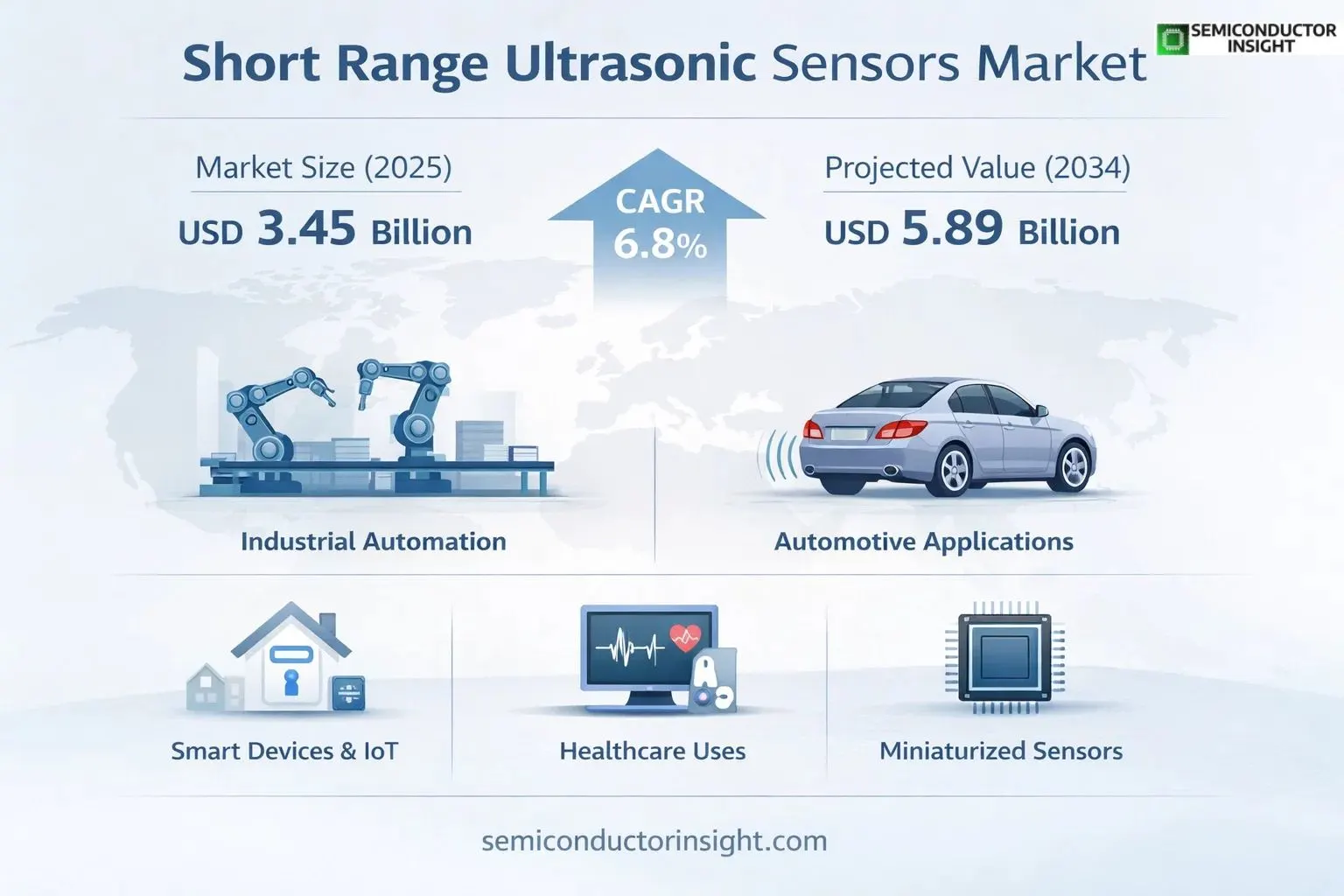
Global Short Range Ultrasonic Sensors market size was valued at USD 3.45 billion in 2025. The market is projected to grow from USD 3.72 billion in 2026 to USD 5.89 billion by 2034, exhibiting a CAGR of 6.8% during the forecast period.
Short range ultrasonic sensors are devices that utilize high-frequency sound waves to detect objects within a limited distance range, typically up to a few meters. These sensors operate by emitting ultrasonic pulses and measuring the time taken for the echo to return after reflecting off an object, enabling precise distance measurement and object detection without physical contact.
The market growth is driven by increasing automation across industries, rising demand for non-contact sensing solutions, and advancements in IoT applications. Key players such as Honeywell International, Robert Bosch, and Pepperl+Fuchs are expanding their product portfolios with compact, energy-efficient sensors tailored for industrial automation and smart infrastructure projects.
MARKET DRIVERS
Increasing Automation Across Industries
The Short Range Ultrasonic Sensors Market is experiencing growth due to rising industrial automation demand. These sensors play a critical role in proximity detection and object measurement with high accuracy. Industries such as manufacturing, automotive, and robotics increasingly rely on short-range ultrasonic sensors for precise operations.
Expanding Applications in Smart Devices
Smart home systems and IoT devices are incorporating short-range ultrasonic sensors for enhanced functionality. These sensors enable touchless controls and presence detection in consumer electronics, driving market adoption. The global smart home market is projected to grow at 12% annually, creating opportunities for sensor manufacturers.
Key Insight: The automotive sector accounts for nearly 35% of short-range ultrasonic sensor demand, primarily for parking assistance systems.
Technological advancements in sensor miniaturization and energy efficiency continue to expand application possibilities across multiple sectors.
MARKET CHALLENGES
Technical Limitations in Extreme Conditions
Short-range ultrasonic sensors face performance issues in environments with temperature fluctuations or high humidity. These conditions can affect signal accuracy, limiting adoption in certain industrial applications. Manufacturers are developing ruggedized models to address these challenges.
Other Challenges
Competition from Alternative Technologies
LIDAR and infrared sensors are emerging as alternatives, particularly in applications requiring higher precision. However, ultrasonic sensors maintain cost advantages in many short-range applications.
MARKET RESTRAINTS
High Development Costs
The specialized nature of short-range ultrasonic sensor manufacturing leads to significant R&D expenditures. These costs can limit market entry for smaller players and slow down innovation cycles. Currently, about 60% of production is concentrated among five major global manufacturers.
MARKET OPPORTUNITIES
Emerging Medical Applications
The healthcare sector presents new opportunities for short-range ultrasonic sensors in diagnostic equipment and patient monitoring systems. These sensors enable non-contact measurement of vital signs and fluid levels. The global medical sensor market is expected to reach $22 billion by 2028, creating significant potential for specialized ultrasonic solutions.
Short Range Ultrasonic Sensors Market Trends
Increasing Demand for Precision Distance Measurement
The Short Range Ultrasonic Sensors market is experiencing significant growth due to rising demand for precise distance measurement in industrial automation. These sensors offer reliable detection within 0-5 meter ranges with millimeter-level accuracy, making them ideal for robotics and quality control applications. Manufacturers are focusing on improving measurement consistency in challenging environments with temperature variations.
Other Trends
Adoption in Automotive Parking Assistance
Automotive OEMs are increasingly integrating short-range ultrasonic sensors for parking assistance and collision avoidance systems. Compact sensor designs with IP67 ratings are enabling wider deployment in vehicle bumpers and side panels. The technology’s immunity to weather conditions gives it an edge over optical alternatives.
Expansion in Healthcare Applications
Medical device manufacturers are leveraging Short Range Ultrasonic Sensors for non-invasive diagnostics and patient monitoring. Emerging applications include respiratory monitoring devices and automated medication dispensers. The healthcare segment is driving innovation in low-power sensor designs compliant with medical safety standards.
Miniaturization and Power Efficiency Improvements
Vendors are competing to develop smaller form factor sensors with reduced power consumption. New piezoelectric materials and signal processing algorithms are enabling 50% smaller packages while maintaining detection performance. This trend particularly benefits battery-operated IoT devices and wearable applications.
North America Leads in Industrial Automation Integration
The U.S. market accounts for the highest industrial adoption of Short Range Ultrasonic Sensors, particularly in manufacturing and logistics automation. Major players are investing in smart sensor networks that combine ultrasonic detection with wireless connectivity for Industry 4.0 applications.
COMPETITIVE LANDSCAPE
Key Industry Players
Strategic Positioning in the $XX Billion Short Range Ultrasonic Sensors Market
The short range ultrasonic sensors market is characterized by a mix of established industrial automation leaders and specialized sensor manufacturers. Honeywell International and Robert Bosch dominate the competitive landscape with their diversified product portfolios and strong R&D capabilities, holding a combined market share of approximately 25% as of 2025. These industry giants leverage their global distribution networks and cross-industry applications ranging from automotive to industrial automation to maintain market leadership.
Niche players like Migatron Corporation and Massa Products Corporation have carved out specialized positions through technological expertise in high-precision measurement applications. Meanwhile, European sensor specialists Baumer and Pepperl+Fuchs compete on advanced industrial-grade solutions, while MaxBotix and DADISICK focus on cost-effective consumer and robotics applications. The market also features specialized UK-based firms like Ixthus Instrumentation and Deeter Electronics that cater to specific industrial metrology needs.
List of Key Short Range Ultrasonic Sensors Companies Profiled
- Honeywell International
- Robert Bosch
- Baumer
- Pepperl+Fuchs
- MaxBotix
- Massa Products Corporation
- Migatron Corporation
- Deeter Electronics Ltd.
- DADISICK
- Ixthus Instrumentation
- Sick AG
- Piezo Hannas
- Murata Manufacturing
- Omron Corporation
- Rockwell Automation
Segment Analysis:
| Segment Category | Sub-Segments | Key Insights |
| By Type |
|
Piezoelectric Sensors dominate due to superior accuracy in distance measurement and widespread adoption in industrial automation. Key advantages include:
|
| By Application |
|
Distance Measurement Applications lead segment adoption, driven by precision requirements in multiple sectors:
|
| By End User |
|
Industrial Manufacturing represents the largest end-user segment due to:
|
| By Detection Range |
|
0-50 cm Range sensors are most prevalent across applications:
|
| By Technology |
|
Smart Sensors show strongest growth trajectory due to:
|
Regional Analysis: Global Short Range Ultrasonic Sensors Market
Asia-Pacific’s automotive sector accounts for the highest short range ultrasonic sensor adoption, particularly for parking assistance systems. Japanese OEMs integrate advanced sensor arrays while Chinese manufacturers focus on cost-effective solutions for emerging markets.
Government-backed smart city projects across India and Southeast Asia are driving ultrasonic sensor demand for traffic management and building automation applications where short-range detection proves most effective.
China’s massive consumer electronics production fuels ultrasonic sensor integration for touchless interfaces and proximity detection in smartphones, tablets, and smart home devices from regional OEMs.
The region’s extensive electronics manufacturing ecosystem facilitates rapid prototype-to-production cycles for ultrasonic sensors, with specialized clusters in Taiwan and South Korea driving technical innovation.
North America
North America maintains significant demand for high-performance short range ultrasonic sensors, particularly in advanced automotive safety systems and industrial automation. The U.S. leads with substantial R&D investments from sensor manufacturers developing compact ultrasonic solutions for medical devices and robotics. Canada shows growing adoption in smart building technologies and HVAC systems. Stringent industrial safety regulations drive replacement demand for ultrasonic sensors in factory automation applications across the region.
Europe
The European short range ultrasonic sensors market benefits from strong automotive OEM demand in Germany and France, where parking sensor integration approaches 100% in new vehicles. The region emphasizes premium, high-accuracy sensors for industrial metrology applications. Nordic countries lead in innovative applications like underwater vehicle navigation and winter condition detection systems. EU directives on pedestrian safety and industrial automation continue to stimulate sensor deployment across multiple sectors.
South America
Brazil anchors the South American market with increasing automotive production adopting basic ultrasonic parking sensors. The region shows gradual uptake in industrial applications including food processing and agricultural equipment. Infrastructure limitations temper market growth, but recent investments in Argentinian and Chilean mining operations drive specialized sensor demand for hazardous environment applications.
Middle East & Africa
Gulf Cooperation Council countries lead regional adoption, particularly for ultrasonic sensors in smart city infrastructure and parking management systems. Africa shows nascent growth in industrial applications, with South Africa serving as the primary market. Oil and gas operations utilize ruggedized ultrasonic sensors, while limited manufacturing bases constrain broader market expansion across most African nations.
Report Scope
This market research report provides a comprehensive analysis of the Short Range Ultrasonic Sensors Market, covering the forecast period 2025–2034. It offers detailed insights into market dynamics, technological advancements, competitive landscape, and key trends shaping the industry.
Key focus areas of the report include:
- Market Overview: The report begins with an overview outlining its current market scenario, key growth indicators, and industry transformation drivers. It discusses macroeconomic factors, demand-supply balance, regulatory landscape, and the strategic role of ultrasonic sensors in applications such as distance measurement, liquid level detection, anti-theft alarms, object recognition, and medical diagnostics.
- Market Size & Forecast: Historical data and future projections for revenue, unit shipments, and market value across major regions and segments.
- Segmentation Analysis: Detailed breakdown by product type (Piezoelectric, Electromagnetic, Others), application, and end-user industry to identify high-growth segments and investment opportunities.
- Regional Insights: Insights into market performance across North America, Europe, Asia, South America, and the Middle East & Africa, including country-level analysis where relevant.
- Competitive Landscape: Profiles of leading market participants, including their product offerings, R&D focus, manufacturing capacity, pricing strategies, and recent developments such as mergers, acquisitions, and partnerships.
- Technology Trends & Innovation: Assessment of emerging technologies, integration of AI/IoT, sensor design trends, and evolving industry standards.
- Market Drivers & Restraints: Evaluation of factors driving market growth along with challenges, supply chain constraints, regulatory issues, and market-entry barriers.
- Stakeholder Insights: Insights for component suppliers, OEMs, system integrators, investors, and policymakers regarding the evolving ecosystem and strategic opportunities.
Primary and secondary research methods are employed, including interviews with industry experts, data from verified sources, and real-time market intelligence to ensure the accuracy and reliability of the insights presented.
FREQUENTLY ASKED QUESTIONS:
What is the current market size of Short Range Ultrasonic Sensors Market?
->Short Range Ultrasonic Sensors Market was valued at USD million in 2025 and is expected to reach USD million by 2034.
Which key companies operate in Short Range Ultrasonic Sensors Market?
-> Key players include Migatron Corporation, Massa Products Corporation, Deeter Electronics Ltd., Honeywell International, Baumer, MaxBotix, Robert Bosch, Pepperl+Fuchs, DADISICK, Ixthus Instrumentation, among others.
What are the key growth drivers?
-> Key growth drivers include increasing demand for distance measurement and object recognition applications, technological advancements in sensor accuracy, and expanding industrial automation.
Which region dominates the market?
-> Asia is a key growth region, with China reaching USD million by 2025, while North America remains a significant market.
What are the emerging trends?
-> Emerging trends include integration of IoT in ultrasonic sensors, development of miniaturized sensors, and increasing use in medical diagnostics.
Get Sample Report PDF for Exclusive Insights
Report Sample Includes
- Table of Contents
- List of Tables & Figures
- Charts, Research Methodology, and more...