
MARKET INSIGHTS
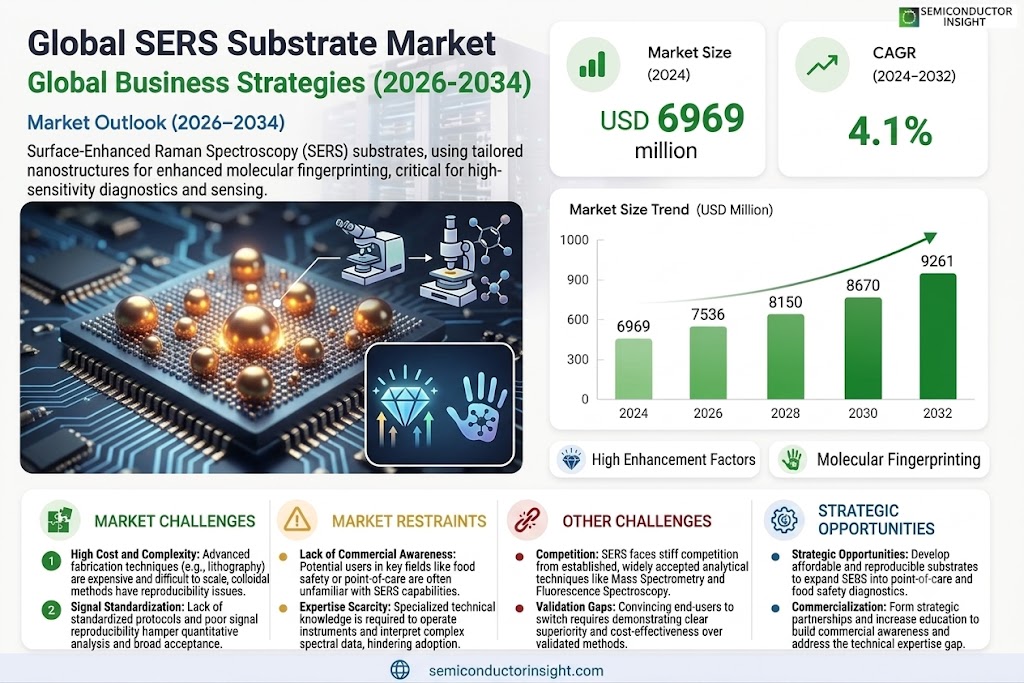
Global SERS Substrate Market size was valued at USD 6969 million in 2024 to USD 9261 million by 2032, exhibiting a CAGR of 4.1% during the forecast period.
SERS substrates are specialized materials crucial for enhancing Raman scattering signals, enabling highly sensitive spectroscopic analysis. These substrates facilitate the amplification of the weak Raman effect by creating localized surface plasmon resonances, typically using nanostructured surfaces of noble metals like silver, gold, and copper. The technique requires the adsorption of analyte molecules onto the substrate surface to achieve significant signal enhancement.
The market is experiencing steady growth driven by several factors, including increased investment in life sciences and pharmaceutical research, rising demand for sensitive chemical detection methods, and the expanding application of biosensors. Furthermore, technological advancements in nanotechnology and the growing adoption of SERS in point-of-care diagnostics are contributing to market expansion. Initiatives by key players are also expected to fuel growth. For instance, companies are continuously developing novel substrates with higher enhancement factors and improved reproducibility. HORIBA, Ocean Insight, and Hamamatsu Photonics are some of the key players that operate in the market with a wide range of portfolios.
MARKET DRIVERS
Increasing Demand for Highly Sensitive Detection Methods
The global SERS substrate market is primarily driven by the escalating need for highly sensitive and specific analytical techniques across life sciences, pharmaceuticals, and security applications. Surface-enhanced Raman scattering (SERS) offers significant advantages over traditional analytical methods, providing single-molecule detection capabilities and unique molecular fingerprints. This is critical for applications such as early disease diagnosis, drug discovery, and environmental monitoring. The technology’s ability to provide rapid, label-free detection with minimal sample preparation is a key factor accelerating its adoption.
Technological Advancements in Nanofabrication
Continuous innovation in nanofabrication techniques, including electron-beam lithography, nanoimprinting, and colloidal synthesis, is enabling the production of highly reproducible and optimized SERS substrates. These advancements allow for precise control over the size, shape, and arrangement of metallic nanostructures, which are crucial for generating strong and uniform electromagnetic fields (hot spots) essential for signal enhancement. The development of novel materials like hybrid nanostructures and two-dimensional materials is further expanding the performance and application scope of SERS substrates.
➤ The pharmaceutical industry’s rigorous quality control requirements are a significant driver, with SERS being utilized for drug formulation analysis and counterfeit detection.
Growing government funding and private investments in research and development related to nanotechnology and spectroscopy are also fueling market growth. This financial support is facilitating academic and industrial research, leading to the commercialization of new and improved SERS substrate products.
MARKET CHALLENGES
High Cost and Complexity of Substrate Fabrication
A major challenge facing the SERS substrate market is the high cost and technical complexity associated with fabricating substrates with high enhancement factors and excellent reproducibility. Techniques like lithography are expensive and not easily scalable for mass production, while colloidal methods can suffer from batch-to-batch variability. This limits widespread adoption, particularly in cost-sensitive applications and point-of-care diagnostics.
Other Challenges
Signal Reproducibility and Standardization
Achieving consistent and reproducible SERS signals across different substrates and laboratories remains a significant hurdle. The lack of standardized protocols for substrate characterization and measurement can lead to variability in results, hindering the quantitative application of SERS and its acceptance as a routine analytical tool.
Competition from Established Techniques
SERS faces strong competition from other well-established analytical techniques such as mass spectrometry and fluorescence spectroscopy, which have entrenched workflows, extensive validation, and broader user acceptance. Convincing end-users to switch to a newer technology requires demonstrated clear superiority and cost-effectiveness.
MARKET RESTRAINTS
Limited Commercial Awareness and Technical Expertise
The growth of the SERS substrate market is restrained by a relative lack of widespread commercial awareness and the specialized technical expertise required to effectively utilize the technology. Potential users in fields like food safety or clinical diagnostics may be unfamiliar with SERS capabilities or lack the trained personnel to operate the instrumentation and interpret the complex spectral data, slowing down market penetration.
Stringent Regulatory Frameworks
For applications in medical diagnostics and pharmaceuticals, SERS-based products must navigate stringent regulatory approval processes from bodies like the FDA and EMA. The time-consuming and costly nature of obtaining regulatory clearance for new medical devices or diagnostic tests acts as a significant barrier to entry for companies and can delay the commercialization of innovative SERS substrate-based solutions.
MARKET OPPORTUNITIES
Expansion into Point-of-Care Diagnostics
A significant opportunity lies in the development of low-cost, disposable SERS substrates integrated into portable devices for point-of-care (POC) diagnostics. The ability of SERS to provide rapid, sensitive detection of disease biomarkers directly from bodily fluids like blood or saliva makes it ideal for POC applications, potentially revolutionizing early disease detection and personalized medicine in decentralized settings.
Emerging Applications in Food Safety and Environmental Monitoring
There is growing potential for SERS substrates in food safety for detecting pathogens, pesticides, and adulterants, and in environmental monitoring for identifying pollutants and toxins. The demand for rapid, on-site screening tools in these sectors presents a substantial growth avenue for manufacturers who can develop robust and user-friendly SERS-based kits and sensors.
Development of Multiplexed Assays
The unique fingerprinting capability of Raman spectroscopy allows for the simultaneous detection of multiple analytes. This creates an opportunity for designing sophisticated SERS substrates tailored for multiplexed assays, which are highly valuable in clinical diagnostics for panel testing and in pharmaceutical high-throughput screening, offering significant time and cost savings.
SERS Substrate Market Trends
Steady Market Growth and Expansion
The global SERS Substrate market is demonstrating robust and consistent expansion, valued at $6969 million in 2024. Projections indicate the market will reach $9261 million by 2032, growing at a compound annual growth rate (CAGR) of 4.1% during the forecast period. This steady growth trajectory is primarily fueled by the increasing demand for high-sensitivity analytical techniques across life sciences, pharmaceuticals, and security applications. Surface-Enhanced Raman Spectroscopy (SERS) substrates are essential as they amplify Raman scattering signals from molecules adsorbed onto their surfaces, enabling highly sensitive detection and analysis at extremely low concentrations.
Other Trends
Material Dominance and Application Focus
A significant trend is the clear dominance of silver-based substrates, which account for approximately 51% of the market share by product type. Silver’s superior enhancement properties make it the preferred material. In terms of application, the Biology & Medicine segment is the largest driver of market demand, holding about a 45% share. This is attributed to the widespread use of SERS in drug discovery, disease diagnostics, and biomedical research where non-destructive, label-free detection is critical. The Chemical and Food industries represent other key growth areas, utilizing SERS for quality control and contaminant detection.
Competitive Landscape and Consolidation
The market is characterized by a moderately consolidated competitive landscape, with the top three players—HORIBA, Ocean Insight, and Hamamatsu Photonics—collectively holding over 41% of the market share. This concentration indicates a market where technological expertise and established product portfolios are significant barriers to entry. Recent activities among these key players include strategic developments focused on enhancing substrate reproducibility, stability, and ease of use. The market dynamics are further influenced by ongoing research into novel nanostructures and hybrid materials aimed at improving enhancement factors and expanding the range of detectable analytes.
COMPETITIVE LANDSCAPE
Key Industry Players
A Market Led by Spectroscopy Giants with a Strong Application Focus on Biology & Medicine
The global SERS Substrate market is characterized by a moderately concentrated competitive landscape, with the top three players collectively holding a share of over 41%. HORIBA, a leader in spectroscopic instrumentation, along with Ocean Insight and Hamamatsu Photonics, dominate the market through their extensive product portfolios, strong R&D capabilities, and established global sales networks. The market structure is primarily driven by the critical need for high-sensitivity detection in analytical applications. Silver substrates are the dominant product type, capturing about 51% of the market, due to their superior enhancement properties. The largest end-use segment is Biology & Medicine, accounting for approximately 45% of applications, which fuels demand from academic research institutions, pharmaceutical companies, and diagnostic laboratories.
Beyond the dominant players, a range of specialized companies compete effectively by focusing on niche applications, novel substrate fabrication techniques, or specific material types. Companies such as Ato ID and Silmeco offer advanced, customizable substrates tailored for research and development. Instrumentation suppliers like Metrohm integrate SERS substrates into their analytical systems, providing complete solutions. Other significant participants, including Enhanced Spectrometry and StellarNet, cater to specific market segments with innovative products. This diverse competitive field indicates a healthy market with opportunities for specialization alongside the broad offerings of the leading corporations.
List of Key SERS Substrate Companies Profiled
- HORIBA
- Ocean Insight
- Hamamatsu Photonics
- Ato ID
- Silmeco
- Metrohm
- Enhanced Spectrometry
- StellarNet
- Thermo Fisher Scientific
- B&W Tek
- Renishaw plc
- Horiba Scientific
- BioTools, Inc.
- SERSitive
- Diagnostics Development
Segment Analysis:
| Segment Category | Sub-Segments | Key Insights |
| By Type |
|
Silver substrates are the dominant segment due to their superior plasmonic properties, which provide exceptionally high signal enhancement critical for sensitive detection. The material’s widespread adoption is driven by its excellent performance in a broad range of analytes and established manufacturing processes. Although gold substrates offer superior chemical stability, particularly for certain biological applications, the cost-effectiveness and proven efficacy of silver maintain its leading market position. |
| By Application |
|
Biology & Medicine represents the most significant application area, fueled by the critical need for high-sensitivity detection of biomolecules, pathogens, and pharmaceuticals. The non-destructive nature of SERS is particularly advantageous for analyzing delicate biological samples. This segment’s growth is underpinned by continuous advancements in medical diagnostics, drug discovery, and life science research. Applications in the chemical industry for catalysis monitoring and the food industry for safety testing are also expanding, but the depth and diversity of requirements in biomedical fields solidify its market leadership. |
| By End User |
|
Academic & Research Institutions constitute a primary end-user segment, serving as the foundational hub for methodological development and early-stage application exploration. These institutions drive innovation and validate new SERS substrate technologies, creating a pipeline of applications for commercial use. While pharmaceutical and biotechnology companies are major consumers for rigorous quality control and R&D, the broad-based, continuous demand from universities and public research organizations for fundamental studies and specialized detection projects ensures this segment’s prominence. |
| By Substrate Form |
|
Solid Planar Substrates are the leading form factor, valued for their reproducibility, ease of handling, and compatibility with standardized analytical protocols. These substrates offer a stable and uniform surface ideal for quantitative analysis and integration into automated systems. Although nanoparticle colloids provide high enhancement factors and are useful for solution-based studies, challenges with aggregation and reproducibility can limit their use. The reliability and user-friendly nature of planar substrates make them the preferred choice for routine laboratory analysis and commercial applications. |
| By Fabrication Technology |
|
Top-Down Lithography techniques, such as electron-beam lithography, lead this segment due to their unparalleled precision in creating well-defined and reproducible nanostructures. This capability is essential for applications requiring high uniformity and specific hot-spot engineering for maximum signal enhancement. While bottom-up chemical synthesis is crucial for producing high-quality nanoparticles, the scalability and design control offered by advanced lithography methods make them indispensable for manufacturing commercial-grade substrates, particularly for sensitive diagnostic and sensing applications where consistency is paramount. |
Regional Analysis: SERS Substrate Market
Asia-Pacific
Substantial national science and technology initiatives in countries like China and Singapore provide continuous funding for fundamental and applied research in plasmonics and sensing technologies. These programs are crucial for advancing SERS substrate development, fostering collaborations between national laboratories and universities to push the boundaries of sensitivity and specificity for various analytical challenges, from detecting trace explosives to identifying disease biomarkers.
The region’s powerful pharmaceutical and semiconductor industries are major consumers of sensitive analytical tools. The need for quality control, counterfeit detection, and ultra-sensitive material characterization in these sectors creates a consistent and growing demand for reliable SERS substrates. This close link to high-tech manufacturing ensures that substrate development is highly application-oriented, focusing on robustness, reproducibility, and integration into automated systems.
A high density of world-class universities and research institutions in the region contributes a continuous flow of breakthroughs in nanofabrication and surface chemistry. This academic prowess directly feeds into the SERS substrate market through the development of novel nanostructures, such as highly ordered arrays and hybrid materials, which offer enhanced Raman signal amplification and improved stability compared to conventional substrates.
The well-established electronics and chemical manufacturing infrastructure in Asia-Pacific enables cost-effective and scalable production of SERS substrates. This includes the synthesis of uniform nanoparticles and the precise patterning required for high-performance substrates. The efficient supply chain for raw materials and precision equipment further supports the region’s ability to produce and export a wide variety of SERS substrates to global markets.
North America
North America represents a highly mature and technologically advanced market for SERS substrates, characterized by strong demand from well-funded defense, homeland security, and life sciences sectors. The United States, in particular, is a hub for innovation, with numerous companies and federal agencies driving the development of next-generation substrates for applications in threat detection and medical diagnostics. The presence of leading instrument manufacturers ensures a close integration between substrate design and spectrometer capabilities. The market is distinguished by a focus on high-value, specialized substrates that offer extreme sensitivity for challenging analytical problems, supported by a robust venture capital environment that funds startups focusing on novel SERS technologies and applications.
Europe
Europe maintains a strong position in the SERS substrate market, underpinned by a rich academic tradition in physics and chemistry and a coordinated approach to research funding through entities like the European Union. The market is diverse, with significant activity in environmental monitoring, food quality control, and art conservation. Countries such as Germany, the UK, and France are centers of excellence, with a strong emphasis on developing standardized and reproducible substrates suitable for regulatory use. Collaborative projects between universities and small-to-medium enterprises are common, fostering innovation in substrate design while adhering to high-quality manufacturing standards. The regulatory framework for chemical safety and medical devices also drives the demand for reliable SERS-based analytical methods.
South America
The SERS substrate market in South America is an emerging landscape, with growth primarily driven by academic research and increasing applications in agricultural and environmental sectors. Brazil and Argentina are the most active markets, where research groups are exploring the use of SERS for analyzing pesticides, monitoring water quality, and characterizing natural products. While the industrial adoption is still in early stages compared to other regions, there is growing interest from government agencies and agricultural exporters in utilizing this sensitive detection technology. The market growth is contingent on increased investment in research infrastructure and greater collaboration between academia and local industries to develop cost-effective solutions tailored to regional needs.
Middle East & Africa
The SERS substrate market in the Middle East & Africa region is nascent but shows potential for growth, particularly in the Middle East where investments in technological diversification are increasing. Applications in security and oil & gas industries, such as pipeline monitoring and petrochemical analysis, are initial drivers. In Africa, the market is almost entirely research-led, with a few academic institutions exploring SERS for medical diagnostics and food safety. The overall market development is challenged by limited local manufacturing capabilities and a reliance on imported analytical instruments and substrates, though strategic investments in education and technology hubs indicate a slowly growing awareness and potential for future market expansion.
Report Scope
This market research report provides a comprehensive analysis of the SERS Substrate Market, covering the forecast period 2025–2032. It offers detailed insights into market dynamics, technological advancements, competitive landscape, and key trends shaping the industry.
Key focus areas of the report include:
- Market Overview: The report begins with an overview outlining its current market scenario, key growth indicators, and industry transformation drivers. It discusses macroeconomic factors, demand–supply balance, regulatory landscape, and the strategic role of semiconductors in powering advancements across industries such as automotive, telecommunications, consumer electronics, and industrial automation.
- Market Size & Forecast: Historical data and future projections for revenue, unit shipments, and market value across major regions and segments.
- Segmentation Analysis: Detailed breakdown by product type, technology, application, and end-user industry to identify high-growth segments and investment opportunities.
- Regional Insights: Insights into market performance across North America, Europe, Asia-Pacific, Latin America, and the Middle East & Africa, including country-level analysis where relevant.
- Competitive Landscape: Profiles of leading market participants, including their product offerings, R&D focus, manufacturing capacity, pricing strategies, and recent developments such as mergers, acquisitions, and partnerships.
- Technology Trends & Innovation: Assessment of emerging technologies, integration of AI/IoT, semiconductor design trends, fabrication techniques, and evolving industry standards.
- Market Drivers & Restraints: Evaluation of factors driving market growth along with challenges, supply chain constraints, regulatory issues, and market-entry barriers.
- Stakeholder Insights: Insights for component suppliers, OEMs, system integrators, investors, and policymakers regarding the evolving ecosystem and strategic opportunities.
Primary and secondary research methods are employed, including interviews with industry experts, data from verified sources, and real-time market intelligence to ensure the accuracy and reliability of the insights presented.
FREQUENTLY ASKED QUESTIONS:
What is the current market size of SERS Substrate Market?
-> Global SERS Substrate Market was valued at USD 6969 million in 2024 and is projected to reach USD 9261 million by 2032, exhibiting a CAGR of 4.1% during the forecast period.
Which key companies operate in SERS Substrate Market?
-> Key players include HORIBA, Ocean Insight, Hamamatsu Photonics, Ato ID, Silmeco, Metrohm, Enhanced Spectrometry, and StellarNet, among others. The top three players hold a share over 41%.
What are the key growth drivers?
-> Key growth drivers include advancements in Raman spectroscopy, increasing application in sensitive molecular analysis, and rising demand from the Biology & Medicine sector.
Which region dominates the market?
-> Asia is a significant market, with detailed analysis provided for regions including North America, Europe, Asia, South America, and Middle East & Africa.
What are the emerging trends?
-> Emerging trends include the development of advanced metallic substrates (Silver, Gold) and expanding applications in chemical and food industry safety testing.
Get Sample Report PDF for Exclusive Insights
Report Sample Includes
- Table of Contents
- List of Tables & Figures
- Charts, Research Methodology, and more...






