Market Insights
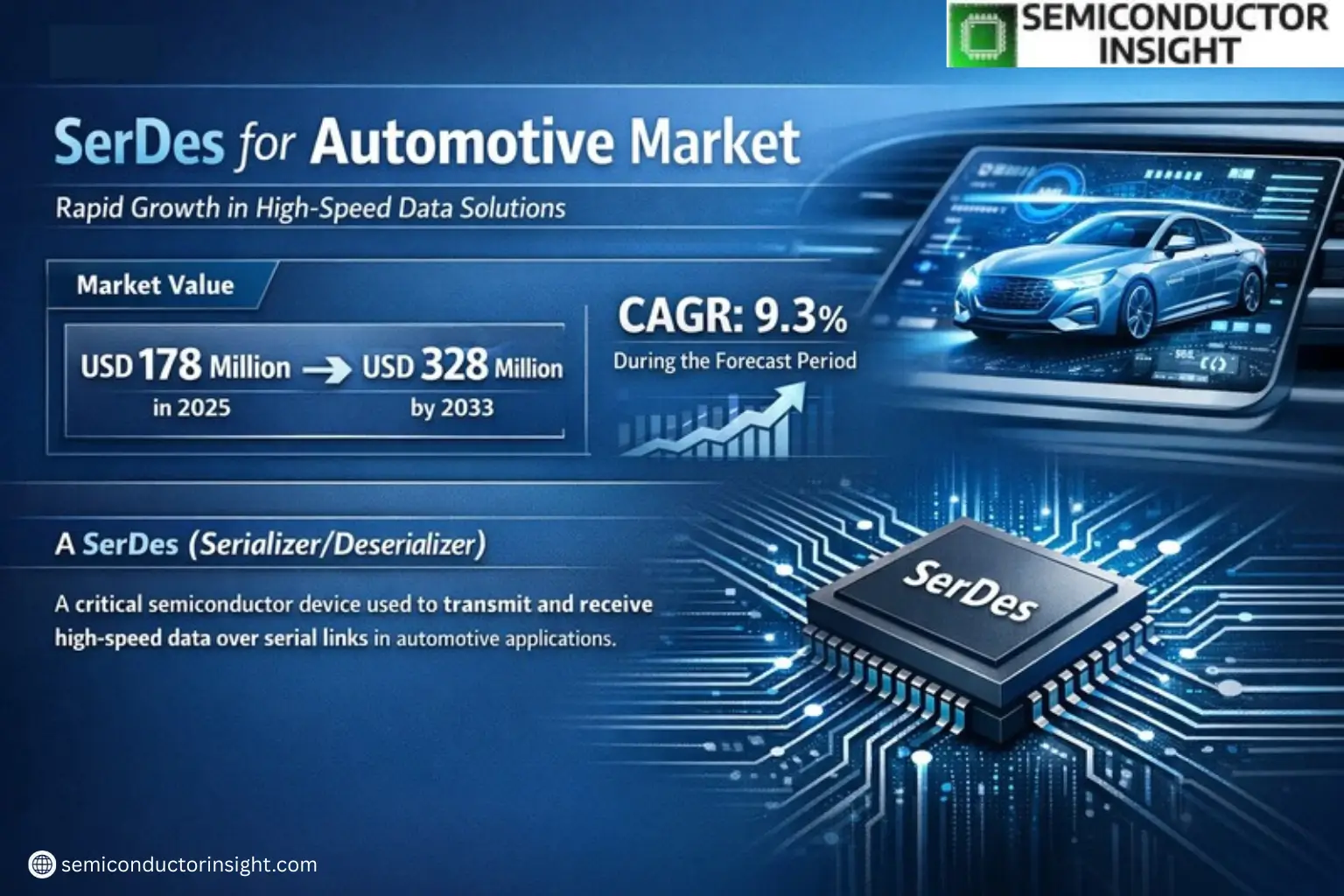
Global SerDes for Automotive Market was valued at USD 178 million in 2025 and is projected to reach USD 328 million by 2033, exhibiting a CAGR of 9.3% during the forecast period.
A SerDes (Serializer/Deserializer) is a critical semiconductor device used to transmit and receive high-speed data over serial links in automotive applications. It converts parallel data into a serial stream for transmission and reconstructs the original parallel data upon reception. This technology is widely integrated into advanced driver-assistance systems (ADAS), infotainment, and vehicle networking solutions, enabling efficient data transfer with minimal wiring complexity.
The market growth is driven by increasing demand for high-bandwidth communication in modern vehicles, particularly with the rise of autonomous driving and connected car technologies. Key players such as Texas Instruments, Maxim Integrated, and NXP dominate the market, collectively holding around 53% share. Geographically, Asia-Pacific leads in consumption (40% share), while North America remains the largest production hub (40% share). The adoption of higher-bit SerDes solutions (above 32-bit) is accelerating due to their ability to handle complex automotive data streams efficiently.
MARKET DRIVERS
Rising Demand for Advanced Driver Assistance Systems (ADAS)
The increasing adoption of ADAS in modern vehicles is a key driver for the SerDes for Automotive Market. These systems require high-speed data transmission for sensors, cameras, and radar, fueling demand for SerDes solutions that can handle massive data bandwidths efficiently.
Growth of In-Vehicle Infotainment Systems
Consumer preference for connected cars with high-resolution displays and seamless multimedia integration is accelerating the need for automotive SerDes technology. The market is projected to grow at 12% CAGR as automakers incorporate multiple high-definition screens per vehicle.
The transition to autonomous driving features continues to push the boundaries of data transmission requirements, creating sustained demand for robust SerDes architectures in automotive applications.
MARKET CHALLENGES
Signal Integrity in Harsh Automotive Environments
Maintaining reliable high-speed data transmission in vehicles presents significant challenges. Automotive SerDes must withstand temperature extremes, vibrations, and electromagnetic interference while maintaining signal integrity across complex vehicle architectures.
Other Challenges
Thermal Management Concerns
The power dissipation of high-speed SerDes links in confined automotive spaces requires innovative thermal solutions, adding to system complexity and cost.
Integration Complexity
Harmonizing multiple SerDes links with legacy automotive networks creates integration hurdles that slow deployment timelines in some vehicle platforms.
MARKET RESTRAINTS
High Development Costs
The substantial R&D investment required for automotive-grade SerDes solutions limits market entry to established semiconductor players. These costs contribute to higher SerDes for Automotive solution prices, potentially slowing adoption in budget vehicle segments.
MARKET OPPORTUNITIES
Expansion into Electric Vehicle Platforms
The rapid growth of electric vehicles presents new opportunities for automotive SerDes deployment. EV architectures with centralized computing require robust data backbone solutions, with some platforms incorporating 15+ high-speed SerDes links per vehicle.
Emerging Applications in Vehicle-to-Everything (V2X)
The development of V2X communication standards creates additional demand for high-performance SerDes solutions capable of supporting real-time data exchange between vehicles and infrastructure.
SerDes for Automotive Market Trends
Rapid Growth Driven by Advanced Vehicle Electronics
Global SerDes for Automotive Market is experiencing significant growth, valued at USD 178 million in 2025 and projected to reach USD 328 million by 2033 at a 9.3% CAGR. This expansion is fueled by increasing adoption of high-speed data transmission solutions in modern vehicles. Automotive SerDes technology enables efficient communication between sensors, cameras, and ECUs, supporting advanced driver-assistance systems (ADAS) and autonomous driving features.
Other Trends
Dominance of Key Players and Regional Markets
Texas Instruments, Maxim Integrated, and NXP collectively hold 53% of Global SerDes for Automotive Market share. North America leads production with 40% share, while Asia-Pacific dominates consumption with 40% market share. The 16 to 32 Bit segment accounts for the largest portion of SerDes implementations in automotive applications due to its balanced performance for most vehicle systems.
Technology Segmentation and Application Growth
Passenger cars represent the largest application segment for automotive SerDes, driven by increasing demand for infotainment systems and safety features. Commercial vehicles are adopting SerDes technology for fleet management and telematics solutions. The market shows particular strength in camera serial interface (CSI) and display serial interface (DSI) applications, supporting the proliferation of surround-view systems and digital dashboards.
Emerging Challenges and Opportunities
While the SerDes for Automotive Market grows, challenges include thermal management in compact designs and electromagnetic interference in high-speed links. However, technological advancements continue to address these issues, with new SerDes solutions offering improved power efficiency and noise immunity. The transition to vehicle electrification and autonomous driving presents significant opportunities for further SerDes adoption in automotive applications.
COMPETITIVE LANDSCAPE
Key Industry Players
SerDes Market Dominated by Semiconductor Giants with Strong Automotive Focus
SerDes for Automotive Market is consolidated with the top three players Texas Instruments, Maxim Integrated (now part of Analog Devices), and NXP Semiconductors controlling approximately 53% of global market share. These companies dominate through extensive automotive-grade SerDes IP portfolios and strategic partnerships with OEMs. Texas Instruments leads with its FPD-Link technology widely adopted in advanced driver-assistance systems (ADAS), while NXP’s robust automotive ecosystem gives it an edge in in-vehicle networking applications.
Niche players like Inova Semiconductors and THine Electronics specialize in high-speed SerDes solutions for camera and display applications, capturing significant shares in premium vehicle segments. ROHM Semiconductor and Renesas (through its Intersil acquisition) have strengthened positions through customized SerDes solutions for Japanese automakers. Meanwhile, Broadcom and Microsemi (Vitesse) focus on ruggedized SerDes for commercial vehicle applications.
List of Key SerDes for Automotive Companies Profiled
- Texas Instruments
- Maxim Integrated (Analog Devices)
- NXP Semiconductors
- ON Semiconductor
- ROHM Semiconductor
- Inova Semiconductors
- Broadcom
- STMicroelectronics
- THine Electronics
- Renesas (Intersil)
- Infineon Technologies
- Semtech
- Microsemi (Vitesse)
- Synopsys
- Silicon Creations
Segment Analysis:
| Segment Category | Sub-Segments | Key Insights |
| By Type |
|
16 to 32 Bit Segment dominates due to:
|
| By Application |
|
Passenger Cars Segment shows strongest adoption due to:
|
| By End User |
|
OEMs Segment leads the market because:
|
| By Integration Level |
|
IP Cores in ASICs Segment shows strongest growth due to:
|
| By Data Protocol |
|
Ethernet Segment is gaining traction because:
|
Regional Analysis: SerDes for Automotive Market
North America maintains technological leadership with advanced SerDes architectures specifically developed for automotive applications. The region sees rapid adoption of serializer/deserializer solutions supporting multi-gigabit data transmission needed for camera-based ADAS and autonomous driving systems.
Stringent U.S. vehicle safety mandates create sustained demand for automotive SerDes solutions. NHTSA and other regulators require collision avoidance systems that depend on reliable high-speed data transmission between vehicle components, directly benefiting SerDes adoption.
Strong collaboration between Detroit automakers and semiconductor firms drives customized SerDes development. Co-engineering projects focus on optimizing serializer/deserializer performance for specific vehicle architectures while meeting automotive-grade reliability standards.
North America’s thriving semiconductor startup environment spurs innovation in automotive SerDes technology. Emerging companies develop low-power, high-bandwidth solutions for next-generation vehicle architectures, challenging established providers with novel approaches.
Europe
Europe represents a high-growth market for automotive SerDes solutions, driven by premium vehicle production and strict Euro NCAP safety requirements. German automakers lead in adopting serializer/deserializer technology for luxury vehicles’ advanced infotainment and driver monitoring systems. The region sees increasing integration of SerDes in electric vehicle platforms to support growing sensor and camera networks. European semiconductor firms collaborate with automotive OEMs to develop ruggedized SerDes solutions meeting extended temperature and vibration specifications. The push toward centralized vehicle architectures accelerates demand for high-performance serial communication solutions.
Asia-Pacific
Asia-Pacific emerges as the fastest-growing SerDes for Automotive Market, fueled by expanding vehicle production and electrification initiatives. China’s automotive semiconductor industry develops domestic SerDes solutions to reduce import dependence. Japanese automakers integrate serializer/deserializer technology in advanced safety systems for export markets. South Korea’s strong display industry drives demand for SerDes in automotive display applications. The region benefits from aggressive ADAS adoption in mass-market vehicles, requiring cost-optimized SerDes implementations without compromising reliability.
South America
South America shows nascent but growing adoption of SerDes technology, primarily in premium vehicle segments. Brazilian automakers begin integrating basic serializer/deserializer functionality in high-end models. The region’s developing automotive electronics ecosystem creates opportunities for SerDes providers, though cost sensitivity remains a challenge. Growing safety awareness and gradual regulatory changes may accelerate market growth as local production of automotive electronic systems expands.
Middle East & Africa
The Middle East & Africa region exhibits limited but specialized demand for automotive SerDes solutions, primarily in luxury vehicles and commercial fleets. Extreme climate conditions drive specific requirements for temperature-tolerant serializer/deserializer implementations. GCC countries show particular interest in SerDes-enabled advanced driver assistance systems for premium vehicles, while South Africa’s automotive sector demonstrates growing awareness of the technology’s benefits for vehicle safety and connectivity features.
Report Scope
This market research report provides a comprehensive analysis of the SerDes for Automotive Market , covering the forecast period 2025–2033. It offers detailed insights into market dynamics, technological advancements, competitive landscape, and key trends shaping the industry.
Key focus areas of the report include:
- Market Overview: The report begins with an overview outlining its current market scenario, key growth indicators, and industry transformation drivers. It discusses macroeconomic factors, demand–supply balance, regulatory landscape, and the strategic role of semiconductors in powering advancements across industries such as automotive, telecommunications, consumer electronics, and industrial automation.
- Market Size & Forecast: Historical data and future projections for revenue, unit shipments, and market value across major regions and segments.
- Segmentation Analysis: Detailed breakdown by product type, technology, application, and end-user industry to identify high-growth segments and investment opportunities.
- Regional Insights: Insights into market performance across North America, Europe, Asia-Pacific, Latin America, and the Middle East & Africa, including country-level analysis where relevant.
- Competitive Landscape: Profiles of leading market participants, including their product offerings, R&D focus, manufacturing capacity, pricing strategies, and recent developments such as mergers, acquisitions, and partnerships.
- Technology Trends & Innovation: Assessment of emerging technologies, integration of AI/IoT, semiconductor design trends, fabrication techniques, and evolving industry standards.
- Market Drivers & Restraints: Evaluation of factors driving market growth along with challenges, supply chain constraints, regulatory issues, and market-entry barriers.
- Stakeholder Insights: Insights for component suppliers, OEMs, system integrators, investors, and policymakers regarding the evolving ecosystem and strategic opportunities.
Primary and secondary research methods are employed, including interviews with industry experts, data from verified sources, and real-time market intelligence to ensure the accuracy and reliability of the insights presented.
FREQUENTLY ASKED QUESTIONS:
What is the current market size of SerDes for Automotive Market?
-> SerDes for Automotive Market was valued at USD 178 million in 2025 and is projected to reach USD 328 million by 2033, exhibiting a CAGR of 9.3% during the forecast period.
Which key companies operate in SerDes for Automotive Market?
-> Key players include Texas Instruments, Maxim Integrated, NXP, ON Semiconductor, ROHM Semiconductor, Inova Semiconductors, Broadcom, STMicroelectronics, THine Electronics, Renesas (Intersil), Infineon, Semtech, and Microsemi (Vitesse). The top three players hold about 53% market share.
What are the key growth drivers?
-> Key growth drivers include rising demand for advanced automotive electronics, increasing adoption of high-speed data transmission in vehicles, and growth in autonomous driving technologies.
Which region dominates the market?
-> Asia-Pacific is the largest market with a 40% share, followed by North America (35%) and Europe (19%).
What are the emerging trends?
-> Emerging trends include integration of AI in SerDes technology, development of low-power SerDes solutions for electric vehicles, and increasing demand for high-bandwidth data transmission in automotive applications.

Get Sample Report PDF for Exclusive Insights
Report Sample Includes
- Table of Contents
- List of Tables & Figures
- Charts, Research Methodology, and more...
 Download Sample Report PDF