Sensors and Actuators for Wearables Market Insights
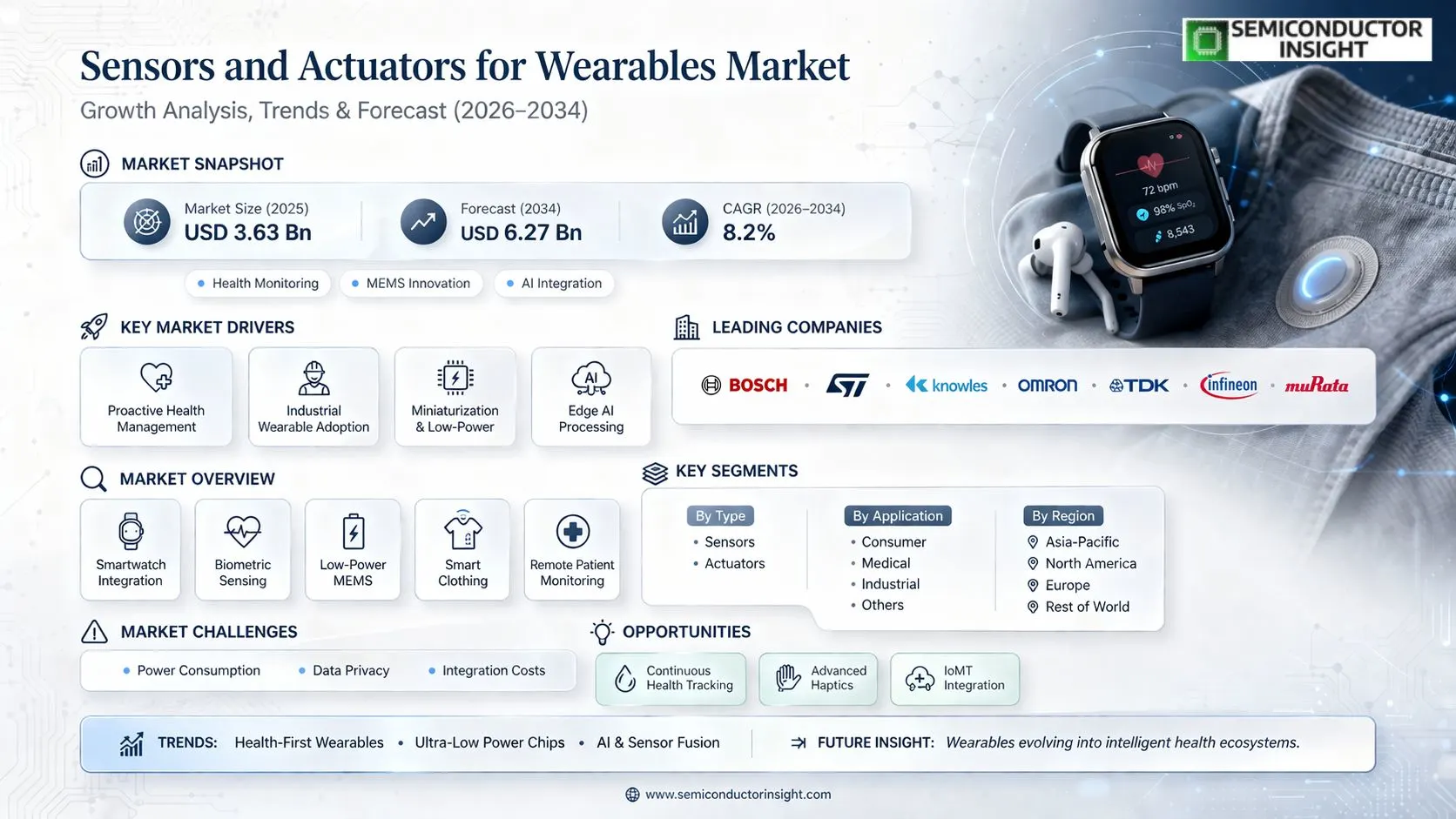
Global Sensors and Actuators for Wearables market size was valued at USD 3.63 billion in 2025. The market is projected to grow from USD 3.92 billion in 2026 to USD 6.27 billion by 2034, exhibiting a CAGR of 8.2% during the forecast period.
Sensors and actuators for wearables are crucial components that enable these devices to monitor and interact with the user’s body and environment. These components encompass a wide range of technologies, including inertial measurement units (IMUs), optical heart rate sensors, temperature sensors, microphones, haptic feedback actuators, and micro-electromechanical systems (MEMS). They are fundamental to the functionality of smartwatches, fitness trackers, smart clothing, and medical monitoring devices.
The market is experiencing robust growth due to several factors, including rising consumer health awareness driving demand for fitness trackers and the increasing adoption of remote patient monitoring systems in healthcare. Furthermore, advancements in miniaturization and power efficiency of MEMS technology are enabling more sophisticated wearable applications. Initiatives by key players are also expected to fuel market growth. For instance, in recent developments, companies like STMicroelectronics continue to launch ultra-low-power sensor solutions tailored for always-on wearable applications. Bosch Sensortec, STMicroelectronics N.V., Knowles Corporation, TDK Corporation (InvenSense), and Infineon Technologies AG are some of the key players that operate in the market with a wide range of portfolios.
MARKET DRIVERS
Consumer Demand for Proactive Health Management
The Sensors and Actuators for Wearables Market is primarily driven by a global shift towards preventive healthcare. Consumers are increasingly adopting smartwatches and fitness bands to monitor vital signs like heart rate, blood oxygen, and sleep patterns. This demand compels manufacturers to integrate more advanced, miniaturized sensors to provide clinical-grade data, encouraging continuous innovation and market growth.
Expansion of Industrial and Enterprise Applications
Beyond consumer electronics, wearables are gaining significant traction in enterprise environments. In sectors like manufacturing, logistics, and healthcare, wearable devices equipped with motion sensors, environmental sensors, and haptic actuators are used for worker safety, asset tracking, and augmented reality training. This diversification of application areas significantly expands the total addressable market for sensor and actuator components.
➤ Continuous technological miniaturization and the development of low-power consumption chips are fundamental enablers, allowing for more complex sensor fusion and longer device battery life, which directly enhances user adoption rates.
Furthermore, the integration of Artificial Intelligence for real-time data processing on the device, known as edge AI, is creating a new wave of smart wearables. This trend necessitates more sophisticated sensor arrays and precise actuators to enable responsive and context-aware functionalities, pushing the Sensors and Actuators for Wearables Market toward higher-value components.
MARKET CHALLENGES
Technical and Design Constraints
A primary challenge in the Sensors and Actuators for Wearables Market is the inherent trade-off between performance, size, and power efficiency. Developing sensors that are accurate, durable, and small enough for comfortable wearables requires significant R&D investment. Similarly, designing effective actuators for haptic feedback in a tiny form factor without draining the battery remains a complex engineering hurdle.
Other Challenges
Data Privacy and Security Concerns
Wearables collect vast amounts of personal biometric and location data. Ensuring this data is encrypted and stored securely is paramount. Breaches or misuse of data can lead to severe reputational damage for brands and erode consumer trust, potentially stifling market growth for the Sensors and Actuators for Wearables Market.
High Development and Integration Costs
The cost of advanced micro-electromechanical systems (MEMS) sensors and precision actuators can be high, impacting the final price of wearable devices. For mass-market adoption, achieving cost-effective integration of these components without compromising quality is a persistent challenge for OEMs.
MARKET RESTRAINTS
Regulatory Hurdles and Certification Delays
Wearables making health claims face stringent regulatory scrutiny from bodies like the FDA or CE. The process of certifying new sensor technologies for medical accuracy is lengthy and expensive. This can delay product launches and increase time-to-market, acting as a significant restraint for the Sensors and Actuators for Wearables Market, particularly for startups and innovators.
Market Saturation and Consumer Upgrade Cycles
The consumer smartwatch and fitness tracker segment is showing signs of maturity in several regions. As the market saturates, growth becomes more dependent on replacement cycles rather than first-time purchases. This can lead to reduced volumes of sensor shipments unless new, compelling features driven by novel sensor or actuator technology reinvigorate consumer demand.
MARKET OPPORTUNITIES
Growth of Continuous Health Monitoring
There is a substantial opportunity in developing non-invasive, continuous monitoring sensors for conditions like glucose, blood pressure, and hydration. Successfully commercializing such technologies would transition wearables from fitness tools to essential health management devices, opening a massive new segment within the Sensors and Actuators for Wearables Market.
Advancements in Haptic Feedback and Soft Robotics
The next frontier for actuators in wearables lies in advanced haptics and soft robotics. Innovations in materials science are leading to actuators that can provide more nuanced tactile feedback or even gentle physical assistance. This has profound implications for immersive AR/VR experiences, rehabilitation devices, and next-generation human-computer interfaces, creating lucrative new avenues for market expansion.
Integration with the Internet of Medical Things (IoMT)
The convergence of wearables with the broader IoMT ecosystem presents a significant opportunity. Sensors and actuators will act as critical data nodes, feeding information into secure cloud platforms for AI-driven analysis by healthcare providers. This trend demands reliable, interoperable, and secure components, driving demand for higher-specification sensors and fostering partnerships across the healthcare technology value chain.
Primary and Emerging () Trends
Convergence Towards Health-First Wearables
The shift from basic fitness tracking to advanced medical-grade monitoring is a dominant trend in the Sensors and Actuators for Wearables Market. Devices are increasingly incorporating multiple biometric sensors, such as those for continuous glucose monitoring, blood pressure, and blood oxygen saturation, to serve both consumer health and professional healthcare applications. This necessitates high-accuracy sensors and reliable actuators for functions like haptic alerts. Major manufacturers are focusing on developing integrated sensor modules that provide clinical-grade data, pushing the market toward solutions that can be utilized in remote patient monitoring and disease management protocols. This trend is significantly driven by the demand within the medical wearables segment, which requires stringent reliability and data integrity. Advances in sensor fusion, which combine inputs from various sensors to improve accuracy, are central to this evolution, enabling more sophisticated health insights from compact wearable form factors.
Other Trends
Miniaturization and Power Efficiency
Ongoing innovation is centered around making sensors and actuators smaller, more power-efficient, and capable of operating at lower voltages. This is critical for extending battery life in wearables like smartwatches and hearables, and for enabling new product categories such as smart rings and skin patches. The market is seeing a rise in the development of micro-electromechanical systems (MEMS)-based components, which allow for this scaling. Actuators, particularly linear resonant actuators (LRAs) for haptic feedback, are also being optimized for minimal power consumption while delivering precise tactile sensations. This drive for efficiency is essential for improving user adoption by eliminating frequent charging as a key pain point. The focus on energy harvesting technologies, which allow sensors to draw power from body heat or motion, further supports this trend toward autonomy and sustainability in the Sensors and Actuators for Wearables Market.
Enhanced Haptic Feedback and Immersive Interfaces
Beyond health monitoring, there is a growing trend to improve user experience through advanced haptic actuators and environmental sensors. Wearables are moving towards more nuanced and expressive haptic feedback, moving from simple vibration to simulating textures and directional cues, which is vital for augmented and virtual reality applications. Simultaneously, wearables are integrating more actuators that interact with the user’s environment, such as micro-pumps for drug delivery in medical devices or micro-valves in smart fabrics. This progression enhances the interactive capabilities of wearables, transforming them from passive monitors to active tools for user engagement and intervention. This evolution is expanding the market’s scope, with industrial wearables adopting ruggedized sensors and actuators for safety alerts and operational feedback in demanding environments.
COMPETITIVE LANDSCAPE
Key Industry Players
A Market Driven by Established Semiconductor Giants and Specialized Component Suppliers
The market for sensors and actuators in wearables is characterized by a high degree of consolidation, with a few global semiconductor leaders commanding a dominant revenue share. In 2025, the top five players collectively held a significant portion of the market. Key players like STMicroelectronics, Infineon, and Bosch leverage their extensive portfolios in micro-electromechanical systems (MEMS), inertial measurement units (IMUs), and environmental sensors, securing long-term design wins in high-volume consumer wearables such as smartwatches and fitness trackers. This market structure is defined by intense competition on miniaturization, power efficiency, and integration, with R&D investments acting as a critical barrier to entry for new players.
Beyond the broad-based semiconductor leaders, several companies have successfully carved out strategic niches. Knowles and Sonion are pivotal in providing high-performance acoustic components for hearables and advanced audio wearables. Companies like Omron and TDK focus on specialized sensing solutions, particularly for medical and healthcare wearables where accuracy and reliability are paramount. Niche innovators and regional suppliers, such as AMS (ams OSRAM) with its optical sensor expertise and Murata with its broad component capabilities, add further depth and competitive pressure to the landscape, catering to specific application segments like industrial wearables and smart clothing.
List of Key Sensors and Actuators for Wearables Companies Profiled
- Robert Bosch GmbH
- STMicroelectronics N.V.
- Knowles Corporation
- Omron Corporation
- ams-OSRAM AG (AMS)
- Goermicro (Gioermicro)
- Sonion
- Zilltek Technology Corp.
- TDK Corporation
- Infineon Technologies AG
- AAC Technologies Holdings Inc.
- Murata Manufacturing Co., Ltd.
- TE Connectivity
- NXP Semiconductors N.V.
- Analog Devices, Inc.
Segment Analysis:
| Segment Category | Sub-Segments | Key Insights |
| By Type |
|
Sensors represent the fundamental and leading category, serving as the primary data-gathering modules that enable wearable functionality. This dominance is driven by the critical need for continuous, passive data collection on biometrics and environment across all wearable forms. Key factors include the proliferation of health and fitness tracking features, which demand a suite of sensors including accelerometers, gyroscopes, and heart rate monitors. Furthermore, sensor miniaturization and advancements in power efficiency are consistently prioritized by device manufacturers to enhance user experience and battery life. The development of new sensing modalities, such as those for blood glucose or advanced sleep monitoring, continues to expand the technological frontier and application scope for this segment. |
| By Application |
|
Consumer Wearables is the leading and most dynamic application segment, fueled by massive consumer adoption of smartwatches, fitness bands, and hearables. The segment’s growth is anchored in a powerful cycle of technological innovation and lifestyle integration, where new sensor capabilities drive consumer desire for more personalized health and activity data. This mass-market demand compels component manufacturers to focus on cost-effective, high-volume production while pushing for greater integration and multifunctionality in single components. The evolution from basic step counting to comprehensive wellness platforms with stress monitoring and oxygen saturation measurement illustrates the segment’s role as a primary driver for technological advancement and component specification in the broader market. |
| By End User |
|
Individual Consumers constitute the dominant end-user group, shaping market trends through their preferences for connectivity, design, and health insights. Their purchasing decisions directly influence OEM product roadmaps, placing a premium on user-centric features like comfort, long battery life, and seamless smartphone integration. This drives component innovation towards ultra-compact form factors and low power consumption. The increasing consumer health consciousness transforms wearables from gadgets into essential wellness tools, creating sustained demand for more accurate and diverse sensors. As consumers become more data-literate, the expectation for actionable insights from sensor data further pushes the need for sophisticated on-device processing and algorithm development, influencing the entire supply chain. |
| By Function |
|
Biometric Monitoring functions represent the leading and fastest-evolving category, as they deliver the core value proposition for most modern wearables. The focus on preventative health and personalized wellness has made continuous, non-invasive monitoring of vital signs like heart rate, temperature, and blood oxygen a critical battleground for device differentiation. This demand fuels intense R&D into new sensing technologies that can deliver clinical-grade accuracy in a consumer form factor. The integration of multiple biometric sensors into a single, cohesive health dashboard is a key trend, requiring sophisticated sensor fusion algorithms. This segment’s growth is tightly linked to regulatory trends and the gradual blurring of lines between consumer wellness and medically validated data collection. |
| By Wearable Form Factor |
|
Wrist-Worn Devices, including smartwatches and fitness bands, are the undisputed leading form factor, acting as the central hub for wearable technology. Their prominent market position is due to the optimal balance they offer between user accessibility, sufficient surface area for multiple sensors, and social acceptability. This form factor sets the standard for component integration, demanding that sensors and actuators be miniaturized to fit within a confined, stylish enclosure without sacrificing performance. The wrist’s unique position on the body allows for reliable collection of certain biometric data, such as heart rate through photoplethysmography (PPG). Consequently, innovation in sensors for wrist-worn devices often defines the technological capabilities for the entire wearable ecosystem, pushing the boundaries of what is possible in continuous, on-body monitoring. |
Regional Analysis: Sensors and Actuators for Wearables Market
Asia-Pacific
The region’s unparalleled electronics manufacturing infrastructure provides a critical advantage for the sensors and actuators for wearables market. It enables economies of scale, swift prototyping, and integration of components from local suppliers, reducing lead times and costs for global wearable brands.
Rapid urbanization, increasing health consciousness, and high smartphone penetration have created a fertile ground for wearable adoption. This massive, addressable market demands continuous innovation in biometric sensors and compact haptic actuators to satisfy discerning consumer preferences.
Strong investments in R&D, particularly in South Korea and Japan, are focused on next-generation micro-electromechanical systems (MEMS) for sensors and actuators for wearables. Research is geared towards improving energy efficiency, accuracy, and developing novel form factors for future wearable applications.
Supportive government policies promoting domestic semiconductor production and digital health initiatives are key catalysts. These frameworks encourage local sourcing of components and create pilot markets for medical-grade sensors and actuators integrated into wearable health devices.
North America
North America is a critical market defined by high-value innovation and early adoption of premium wearable technologies. The presence of leading technology firms and a strong venture capital ecosystem drives the development of sophisticated sensors and actuators for wearables, particularly for health and fitness applications. The market is characterized by stringent regulatory standards for medical devices, pushing for highly accurate and reliable sensor technologies. Demand is fueled by a consumer base willing to pay for advanced features and an established healthcare infrastructure exploring remote patient monitoring solutions using wearable sensors.
Europe
Europe maintains a strong position in the sensors and actuators for wearables market, anchored by robust engineering expertise and a focus on quality, privacy, and specialized applications. The region excels in high-precision sensor manufacturing for industrial and healthcare wearables, with a particularly strong emphasis on data security compliant with GDPR. Collaborative research initiatives between academia and industry are common, fostering innovation in areas like flexible sensors and energy-harvesting actuators. Consumer demand is steady, with a notable trend towards wearables that offer both lifestyle and clinical-grade health insights.
South America
The South American market for sensors and actuators for wearables is in a growth phase, primarily driven by increasing smartphone penetration and a growing middle class adopting entry-level and mid-tier fitness trackers and smartwatches. Market dynamics are influenced by economic fluctuations and import dependencies, but local assembly is gradually increasing. The focus is on cost-competitive sensor solutions, with potential for growth in health-oriented wearables as digital health awareness rises, though adoption of high-end components remains limited compared to more mature markets.
Middle East & Africa
This region presents a diverse and emerging landscape for the sensors and actuators for wearables market. Growth is concentrated in affluent Gulf Cooperation Council (GCC) countries, where there is high demand for luxury and high-tech wearables, driving imports of advanced components. In other parts, the market is nascent but expanding, with potential linked to mobile health initiatives and basic activity tracking. Overall growth is challenged by varying economic conditions but supported by increasing digitalization and health awareness, pointing towards gradual market development.
Report Scope
This market research report provides a comprehensive analysis of the Sensors and Actuators for Wearables Market , covering the forecast period 2026–2034. It offers detailed insights into market dynamics, technological advancements, competitive landscape, and key trends shaping the industry.
Key focus areas of the report include:
- Market Overview: The report begins with an overview outlining its current market scenario, key growth indicators, and industry transformation drivers. It discusses macroeconomic factors, demand–supply balance, regulatory landscape, and the strategic role of sensors and actuators in powering advancements across wearable form factors such as smartwatches, fitness trackers, smart clothing, and medical devices.
- Market Size & Forecast: Historical data and future projections for revenue, unit shipments, and market value across major regions and segments.
- Segmentation Analysis: Detailed breakdown by product type (Sensors/Actuators), technology, application, and end-use industry to identify high-growth segments and investment opportunities.
- Regional Insights: Insights into market performance across North America, Europe, Asia-Pacific, Latin America, and the Middle East & Africa, including country-level analysis where relevant.
- Competitive Landscape: Profiles of leading market participants, including their product offerings, R&D focus, manufacturing capacity, pricing strategies, and recent developments such as mergers, acquisitions, and partnerships.
- Technology Trends & Innovation: Assessment of emerging technologies, integration of AI/IoT, miniaturization trends, fabrication techniques, and evolving industry standards for wearable integration.
- Market Drivers & Restraints: Evaluation of factors driving market growth along with challenges, supply chain constraints, regulatory issues, and market-entry barriers.
- Stakeholder Insights: Insights for component suppliers, OEMs, system integrators, investors, and policymakers regarding the evolving ecosystem and strategic opportunities.
Primary and secondary research methods are employed, including interviews with industry experts, data from verified sources, and real-time market intelligence to ensure the accuracy and reliability of the insights presented.
FREQUENTLY ASKED QUESTIONS:
What is the current market size of Sensors and Actuators for Wearables Market?
-> Global Sensors and Actuators for Wearables Market was valued at USD 3,629 million in 2025 and is projected to reach USD 6,274 million by 2034, at a CAGR of 8.2% during the forecast period.
Which key companies operate in Sensors and Actuators for Wearables Market?
-> Key players include Bosch, STMicroelectronics, Knowles, Omron, AMS, Gioermicro, Sonion, Zilltek, TDK, Infineon, AAC, and Murata, among others.
What are the key growth drivers?
-> Key growth drivers include rising adoption of smartwatches and fitness trackers, increasing demand for medical and health monitoring wearables, technological advancements in sensor miniaturization, and the integration of AI/IoT for real-time feedback.
Which region dominates the market?
-> The market is analyzed across regions including North America, Europe, Asia, South America, and Middle East & Africa. The U.S. and China are key country-level markets within this global landscape.
What are the emerging trends?
-> Emerging trends include expansion into smart clothing and industrial wearable applications, development of highly integrated and power-efficient sensor modules, and the growing focus on continuous health monitoring and predictive analytics.

Get Sample Report PDF for Exclusive Insights
Report Sample Includes
- Table of Contents
- List of Tables & Figures
- Charts, Research Methodology, and more...
 Download Sample Report PDF