MARKET INSIGHTS
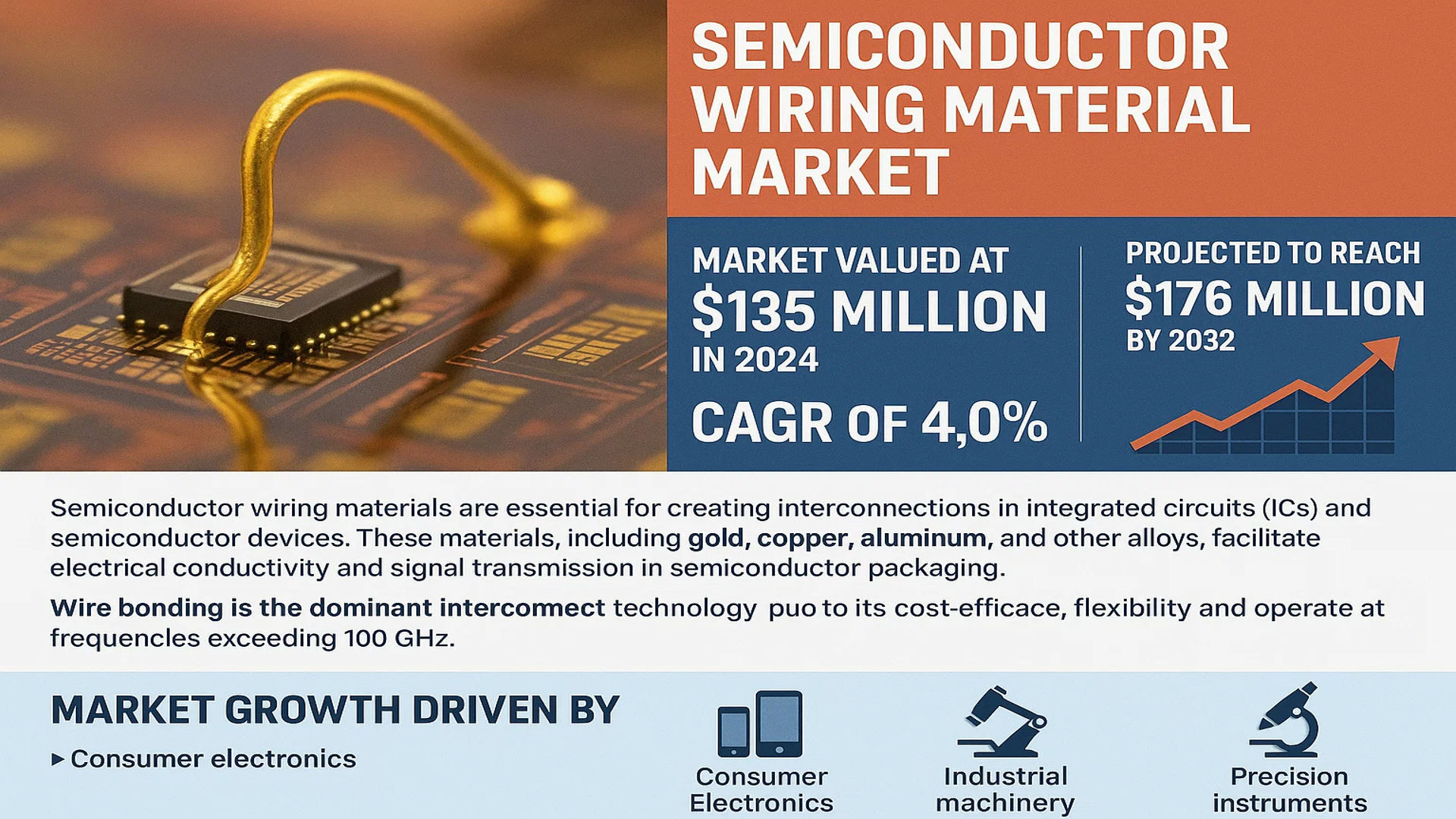
The global Semiconductor Wiring Material Market was valued at 135 million in 2024 and is projected to reach US$ 176 million by 2032, at a CAGR of 4.0% during the forecast period.
Semiconductor wiring materials are essential for creating interconnections in integrated circuits (ICs) and semiconductor devices. These materials, including gold, copper, aluminum, and other alloys, facilitate electrical conductivity and signal transmission in semiconductor packaging. Wire bonding remains the dominant interconnect technology due to its cost-effectiveness, flexibility, and ability to operate at frequencies exceeding 100 GHz.
Market growth is driven by increasing demand for advanced semiconductor packaging, particularly in consumer electronics, industrial machinery, and precision instruments. While copper dominates due to its superior conductivity and cost efficiency, gold wiring remains critical for high-reliability applications. The broader semiconductor industry, valued at USD 579 billion in 2022 and projected to reach USD 790 billion by 2029, further amplifies demand. Key players like Heraeus, Applied Materials, and Alpha Wire are expanding their portfolios to address emerging needs in IoT and automotive applications.
MARKET DYNAMICS
MARKET DRIVERS
Rising Demand for Advanced Semiconductor Packaging to Accelerate Market Growth
The global semiconductor wiring material market is experiencing robust growth, driven primarily by the increasing demand for advanced semiconductor packaging solutions. As semiconductor devices become smaller yet more powerful, the need for high-performance wiring materials that can support finer pitches and higher frequencies has surged. Wire bonding remains the dominant interconnection technology, accounting for over 60% of all semiconductor packaging connections worldwide. The growing adoption of heterogeneous integration and 3D packaging techniques is further propelling the demand for specialized wiring materials with superior electrical and thermal properties.
Proliferation of IoT and 5G Devices to Fuel Semiconductor Wiring Demand
The rapid expansion of IoT applications and 5G network deployments is creating substantial demand for semiconductor wiring materials. With over 30 billion IoT devices expected to be in operation globally by 2025, the need for reliable interconnect solutions in sensors, RF components, and power management ICs has grown exponentially. 5G infrastructure requires advanced semiconductor packages that can operate at millimeter-wave frequencies, driving innovation in copper and gold bonding wires that minimize signal loss at high frequencies. This technological transition presents significant opportunities for materials that can meet the stringent performance requirements of next-generation communication devices.
Automotive Electrification Trends to Drive Specialized Wiring Solutions
The automotive industry’s shift toward electrification is creating new demands for semiconductor wiring materials capable of withstanding harsh operating conditions. Modern electric vehicles contain semiconductor components valued at nearly $1,000 per vehicle, nearly double that of conventional automobiles. These components require wiring materials that can maintain reliability under high current loads, vibration, and extreme temperatures. The growing adoption of advanced driver assistance systems (ADAS) and autonomous driving technologies is further increasing the semiconductor content in vehicles, with wiring materials playing a critical role in ensuring signal integrity and power delivery.
MARKET CHALLENGES
Volatile Raw Material Prices to Create Cost Pressures
While the semiconductor wiring material market shows strong growth potential, it faces significant challenges from fluctuating raw material prices. Gold, which accounts for approximately 25-30% of high-end bonding wire production costs, has experienced price volatility exceeding 15% annually in recent years. Copper prices, while generally more stable, remain subject to global market dynamics that can impact production costs. These fluctuations create pricing challenges for manufacturers who must balance cost competitiveness with the need to maintain stringent quality standards required by semiconductor applications.
Technical Hurdles in Advanced Packaging Applications
The industry faces increasing technical challenges as wire bonding dimensions continue to shrink. Bonding wire diameters below 15 microns present significant manufacturing and reliability challenges, requiring materials with exceptional purity and consistency. The transition to ultra-fine pitch bonding (below 40 microns) demands wires with precise mechanical properties to prevent wire sweep during encapsulation. Additionally, the thermal management requirements of high-power devices are pushing materials to their performance limits, necessitating continuous innovation in alloy compositions and wire geometries.
MARKET RESTRAINTS
Alternative Interconnect Technologies to Limit Growth Potential
The semiconductor wiring material market faces competitive pressure from alternative interconnect technologies that threaten to displace traditional wire bonding in certain applications. Flip-chip technologies currently account for about 30% of semiconductor interconnects and are gaining traction in high-performance applications. The development of advanced through-silicon via (TSV) technologies and wafer-level packaging approaches may further erode the wire bonding market share, particularly in memory and high-end processor applications where density and performance requirements exceed conventional wire bonding capabilities.
Stringent Quality Requirements to Increase Production Costs
The semiconductor industry’s exacting quality standards act as a significant restraint on wiring material suppliers. The transition to smaller technology nodes and more complex package designs requires wires that meet increasingly stringent specifications for surface finish, mechanical properties, and metallurgical consistency. These requirements drive up production costs through the need for sophisticated quality control systems and specialized manufacturing equipment. For many suppliers, the capital expenditures required to maintain competitiveness in advanced wire bonding materials can represent a substantial barrier to market entry or expansion.
MARKET OPPORTUNITIES
Emerging Materials Technologies to Open New Application Areas
Significant opportunities exist for wiring material suppliers to capitalize on emerging material technologies. The development of advanced alloy wires combining gold, copper, and palladium offers improved performance characteristics for high-frequency applications. Silver-coated copper wires are gaining traction as a potential alternative to pure gold wires in certain applications, offering cost savings while maintaining good electrical performance. Research into nanostructured wires and composite materials may yield breakthrough solutions that combine the conductivity of copper with the oxidation resistance of more expensive noble metals.
Regional Manufacturing Expansion to Create Local Supply Opportunities
The semiconductor industry’s geographic diversification presents new opportunities for wiring material suppliers. With major semiconductor manufacturers investing over $200 billion in new fabrication facilities across North America, Europe, and Asia, local supply chains are being rebuilt to support these operations. This trend creates openings for material suppliers to establish regional production capabilities and forge closer relationships with semiconductor manufacturers seeking to reduce supply chain risks. The emphasis on supply chain resilience may benefit companies that can demonstrate localized production capacity and rapid response capabilities.
SEMICONDUCTOR WIRING MATERIAL MARKET TRENDS
Growing Demand for High-Performance Semiconductor Packaging Drives Market Growth
The semiconductor wiring material market is experiencing significant growth, driven by the increasing demand for high-performance semiconductor packaging in consumer electronics, industrial machinery, and precision instruments. Wire bonding remains the dominant interconnect technology, accounting for over 80% of semiconductor packaging applications due to its cost-effectiveness and flexibility. With the semiconductor market projected to grow from $579 billion in 2022 to $790 billion by 2029, the demand for advanced wiring materials like gold, copper, and aluminum continues to rise. The transition toward finer pitch wire bonding and high-frequency applications has further accelerated the need for materials with superior electrical conductivity and thermal stability.
Other Trends
Shift Toward Copper and Aluminum in Wire Bonding
While gold remains a traditional choice for wire bonding due to its excellent conductivity and corrosion resistance, the market is witnessing a steady shift toward copper and aluminum alternatives. Copper, in particular, offers superior electrical performance at a lower cost and is increasingly being adopted in power semiconductor devices. However, challenges such as oxidation and bonding reliability persist, leading to ongoing material innovations. Aluminum, on the other hand, is gaining traction in applications requiring fine-pitch bonding, driven by its compatibility with advanced semiconductor packaging techniques like fan-out wafer-level packaging (FOWLP).
Expansion of 5G and IoT Applications Boosts Semiconductor Wiring Demand
The rapid expansion of 5G networks and IoT-enabled devices is creating new opportunities for semiconductor wiring materials. High-performance processors and analog ICs used in 5G base stations and IoT sensors require reliable interconnects capable of handling higher frequencies. For instance, RF components in 5G infrastructure demand wiring materials with low signal loss and high durability. The integration of AI-powered automation in semiconductor manufacturing is also enhancing production efficiency, leading to optimized material usage and reduced waste. As the demand for connectivity solutions grows, semiconductor wiring materials will continue to evolve to meet stringent performance requirements.
COMPETITIVE LANDSCAPE
Key Industry Players
Strategic Collaborations and Technological Advancements Drive Market Competition
In the global Semiconductor Wiring Material Market, the competitive landscape reflects a dynamic mix of established corporations and niche players vying for market share through innovation and operational efficiency. The market is characterized by a high level of technological expertise, with leading companies investing heavily in R&D to enhance wire bonding performance, particularly in high-frequency applications. Firms compete not only on product quality but also on delivery reliability, traceability, and compliance with stringent industry standards.
Heraeus and Applied Materials currently dominate the market for semiconductor wiring materials, leveraging their extensive material science expertise and vertically integrated supply chains. Both companies have consistently increased their market presence through strategic acquisitions and partnerships with foundries. Meanwhile, TATSUTA Electric Wire & Cable Co., Ltd. maintains strong positioning in the Asian market through cost-competitive copper bonding wire solutions that cater to mass production requirements.
Several emerging trends are reshaping competition in the space, including the shift from gold to copper bonding wires due to material cost advantages and superior electrical conductivity. While gold wires still account for approximately 48% of the market by volume (2024 data), copper adoption continues to grow at a 6.2% CAGR, prompting companies to adjust their production capabilities. Manufacturers are also exploring hybrid solutions that combine different wire materials to optimize performance across diverse semiconductor applications.
Notably, the competitive intensity varies by region – with Helukabel and ALPHANY Co., Ltd. showing particular strength in European automotive semiconductor applications, while BizLink Group captures significant share in North American data center and networking segments. This geographical specialization allows mid-sized players to compete effectively against larger multinationals by focusing on specific application verticals.
List of Key Semiconductor Wiring Material Companies Profiled
- Heraeus (Germany)
- Applied Materials (U.S.)
- TATSUTA Electric Wire & Cable Co., Ltd. (Japan)
- Helukabel (Germany)
- ALPHANY Co.,Ltd (South Korea)
- BizLink Group (U.S.)
- KSM Electronics (U.S.)
- Wire & Cable Assemblies (U.S.)
- Omron Automation (Japan)
- MC Electronics (Taiwan)
- HYBOND, Inc. (U.S.)
- Soulbrain (South Korea)
- GORE (U.S.)
- Alpha Wire (U.S.)
Segment Analysis:
By Type
Copper Wiring Holds the Largest Share Owing to its Cost-Effectiveness and High Conductivity
The market is segmented based on type into:
- Gold
- Copper
- Aluminum
- Other
By Application
Consumer Electronics Segment Leads Due to Expanding Smartphone and IoT Device Production
The market is segmented based on application into:
- Consumer Electronics
- Industrial Machinery
- Precision Instruments
- Others
By Technology
Wire Bonding Technology Dominates Semiconductor Packaging Applications
The market is segmented based on technology into:
- Wire Bonding
- Flip Chip
- Through-Silicon Via (TSV)
- Others
By End-User
Semiconductor Manufacturers Account for the Bulk of Demand
The market is segmented based on end-user into:
- Semiconductor Manufacturers
- Electronic Component Suppliers
- Research Institutions
- Others
Regional Analysis: Semiconductor Wiring Material Market
Asia-Pacific
The Asia-Pacific region dominates the global Semiconductor Wiring Material Market, accounting for the largest market share due to its thriving semiconductor manufacturing ecosystem. Countries like China, Taiwan, South Korea, and Japan lead in semiconductor production, with China contributing over 50% of the global semiconductor packaging market. The region’s growth is driven by massive investments in chip fabrication plants (fabs) and increasing demand for consumer electronics, automotive semiconductors, and IoT devices. Taiwan Semiconductor Manufacturing Company (TSMC) and Samsung Electronics significantly influence wiring material adoption trends. While copper remains dominant due to cost efficiency, advanced packaging technologies like fan-out wafer-level packaging (FOWLP) are increasing demand for specialized gold bonding wires in high-performance applications.
North America
North America maintains strong technological leadership in semiconductor wiring materials, particularly in R&D of advanced interconnect solutions. The U.S. accounts for 42% of global semiconductor design activity, driving demand for high-purity gold and copper materials in precision applications. Major players like Applied Materials and Alpha Wire are innovating in ultra-fine bonding wires for 5G and AI chips. The CHIPS and Science Act’s $52 billion funding injection is accelerating domestic semiconductor manufacturing capacity, which will significantly increase wiring material consumption. However, stricter environmental regulations on mining and material processing present supply chain challenges for raw material sourcing.
Europe
Europe’s semiconductor wiring material market focuses on high-reliability applications in automotive and industrial sectors, with Germany and France as key consumers. The EU’s Chips Act aims to double Europe’s semiconductor market share to 20% by 2030, creating opportunities for wiring material suppliers. Strict EU RoHS directives push manufacturers toward lead-free and environmentally sustainable materials. Companies like Heraeus and Helukabel are leaders in developing alloy wires that balance performance with regulatory compliance. The region shows growing adoption of aluminum wires in power semiconductor devices, though at a slower pace compared to other regions due to conservative automotive supply chains.
South America
South America represents a developing market with Brazil and Argentina showing gradual growth in semiconductor assembly. The focus remains primarily on conventional copper and aluminum wiring for consumer electronics assembly. Limited local semiconductor production means most wiring materials are imported, subject to volatile currency exchange rates. Recent trade agreements are improving access to Asian-sourced materials. While the market remains small compared to other regions, increasing smartphone penetration and automotive electronics present long-term growth opportunities.
Middle East & Africa
The MEA semiconductor wiring material market is in early stages, with growth concentrated in Israel’s emerging semiconductor design sector and UAE’s electronics manufacturing zones. South Africa shows potential as an assembly hub for automotive electronics. The region faces challenges including limited local expertise and dependence on imported materials. However, strategic investments in technology parks and free zones, coupled with growing 5G infrastructure projects, are expected to drive gradual market expansion over the next decade, particularly for copper-based wiring solutions.
Report Scope
This market research report provides a comprehensive analysis of the global Semiconductor Wiring Material market, covering the forecast period 2024–2032. It offers detailed insights into market dynamics, technological advancements, competitive landscape, and key trends shaping the industry.
Key focus areas of the report include:
- Market Size & Forecast: Historical data and future projections for revenue, unit shipments, and market value across major regions and segments. The global market was valued at USD 135 million in 2024 and is projected to reach USD 176 million by 2032, growing at a CAGR of 4.0%.
- Segmentation Analysis: Detailed breakdown by material type (gold, copper, aluminum, others) and application (consumer electronics, industrial machinery, precision instruments, others) to identify high-growth segments.
- Regional Outlook: Insights into market performance across North America, Europe, Asia-Pacific, Latin America, and the Middle East & Africa, with Asia-Pacific dominating the market share.
- Competitive Landscape: Profiles of 14 leading market participants including Helukabel, Heraeus, Applied Materials, and Omron Automation, covering their product portfolios and strategic initiatives.
- Technology Trends & Innovation: Analysis of wire bonding technologies operating at frequencies above 100 GHz and emerging interconnect solutions for advanced semiconductor packaging.
- Market Drivers & Restraints: Evaluation of factors including IoT proliferation, semiconductor industry growth (projected to reach USD 790 billion by 2029), and supply chain challenges.
- Stakeholder Analysis: Strategic insights for material suppliers, semiconductor manufacturers, and investors regarding the evolving market ecosystem.
The report employs primary and secondary research methodologies, including interviews with industry experts and analysis of verified market data, to ensure accuracy and reliability.
FREQUENTLY ASKED QUESTIONS:
What is the current market size of Global Semiconductor Wiring Material Market?
-> Semiconductor Wiring Material Market was valued at 135 million in 2024 and is projected to reach US$ 176 million by 2032, at a CAGR of 4.0% during the forecast period.
Which key companies operate in Global Semiconductor Wiring Material Market?
-> Key players include Helukabel, Heraeus, Applied Materials, Omron Automation, GORE, and Alpha Wire, among others.
What are the key growth drivers?
-> Key growth drivers include rising semiconductor demand (projected 6% CAGR through 2029), IoT expansion, and advancements in wire bonding technologies.
Which region dominates the market?
-> Asia-Pacific holds the largest market share, driven by semiconductor manufacturing hubs in China, Japan, and South Korea.
What are the emerging trends?
-> Emerging trends include adoption of copper wiring for cost efficiency, development of ultra-high frequency solutions, and integration with advanced packaging technologies.

Get Sample Report PDF for Exclusive Insights
Report Sample Includes
- Table of Contents
- List of Tables & Figures
- Charts, Research Methodology, and more...
 Download Sample Report PDF