Semiconductor Thermostat Market Insights
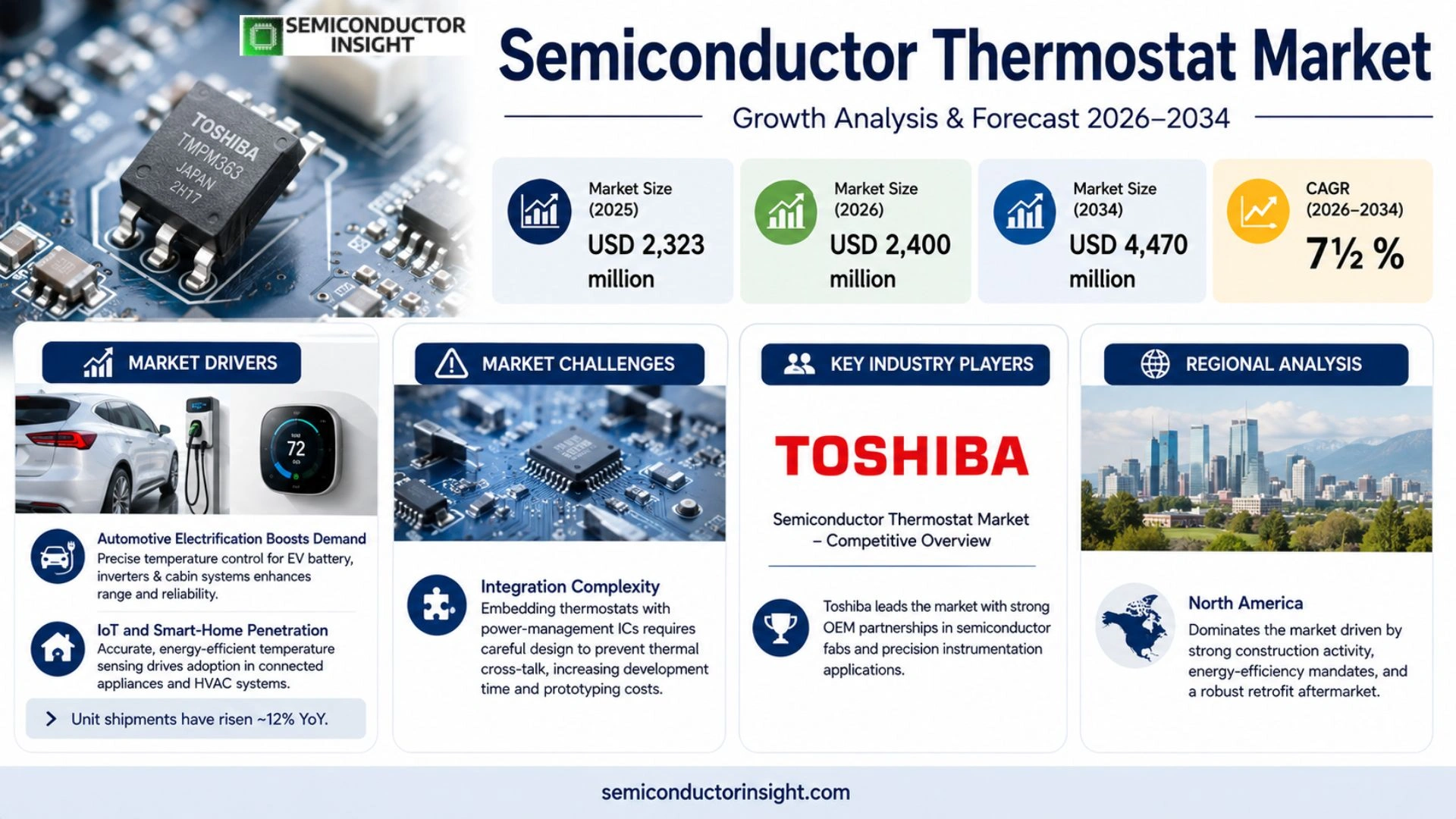
Semiconductor Thermostat market size was valued at USD 2,323 million in 2025. The market is projected to grow from USD 2,400 million in 2026 to USD 4,470 million by 2034, exhibiting a CAGR of approximately 7½ percent during the forecast period.
A semiconductor thermostat is a precision temperature‑control device that relies on thermoelectric effects,principally the Peltier effect,to provide both cooling and heating through accurate regulation of electrical current and power. Compared with traditional compressor‑based systems or single‑mode heaters, these thermostats deliver a compact form factor, rapid response time, high temperature‑control accuracy, vibration‑free operation, straightforward integration and reduced maintenance needs.
The sector’s expansion stems from several intertwined forces: upgrades in semiconductor manufacturing equipment demand tighter thermal management; the rise of precision instrumentation across optics, biomedical and laboratory markets creates new application niches; and localization efforts for high‑end instruments boost regional procurement volumes. Moreover, recent product launches emphasizing wider operating temperature ranges, improved energy efficiency and intelligent control algorithms have reinforced customer preference for semiconductor thermostats over legacy solutions.
MARKET DRIVERS
Automotive Electrification Boosts Demand
The shift toward electric power‑train architectures has created a fertile environment for Semiconductor Thermostat Market. Modern EVs rely on precise temperature regulation for battery packs, power inverters, and cabin climate systems. Semiconductor thermostats deliver the rapid response and low power draw required, enabling manufacturers to squeeze additional range and reliability from their platforms.
IoT and Smart‑Home Penetration
Connected devices now account for more than 40 % of new appliance launches, and each unit integrates a temperature sensor that must be both accurate and energy‑efficient. Semiconductor thermostats meet these criteria, driving adoption in smart thermostats, refrigerators, and HVAC controllers. The resulting volume uplift is evident in the fact that unit shipments have risen by roughly 12 % year‑over‑year.
➤ Manufacturers cite a 15‑20 % reduction in board space when swapping discrete thermistors for integrated semiconductor solutions, directly influencing design cycles and cost structures.
Beyond automotive and IoT, the rise of edge‑computing nodes in industrial settings demands robust thermal management. Semiconductor thermostats, with their programmable set‑points and self‑diagnostic capabilities, allow operators to maintain optimal performance without manual intervention, reinforcing the overall growth narrative of the market.
Regulatory Push for Energy Efficiency adds a subtle yet powerful impetus. Stricter regional standards on standby power consumption push OEMs toward components that can shut down or throttle precisely,functions that semiconductor thermostats inherently provide.
MARKET CHALLENGES
Integration Complexity
Designing boards that embed semiconductor thermostats alongside power‑management ICs requires careful layout to avoid thermal cross‑talk. Smaller design houses often lack the simulation tools needed to model such interactions, leading to longer development timelines and higher prototyping costs.
Other Challenges
Cost Sensitivity
While the total cost of ownership improves over product life, the upfront price premium of semiconductor thermostats versus traditional thermistors can deter price‑conscious OEMs, especially in mass‑market consumer electronics.
Supply‑Chain Volatility
Recent silicon fab capacity constraints have introduced lead‑time extensions of up to 10 weeks for niche process nodes used in high‑precision thermostats. Clients that cannot buffer inventory face production delays, which in turn slows market adoption.
MARKET RESTRAINTS
Thermal Performance Limits
Even the most advanced semiconductor thermostats exhibit a finite temperature sensing range, typically capped near 150 °C. Applications that operate in extreme environments,such as aerospace or deep‑well drilling,still rely on ruggedized discrete sensors, limiting market penetration in those verticals.
Regulatory Hurdles
Certification processes for automotive safety standards (e.g., ISO‑26262) add extra validation steps for semiconductor thermostats. The time and expense of achieving functional safety compliance can discourage smaller suppliers from entering the market.
Furthermore, regional export controls on certain semiconductor manufacturing technologies impose additional licensing requirements, creating a compliance overhead that some manufacturers prefer to avoid.
MARKET OPPORTUNITIES
Renewable Energy Systems Integration
Solar inverters and wind‑turbine converters increasingly embed power‑electronics that must stay within tight thermal envelopes to maintain efficiency. Semiconductor thermostats, with programmable thresholds and remote monitoring, present a clear upgrade path for system integrators seeking to improve uptime and reduce maintenance visits.
Expansion into Edge‑Computing Devices
Edge nodes deployed in factories, logistics hubs, and retail outlets operate continuously under variable loads. The ability of semiconductor thermostats to adjust cooling profiles in real‑time translates into lower energy bills and longer component lifespans, making them attractive for next‑generation edge solutions.
Finally, the emergence of customizable firmware platforms enables OEMs to embed proprietary algorithms directly into the thermostat’s control logic. This opens a revenue stream for chipset vendors that can offer differentiated, software‑enabled thermal management services, further broadening the addressable market for semiconductor thermostat solutions.
Semiconductor Thermostat Market Trends
Technology‑Driven Demand for Precision Thermal Management
The latest production figures show that more than 1.28 million semiconductor thermostats rolled off factories in 2025, each fetching close to US$ 2,000. This pricing signals that OEMs are willing to pay a premium for devices that combine rapid response, vibration‑free operation, and sub‑degree temperature stability. The underlying driver is a wave of equipment upgrades across semiconductor fabs and high‑end laboratory platforms. As manufacturers shift from legacy compressor‑based cooling toward solid‑state thermal solutions, they seek submodules that can be embedded directly into the instrument chassis. The resulting procurement pattern links thermostat orders tightly to capital‑intensive system purchases, reinforcing a feedback loop where higher‑performance host equipment creates space for more sophisticated temperature control units.
Other Trends
Miniaturization and Modular Integration
Device footprints have shrunk by roughly 15 % over the past three years, a trend propelled by advances in thermoelectric material engineering and package‑level heat‑sink designs. Smaller form factors enable system integrators to embed thermostats within tight mechanical envelopes, expanding the addressable application set to include portable spectrometers and compact medical imaging rigs. At the same time, modular architectures,where a thermostat can be swapped without disturbing the surrounding circuitry,have become a procurement requirement. This shift reduces downtime for equipment owners and creates a secondary revenue stream for vendors that offer rapid‑change modules and extended service contracts.
Energy Efficiency and Intelligent Controls
Energy consumption per unit has fallen as control algorithms evolve from simple on‑off schemes to sophisticated PID and model‑predictive implementations. The added intelligence allows the thermostat to fine‑tune power delivery, cutting waste heat by an estimated 10 % in benchmark laboratory setups. For end users, lower electricity bills translate directly into reduced total cost of ownership, a compelling argument in cost‑sensitive research institutions. Moreover, the ability to interface with remote monitoring platforms gives plant managers real‑time insight into thermal performance, opening pathways for predictive maintenance and better process optimization. As more equipment manufacturers embed these smart capabilities, the overall demand for high‑accuracy, network‑ready semiconductor thermostats is set to deepen, reinforcing the market’s resilience despite cyclical fluctuations in downstream sectors.
COMPETITIVE LANDSCAPE
Key Industry Players
Semiconductor Thermostat Market – Competitive Overview
Toshiba commands the top tier of Semiconductor Thermostat arena, leveraging its deep integration with major equipment OEMs in the semiconductor fabs and precision instrumentation sectors. The company’s portfolio spans high‑power Peltier modules and compact PID‑controlled units that satisfy the exacting temperature stability requirements of advanced lithography and metrology tools. Because procurement decisions are typically bundled with the host system, Toshiba’s ability to deliver end‑to‑end thermal solutions,combining hardware, firmware, and aftermarket support,creates a high barrier to entry for newcomers. Its revenue share, while not disclosed publicly, is reinforced by long‑term supply contracts that lock in volume across North America, Europe, and key Asian hubs. The market structure therefore resembles a few dominant integrators supported by a broader base of specialist firms.
The remainder of the landscape features a diverse set of specialists that address niche applications or regional demand. Honeywell and Sensata Technologies exploit their broader sensor expertise to embed thermostat functions within safety‑critical industrial control panels. Matsuho Electric focuses on compact, air‑cooled designs for laboratory equipment, whereas LNEYA supplies liquid‑cooled modules preferred by high‑power laser systems. Japanese firms Yamato Scientific and IKA differentiate through precision manufacturing for biomedical devices. European players such as Firedect GmbH, LAUDA‑Brinkmann, and Huber emphasize modularity and energy‑efficient control algorithms for industrial automation. Guangdong Fuxin Technology and TEC address cost‑sensitive markets in China and Southeast Asia, providing scalable solutions for communications gear. Backer Hotwatt, though smaller, has carved a reputation for rugged thermostats used in field‑deployed test rigs. Collectively, these companies sustain a competitive equilibrium, each leveraging unique engineering capabilities, regional manufacturing footprints, or strategic alliances with equipment makers.
List of Key Semiconductor Thermostat Companies Profiled
- Toshiba
- Honeywell
- Sensata Technologies
- Matsuho Electric Co., Ltd.
- LNEYA
- Yamato Scientific
- Backer Hotwatt
- IKA
- Firedect GmbH
- Guangdong Fuxin Technology
- TEC
- LAUDA‑Brinkmann
- Huber
Segment Analysis:
| Segment Category | Sub-Segments | Key Insights |
| By Type |
|
General is the dominant sub‑segment because it delivers core temperature‑control capability with a proven reliability record.
|
| By Application |
|
Industrial stands out as the leading application segment because industrial process equipment demands ultra‑stable temperature regulation.
|
| By End User |
|
Semiconductor Manufacturing Equipment is the primary end‑user due to the critical role of precise thermal management in lithography and wafer processing.
|
| By Control Method |
|
PID‑Controlled Thermostat leads because it delivers sophisticated, adaptive temperature regulation essential for high‑performance processes.
|
| By Cooling Method |
|
Liquid‑Cooled Semiconductor Thermostat is the preferred segment for applications demanding extended temperature ranges and superior heat‑dissipation.
|
Regional Analysis: Semiconductor Thermostat Market
State‑level energy codes, such as California’s Title 24, compel new constructions to adopt programmable thermostats with semiconductor control logic. Federal tax credits for high‑efficiency HVAC upgrades create a fiscal incentive that nudges homeowners toward advanced thermostat solutions, reinforcing market momentum.
Proximity to major silicon fabs and component distributors shortens lead times, allowing manufacturers to respond swiftly to demand spikes. Strategic stockpiling of critical chips by tier‑one suppliers buffers the region against global shortages.
Growing awareness of utility bill savings, coupled with seamless integration into voice‑assistant platforms, fuels homeowner willingness to upgrade. The convergence of HVAC control with smart‑home hubs amplifies perceived value beyond temperature regulation.
Market leaders leverage extensive firmware ecosystems, while agile challengers differentiate through open‑source APIs that enable third‑party integrations, intensifying the race for ecosystem lock‑in.
Europe
European nations exhibit a fragmented yet progressive market for semiconductor‑based thermostats. The European Union’s Energy‑Performance‑of‑Buildings Directive drives retrofitting campaigns across older housing stock, prompting installers to favor programmable devices with precise temperature control. Germany and the United Kingdom lead with public‑private partnerships that subsidize smart thermostat adoption in multi‑unit dwellings. Meanwhile, Scandinavia’s cold climate and high electricity tariffs make energy‑saving thermostats a practical necessity, reinforcing demand. Manufacturers must navigate a patchwork of certification regimes, but the overall trend toward digitized heating management positions Europe as a fertile ground for niche players that can offer localized firmware and multilingual user interfaces. The trajectory suggests a gradual shift from utility‑led incentives toward consumer‑driven upgrades as awareness of comfort and cost benefits spreads.
Asia‑Pacific
Asia‑Pacific represents a contrast of rapid urbanization and varied climate conditions, shaping divergent adoption patterns. In China, aggressive smart‑city initiatives embed semiconductor thermostats within large residential complexes, while government subsidies for green building certifications accelerate diffusion. Japan’s mature appliance market emphasizes integration with home‑automation platforms, prompting OEMs to prioritize seamless Wi‑Fi connectivity and low‑power designs. Emerging economies such as India and Indonesia display nascent demand, driven primarily by rising middle‑class purchasing power and growing electricity costs. However, limited broadband penetration in rural areas dampens full‑feature rollout, directing manufacturers toward hybrid solutions that combine local control with optional cloud services. The region’s scale offers a long‑term growth horizon, contingent on infrastructure upgrades and policy alignment with energy‑efficiency targets.
South America
South America’s semiconductor thermostat outlook is shaped by economic volatility and a climate that swings between tropical heat and temperate zones. Brazil’s sizable housing market benefits from recent utility programs that reward customers for installing energy‑efficient HVAC controls, creating modest but steady demand. Argentina and Chile see growth concentrated in upscale residential projects where smart‑home convenience justifies premium pricing. Supply‑chain constraints, particularly import tariffs on electronic components, elevate cost structures, compelling local distributors to favor established brands with robust after‑sales networks. As nations adopt stricter building codes aligned with renewable‑energy commitments, the market is expected to shift from isolated pilot projects to broader commercial adoption across the middle‑income segment.
Middle East & Africa
In the Middle East and Africa, market dynamics are heavily influenced by climate extremes and evolving energy‑policy frameworks. The Gulf Cooperation Council (GCC) states, especially the United Arab Emirates, invest heavily in smart‑building infrastructure for high‑rise towers, integrating semiconductor thermostats with centralised building‑management systems to curtail cooling loads. South Africa’s commercial sector leads regional adoption, leveraging thermostats to fine‑tune HVAC performance in energy‑intensive office complexes. Sub‑Saharan markets remain in early stages, where limited electricity reliability hampers widespread deployment. Nonetheless, growing awareness of peak‑load reduction and the rollout of solar‑powered off‑grid solutions present a niche where low‑power semiconductor thermostats can add value. The region’s future will hinge on the balance between infrastructure investment and the ability of manufacturers to tailor solutions to intermittent power environments.
Report Scope
This market research report provides a comprehensive analysis of the Semiconductor Thermostat Market , covering the forecast period 2026–2034. It offers detailed insights into market dynamics, technological advancements, competitive landscape, and key trends shaping the industry.
Key focus areas of the report include:
- Market Overview: The report begins with an overview outlining its current market scenario, key growth indicators, and industry transformation drivers. It discusses macroeconomic factors, demand–supply balance, regulatory landscape, and the strategic role of semiconductors in powering advancements across industries such as automotive, telecommunications, consumer electronics, and industrial automation.
- Market Size & Forecast: Historical data and future projections for revenue, unit shipments, and market value across major regions and segments.
- Segmentation Analysis: Detailed breakdown by product type, technology, application, and end-user industry to identify high-growth segments and investment opportunities.
- Regional Insights: Insights into market performance across North America, Europe, Asia-Pacific, Latin America, and the Middle East & Africa, including country-level analysis where relevant.
- Competitive Landscape: Profiles of leading market participants, including their product offerings, R&D focus, manufacturing capacity, pricing strategies, and recent developments such as mergers, acquisitions, and partnerships.
- Technology Trends & Innovation: Assessment of emerging technologies, integration of AI/IoT, semiconductor design trends, fabrication techniques, and evolving industry standards.
- Market Drivers & Restraints: Evaluation of factors driving market growth along with challenges, supply chain constraints, regulatory issues, and market-entry barriers.
- Stakeholder Insights: Insights for component suppliers, OEMs, system integrators, investors, and policymakers regarding the evolving ecosystem and strategic opportunities.
Primary and secondary research methods are employed, including interviews with industry experts, data from verified sources, and real-time market intelligence to ensure the accuracy and reliability of the insights presented.
FREQUENTLY ASKED QUESTIONS:
What is the current market size of Semiconductor Thermostat Market?
-> Semiconductor Thermostat market is projected to grow from USD 2,400 million in 2026 to USD 4,470 million by 2034, a CAGR of approximately 7½ percent
Which key companies operate in Semiconductor Thermostat Market?
-> Key players include Toshiba, Honeywell, Sensata Technologies, MATSUO ELECTRIC CO., LTD, LNEYA, Yamato Scientific, Backer Hotwatt, IKA, Firedect GmbH, Guangdong Fuxin Technology, TEC, LAUDA-Brinkmann, Huber.
What are the key growth drivers?
-> Key growth drivers include upgrades in semiconductor manufacturing equipment, the development of precision manufacturing, and the localization of high‑end instruments.
Which region dominates the market?
-> The provided reference does not specify a single dominant region for Semiconductor Thermostat market.
What are the emerging trends?
-> Emerging trends include higher temperature‑control precision, wider operating temperature ranges, improved energy efficiency, more intelligent control capabilities, modularization, miniaturization, and system‑level thermal‑management integration.

Get Sample Report PDF for Exclusive Insights
Report Sample Includes
- Table of Contents
- List of Tables & Figures
- Charts, Research Methodology, and more...
 Download Sample Report PDF