MARKET INSIGHTS
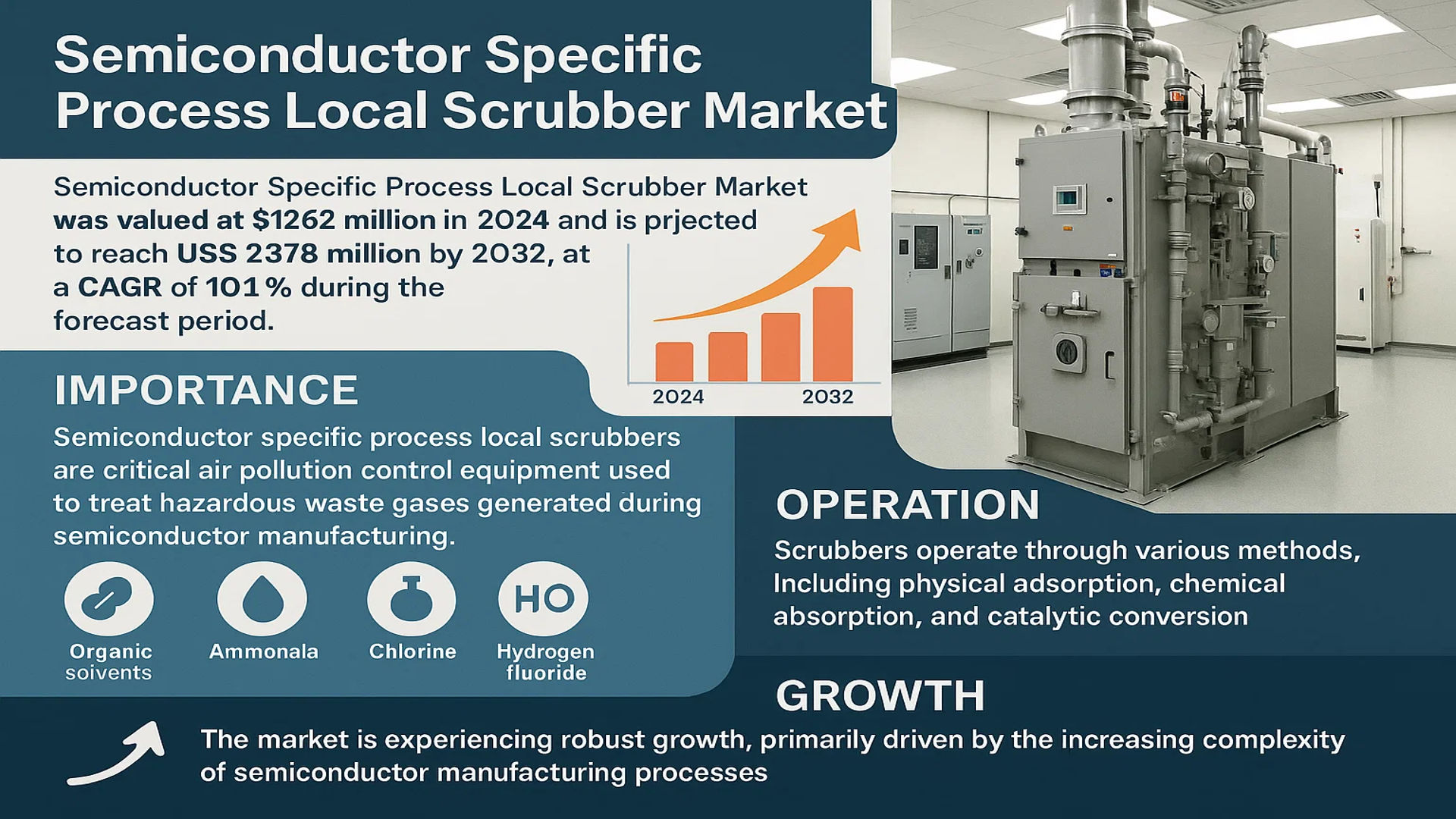
The global Semiconductor Specific Process Local Scrubber Market was valued at 1262 million in 2024 and is projected to reach US$ 2378 million by 2032, at a CAGR of 10.1% during the forecast period..
Semiconductor Specific Process Local Scrubbers are critical air pollution control equipment used to treat hazardous waste gases generated during semiconductor manufacturing. These systems are essential for removing or neutralizing harmful substances, such as organic solvents, ammonia, chlorine, and hydrogen fluoride, to ensure compliance with stringent environmental regulations and protect human health. The scrubbers operate through various methods, including physical adsorption, chemical absorption, and catalytic conversion, transforming toxic emissions into harmless compounds.
The market is experiencing robust growth, primarily driven by the increasing complexity of semiconductor manufacturing processes. As process nodes shrink to 10nm and below, the number of required fabrication steps rises significantly. According to industry data from SEMI, advanced nodes can require over 1,400 process steps, compared to approximately 1,000 for a 20nm process. This escalation directly increases the volume and variety of pollutants emitted, necessitating more advanced and numerous local scrubber installations. Furthermore, the surge in demand for semiconductors from key sectors like data centers, 5G infrastructure, and consumer electronics is accelerating fab investments and expansions worldwide, thereby fueling the demand for these essential emission control systems.
MARKET DYNAMICS
MARKET DRIVERS
Escalating Semiconductor Process Complexity and Miniaturization Demands
The relentless progression toward smaller semiconductor nodes is fundamentally driving demand for advanced local scrubber systems. As process technologies advance from 20nm to 7nm and below, the number of manufacturing steps increases exponentially, with 7nm processes requiring over 1,400 individual steps compared to approximately 1,000 steps at 20nm. This complexity generates significantly higher volumes of hazardous byproducts including perfluorocompounds, acid gases, and volatile organic compounds that require immediate and efficient abatement. The semiconductor industry’s transition to advanced 3D NAND, FinFET, and emerging GAA architectures further intensifies the need for precision gas treatment solutions that can handle increasingly complex chemical compositions while maintaining ultra-clean manufacturing environments essential for high yields.
Global Semiconductor Capacity Expansion and Fab Investments
Massive capital investments in new semiconductor fabrication facilities worldwide are creating substantial demand for local scrubber systems. The global semiconductor industry is projected to invest over $500 billion in new manufacturing capacity between 2024 and 2032, with China alone accounting for approximately 41% of the global scrubber market. Major foundries and memory manufacturers are accelerating fab construction to address supply chain vulnerabilities and meet growing demand from cloud computing, 5G infrastructure, and automotive electronics sectors. Each new fab requires hundreds of local scrubber units integrated into process tools, with advanced nodes demanding more sophisticated abatement solutions. This capacity expansion cycle represents the largest driver for scrubber market growth, particularly in Asia where over 70% of new fab investments are concentrated.
Stringent Environmental Regulations and Sustainability Initiatives
Increasingly rigorous environmental regulations worldwide are compelling semiconductor manufacturers to adopt advanced gas abatement technologies. Regulatory bodies across major manufacturing regions have implemented stricter emission standards for perfluorocompounds, greenhouse gases, and toxic compounds used in semiconductor processes. The semiconductor industry’s commitment to reducing its environmental footprint has led to the adoption of more efficient scrubber technologies that achieve destruction removal efficiencies exceeding 99% for most process gases. Major manufacturers are implementing comprehensive sustainability programs that include upgrading older scrubber systems with newer, more efficient technologies to meet corporate environmental targets and regulatory requirements simultaneously.
MARKET CHALLENGES
High Capital and Operational Expenditure Requirements
The substantial investment required for advanced local scrubber systems presents significant challenges for market adoption. Advanced scrubber technologies incorporating plasma, combustion, and multi-stage treatment systems can cost between $200,000 to $500,000 per unit, with installation and integration expenses adding 30-50% to the total cost. Additionally, operational costs including energy consumption, consumables, and maintenance represent ongoing financial burdens. For semiconductor manufacturers operating numerous process tools, the cumulative cost of scrubber systems becomes substantial, particularly in price-sensitive markets where manufacturers seek to minimize capital expenditure while maintaining compliance with environmental regulations.
Other Challenges
Technical Integration Complexities
Integrating local scrubber systems with increasingly sophisticated semiconductor process tools presents significant engineering challenges. As process technologies advance, scrubber systems must handle more complex gas mixtures while maintaining precise pressure control and avoiding any contamination back to the process chamber. The need for real-time monitoring and control integration with fab-wide systems adds layers of complexity that require specialized expertise and customized solutions for different process applications.
Rapid Technological Obsolescence
The accelerating pace of semiconductor technology development creates challenges for scrubber manufacturers who must continuously innovate to address new process chemistries and requirements. Scrubber systems designed for current process technologies may become obsolete within 3-5 years as new materials and processes emerge, requiring substantial re-engineering and replacement costs for semiconductor manufacturers.
MARKET RESTRAINTS
Supply Chain Constraints and Component Availability Issues
The semiconductor equipment industry, including scrubber manufacturers, faces significant supply chain challenges that restrain market growth. Critical components such as specialized corrosion-resistant materials, high-temperature ceramics, and advanced control systems experience extended lead times and supply constraints. The concentration of certain component manufacturing in specific geographic regions creates vulnerability to geopolitical tensions and trade restrictions. These supply chain issues delay scrubber system deliveries and increase costs, potentially slowing the pace of fab expansions and technology transitions within the semiconductor industry.
Technical Limitations in Handling Emerging Process Chemistries
As semiconductor manufacturers adopt new materials and processes for advanced nodes, local scrubber systems face challenges in effectively treating novel byproducts and waste streams. The introduction of new precursor chemicals, etch gases, and cleaning agents creates unknown abatement requirements that existing scrubber technologies may not adequately address. This technological gap requires extensive research and development efforts from scrubber manufacturers, delaying the availability of effective solutions and potentially restraining the adoption of new semiconductor processes until appropriate abatement technologies are developed and validated.
Intensive Maintenance Requirements and Downtime Concerns
Local scrubber systems require regular maintenance and consumable replacement to maintain optimal performance, creating operational challenges for semiconductor manufacturers. The need for periodic shutdowns for maintenance can conflict with fab production schedules and utilization targets. Additionally, the corrosive nature of many process byproducts accelerates equipment wear, requiring more frequent part replacements and increasing total cost of ownership. These maintenance requirements pose significant operational restraints, particularly for manufacturers operating at high utilization rates where any tool downtime directly impacts production output and revenue.
MARKET OPPORTUNITIES
Development of AI-Enabled Predictive Maintenance and Optimization Systems
The integration of artificial intelligence and machine learning technologies presents significant opportunities for enhancing local scrubber system performance and reliability. AI-enabled systems can predict maintenance needs, optimize energy consumption, and automatically adjust operating parameters based on real-time process conditions. These smart scrubber systems can reduce operational costs by up to 30% while improving destruction efficiency and extending equipment lifespan. The adoption of Industry 4.0 principles in semiconductor manufacturing creates substantial opportunities for scrubber manufacturers to develop connected, intelligent systems that provide valuable data analytics and predictive capabilities to their customers.
Expansion into Emerging Semiconductor Manufacturing Regions
The geographic diversification of semiconductor manufacturing creates substantial growth opportunities for local scrubber suppliers. Countries across Southeast Asia, India, and the Middle East are developing their semiconductor manufacturing capabilities through government incentives and foreign investments. These emerging manufacturing regions will require comprehensive gas abatement solutions, presenting new market opportunities for scrubber manufacturers to establish presence and partnerships. The establishment of new semiconductor clusters in these regions represents a significant growth avenue beyond traditional manufacturing centers.
Development of Sustainable and Energy-Efficient Abatement Technologies
The increasing focus on environmental sustainability within the semiconductor industry creates opportunities for innovative scrubber technologies that reduce energy consumption and environmental impact. Systems that incorporate heat recovery, water recycling, and reduced chemical consumption align with industry sustainability goals while providing operational cost savings. The development of scrubbers that can convert waste gases into reusable byproducts or less harmful compounds represents a significant innovation opportunity. These sustainable technologies address both regulatory requirements and corporate environmental targets, creating competitive advantages for manufacturers that can deliver effective green abatement solutions.
SEMICONDUCTOR SPECIFIC PROCESS LOCAL SCRUBBER MARKET TRENDS
Increasing Process Complexity and Stringent Environmental Regulations Drive Market Growth
The semiconductor industry’s relentless pursuit of smaller process nodes has dramatically increased manufacturing complexity, creating unprecedented demand for advanced local scrubber systems. As fabrication processes shrink below 10nm, the number of required process steps has escalated to over 1,400, significantly increasing the volume and variety of hazardous byproducts generated during production. This complexity necessitates more sophisticated abatement solutions capable of handling diverse chemical compositions including perfluorocompounds (PFCs), volatile organic compounds (VOCs), and acid gases. Concurrently, global environmental regulations have tightened considerably, with regions implementing stricter emission standards that require removal efficiencies exceeding 99% for certain compounds. This regulatory pressure, combined with the industry’s commitment to environmental sustainability, has compelled semiconductor manufacturers to invest in next-generation scrubber technologies that can reliably meet these challenging requirements while maintaining production uptime and yield.
Other Trends
Technological Advancements in Scrubber Systems
Recent technological innovations have significantly enhanced the performance and efficiency of local scrubber systems. Manufacturers are developing integrated solutions that combine multiple treatment technologies such as thermal, catalytic, and plasma-based abatement methods to address the wide spectrum of process gases encountered in modern fabs. The integration of real-time monitoring and IoT connectivity has enabled predictive maintenance capabilities, reducing unplanned downtime and optimizing consumable usage. Advanced materials and coating technologies have improved corrosion resistance and extended equipment lifespan, particularly important when handling aggressive chemicals like hydrogen fluoride and chlorine. These technological improvements have resulted in systems achieving destruction removal efficiencies (DRE) of 99.9% for certain compounds while reducing energy consumption by up to 30% compared to previous generation systems.
Geographic Market Expansion and Capacity Investments
The global semiconductor local scrubber market is experiencing significant geographic expansion driven by massive capacity investments across multiple regions. China’s dominant market position, representing approximately 41% of global demand, continues to grow as the country accelerates its semiconductor self-sufficiency initiatives with numerous new fab projects. Meanwhile, substantial investments are occurring in other regions including the United States, Taiwan, South Korea, and Europe, each implementing their respective semiconductor acts and incentive programs. This geographic diversification is creating opportunities for scrubber manufacturers to expand their global footprint while adapting to regional environmental standards and customer requirements. The market concentration remains high, with the top three manufacturers holding approximately 52% market share, though regional players are gaining traction in local markets through specialized solutions and competitive pricing strategies.
COMPETITIVE LANDSCAPE
Key Industry Players
Technological Innovation and Strategic Expansion Drive Market Leadership
The competitive landscape of the global Semiconductor Specific Process Local Scrubber market is characterized by a high degree of concentration, dominated by a few key players who leverage advanced technology and extensive global networks. Edwards Vacuum, a subsidiary of Atlas Copco, is a preeminent leader, commanding a significant market share due to its comprehensive portfolio of dry pump and abatement systems and its entrenched relationships with major semiconductor fabrication plants worldwide. The company’s stronghold is particularly evident in technology hubs across Asia, North America, and Europe.
Ebara Corporation and Global Standard Technology (GST) are also pivotal forces, collectively holding a substantial portion of the market. Their leadership is cemented by decades of specialized expertise in handling the complex waste gases from advanced etching and chemical vapor deposition (CVD) processes. The growth trajectory of these companies is propelled by relentless investment in R&D to develop scrubbers that meet the stringent requirements of next-generation nodes below 7nm, where the volume and toxicity of process emissions are significantly higher.
Furthermore, these established players are actively pursuing growth through strategic initiatives. Geographic expansion into emerging semiconductor manufacturing regions, particularly in Southeast Asia, is a key focus. Additionally, a stream of new product launches featuring higher efficiency, lower consumable usage, and integrated IoT for predictive maintenance is expected to further consolidate their market positions over the forecast period.
Meanwhile, other notable companies like Taiyo Nippon Sanso and KC Innovation are strengthening their presence. They compete by focusing on niche applications, forming strategic partnerships with equipment OEMs, and offering cost-competitive and reliable solutions for specific processes such as diffusion and photolithography. Their agility and targeted approach allow them to capture valuable segments within the broader competitive landscape.
List of Key Semiconductor Specific Process Local Scrubber Companies Profiled
- Edwards Vacuum (UK)
- Ebara Corporation (Japan)
- Global Standard Technology (GST) (South Korea)
- CSK Inc. (South Korea)
- Kanken Techno Co., Ltd. (Japan)
- Unisem Co., Ltd. (South Korea)
- EcoSys Co., Ltd. (South Korea)
- GnBS Eco Co., Ltd. (South Korea)
- DAS EE (South Korea)
- Shengjian (China)
- CS Clean Solutions AG (Germany)
- YOUNGJIN IND CO., LTD. (South Korea)
- Integrated Plasma Inc (IPI) (U.S.)
- Taiyo Nippon Sanso Corporation (Japan)
- MAT Plus GmbH (Germany)
- KC Innovation Co., Ltd. (South Korea)
- Busch Vacuum Solutions (Germany)
- Triple Cores Technology Inc. (Taiwan)
- Air Water Mechatronics, Inc. (Japan)
Segment Analysis:
By Type
Wet Scrubber Segment Dominates the Market Due to High Efficiency in Treating Acidic and Alkaline Gases
The market is segmented based on type into:
- Burn Scrubber
- Plasma Scrubber
- Wet Scrubber
- Subtypes: Heat Wet Scrubber, Chemical Wet Scrubber, and others
- Dry Scrubber
- Catalytic Scrubber
By Application
Etch Process Segment Leads Due to High Volume of Hazardous Fluorinated Compound Emissions
The market is segmented based on application into:
- CVD (Chemical Vapor Deposition)
- Diffusion
- Etch
- Ion Implantation
- Others
By Technology
Chemical Absorption Technology Holds Major Share Due to Effective Neutralization of Acidic Gases
The market is segmented based on technology into:
- Physical Adsorption
- Chemical Absorption
- Thermal Oxidation
- Catalytic Conversion
- Plasma Abatement
By End User
Integrated Device Manufacturers (IDMs) Represent Largest Segment Due to In-house Manufacturing Requirements
The market is segmented based on end user into:
- Integrated Device Manufacturers (IDMs)
- Foundries
- OSAT (Outsourced Semiconductor Assembly and Test) Providers
- Research and Development Facilities
Regional Analysis: Semiconductor Specific Process Local Scrubber Market
Asia-Pacific
The Asia-Pacific region is the undisputed global leader in the Semiconductor Specific Process Local Scrubber market, accounting for approximately 70% of global demand. This dominance is primarily driven by China, which holds a 41% global market share, followed by significant manufacturing hubs in Japan, South Korea, and Taiwan. The region’s supremacy is fueled by massive government-backed investments in semiconductor self-sufficiency, such as China’s “Big Fund” initiatives and South Korea’s K-Semiconductor Strategy. The sheer density of advanced fabrication plants, or fabs, necessitates a vast and continuous deployment of local scrubbers to manage the complex waste streams from processes like extreme ultraviolet (EUV) lithography and advanced etching. While cost-competitive solutions are sought after, the push towards more advanced sub-7nm and sub-3nm nodes is mandating the adoption of highly efficient scrubber technologies, particularly plasma and burn types, to handle increasingly hazardous and complex per- and polyfluoroalkyl substances (PFAS) and other byproducts. The supply chain is deeply integrated, with local manufacturers like Shengjian and CS Clean Solution gaining significant traction alongside global leaders.
North America
North America represents a high-value, technologically advanced market characterized by stringent environmental, health, and safety (EHS) regulations enforced by agencies like the U.S. Environmental Protection Agency (EPA). The recent CHIPS and Science Act, which allocates over $52 billion in funding for domestic semiconductor research and manufacturing, is a primary catalyst for new fab construction and, consequently, scrubber demand. The market is driven by a focus on cutting-edge manufacturing processes, leading to a strong preference for high-efficiency dry and plasma scrubbers that can handle the unique exhaust gases from next-generation chip production. Key industry players like Edwards Vacuum and Integrated Plasma Inc. (IPI) have a strong presence, catering to major foundries and memory manufacturers. Compliance with strict emissions standards for substances like acid gases and volatile organic compounds (VOCs) is non-negotiable, making advanced abatement solutions a critical capital expenditure.
Europe
The European market is shaped by the world’s most rigorous environmental directives, including the EU Industrial Emissions Directive (IED) and the Registration, Evaluation, Authorisation and Restriction of Chemicals (REACH) regulation. This regulatory landscape creates a stable demand for top-tier scrubber technology that guarantees compliance and minimizes the environmental footprint of semiconductor manufacturing. While the region’s manufacturing capacity is smaller than Asia’s, it is highly specialized in research, development, and production of power semiconductors and micro-electromechanical systems (MEMS), which require tailored abatement solutions. The market is innovation-driven, with a focus on developing scrubbers with higher destruction removal efficiency (DRE) for a wider range of process gases. Companies like Busch Vacuum Solutions are key innovators in this space. The EU’s own European Chips Act aims to bolster regional capacity, which is expected to gradually increase demand for these essential pollution control systems.
South America
The semiconductor scrubber market in South America is nascent and relatively underdeveloped. The region lacks large-scale, advanced semiconductor fabrication facilities, resulting in minimal localized demand for process-specific scrubbers. The market is primarily served by imports for maintenance, upgrades, or small-scale research and development operations. Economic volatility and a lack of cohesive, long-term national strategies for developing a semiconductor industry are the main barriers to market growth. Consequently, demand is sporadic and price-sensitive, with simpler, more cost-effective wet scrubber solutions often being utilized where needed. The market potential remains largely untapped, dependent on future significant foreign direct investment in high-tech manufacturing.
Middle East & Africa
Similar to South America, the Middle East and Africa region represents an emerging market with currently very low penetration. Strategic visions like Saudi Arabia’s Vision 2030 and initiatives in the UAE aim to diversify economies away from hydrocarbons and into advanced technology sectors. This has led to initial investments and discussions around building technology hubs, which could eventually include semiconductor-related manufacturing. However, the market for specific process scrubbers is virtually non-existent at present, as no major fabs are operational. Any current demand is limited to small-scale electronics assembly or research laboratories. Long-term growth is contingent upon the successful execution of these ambitious economic diversification plans, which would create the foundational infrastructure necessary for a semiconductor industry to emerge.
Report Scope
This market research report provides a comprehensive analysis of the global Semiconductor Specific Process Local Scrubber market, covering the forecast period 2025–2032. It offers detailed insights into market dynamics, technological advancements, competitive landscape, and key trends shaping the industry.
Key focus areas of the report include:
- Market Size & Forecast: Historical data and future projections for revenue, unit shipments, and market value across major regions and segments.
- Segmentation Analysis: Detailed breakdown by product type, technology, application, and end-user industry to identify high-growth segments and investment opportunities.
- Regional Outlook: Insights into market performance across North America, Europe, Asia-Pacific, Latin America, and the Middle East & Africa, including country-level analysis where relevant.
- Competitive Landscape: Profiles of leading market participants, including their product offerings, R&D focus, manufacturing capacity, pricing strategies, and recent developments such as mergers, acquisitions, and partnerships.
- Technology Trends & Innovation: Assessment of emerging technologies, integration of AI/IoT, semiconductor design trends, fabrication techniques, and evolving industry standards.
- Market Drivers & Restraints: Evaluation of factors driving market growth along with challenges, supply chain constraints, regulatory issues, and market-entry barriers.
- Stakeholder Analysis: Insights for component suppliers, OEMs, system integrators, investors, and policymakers regarding the evolving ecosystem and strategic opportunities.
Primary and secondary research methods are employed, including interviews with industry experts, data from verified sources, and real-time market intelligence to ensure the accuracy and reliability of the insights presented.
FREQUENTLY ASKED QUESTIONS:
What is the current market size of Global Semiconductor Specific Process Local Scrubber Market?
->Semiconductor Specific Process Local Scrubber Market was valued at 1262 million in 2024 and is projected to reach US$ 2378 million by 2032, at a CAGR of 10.1% during the forecast period..
Which key companies operate in Global Semiconductor Specific Process Local Scrubber Market?
-> Key players include Edwards Vacuum, Ebara, Global Standard Technology (GST), CSK, and Kanken Techno, among others.
What are the key growth drivers?
-> Key growth drivers include increasing semiconductor manufacturing complexity, stringent environmental regulations, and rising demand from server cloud, 5G smartphones, and PC markets.
Which region dominates the market?
-> Asia-Pacific is the dominant market, with China holding approximately 41% of the global market share, followed by Japan and South Korea.
What are the emerging trends?
-> Emerging trends include development of advanced scrubber technologies for sub-7nm processes, integration of IoT for predictive maintenance, and increased focus on energy-efficient and sustainable abatement solutions.

Get Sample Report PDF for Exclusive Insights
Report Sample Includes
- Table of Contents
- List of Tables & Figures
- Charts, Research Methodology, and more...