MARKET INSIGHTS
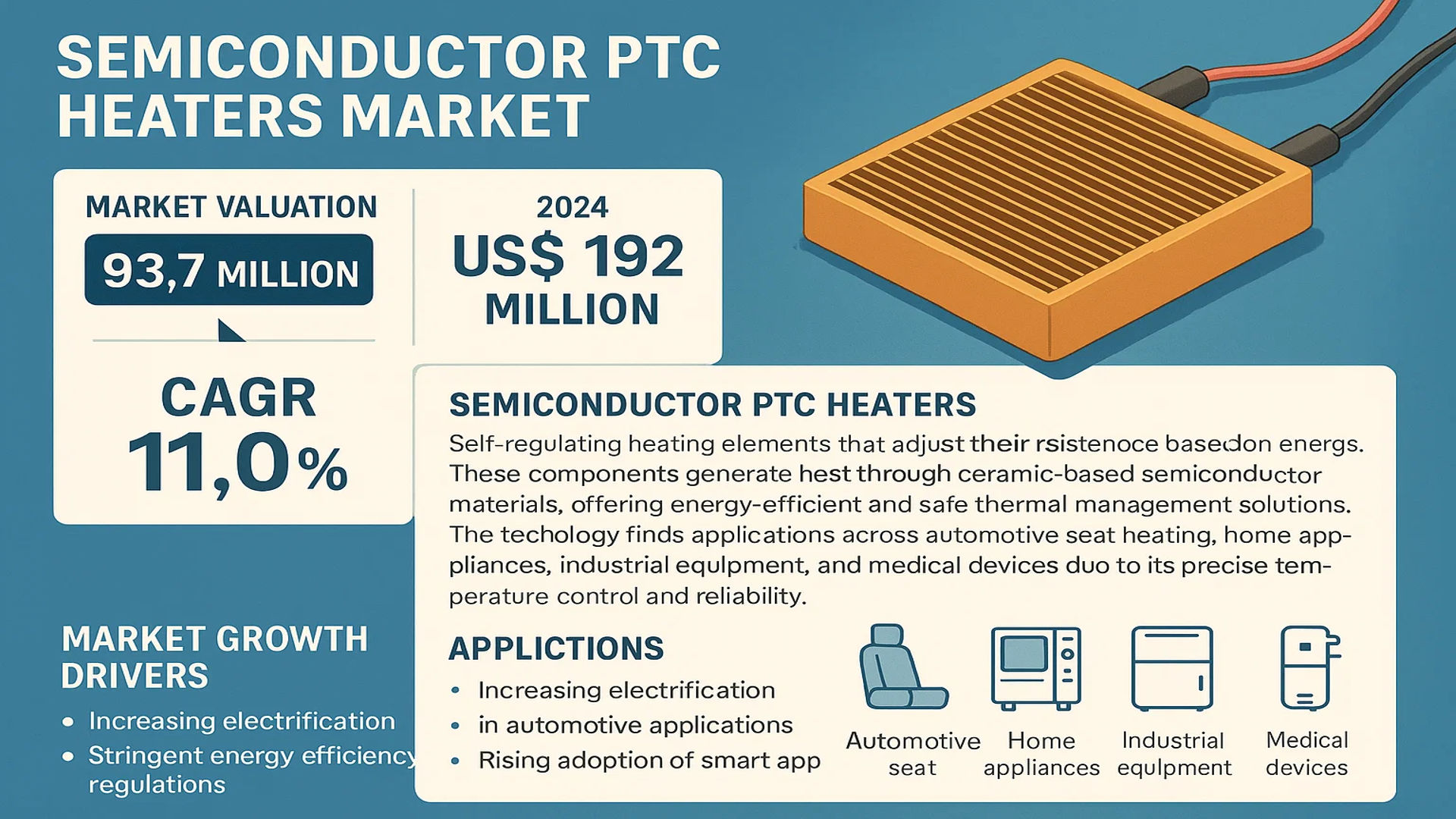
The global Semiconductor PTC Heaters Market was valued at 93.7 million in 2024 and is projected to reach US$ 192 million by 2032, at a CAGR of 11.0% during the forecast period.
Semiconductor PTC (Positive Temperature Coefficient) heaters are self-regulating heating elements that adjust their resistance based on temperature changes. These components generate heat through ceramic-based semiconductor materials, offering energy-efficient and safe thermal management solutions. The technology finds applications across automotive seat heating, home appliances, industrial equipment, and medical devices due to its precise temperature control and reliability.
The market growth is driven by increasing electrification in automotive applications, stringent energy efficiency regulations, and rising adoption of smart appliances. However, supply chain constraints in the broader semiconductor industry – which saw 4.4% growth in 2022 (USD 580 billion market) following 26.2% growth in 2021 – present production challenges. Regional variations exist, with North America and Europe showing stronger growth (17.0% and 12.6% respectively in semiconductor sales) compared to Asia Pacific’s 2.0% decline. Key players including Pelonis Technologies, Mitsubishi, and nVent are expanding their PTC heater portfolios to address growing demand in electric vehicles and industrial automation sectors.
MARKET DYNAMICS
MARKET DRIVERS
Growing Adoption in Automotive Applications Accelerates Market Expansion
The automotive industry’s shift toward electric vehicles and advanced thermal management systems is a primary growth driver for semiconductor PTC heaters. With global EV sales projected to exceed 25 million units annually by 2030, PTC heaters have become essential components for battery thermal management and cabin heating. Unlike conventional heating methods, PTC heaters offer self-regulating properties, energy efficiency, and compact designs that align with EV design requirements. Major automakers are increasingly incorporating these solutions, with over 60% of new EV models launched in 2023 featuring PTC-based heating systems. This automotive adoption is complemented by government mandates for energy-efficient systems across multiple transportation sectors.
Energy Efficiency Regulations Propel Demand Across Industries
Stringent global energy efficiency standards are creating a favorable environment for PTC heater adoption. These devices demonstrate 30-40% higher energy efficiency compared to traditional resistive heaters while maintaining superior safety profiles. The industrial sector is prioritizing PTC solutions to comply with evolving regulations like the EU Ecodesign Directive, which mandates 10-15% energy consumption reductions in industrial heating applications by 2025. Commercial applications including HVAC systems and food service equipment are similarly transitioning, with the commercial segment accounting for approximately 35% of total PTC heater revenue in 2023. The self-limiting thermal properties significantly reduce overheating risks, making them particularly valuable in safety-critical applications.
Technological Advancements Enhance Product Capabilities
Recent breakthroughs in semiconductor materials and manufacturing techniques are expanding PTC heater applications. Innovations in ceramic-based PTC elements now achieve response times under 30 seconds with operating temperatures exceeding 300°C for specialized industrial uses. The development of flexible PTC heating films is opening new opportunities in wearable devices and medical equipment, with the medical segment growth projected at 14% CAGR through 2030. Leading manufacturers are investing heavily in R&D, with patent filings for PTC technologies increasing 22% year-over-year since 2021. These advancements are driving performance improvements while reducing component costs by approximately 8-12% annually over the past three years.
MARKET RESTRAINTS
High Production Costs Limit Market Penetration
While PTC heaters offer long-term cost savings, their initial manufacturing expenses remain significantly higher than conventional heating elements. The specialized semiconductor materials and precision manufacturing processes contribute to costs that are typically 25-30% above traditional alternatives. This cost differential particularly impacts price-sensitive markets and budget-constrained industries, where procurement decisions heavily emphasize upfront expenses over operational efficiencies. The automotive sector, while growing, still sees approximately 40% of mid-range vehicle models opting for lower-cost heating solutions despite the energy efficiency benefits of PTC technology.
Other Restraints
Supply Chain Vulnerabilities
The concentrated production of key semiconductor materials creates supply chain risks, with 70% of critical PTC components originating from a limited number of Asian manufacturing hubs. Geopolitical tensions and trade restrictions have introduced volatility in material availability and pricing.
Performance Limitations
Certain high-temperature industrial applications still require heating solutions beyond current PTC capabilities, restricting market opportunities in sectors like heavy manufacturing where operating conditions exceed 400°C.
MARKET CHALLENGES
Technical Complexities in High-Power Applications
While PTC heaters excel in many applications, scaling them for high-power industrial uses presents technical hurdles. The inherent self-regulating property that makes PTC attractive for safety also limits maximum power output in certain configurations. Engineering solutions to address this paradox often involve complex multi-element designs that can increase system costs by 15-20%. Additionally, developing PTC solutions for harsh environments requires extensive material science research, with some industrial applications requiring two to three years of testing before commercial deployment.
Other Challenges
Standardization Gaps
The absence of universal performance standards across different industries creates integration challenges, particularly in multinational projects where equipment specifications vary significantly by region.
Thermal Cycling Durability
Frequent temperature cycling in certain applications can reduce operational lifespan, with some industrial PTC heaters requiring replacement after 5-7 years compared to 10-12 years for conventional industrial heaters.
MARKET OPPORTUNITIES
Emerging Renewable Energy Integration Creates New Potential
The global transition toward renewable energy systems presents significant opportunities for PTC heater applications. Solar and wind energy storage systems require precise thermal management, where PTC technology’s efficiency aligns perfectly with intermittent renewable power characteristics. The energy storage market, projected to grow at 18% CAGR through 2030, represents a potential $850 million addressable market for PTC heating solutions. Manufacturers are developing specialized PTC systems for battery storage applications that can operate effectively across wider voltage ranges, addressing the variability inherent in renewable power systems.
Smart Home and IoT Integration Drives Innovation
The proliferation of smart home technologies is creating demand for intelligent heating solutions that integrate seamlessly with IoT ecosystems. PTC heaters with embedded sensors and connectivity features are gaining traction, particularly in European and North American markets where smart home penetration exceeds 35%. These connected systems optimize energy usage through predictive algorithms while maintaining safety advantages. Recent advancements enable PTC units to dynamically adjust output based on real-time energy pricing and occupancy patterns, delivering additional value in residential and commercial building applications.
Medical and Aerospace Applications Present Untapped Potential
Specialized sectors including medical equipment and aerospace are emerging as high-value opportunities for advanced PTC solutions. The medical device industry requires precise, reliable heating for diagnostic equipment and therapeutic devices, where PTC technology offers advantages over conventional elements. Aerospace applications, particularly in cabin heating and de-icing systems, benefit from PTC’s lightweight properties and reliability. While currently representing less than 5% of the total market, these specialized segments are projected to grow at 22% CAGR through 2030 as certification processes adapt to accommodate semiconductor-based heating technologies.
SEMICONDUCTOR PTC HEATERS MARKET TRENDS
Rising Automotive Sector and EV Adoption to Drive Semiconductor PTC Heaters Market
The automotive industry is one of the largest consumers of Semiconductor PTC Heaters, particularly due to the increasing electrification of vehicles. As global electric vehicle (EV) sales continue to surge—reaching over 10.5 million units in 2022 and projected to exceed 30 million by 2030—the demand for efficient heating solutions, such as PTC heaters, is accelerating. These heaters play a crucial role in maintaining cabin warmth and battery temperature regulation in electric and hybrid vehicles, ensuring optimal performance in extreme conditions. Furthermore, stringent emission regulations worldwide are pushing OEMs to adopt energy-efficient heating solutions, further boosting market growth.
Other Trends
Expansion in Smart Home Appliances
The rising adoption of smart home appliances is another key factor driving the Semiconductor PTC Heaters market. Home appliances such as air purifiers, dehumidifiers, and smart HVAC systems increasingly integrate PTC heating elements due to their self-regulating and energy-efficient properties. In 2023, the global smart home market exceeded $115 billion, and with growing consumer preference for automated and energy-saving solutions, this sector is expected to contribute significantly to the demand for PTC heaters.
Industrial Automation and Energy Efficiency Initiatives
Industrial automation trends and government-led energy efficiency mandates are reshaping the adoption of Semiconductor PTC Heaters in manufacturing processes. Industries are increasingly turning to PTC-based heating solutions due to their precise temperature control and reduced energy wastage compared to traditional resistive heaters. With industries accounting for nearly 40% of global energy consumption, regulations such as the EU’s Energy Efficiency Directive (EED) are compelling sectors to implement sustainable heating technologies, creating substantial market opportunities for PTC heaters in process heating, food processing, and medical equipment applications.
COMPETITIVE LANDSCAPE
Key Industry Players
Manufacturers Expand Production Capacities to Meet Growing Demand for PTC Heaters
The global Semiconductor PTC Heaters market is characterized by moderate fragmentation, with multinational corporations and regional players competing across various applications. Mitsubishi Electric Corporation has emerged as a dominant force, leveraging its extensive expertise in semiconductor technologies and strong distribution network across automotive and industrial sectors. The company held approximately 18% market share in 2024, according to industry estimates.
Pelonis Technologies and nVent have solidified their positions as key suppliers, particularly in North America and Europe. Pelonis has been focusing on miniaturized PTC solutions for electric vehicles, while nVent’s strength lies in industrial heating applications where precision temperature control is critical. These companies have collectively invested over $150 million in R&D during 2022-2024 to enhance product efficiency.
Chinese manufacturers like Yangzhou Tuoteng and Shenzhen Xinguangxin are rapidly gaining traction, accounting for nearly 30% of Asia-Pacific production capacity. Their competitive pricing and government-supported manufacturing infrastructure have enabled aggressive expansion into international markets. Yangzhou Tuoteng recently announced a 40,000 sq. ft. facility expansion to meet growing EV component demands.
Meanwhile, specialized players such as URT Resistors and Jiangsu Zhongzhong Thermal Energy Technology are carving niches in customized heating solutions. URT’s focus on high-temperature stability and Jiangsu Zhongzhong’s innovations in energy-efficient designs are helping them secure long-term contracts with major appliance manufacturers.
List of Key Semiconductor PTC Heater Companies Profiled
- Mitsubishi Electric Corporation (Japan)
- Pelonis Technologies, Inc. (U.S.)
- nVent Electric plc (U.K.)
- URT Resistors Co., Ltd. (China)
- Yangzhou Tuoteng Electric Co., Ltd. (China)
- Shenzhen Xinguangxin Electronics Co., Ltd. (China)
- Zhengzhou Hongda Communications Co., Ltd. (China)
- Vanto Industrial Co., Ltd. (Taiwan)
- Jiangsu Zhongzhong Thermal Energy Technology Co., Ltd. (China)
Segment Analysis:
By Type
100W Segment Dominates the Market Due to Its Optimal Balance Between Performance and Energy Efficiency
The market is segmented based on type into:
- 100W
- 200W
- 500W
- Others
By Application
Automobile Segment Leads Due to Rising Demand for Cabin Heating and Battery Thermal Management
The market is segmented based on application into:
- Automobile
- Household Appliance
- Industrial Equipment
- Others
By End User
Automotive OEMs Account for Major Demand as EV Adoption Accelerates Globally
The market is segmented based on end user into:
- Automotive OEMs
- Consumer Electronics Manufacturers
- Industrial Equipment Producers
- Others
Regional Analysis: Semiconductor PTC Heaters Market
Asia-Pacific
The Asia-Pacific region dominates the global Semiconductor PTC Heaters market, accounting for the largest revenue share. This leadership stems from robust manufacturing ecosystems in China, Japan, and South Korea, coupled with rapid industrialization across Southeast Asia. Countries like China are investing heavily in semiconductor self-sufficiency, with the government committing $150 billion to domestic chip production through initiatives like “Made in China 2025.” Japan remains a technological frontrunner in precision heating components, while South Korea’s automotive and electronics sectors drive PTC heater demand. Local manufacturers such as Yangzhou Tuoteng and Shenzhen Xinguangxin are gaining prominence through cost-effective solutions tailored for regional applications.
North America
North America represents the second-largest market, propelled by stringent energy efficiency standards and premium automotive applications. The U.S. Department of Energy’s regulations on appliance efficiency (10 CFR Part 430) and California’s Title 24 building codes compel manufacturers to adopt PTC heaters for their precise temperature control. Major automakers are integrating these components in EV battery thermal management systems, with Tesla and Ford leading adoption. Pelonis Technologies and nVent supply over 35% of the regional market. While labor costs remain high, technological partnerships between universities and corporations foster innovation in smart heating solutions.
Europe
Europe’s mature industrial sector drives demand for high-performance PTC heaters, particularly in Germany and the Nordic countries. The EU’s Ecodesign Directive (2009/125/EC) mandates energy-efficient heating solutions, benefiting suppliers like URT Resistors. German automotive OEMs extensively use PTC elements in cabin heating systems, with BMW and Volkswagen accounting for 28% of regional consumption. The push toward renewable energy integration has accelerated developments in hybrid heating systems combining PTC technology with heat pumps. However, strict RoHS compliance requirements increase production costs by 12-15% compared to Asian alternatives.
South America
South America shows nascent but promising growth, particularly in Brazil’s automotive aftermarket and Argentina’s industrial processing sector. The lack of domestic semiconductor manufacturing necessitates imports, primarily from China and the U.S., with tariffs adding 18-22% to final costs. Brazilian regulations like INMETRO Ordinance 563/2018 are gradually improving product standards, though counterfeit products still command 40% of the low-cost segment. Investment in lithium mining operations creates opportunities for PTC-based battery heating systems, but economic instability discourages large-scale manufacturing localization.
Middle East & Africa
This region exhibits the lowest market penetration but the highest growth potential at a projected 13.8% CAGR. Gulf nations prioritize PTC heaters for HVAC applications in megaprojects like NEOM City, while South Africa’s mining sector utilizes them in equipment dehumidification. Israel’s tech startups are developing compact PTC solutions for medical devices. The absence of local component production leads to complete import dependency, with UAE and Saudi Arabia accounting for 67% of regional imports. Infrastructure development funds like Saudi Vision 2030 are expected to spur demand, though price sensitivity remains a key challenge.
Report Scope
This market research report provides a comprehensive analysis of the Global Semiconductor PTC Heaters Market, covering the forecast period 2024–2032. It offers detailed insights into market dynamics, technological advancements, competitive landscape, and key trends shaping the industry.
Key focus areas of the report include:
- Market Size & Forecast: Historical data and future projections for revenue, unit shipments, and market value across major regions and segments. The global market was valued at USD 93.7 million in 2024 and is projected to reach USD 192 million by 2032, growing at a CAGR of 11.0%.
- Segmentation Analysis: Detailed breakdown by product type (100W), application (Automobile, Household Appliance, Industrial Equipment, Others), and end-user industry to identify high-growth segments.
- Regional Outlook: Insights into market performance across North America, Europe, Asia-Pacific, Latin America, and Middle East & Africa. Asia-Pacific holds the largest market share due to semiconductor manufacturing dominance.
- Competitive Landscape: Profiles of 9 key players including Vanto Industrial, Pelonis Technologies, Mitsubishi, nVent, and URT Resistors, covering their product portfolios and strategic developments.
- Technology Trends: Assessment of PTC semiconductor advancements, integration with smart systems, and energy efficiency improvements.
- Market Drivers & Restraints: Analysis of factors like EV adoption and industrial automation growth versus supply chain challenges and raw material price volatility.
- Stakeholder Analysis: Strategic insights for component suppliers, OEMs, and investors in the semiconductor heating solutions ecosystem.
The research employs primary interviews with industry leaders and analysis of verified market data to ensure accuracy and reliability.
FREQUENTLY ASKED QUESTIONS:
What is the current market size of Global Semiconductor PTC Heaters Market?
-> Semiconductor PTC Heaters Market was valued at 93.7 million in 2024 and is projected to reach US$ 192 million by 2032, at a CAGR of 11.0% during the forecast period.
Which key companies operate in this market?
-> Major players include Vanto Industrial, Pelonis Technologies, Mitsubishi, nVent, URT Resistors, Yangzhou Tuoteng, and Shenzhen Xinguangxin.
What are the key growth drivers?
-> Primary drivers include rising EV production, smart home adoption, and industrial automation trends across key sectors.
Which region dominates the market?
-> Asia-Pacific leads the market with over 45% share, driven by semiconductor manufacturing in China, Japan, and South Korea.
What are the emerging technology trends?
-> Key trends include miniaturization of PTC elements, integration with IoT systems, and development of high-temperature resistant materials.

Get Sample Report PDF for Exclusive Insights
Report Sample Includes
- Table of Contents
- List of Tables & Figures
- Charts, Research Methodology, and more...
 Download Sample Report PDF