Market Insights
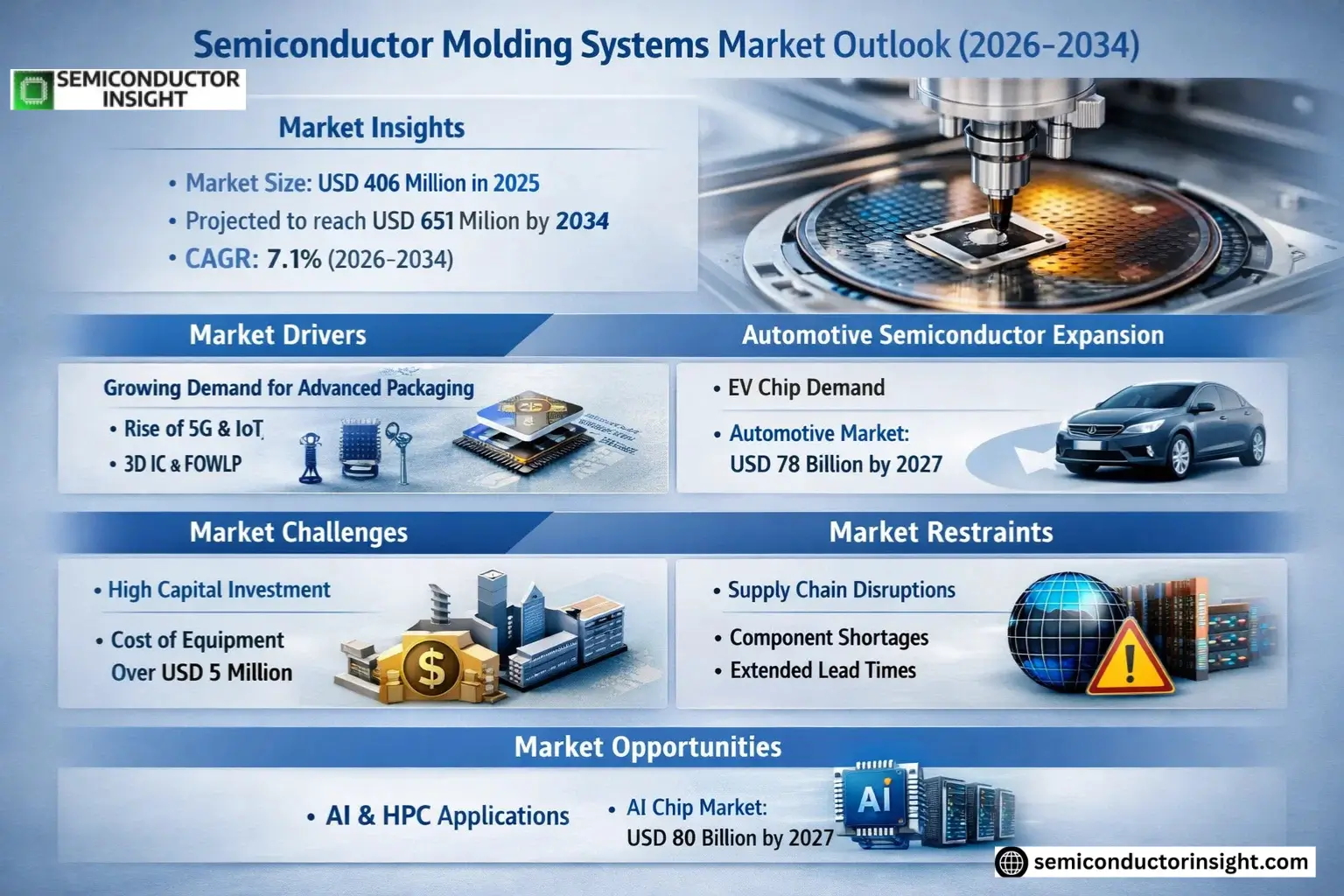
Global Semiconductor Molding Systems Market size was valued at USD 406 million in 2025. The market is projected to grow from USD 435 million in 2026 to USD 651 million by 2034, exhibiting a CAGR of 7.1% during the forecast period.
Semiconductor molding systems are critical equipment used in the packaging phase of chip manufacturing, where epoxy resin or other encapsulants are injected into molds to protect integrated circuits. These systems ensure mechanical stability, electrical connectivity, and environmental protection for delicate semiconductor components. The technology encompasses fully automatic, semi-automatic, and manual molding solutions tailored for advanced and traditional packaging applications.
The market growth is driven by rising demand for compact electronic devices and automotive semiconductors, alongside increasing investments in IoT and 5G infrastructure. While Japan dominates production with advanced systems from leaders like TOWA, Chinese manufacturers such as HIIG Trinity are gaining traction through technological advancements in high-density packaging solutions.
MARKET DRIVERS
Growing Demand for Advanced Semiconductor Packaging
Semiconductor Molding Systems Market is experiencing robust growth due to increasing demand for advanced packaging solutions in the semiconductor industry. Technologies like fan-out wafer-level packaging (FOWLP) and 3D IC packaging require high-precision molding systems to meet performance and miniaturization requirements. The market is projected to grow at a CAGR of 6.8% through 2028, driven by IoT and 5G adoption.
Automotive Semiconductor Expansion
Rapid electrification in the automotive sector is creating significant demand for semiconductor molding systems. Electric vehicles utilize 2-3x more chips than conventional vehicles, requiring specialized encapsulation solutions. The automotive semiconductor market is expected to reach USD 78 billion by 2027, directly benefiting semiconductor molding equipment manufacturers.
Additional growth comes from increasing investments in semiconductor manufacturing infrastructure, with over USD 100 billion committed to new fab construction worldwide through 2025.
MARKET CHALLENGES
High Capital Investment Requirements
Semiconductor Molding Systems Market faces challenges from the substantial capital expenditure needed for advanced equipment. A single high-end molding system can cost over USD 5 million, creating barriers for small and medium-sized manufacturers. Maintenance and operational costs add another 20-25% annually to the total cost of ownership.
Other Challenges
Technical Complexity in Miniaturization
As chip sizes shrink below 7nm, molding systems must achieve micron-level precision while handling fragile dies. This requires continuous R&D investment, with leading companies spending 8-12% of revenues on innovation.
MARKET RESTRAINTS
Supply Chain Disruptions
Semiconductor Molding Systems Market faces constraints from ongoing supply chain challenges. Critical components like precision molds and high-temperature resins experience lead times extending beyond 6 months. This has slowed equipment delivery schedules and increased costs by 15-20% across the industry.
MARKET OPPORTUNITIES
AI and HPC Applications
Semiconductor Molding Systems Market has significant growth potential from artificial intelligence and high-performance computing applications. These sectors require specialized packaging solutions that can handle high thermal loads up to 200°C. The AI chip market is projected to exceed USD 80 billion by 2027, creating substantial demand for advanced molding systems.
Semiconductor Molding Systems Market TrendsIncreasing Demand for Advanced Packaging Solutions
Semiconductor Molding Systems Market is witnessing significant growth driven by rising demand for advanced packaging technologies. Manufacturers are shifting towards finer pitch designs and higher I/O counts, requiring more precise molding systems. Epoxy resin-based encapsulation remains dominant due to its excellent protective properties for sensitive semiconductor components against environmental factors.
Other Trends
Automation Adoption Across Production Lines
Fully automated molding systems are gaining traction as semiconductor manufacturers seek to improve yield rates and reduce human error. Leading suppliers like TOWA and ASMPT are integrating AI-driven quality control systems into their equipment, enabling real-time process adjustments during plastic encapsulation operations.
Regional Manufacturing Capacity Expansion
Asia continues to dominate semiconductor molding system production, with Japan maintaining technological leadership while China accelerates domestic equipment development. Chinese manufacturers like HIIG Trinity are progressively closing the technology gap through increased R&D investment and partnerships with global packaging specialists.
Material Innovation for Enhanced Performance
The market sees growing development of next-generation molding compounds with improved thermal conductivity and reduced warpage characteristics. These advancements address challenges in high-power device packaging and enable thinner package profiles for mobile applications.
Supply Chain Localization Efforts
Geopolitical factors are prompting semiconductor companies to establish regionalized supply chains, driving demand for local molding system providers. This trend particularly benefits equipment manufacturers in Southeast Asia and India as global foundries diversify production locations.
COMPETITIVE LANDSCAPE
Key Industry Players
Japanese Firms Dominate While Chinese Manufacturers Gain Traction in Semiconductor Molding Systems
Semiconductor Molding Systems Market is led by Japanese manufacturers holding majority market share, with Towa Corporation emerging as the dominant player. The company specializes in fully automated precision molding systems for advanced packaging applications. ASMPT and Besi follow closely with their high-performance molding solutions for both traditional and advanced packaging segments. The market exhibits an oligopolistic structure with technological leadership being the key competitive advantage.
Chinese manufacturers like HIIG Trinity and Shanghai Xinsheng have been rapidly improving their technological capabilities in recent years, particularly in semi-automatic molding systems. These companies are gaining market share in mid-range applications through competitive pricing and localized support. Other niche players such as APIC YAMADA and Mtex Matsumura specialize in customized molding solutions for specific semiconductor packaging requirements.
List of Key Semiconductor Molding Systems Companies Profiled
- Towa Corporation
- Besi
- ASMPT
- I-PEX Inc
- HIIG Trinity (Anhui) Technology
- Shanghai Xinsheng
- Mtex Matsumura
- Asahi Engineering
- Nextool Technology Co., Ltd.
- APIC YAMADA
- Suzhou Bopai Semiconductor (Boschman)
- Suzhou Saiken Intelligent Technology
- Jiangsu Guoxin Intelligent Equipment Co., Ltd
- Dongguan Huayue Semiconductor Technology
- GALLANT Micro Machining Co., Ltd.
Segment Analysis:
| Segment Category | Sub-Segments | Key Insights |
| By Type |
|
Fully Automatic Molding Systems are gaining prominence due to:
|
| By Application |
|
Advanced Packaging segment shows strong growth potential driven by:
|
| By End User |
|
OSAT providers constitute the predominant segment due to:
|
| By Technology Level |
|
High-end Molding Systems demonstrate significant demand growth because:
|
| By Material Processing |
|
Epoxy Resin Systems maintain market leadership due to:
|
Regional Analysis: Semiconductor Molding Systems Market
Asia-Pacific
China’s Manufacturing Leadership
China’s semiconductor molding sector thrives through vertical integration, with domestic players developing complete molding-to-testing solutions. The government’s “Made in China 2025” initiative specifically targets semiconductor equipment self-sufficiency, accelerating R&D in advanced compression and transfer molding technologies for 3D packaging applications.
Taiwan’s Advanced Packaging Hub
Taiwan’s OSAT providers drive innovation in fan-out wafer-level packaging (FOWLP) and system-in-package (SiP) molding solutions. The island’s molding system vendors maintain close partnerships with TSMC and other foundries to develop customized solutions for heterogeneous integration requirements.
South Korea’s Memory Focus
South Korean equipment suppliers specialize in high-volume molding systems optimized for memory packaging. The country’s leadership in DRAM and NAND flash production has spurred development of specialized molding solutions for stacked die configurations and ultra-thin packages.
Japan’s Precision Engineering
Japanese manufacturers maintain technological leadership in high-precision molding presses and cleanroom-compatible systems. Their focus on miniaturization supports the growing demand for molding solutions suitable for automotive-grade semiconductors and medical applications.
North America
North America remains at the forefront of semiconductor molding system innovation, with strong R&D investments in AI-driven process optimization. The region benefits from close collaboration between equipment manufacturers and leading fabless chip companies developing complex SoC packages. California’s Silicon Valley hosts several pioneering firms developing smart molding systems with real-time quality analytics. The US defense sector’s demand for secure, high-reliability packaging keeps specialized molding system suppliers busy with military-grade solutions.
Europe
European semiconductor molding system providers excel in serving automotive and industrial applications, with German and Dutch companies leading in precision engineering solutions. The region’s strength lies in developing environmentally sustainable molding compounds and energy-efficient equipment. Collaborative projects between equipment makers and material science institutes drive innovations in lead-free molding compounds optimized for EU RoHS compliance requirements.
Middle East & Africa
The MEA region shows emerging potential for semiconductor molding systems as countries like UAE and Saudi Arabia initiate semiconductor manufacturing initiatives. While current demand remains modest, regional investors are showing increasing interest in back-end equipment to support local electronics production. The market predominantly imports standard molding systems from Asia with growing interest in turnkey packaging solutions.
South America
South America’s semiconductor molding systems market remains niche but stable, primarily serving regional electronics assembly requirements. Brazil leads with several domestic OSAT facilities utilizing mid-range Asian and European molding equipment. The market shows potential growth in automotive electronics packaging as regional vehicle production expands.
Report Scope
This market research report provides a comprehensive analysis of the Semiconductor Molding Systems Market, covering the forecast period 2025–2034. It offers detailed insights into market dynamics, technological advancements, competitive landscape, and key trends shaping the industry.
Key focus areas of the report include:
- Market Overview: The report begins with an overview outlining its current market scenario, key growth indicators, and industry transformation drivers. It discusses macroeconomic factors, demand-supply balance, regulatory landscape, and the strategic role of semiconductor molding systems in powering advancements across industries such as automotive, telecommunications, consumer electronics, and industrial automation.
- Market Size & Forecast: Historical data and future projections for revenue, unit shipments, and market value across major regions and segments.
- Segmentation Analysis: Detailed breakdown by product type, technology, application, and end-user industry to identify high-growth segments and investment opportunities.
- Regional Insights: Insights into market performance across North America, Europe, Asia-Pacific, Latin America, and the Middle East & Africa, including country-level analysis where relevant.
- Competitive Landscape: Profiles of leading market participants, including their product offerings, R&D focus, manufacturing capacity, pricing strategies, and recent developments such as mergers, acquisitions, and partnerships.
- Technology Trends & Innovation: Assessment of emerging technologies, integration of automation, semiconductor packaging trends, fabrication techniques, and evolving industry standards.
- Market Drivers & Restraints: Evaluation of factors driving market growth along with challenges, supply chain constraints, regulatory issues, and market-entry barriers.
- Stakeholder Insights: Insights for component suppliers, OEMs, system integrators, investors, and policymakers regarding the evolving ecosystem and strategic opportunities.
Primary and secondary research methods are employed, including interviews with industry experts, data from verified sources, and real-time market intelligence to ensure the accuracy and reliability of the insights presented.
FREQUENTLY ASKED QUESTIONS:
What is the current market size of Semiconductor Molding Systems Market?
-> Semiconductor Molding Systems Market size was valued at USD 406 million in 2025. The market is projected to grow from USD 435 million in 2026 to USD 651 million by 2034, exhibiting a CAGR of 7.1% during the forecast period.
Which key companies operate in Semiconductor Molding Systems Market?
-> Key players include Towa, Besi, ASMPT, I-PEX Inc, HIIG Trinity (Anhui) Technology, Shanghai Xinsheng, Mtex Matsumura, Asahi Engineering, and APIC YAMADA, among others.
What are the key growth drivers?
-> Key growth drivers include increasing demand for semiconductor packaging, advancements in molding technology, and the rising adoption of advanced packaging solutions across various industries.
Which region dominates the market?
-> Asia is the dominant market, with Japan and China being the major production areas for semiconductor molding systems.
What are the emerging trends?
-> Emerging trends include increased automation in molding systems, development of high-performance encapsulation materials, and advancements in packaging technologies to meet the demands of next-generation semiconductors.
Get Sample Report PDF for Exclusive Insights
Report Sample Includes
- Table of Contents
- List of Tables & Figures
- Charts, Research Methodology, and more...
 Download Sample Report PDF