MARKET INSIGHTS
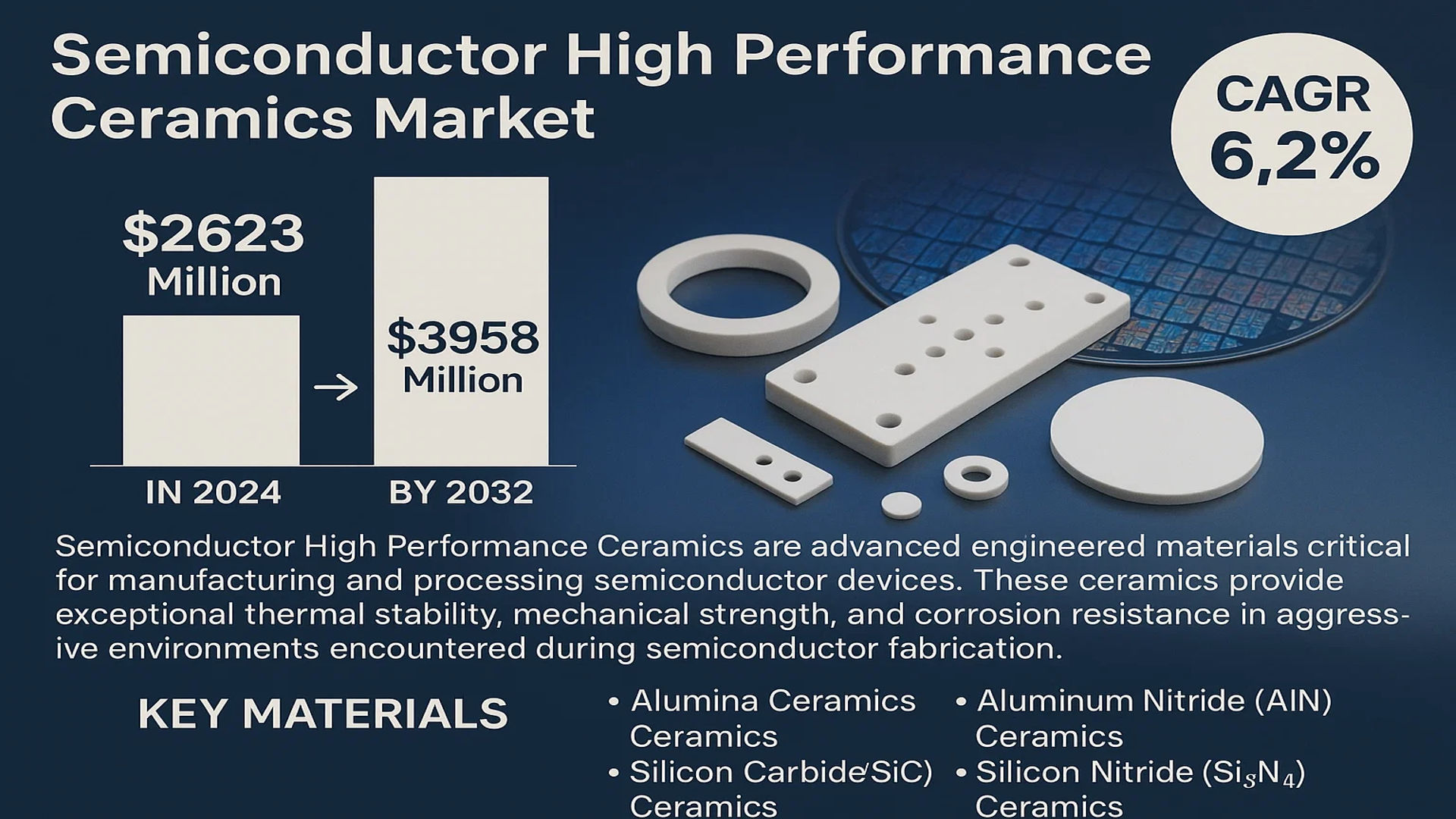
The global Semiconductor High Performance Ceramics Market was valued at 2623 million in 2024 and is projected to reach US$ 3958 million by 2032, at a CAGR of 6.2% during the forecast period.
Semiconductor High Performance Ceramics are advanced engineered materials critical for manufacturing and processing semiconductor devices. These ceramics provide exceptional thermal stability, mechanical strength, and corrosion resistance in aggressive environments encountered during semiconductor fabrication. Key materials include Alumina Ceramics, Aluminum Nitride (AlN) Ceramics, Silicon Carbide (SiC) Ceramics, and Silicon Nitride (Si3N4) Ceramics, which are utilized in components for deposition equipment, etch systems, lithography machines, ion implanters, and wafer handling systems.
The market growth is primarily driven by the expanding global semiconductor industry and the increasing complexity of fabrication processes, which demand highly reliable and durable ceramic components. Furthermore, advancements in artificial intelligence, 5G technology, and the Internet of Things (IoT) are fueling the production of more sophisticated chips, thereby increasing the consumption of high-performance ceramics. The market is highly concentrated, with the top nine players holding a combined market share of over 88%. Japanese manufacturers dominate the landscape, accounting for approximately 68% of the global market share, followed by U.S. and European players.
MARKET DYNAMICS
MARKET DRIVERS
Accelerated Semiconductor Manufacturing Expansion to Propel Demand for High-Performance Ceramics
The global semiconductor industry is experiencing unprecedented growth, driven by the proliferation of artificial intelligence, 5G infrastructure, electric vehicles, and IoT devices. This expansion necessitates advanced fabrication equipment requiring high-performance ceramics for critical components. Semiconductor fabrication equipment spending reached over $100 billion annually, with projections indicating sustained growth. High-performance ceramics provide essential properties including thermal stability, corrosion resistance, and electrical insulation in extreme processing environments. The increasing complexity of semiconductor manufacturing processes, particularly in sub-7nm node technologies, demands ceramic components that can withstand aggressive chemistries and high temperatures exceeding 1000°C. This technological evolution directly correlates with increased ceramic consumption per wafer processed, creating a compound growth effect for the market.
Rising Adoption of Advanced Packaging Technologies to Boost Ceramic Component Utilization
Advanced packaging technologies including 2.5D and 3D integration, fan-out wafer-level packaging, and system-in-package solutions are revolutionizing semiconductor manufacturing. These technologies require sophisticated ceramic substrates and components that provide superior thermal management, dimensional stability, and hermetic sealing properties. The market for advanced packaging is growing at approximately 8% annually, driven by demands for higher performance, miniaturization, and heterogeneous integration. Ceramic materials, particularly aluminum nitride and silicon carbide, offer thermal conductivity values exceeding 170 W/mK, making them indispensable for heat dissipation in high-power applications. The transition to more complex packaging architectures necessitates precision ceramic components that maintain integrity under thermal cycling and mechanical stress, creating sustained demand across multiple semiconductor manufacturing segments.
Moreover, the increasing investment in semiconductor manufacturing capacity worldwide is expected to further accelerate market growth.
➤ For instance, major semiconductor manufacturers have announced capital expenditure plans exceeding $200 billion for new fabrication facilities across multiple regions, each requiring substantial quantities of high-performance ceramic components.
Furthermore, the development of new ceramic compositions with enhanced properties and manufacturing techniques is enabling broader application ranges, supporting market expansion into emerging semiconductor manufacturing processes.
MARKET CHALLENGES
High Manufacturing Costs and Complex Production Processes to Constrain Market Growth
The production of semiconductor-grade high-performance ceramics involves sophisticated manufacturing techniques including hot isostatic pressing, chemical vapor deposition, and precision machining, resulting in significantly higher costs compared to conventional materials. The stringent purity requirements, often demanding 99.9% or higher purity levels, necessitate specialized raw material processing and controlled manufacturing environments. These factors contribute to production costs that can be 5-10 times higher than standard industrial ceramics. The capital investment required for ceramic manufacturing facilities typically ranges from $50 million to $200 million depending on production scale and technology sophistication, creating substantial barriers to market entry and expansion.
Other Challenges
Technical Performance Limitations
Despite their excellent properties, ceramics face challenges in certain applications due to inherent brittleness and difficulty in achieving complex geometries with tight tolerances. The fracture toughness of advanced ceramics, while improved through composite approaches, remains significantly lower than metals, limiting their use in applications requiring high impact resistance. Achieving dimensional tolerances within ±0.0005 inches for critical semiconductor components requires specialized machining capabilities that are both time-consuming and expensive.
Supply Chain Vulnerabilities
The concentration of advanced ceramic manufacturing capabilities in specific geographic regions creates supply chain vulnerabilities. Any disruption in raw material availability or manufacturing operations can significantly impact semiconductor production timelines, as ceramic components often have long lead times ranging from 12 to 24 weeks due to complex manufacturing and quality assurance processes.
MARKET RESTRAINTS
Intense Competition from Alternative Materials to Limit Market Penetration
While high-performance ceramics offer unique advantages, they face increasing competition from advanced composite materials and surface-treated metals in certain semiconductor applications. Materials including carbon-carbon composites, specialized polymers, and metal matrix composites are being developed with properties that challenge traditional ceramic advantages in specific use cases. These alternative materials often offer better machinability, lower production costs, and improved fracture resistance, making them attractive for applications where extreme conditions are less severe. The continuous development of new material technologies creates pressure on ceramic manufacturers to innovate while maintaining cost competitiveness, particularly in price-sensitive market segments.
Additionally, the long development and qualification cycles for new ceramic components, typically requiring 18-36 months for full qualification in semiconductor applications, can delay market adoption and limit responsiveness to rapidly changing technological requirements.
MARKET OPPORTUNITIES
Emerging Applications in Next-Generation Semiconductor Technologies to Create New Growth Avenues
The development of new semiconductor technologies including gallium nitride and silicon carbide power devices, quantum computing components, and advanced memory architectures presents significant opportunities for high-performance ceramics. These emerging applications require materials that can operate under extreme conditions while maintaining precise electrical and thermal properties. The market for wide-bandgap semiconductors is projected to grow at over 40% annually, creating substantial demand for specialized ceramic components that can handle higher power densities and operating frequencies. Ceramic manufacturers are developing new material formulations specifically tailored for these applications, enabling performance characteristics previously unattainable with conventional materials.
Furthermore, the increasing adoption of ceramic matrix composites and functionally graded materials allows for customized property profiles that address specific application requirements, opening new market segments beyond traditional ceramic applications.
Additionally, advancements in additive manufacturing techniques for ceramics are enabling the production of complex geometries that were previously impossible or economically unfeasible, creating opportunities for innovative component designs in semiconductor manufacturing equipment.
SEMICONDUCTOR HIGH PERFORMANCE CERAMICS MARKET TRENDS
Advanced Semiconductor Fabrication Processes Drive Demand for High-Performance Ceramics
The global semiconductor industry’s relentless pursuit of miniaturization and increased processing power is fundamentally driving the demand for high-performance ceramics. As chip manufacturers transition to more advanced nodes, such as 3nm and below, the processing environments become increasingly extreme. These ceramics provide critical thermal management, corrosion resistance, and electrical insulation in equipment like etch, deposition, and lithography systems. The market, valued at approximately $2,623 million in 2024, is projected to grow at a CAGR of 6.2%, reaching nearly $3,958 million by 2032. This growth is intrinsically linked to the expansion of global semiconductor capital expenditure, which exceeded $180 billion in 2023, creating a direct and sustained demand for these essential ceramic components that can withstand highly reactive plasmas and ultra-high temperatures.
Other Trends
Material Innovation for Next-Generation Applications
While alumina and aluminum nitride (AlN) ceramics currently dominate the market with a combined share of over 80%, significant R&D is focused on enhancing the properties of silicon nitride (Si3N4) and silicon carbide (SiC) for more demanding applications. The push for higher thermal conductivity and improved fracture toughness is paramount, especially for components in ion implant and heat treatment equipment where thermal shock resistance is critical. Recent developments have yielded new grades of AlN ceramics with thermal conductivity values exceeding 200 W/mK, a substantial improvement necessary to manage the intense heat generated in modern deposition chambers. Furthermore, the integration of additive manufacturing techniques is beginning to allow for the production of complex, near-net-shape ceramic components that were previously impossible to fabricate, reducing waste and lead times for custom parts.
Geopolitical and Supply Chain Factors Reshaping Manufacturing Hubs
The strategic importance of semiconductor self-sufficiency is causing a significant geographical shift in manufacturing and, consequently, in the demand for high-performance ceramics. While Japanese manufacturers currently command a dominant 68% share of the global market, major government initiatives like the U.S. CHIPS and Science Act and similar programs in Europe and China are catalyzing the construction of new fabrication plants (fabs) outside of traditional hubs. This is compelling established ceramic component suppliers to expand their production capacities and establish local presences in these emerging regions to mitigate supply chain risks and meet the stringent just-in-time delivery requirements of semiconductor manufacturers. This trend is fostering increased competition and potential for regional specialization, as new fabs often specify ceramics that meet the unique demands of their specific tool sets and processes.
COMPETITIVE LANDSCAPE
Key Industry Players
Market Dominance Driven by Technological Expertise and Strategic Expansion
The global Semiconductor High Performance Ceramics market exhibits a highly concentrated competitive structure, dominated by a handful of established players from key manufacturing regions. This concentration is underscored by the fact that the top nine companies collectively command over 88% of the total market share. Japanese manufacturers are the undisputed leaders, holding a dominant share of approximately 68%, a testament to their long-standing expertise in advanced materials science and deep integration into the global semiconductor supply chain.
NGK Insulators, Ltd. and Kyocera Corporation are pivotal forces in the market. Their leadership is anchored in extensive R&D capabilities, a comprehensive portfolio of alumina and aluminum nitride (AlN) ceramics, and strategic long-term partnerships with major semiconductor fabrication equipment (SemiFab) manufacturers. Similarly, Ferrotec Corporation and TOTO Advanced Ceramics (a subsidiary of TOTO LTD.) hold significant market positions, leveraging their specialized material formulations for critical applications in extreme environments, such as etch and deposition chambers.
Furthermore, these industry giants are actively strengthening their positions through strategic expansions and acquisitions to bolster production capacity and technological prowess. This is a direct response to the escalating demand driven by the global semiconductor industry’s expansion. Meanwhile, Western players like CoorsTek Inc. (U.S.) and Morgan Advanced Materials (U.K.) maintain a strong presence, particularly in North America and Europe, by focusing on high-purity, high-thermal-conductivity ceramics essential for next-generation chip manufacturing. Their growth is fueled by continuous innovation and customization to meet the precise requirements of leading-edge lithography and wafer handling systems.
While the market is led by these behemoths, a cohort of specialized players, including Maruwa Co., Ltd. and CeramTec GmbH, compete effectively in niche segments. These companies focus on high-value applications, such as ceramic components for ion implant equipment and critical wafer inspection tools, by offering superior material properties and reliability. Their strategy involves deep technical collaboration with equipment OEMs to develop bespoke solutions, ensuring their continued relevance in a market where performance tolerances are exceptionally tight.
List of Key Semiconductor High Performance Ceramics Companies Profiled
- NGK Insulators, Ltd. (Japan)
- Kyocera Corporation (Japan)
- Ferrotec Corporation (Japan)
- TOTO Advanced Ceramics (Japan)
- Niterra Co., Ltd. (Japan)
- ASUZAC Fine Ceramics (Japan)
- CoorsTek Inc. (U.S.)
- Morgan Advanced Materials (U.K.)
- 3M Company (U.S.)
- CeramTec GmbH (Germany)
- Saint-Gobain (France)
- Maruwa Co., Ltd. (Japan)
Segment Analysis:
By Material
Alumina Ceramics Segment Dominates the Market Due to its Exceptional Mechanical Strength and Cost-Effectiveness
The market is segmented based on material into:
- Alumina Ceramics
- AlN Ceramics
- SiC Ceramics
- Si3N4 Ceramics
- Others
By Application
Semiconductor Deposition Equipment Segment Leads Due to Critical Role in Advanced Chip Fabrication Processes
The market is segmented based on application into:
- Semiconductor Deposition Equipment
- Semiconductor Etch Equipment
- Lithography Machines
- Ion Implant Equipment
- Heat Treatment Equipment
- CMP Equipment
- Wafer Handling
- Assembly Equipment
- Others
By End User
Semiconductor Fabrication Facilities Segment Dominates Owing to High Volume Consumption of Ceramic Components
The market is segmented based on end user into:
- Semiconductor Fabrication Facilities (Fabs)
- Semiconductor Equipment Manufacturers
- Research and Development Institutes
- Others
By Function
Wafer Processing Components Segment Leads Due to Extensive Use in Critical Manufacturing Stages
The market is segmented based on function into:
- Wafer Processing Components
- Thermal Management Components
- Mechanical Structural Components
- Electrostatic Chucks
- Others
Regional Analysis: Semiconductor High Performance Ceramics Market
Asia-Pacific
The Asia-Pacific region dominates the global semiconductor high performance ceramics market, holding the largest market share estimated at over 68% of global production value, driven primarily by Japan’s established manufacturing base. Japan is home to industry titans like NGK Insulators, Kyocera, and TOTO Advanced Ceramics, which collectively command a significant portion of the global supply. This regional hegemony is supported by decades of advanced material science research and deep integration with leading semiconductor fabrication equipment (SFE) manufacturers. South Korea and China are also critical hubs, fueled by massive domestic semiconductor fabrication plant (fab) investments and strong government support for technological sovereignty. The relentless push for smaller process nodes (e.g., sub-5nm) and the expansion of memory production necessitate increasingly sophisticated ceramic components for etch, deposition, and wafer handling applications, ensuring sustained demand. While cost competitiveness is a key advantage, the focus is intensely on R&D to develop next-generation materials like high-purity Aluminum Nitride (AlN) and Silicon Carbide (SiC) ceramics that meet the extreme thermal and chemical stability requirements of advanced manufacturing processes.
North America
North America, particularly the United States, is a significant and technologically advanced market, accounting for approximately 10.2% of global manufacturing share. The region’s strength lies in its robust R&D ecosystem, presence of major semiconductor equipment OEMs, and key ceramic manufacturers like Coorstek and 3M. Growth is heavily driven by the strategic onshoring of semiconductor manufacturing, catalyzed by legislation such as the CHIPS and Science Act, which allocates billions in funding for domestic fab construction and expansion. This creates direct demand for high-performance ceramics used in the tools that populate these new facilities. The market is characterized by a high emphasis on innovation, with companies developing ceramics for cutting-edge applications in extreme ultraviolet (EUV) lithography and advanced packaging. Collaboration between national labs, universities, and private companies accelerates the development of new ceramic formulations with enhanced properties like superior thermal conductivity and plasma resistance, which are critical for maintaining process yield at leading-edge nodes.
Europe
Europe holds a stable and technologically sophisticated position in the market, with a manufacturing share of about 10.3%. The region benefits from a strong presence of global players like Morgan Advanced Materials and CeramTec, as well as a well-established semiconductor equipment industry. European demand is underpinned by the EU’s ambitions to double its global semiconductor market share by 2030, as outlined in the European Chips Act, which is spurring investments in new production facilities. The regional market is characterized by a strong focus on precision engineering, quality, and developing ceramics for highly specialized applications, including those for power semiconductors and micro-electromechanical systems (MEMS). Environmental regulations and a focus on sustainability also influence material development, pushing for more durable and longer-lasting components to reduce waste in semiconductor manufacturing processes. While not the volume leader, Europe remains a crucial center for high-value, precision ceramic solutions.
South America
The semiconductor high performance ceramics market in South America is nascent and relatively small on the global stage. The region’s involvement is primarily as a consumer of semiconductor devices rather than a manufacturer of the advanced ceramics or the fabs themselves. Local demand is limited to maintenance, repair, and operations (MRO) for existing industrial and electronics manufacturing equipment. There is minimal local production capability for these specialized advanced technical ceramics. Economic volatility and a lack of a significant domestic semiconductor fabrication industry are the primary factors limiting market development. Consequently, the region relies almost entirely on imports from North American, European, and Asian suppliers to meet its niche requirements, with growth tied to the broader expansion of the industrial and electronics manufacturing sectors in countries like Brazil and Argentina.
Middle East & Africa
The market in the Middle East & Africa is in its very early stages of development. Similar to South America, the region lacks a foundational semiconductor manufacturing ecosystem, which is the primary driver for high-performance ceramics. Current demand is sporadic and confined to ceramics required for equipment used in downstream electronics assembly or other industrial processes. However, long-term potential exists, particularly in the Middle East, where nations like Saudi Arabia and the UAE are making substantial investments to diversify their economies under initiatives like Vision 2030. These plans include developing advanced technological and industrial sectors, which could eventually lead to the establishment of semiconductor-related industries. For the foreseeable future, however, the market will remain import-dependent, with any growth being incremental and linked to general industrial advancement rather than specific semiconductor fab investments.
Report Scope
This market research report provides a comprehensive analysis of the global Semiconductor High Performance Ceramics market, covering the forecast period 2025–2032. It offers detailed insights into market dynamics, technological advancements, competitive landscape, and key trends shaping the industry.
Key focus areas of the report include:
- Market Size & Forecast: Historical data and future projections for revenue, unit shipments, and market value across major regions and segments.
- Segmentation Analysis: Detailed breakdown by material type, application, and end-user industry to identify high-growth segments and investment opportunities.
- Regional Outlook: Insights into market performance across North America, Europe, Asia-Pacific, Latin America, and the Middle East & Africa, including country-level analysis where relevant.
- Competitive Landscape: Profiles of leading market participants, including their product offerings, R&D focus, manufacturing capacity, pricing strategies, and recent developments such as mergers, acquisitions, and partnerships.
- Technology Trends & Innovation: Assessment of emerging technologies, integration of advanced materials, semiconductor fabrication techniques, and evolving industry standards.
- Market Drivers & Restraints: Evaluation of factors driving market growth along with challenges, supply chain constraints, regulatory issues, and market-entry barriers.
- Stakeholder Analysis: Insights for component suppliers, OEMs, system integrators, investors, and policymakers regarding the evolving ecosystem and strategic opportunities.
Primary and secondary research methods are employed, including interviews with industry experts, data from verified sources, and real-time market intelligence to ensure the accuracy and reliability of the insights presented.
FREQUENTLY ASKED QUESTIONS:
What is the current market size of Global Semiconductor High Performance Ceramics Market?
-> Semiconductor High Performance Ceramics Market was valued at 2623 million in 2024 and is projected to reach US$ 3958 million by 2032, at a CAGR of 6.2% during the forecast period.
Which key companies operate in Global Semiconductor High Performance Ceramics Market?
-> Key players include NGK Insulators, Kyocera, Ferrotec, TOTO Advanced Ceramics, Coorstek, Morgan Advanced Materials, Niterra Co., Ltd., ASUZAC Fine Ceramics, and 3M, among others. The top nine players hold over 88% of the global market share.
What are the key growth drivers?
-> Key growth drivers include increasing semiconductor manufacturing activities, demand for advanced fabrication equipment, expansion of AI and IoT applications, and the critical need for materials with high thermal stability and corrosion resistance in semiconductor processing environments.
Which region dominates the market?
-> Asia-Pacific is the dominant region, with manufacturers from Japan holding approximately 68% of the global market share, followed by the United States with 10.2% and Europe with 10.3%.
What are the emerging trends?
-> Emerging trends include development of ultra-high purity ceramics, integration of ceramics in advanced packaging solutions, expansion into compound semiconductor applications, and increasing adoption of aluminum nitride (AlN) ceramics for superior thermal management.

Get Sample Report PDF for Exclusive Insights
Report Sample Includes
- Table of Contents
- List of Tables & Figures
- Charts, Research Methodology, and more...
 Download Sample Report PDF