Semiconductor Glass Substrate Market Insights
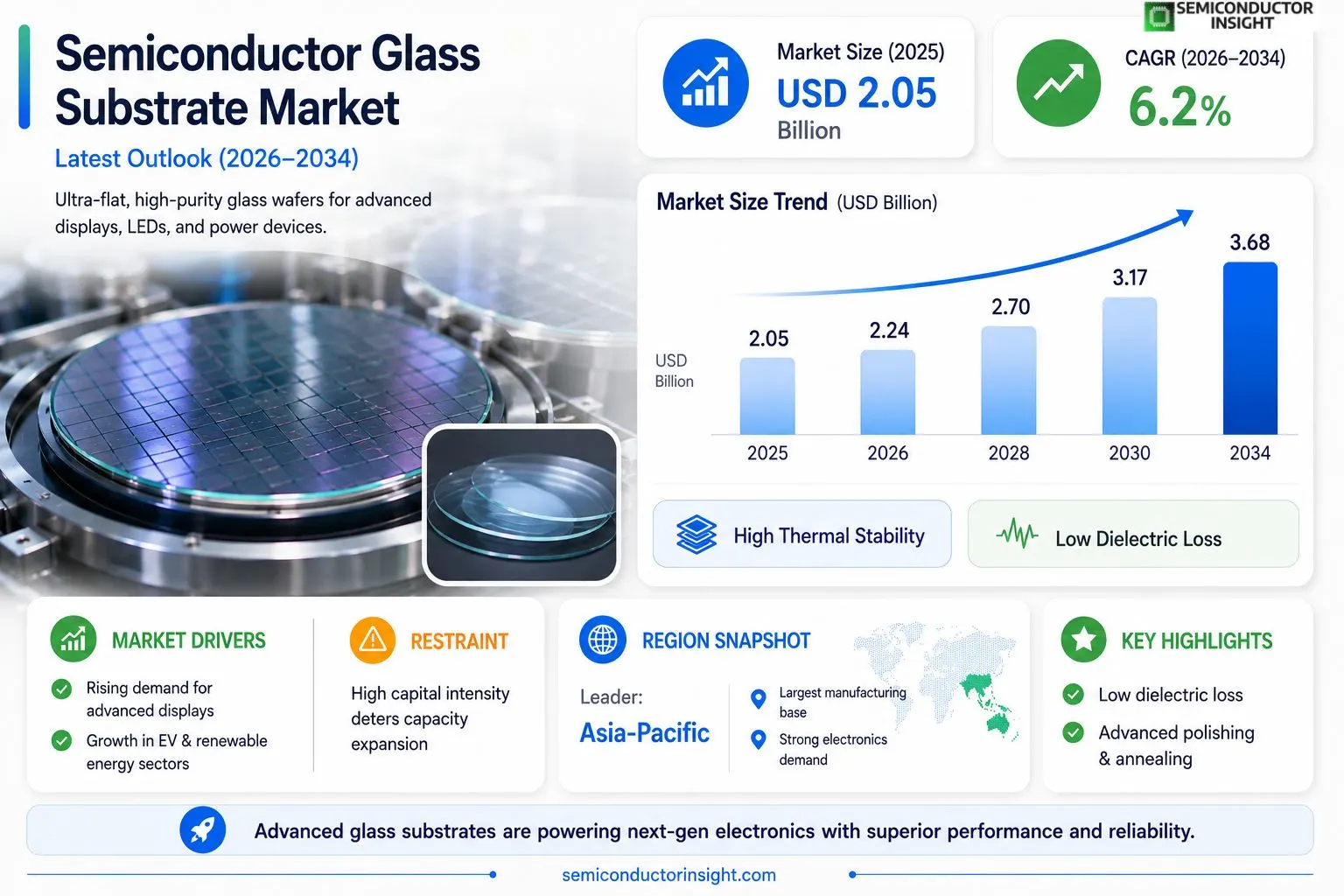
Global Semiconductor Glass Substrate market size was valued at USD 2.05 billion in 2026. The market is projected to grow from USD 2.05 billion in 2026 to USD 3.68 billion by 2034, exhibiting a CAGR of 6.2% during the forecast period.
Semiconductor glass substrates are ultra‑flat, high‑purity glass wafers that serve as foundational platforms for thin‑film deposition in advanced electronic components such as display panels, light‑emitting diodes (LEDs), and power devices. Their exceptional thermal stability, low dielectric loss, and smooth surface morphology enable precise patterning and reliable performance in high‑frequency and high‑power applications.The market is experiencing rapid growth because of rising demand for next‑generation displays, increasing adoption of electric vehicles that require efficient power modules, and expanding investments in renewable energy technologies that rely on high‑performance semiconductor components. Furthermore, advancements in glass manufacturing techniques,such as chemical‑mechanical polishing and low‑temperature annealing,are reducing defect rates and cost structures, thereby attracting new entrants and encouraging existing players to expand capacity.
MARKET DRIVERS
Rising Demand for Advanced Display Technologies
Semiconductor Glass Substrate Market is being propelled by the expansion of high‑resolution display panels used in smartphones, tablets, and emerging AR/VR headsets. Manufacturers are seeking substrates that deliver superior optical clarity and thermal stability, which in turn drives volume growth across tier‑1 display fabs.
Manufacturing Efficiency Improvements
Process innovations such as low‑temperature annealing and advanced chemical‑mechanical polishing are reducing cycle times and waste. These efficiency gains enable cost‑competitive production of glass substrates, encouraging broader adoption by semiconductor equipment makers.
➤ “Industry analysts project a steady CAGR as substrate quality aligns with next‑gen chip architectures.”
Overall, the convergence of consumer electronics growth and production cost reductions forms a robust foundation for Semiconductor Glass Substrate Market to sustain its upward trajectory.
MARKET CHALLENGES
Cost Sensitivity and Supply Constraints
Despite demand, the high capital intensity of glass substrate production creates price pressure, especially for small‑volume manufacturers. Limited furnace capacity in key regions can lead to lead‑time extensions, affecting supply chain reliability.
Other Challenges
Key Technical Barriers
Achieving uniform thickness at large wafer sizes remains difficult, and any deviation can impact yield rates for downstream semiconductor processes.Addressing these challenges requires coordinated investment in equipment upgrades and strategic partnerships to secure raw‑material pipelines.
MARKET RESTRAINTS
Regulatory and Environmental Issues
Stringent environmental regulations on glass manufacturing emissions limit the expansion of new production lines. Compliance costs associated with waste disposal and energy consumption add to the operational burden.Furthermore, the scarcity of high‑purity silica sand in certain regions constrains the scaling of substrate output, imposing an additional restraint on market growth.
MARKET OPPORTUNITIES
Emerging Applications in 5G and Automotive
5G infrastructure and next‑generation automotive electronics require substrates that can sustain higher frequency operation and thermal loads. Glass substrates offer the necessary dielectric properties, opening new revenue streams for suppliers.Regional expansion, particularly in Southeast Asia and Eastern Europe, presents untapped opportunities as local manufacturers invest in advanced packaging capabilities that rely on high‑performance glass substrates.
Semiconductor Glass Substrate Market Trends
Growing Demand for High‑Performance Displays
Semiconductor Glass Substrate Market is being driven by a surge in next‑generation display technologies such as OLED and micro‑LED panels. Ultra‑flat, high‑purity glass wafers provide the surface uniformity needed for thin‑film deposition, enabling higher pixel densities and improved color accuracy. As consumer preferences shift toward larger, flexible, and more energy‑efficient screens, manufacturers are increasingly selecting glass substrates for their thermal stability and low dielectric loss. This trend is reinforced by supply‑chain investments that have lowered defect rates, allowing producers to meet tighter volume requirements without compromising quality.
Other Trends
Manufacturing Process Innovations
Advances in chemical‑mechanical polishing and low‑temperature annealing are reshaping Semiconductor Glass Substrate Market. These techniques reduce surface irregularities and minimize thermal stress, which in turn improves yield and reduces overall production costs. Automation of wafer handling and real‑time inspection further enhances throughput, making it feasible for new entrants to compete alongside established players. The cumulative effect is a more resilient cost structure that supports broader adoption across multiple device categories.
Expansion into Power Electronics for EVs and Renewable Energy
Electric vehicles and renewable energy systems are creating a parallel demand vector for Semiconductor Glass Substrate Market. Power modules in EVs require components that can operate at high voltages and temperatures while maintaining low loss characteristics. Glass substrates meet these criteria, offering superior insulating properties compared to traditional silicon platforms. Simultaneously, solar inverters and wind‑turbine converters are integrating high‑frequency semiconductor devices that benefit from the smooth morphology of glass wafers. The convergence of these sectors is prompting OEMs to increase procurement volumes, reinforcing the market’s growth trajectory.
COMPETITIVE LANDSCAPEKey Industry Players
Semiconductor Glass Substrate Market Competitive Landscape
Semiconductor Glass Substrate Market is currently dominated by a small cohort of large, vertically integrated glass manufacturers that combine high‑purity glass production with advanced polishing and annealing capabilities. Corning Inc., leveraging its Gorilla® Glass technology platform, has rapidly scaled its capacity to serve thin‑film LED and power‑device manufacturers, positioning itself as the market leader in volume and technology depth. SCHOTT AG follows closely, capitalising on its extensive heritage in low‑dielectric‑loss glass for high‑frequency applications, and it has expanded its dedicated semiconductor substrate lines to meet the rising demand from electric‑vehicle power modules and next‑generation display panels. The market structure reflects high entry barriers, with these incumbents controlling most of the supply chain, from raw glass batching to precision wafer finishing, and setting pricing benchmarks for the emerging segment.Beyond the two dominant players, a diverse set of niche manufacturers is strengthening the competitive fabric of the market. LG Siltron and Asahi Glass Co., Ltd. focus on specialty glass for display back‑planes and high‑efficiency LEDs, while Nippon Electric Glass and Hoya Corporation provide ultra‑flat substrates for RF power devices. Shin‑Etsu Chemical, Kyocera Corporation, and Sumitomo Chemical target high‑temperature processing niches, delivering substrates with superior thermal stability for power‑electronics. Imperial Materials and Murata Manufacturing add depth in advanced thin‑film deposition platforms, and Sumitomo Electric contributes integrated solutions for automotive power modules. Collectively, these firms enhance product differentiation and drive incremental innovation across the semiconductor glass substrate value chain.
List of Key Semiconductor Glass Substrate Companies Profiled
- Corning Inc.
- SCHOTT AG
- LG Siltron
- Asahi Glass Co., Ltd.
- Nippon Electric Glass
- Hoya Corporation
- Shin‑Etsu Chemical
- Kyocera Corporation
- Sumitomo Chemical
- Imperial Materials
- Murata Manufacturing
- Sumitomo Electric
Segment Analysis:
| Segment Category | Sub-Segments | Key Insights |
| By Type |
|
Raspberry‑glass substrates are emerging as the leading type because they combine ultra‑flatness with high thermal stability, enabling precise thin‑film patterning for high‑frequency devices.
|
| By Application |
|
Power electronics dominate the application landscape as they demand substrates that withstand high current densities and thermal cycling.
|
| By End User |
|
Automotive OEMs lead the end‑user segment because they require highly reliable substrates for power modules in electric vehicles.
|
| By Manufacturing Process |
|
CMP is regarded as the leading process because it consistently delivers ultra‑flat surfaces essential for high‑frequency device fabrication.
|
| By Performance Attribute |
|
Thermal stability emerges as the most critical attribute, guiding substrate selection across all application domains.
|
Regional Analysis: North America
North America
The North American manufacturing sector for semiconductor glass substrates is characterized by a blend of established players and specialized companies focusing on high-precision production. Investment in automation and advanced manufacturing techniques is key to maintaining a competitive edge in this demanding market. The region benefits from a skilled workforce, although talent acquisition remains a challenge.
Key technological trends in the North American market include the increasing adoption of larger wafer sizes and the development of advanced glass substrate materials to support next-generation semiconductor devices. Research and development efforts are focused on enhancing substrate performance, reliability, and cost-effectiveness. Innovation in surface treatment and polishing technologies are also gaining traction.
The supply chain for semiconductor glass substrates in North America is relatively well-established, with key suppliers catering to domestic and international demand. However, geopolitical factors and supply chain disruptions have highlighted the importance of diversification and resilience. Close collaboration between substrate manufacturers, equipment suppliers, and semiconductor foundries is essential for optimizing the value chain.
The primary drivers for Semiconductor Glass Substrate Market in North America are the growth of the automotive electronics industry, the increasing demand for high-performance computing, and the expansion of the artificial intelligence market. Government initiatives supporting domestic semiconductor manufacturing are also contributing to market growth.
Europe
The European semiconductor glass substrate market exhibits a strong focus on innovation and sustainability. Several countries in Europe, particularly Germany, France, and the Netherlands, host significant semiconductor manufacturing hubs. The region is actively investing in research and development to develop next-generation glass substrate technologies that support advanced semiconductor devices. Environmental regulations and a growing emphasis on circular economy principles are influencing manufacturing practices. The European market is characterized by a diverse range of players, from specialized manufacturers to larger industrial corporations. The drive towards energy efficiency and reduced carbon footprint is shaping the future of the glass substrate industry. Growth in Europe is closely tied to the overall health of the automotive and industrial sectors.
Asia-Pacific
Asia-Pacific dominates the global semiconductor glass substrate market, driven by the massive growth of semiconductor manufacturing in countries like Taiwan, South Korea, and China. The region’s robust electronics industry and increasing demand for consumer electronics fuel the need for high-quality glass substrates. The Asia-Pacific market is characterized by intense competition among manufacturers, leading to price pressures and a focus on cost optimization. Significant investments are being made in expanding production capacity and developing advanced glass substrate technologies. Government support and strategic initiatives are playing a crucial role in fostering growth in the region. The Asia-Pacific market is expected to maintain its leadership position in the coming years.
South America
The South American semiconductor glass substrate market is a relatively nascent but promising market. The region’s growing electronics industry and increasing adoption of technology are driving demand for glass substrates. While the market is smaller compared to North America, Europe, and Asia-Pacific, it offers significant growth potential. The development of local manufacturing capabilities and government initiatives supporting the electronics sector are expected to further stimulate market growth. Challenges include limited infrastructure and a relatively small skilled workforce. The South American market presents opportunities for specialized glass substrate suppliers catering to specific regional needs.
Middle East & Africa
The Middle East & Africa semiconductor glass substrate market is in its early stages of development. The region is witnessing increasing investments in electronics and telecommunications infrastructure, leading to a gradual rise in demand for glass substrates. The growth is primarily driven by countries like Saudi Arabia, the UAE, and South Africa. The market is relatively fragmented, with a mix of local and international suppliers. Challenges include limited domestic manufacturing capacity and a reliance on imports. However, the region’s economic diversification plans and investments in technology are expected to drive future market growth.
Report Scope
This market research report provides a comprehensive analysis of the Semiconductor Glass Substrate Market , covering the forecast period 2026–2034. It offers detailed insights into market dynamics, technological advancements, competitive landscape, and key trends shaping the industry.
Key focus areas of the report include:
- Market Overview: The report begins with an overview outlining its current market scenario, key growth indicators, and industry transformation drivers. It discusses macroeconomic factors, demand–supply balance, regulatory landscape, and the strategic role of semiconductors in powering advancements across industries such as automotive, telecommunications, consumer electronics, and industrial automation.
- Market Size & Forecast: Historical data and future projections for revenue, unit shipments, and market value across major regions and segments.
- Segmentation Analysis: Detailed breakdown by product type, technology, application, and end-user industry to identify high-growth segments and investment opportunities.
- Regional Insights: Insights into market performance across North America, Europe, Asia-Pacific, Latin America, and the Middle East & Africa, including country-level analysis where relevant.
- Competitive Landscape: Profiles of leading market participants, including their product offerings, R&D focus, manufacturing capacity, pricing strategies, and recent developments such as mergers, acquisitions, and partnerships.
- Technology Trends & Innovation: Assessment of emerging technologies, integration of AI/IoT, semiconductor design trends, fabrication techniques, and evolving industry standards.
- Market Drivers & Restraints: Evaluation of factors driving market growth along with challenges, supply chain constraints, regulatory issues, and market-entry barriers.
- Stakeholder Insights: Insights for component suppliers, OEMs, system integrators, investors, and policymakers regarding the evolving ecosystem and strategic opportunities.
Primary and secondary research methods are employed, including interviews with industry experts, data from verified sources, and real-time market intelligence to ensure the accuracy and reliability of the insights presented.
FREQUENTLY ASKED QUESTIONS:
What is the current market size of Semiconductor Glass Substrate Market?
-> Semiconductor Glass Substrate Market was valued at USD 2.05 billion in 2026 and is expected to reach USD 3.68 billion by 2034.
Which key companies operate in Semiconductor Glass Substrate Market?
-> Key players include Axalta Coating Systems, AkzoNobel, BASF SE, PPG, Sherwin-Williams, and 3M, among others.
What are the key growth drivers?
-> Key growth drivers include railway infrastructure investments, urbanization, and demand for durable coatings.
Which region dominates the market?
-> Asia-Pacific is the fastest-growing region, while Europe remains a dominant market.
What are the emerging trends?
-> Emerging trends include bio-based coatings, smart coatings, and sustainable rail solutions.
Get Sample Report PDF for Exclusive Insights
Report Sample Includes
- Table of Contents
- List of Tables & Figures
- Charts, Research Methodology, and more...
 Download Sample Report PDF