Semiconductor for Remote Patient Monitoring Market Insights
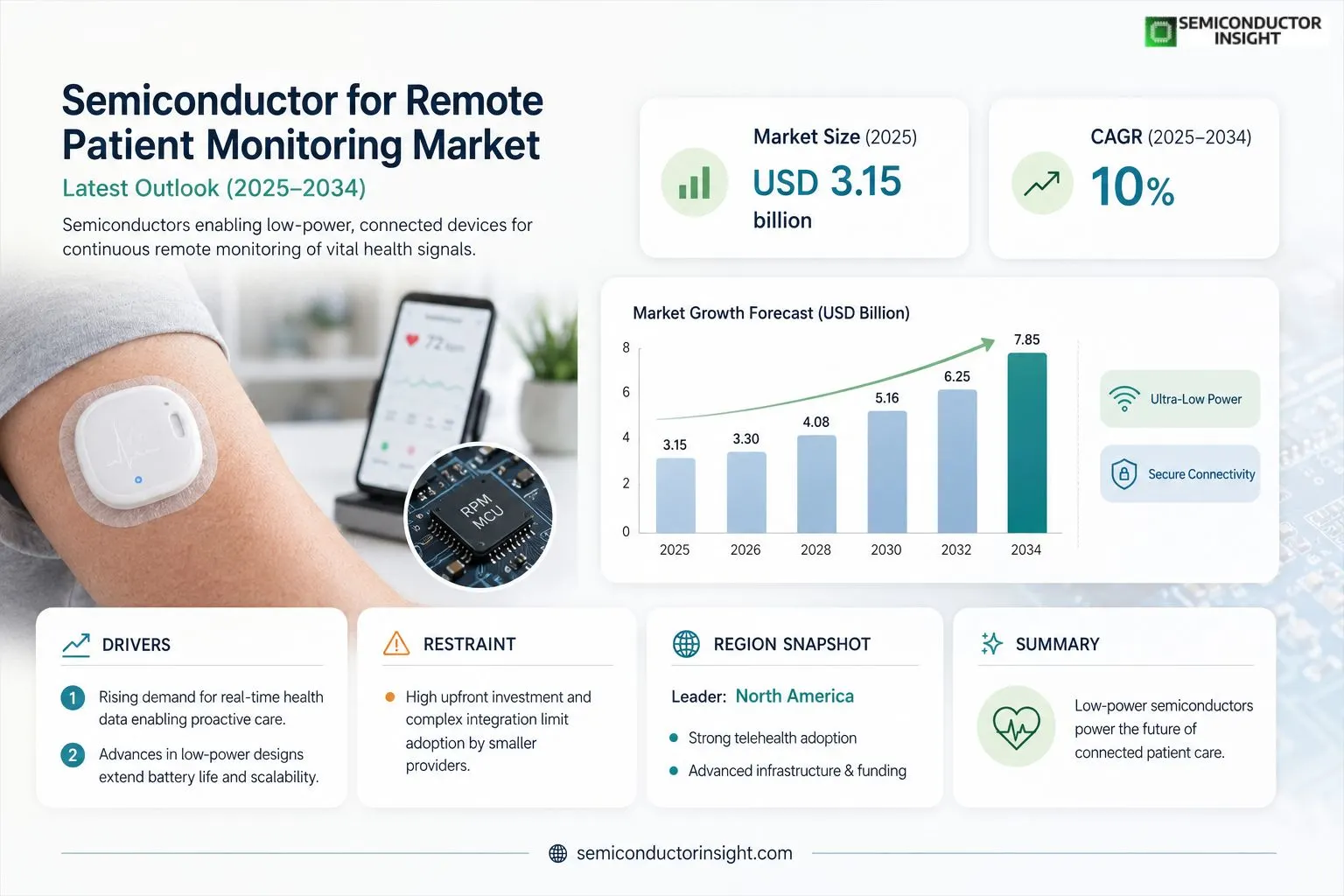
Global semiconductor for remote patient monitoring market size was valued at USD 3.15 billion in 2025. The market is projected to grow from USD 3.30 billion in 2025 to USD 7.85 billion by 2034, exhibiting a CAGR of 10% during the forecast period.
Semiconductors designed for remote patient monitoring encompass low‑power microcontrollers, analog front ends, wireless transceivers and system‑in‑package solutions that enable continuous acquisition of physiological signals such as ECG, SpO₂, blood pressure and glucose levels.
These components are engineered for ultra‑low energy consumption,secure data transmissionand compliance with medical standards,
making them essential building blocks of wearable patches,implantable telemetry unitsand bedside telehealth hubs.The market is experiencing rapid growth because healthcare providers are accelerating adoption of telehealth services and patients increasingly demand home‑based care solutions.Furthermore,advances in Bluetooth Low Energyand LTE‑Cat‑M technologies are expanding connectivity options while reducing battery drain.Key players such as Texas Instruments,Analog Devices, STMicroelectronics,NXP Semiconductorsand Infineon Technologies are actively expanding their product portfolios
MARKET DRIVERS
Growing Demand for Real‑Time Health Data
Semiconductor for Remote Patient Monitoring Market is being propelled by a surge in demand for continuous, real‑time physiological data. Healthcare providers are increasingly adopting wearable sensors that rely on low‑power, high‑precision chips to transmit vital signs instantly, enabling proactive care models.
Advancements in Low‑Power Design
Recent breakthroughs in sub‑nanometer process technologies have reduced power consumption by up to 40%, extending battery life of monitoring devices and making large‑scale deployments financially viable. This technical progress directly fuels market expansion.
➤ “Device uptime exceeding six months without battery replacement is now a realistic benchmark for remote monitoring solutions.”
Additionally, government incentives for telehealth infrastructure are encouraging hospitals to integrate semiconductor‑enabled platforms, further accelerating adoption across both urban and rural settings.
MARKET CHALLENGES
Regulatory Compliance Complexity
Manufacturers face stringent medical device regulations that vary across regions, requiring extensive validation of semiconductor components to meet safety and efficacy standards. This creates longer time‑to‑market cycles.
Other Challenges
Supply Chain Vulnerabilities
Global shortages of silicon wafers and packaging materials can delay production runs, impacting the ability to scale remote monitoring solutions quickly.
MARKET RESTRAINTS
High Initial Capital Expenditure
Deploying advanced semiconductor platforms requires significant upfront investment in R&D, testing, and certification. Smaller healthcare providers often lack the financial resources to adopt these technologies at scale.Moreover, the need for specialized integration expertise adds to implementation costs, limiting rapid rollout in cost‑sensitive markets.
MARKET OPPORTUNITIES
Integration with AI‑Driven Analytics
Embedding AI processors alongside semiconductors opens new avenues for predictive health insights, turning raw biometric streams into actionable alerts. This convergence is expected to create high‑margin revenue streams.Emerging markets in Asia‑Pacific are investing heavily in 5G infrastructure, which will support low‑latency data transfer for remote monitoring devices, presenting a sizable growth frontier.Finally, collaborations between semiconductor firms and pharmaceutical companies are fostering bespoke chips tailored for drug adherence monitoring, expanding the addressable market beyond traditional vital‑sign tracking.
Semiconductor for Remote Patient Monitoring Market Trends
Low‑Power Chip Integration Accelerates Adoption
Semiconductor for Remote Patient Monitoring Market is being reshaped by the rapid integration of ultra‑low‑power microcontrollers and analog front‑end solutions. These components enable continuous capture of vital signs such as ECG, SpO₂, blood pressure, and glucose while consuming minimal energy. Manufacturers prioritize designs that meet stringent medical safety standards and support secure wireless data transmission. As telehealth services expand, healthcare providers seek devices that can operate for weeks on a single charge, driving demand for semiconductor architectures that balance high precision with energy efficiency. This shift is evident in the growing deployment of wearable patches and bedside telemetry units, where the semiconductor layer determines device reliability and patient comfort. Hospitals are integrating these chips into bedside monitoring stations to streamline data flow into electronic health records, further cementing the role of semiconductors as foundational to digital health ecosystems.
Other Trends
Expanding Connectivity Options
Advances in Bluetooth Low Energy (BLE) and LTE‑Cat‑M are broadening the connectivity toolkit for remote health devices. BLE’s streamlined protocol reduces radio‑on time, which directly lowers battery consumption, allowing sensors to remain operational for extended periods without recharging. LTE‑Cat‑M, on the other hand, offers broader coverage and higher data throughput, supporting more complex signal processing and real‑time alerts across regional networks. The convergence of these technologies enables manufacturers to design hybrid modules that switch between short‑range and cellular links based on signal quality, enhancing reliability in both urban and rural settings. Manufacturers also leverage over‑the‑air (OTA) update capabilities, ensuring that firmware enhancements can be delivered securely without physical device access. As a result, clinicians can monitor patients continuously with fewer interruptions, and patients experience less frequent device maintenance.
Competitive Portfolio Diversification
Key industry players such as Texas Instruments, Analog Devices, STMicroelectronics, NXP Semiconductors, and Infineon Technologies are actively broadening their semiconductor portfolios to address the specific needs of remote patient monitoring. Product roadmaps now emphasize integrated system‑in‑package (SiP) solutions that combine microcontroller cores, analog front ends, and RF transceivers on a single die, reducing board space and simplifying device design. These firms also invest in certification programs to ensure compliance with emerging medical standards, thereby shortening time‑to‑market for new wearable and implantable solutions. The intensified focus on application‑specific integration is driving a shift from generic components toward purpose‑built chips, positioning Semiconductor for Remote Patient Monitoring Market for sustained growth. Emerging startups are entering the space with niche solutions focused on glucose monitoring and chronic disease management, prompting incumbents to accelerate innovation cycles.
COMPETITIVE LANDSCAPEKey Industry Players
Semiconductor Solutions Driving Remote Patient Monitoring Growth
The remote patient monitoring (RPM) semiconductor segment is anchored by a handful of large‐scale integrated device manufacturers that supply low‑power microcontrollers, analog front‑ends, and system‑in‑package modules. Texas Instruments, Analog Devices, STMicroelectronics, NXP Semiconductors and Infineon Technologies together command the majority of market share, leveraging extensive design ecosystems and regulatory certifications to dominate wearable patch and bedside hub deployments. Their product roadmaps emphasize ultra‑low energy consumption, integrated security, and compliance with IEC 60601 standards, enabling hospitals and telehealth providers to scale continuous biometric capture while keeping device lifetimes in the multi‑year range.Beyond the core incumbents, a diverse set of niche players contributes specialized IP that broadens the connectivity and sensor‑front‑end options for RPM solutions. Qualcomm and MediaTek supply advanced Bluetooth Low‑Energy and LTE‑Cat‑M connectivity chips that reduce battery drain in wearables. Silicon Labs, Skyworks Solutions and Broadcom focus on RF front‑end modules and power‑management ICs optimized for medical‑grade data integrity. Renesas Electronics, ON Semiconductor, Maxim Integrated, Marvell Technology and Cypress Semiconductor (now part of Infineon) deliver precision analog front‑ends, glucose‑sensor interfaces, and mixed‑signal processors that cater to implantable telemetry units and niche therapeutic devices. Collectively, these firms enrich the supply chain with differentiated functionality, fostering innovation across the RPM value chain.
List of Key Semiconductor Companies Profiled
- Texas Instruments
- Analog Devices
- STMicroelectronics
- NXP Semiconductors
- Infineon Technologies
- Qualcomm
- MediaTek
- Silicon Labs
- Skyworks Solutions
- Renesas Electronics
- ON Semiconductor
- Maxim Integrated
- Broadcom
- Marvell Technology
- Cypress Semiconductor
Segment Analysis:
| Segment Category | Sub-Segments | Key Insights |
| By Type |
|
Low‑power microcontrollers
|
| By Application |
|
Wearable health patches
|
| By End User |
|
Hospitals and health systems
|
| By Connectivity |
|
BLE solutions
|
| By Regulatory Compliance |
|
IEC 60601‑1 safety focus
|
Regional Analysis: North America
North America
Rapid advancements in semiconductor technology are enabling smaller, more powerful, and energy-efficient remote patient monitoring devices. This includes innovations in sensor technology, wireless communication protocols, and data analytics capabilities.
The regulatory environment in North America, particularly in the United States, plays a significant role in shaping the market. Compliance with FDA regulations is crucial for manufacturers of remote patient monitoring devices, influencing product development and market entry strategies.
Significant venture capital and private equity investments are flowing into companies developing innovative semiconductor solutions for remote patient monitoring. This influx of capital is accelerating research and development efforts and driving market growth.
Growing concerns around data security and privacy are prompting the development of robust security features in remote patient monitoring devices, including advanced encryption and authentication protocols.
North America
The North American semiconductor for remote patient monitoring market is characterized by a strong emphasis on innovation and quality. Key players are focusing on developing integrated solutions that combine advanced sensor technology, low-power microprocessors, and secure wireless communication. The market is witnessing a shift towards personalized healthcare models, where remote monitoring plays a vital role in proactive disease management and chronic condition care. Furthermore, the increasing adoption of cloud-based platforms for data storage and analytics is driving demand for semiconductors with enhanced processing capabilities. The strategic collaborations between semiconductor manufacturers, medical device companies, and healthcare providers are further accelerating market growth.
Europe
Europe presents a substantial market opportunity for semiconductor solutions in remote patient monitoring, driven by its universal healthcare systems and aging population. Countries like Germany, the United Kingdom, and France are witnessing increasing adoption of telehealth and remote monitoring services. However, stringent data privacy regulations, such as GDPR, pose challenges for market players. Emphasis on interoperability and standardization of medical devices is also a key factor influencing market dynamics. The focus leans towards integrating these technologies within existing healthcare frameworks.
Asia-Pacific
Asia-Pacific is poised for rapid growth in Semiconductor for Remote Patient Monitoring Market. The region’s expanding healthcare infrastructure, rising disposable incomes, and increasing awareness of health and wellness are contributing to market expansion. China and India represent particularly significant markets, with substantial potential for adoption of remote monitoring solutions. Government initiatives promoting digital healthcare are further fueling market growth. The affordability factor and large patient population are key advantages in this region.
South America
South America offers a growing, albeit nascent, market for semiconductor solutions in remote patient monitoring. Increasing healthcare spending and rising prevalence of chronic diseases are driving demand. However, challenges related to infrastructure limitations and fragmented healthcare systems present obstacles to market penetration. The market is expected to witness gradual growth as healthcare systems modernize and telehealth adoption increases. Focus is on accessible and cost-effective solutions for widespread implementation.
Middle East & Africa
The Middle East and Africa represent emerging markets for semiconductor solutions in remote patient monitoring. Rising healthcare expenditure, coupled with increasing prevalence of chronic diseases, is driving demand. Government initiatives to improve healthcare access and affordability are creating opportunities for market growth. However, challenges related to infrastructure and technological adoption need to be addressed for sustained market expansion. Emphasis is placed on deploying solutions that address specific regional healthcare needs.
Report Scope
This market research report provides a comprehensive analysis of the Semiconductor for Remote Patient Monitoring Market , covering the forecast period 2026–2034. It offers detailed insights into market dynamics, technological advancements, competitive landscape, and key trends shaping the industry.
Key focus areas of the report include:
- Market Overview: The report begins with an overview outlining its current market scenario, key growth indicators, and industry transformation drivers. It discusses macroeconomic factors, demand–supply balance, regulatory landscape, and the strategic role of semiconductors in powering advancements across industries such as automotive, telecommunications, consumer electronics, and industrial automation.
- Market Size & Forecast: Historical data and future projections for revenue, unit shipments, and market value across major regions and segments.
- Segmentation Analysis: Detailed breakdown by product type, technology, application, and end-user industry to identify high-growth segments and investment opportunities.
- Regional Insights: Insights into market performance across North America, Europe, Asia-Pacific, Latin America, and the Middle East & Africa, including country-level analysis where relevant.
- Competitive Landscape: Profiles of leading market participants, including their product offerings, R&D focus, manufacturing capacity, pricing strategies, and recent developments such as mergers, acquisitions, and partnerships.
- Technology Trends & Innovation: Assessment of emerging technologies, integration of AI/IoT, semiconductor design trends, fabrication techniques, and evolving industry standards.
- Market Drivers & Restraints: Evaluation of factors driving market growth along with challenges, supply chain constraints, regulatory issues, and market-entry barriers.
- Stakeholder Insights: Insights for component suppliers, OEMs, system integrators, investors, and policymakers regarding the evolving ecosystem and strategic opportunities.
Primary and secondary research methods are employed, including interviews with industry experts, data from verified sources, and real-time market intelligence to ensure the accuracy and reliability of the insights presented.
FREQUENTLY ASKED QUESTIONS:
What is the current market size of Semiconductor for Remote Patient Monitoring Market?
-> Semiconductor for Remote Patient Monitoring Market was valued at USD 3.15 billion in 2025 and is expected to reach USD 7.85 billion by 2034, representing a CAGR of 10% during the forecast period.
Which key companies operate in Semiconductor for Remote Patient Monitoring Market?
-> Key players include Texas Instruments, Analog Devices, STMicroelectronics, NXP Semiconductors, and Infineon Technologies.
What are the key growth drivers?
-> Key growth drivers include accelerating adoption of telehealth services and increasing patient demand for home‑based care solutions.
Which region dominates the market?
-> The reference does not specify a dominant region.
What are the emerging trends?
-> Emerging trends include advances in Bluetooth Low Energy and LTE‑Cat‑M technologies that expand connectivity options while reducing battery consumption.
Get Sample Report PDF for Exclusive Insights
Report Sample Includes
- Table of Contents
- List of Tables & Figures
- Charts, Research Methodology, and more...
 Download Sample Report PDF