Semiconductor Copper Wire Bonding Equipment Market Insights
Global Semiconductor Copper Wire Bonding Equipment market size was valued at USD 461 million in 2025. The market is projected to reach USD 751 million by 2032, exhibiting a CAGR of 7.4% during the forecast period.
Wire bonding is a technique that connects tiny electrodes on a chip to external circuits using metal wires such as copper, aluminum, or aluminum-clad copper. Copper wire bonding equipment mainly connects copper wires (or other metal wires) to the electrode pads of semiconductor chips or the I/O leads of electronic packaging shells through heating, pressure, and ultrasound. This equipment is a key device for achieving copper wire bonding processes and has wide applications in microelectronics packaging, semiconductor manufacturing, and other fields.
The market is experiencing rapid growth due to continuous development of semiconductor technology and expansion of application fields in power electronics, automotive, and consumer sectors. Rising demand stems from the need for cost-effective alternatives to gold bonding, improved electrical performance, and reliability in high-power devices like IGBT modules. Key players including Kulicke & Soffa, ASM Pacific Technology, TPT, Hesse GmbH, West Bond, Hybond, KAIJO Corporation, and Palomar Technologies dominate with innovative portfolios focused on precision, efficiency, and smart features like IoT integration for remote monitoring.
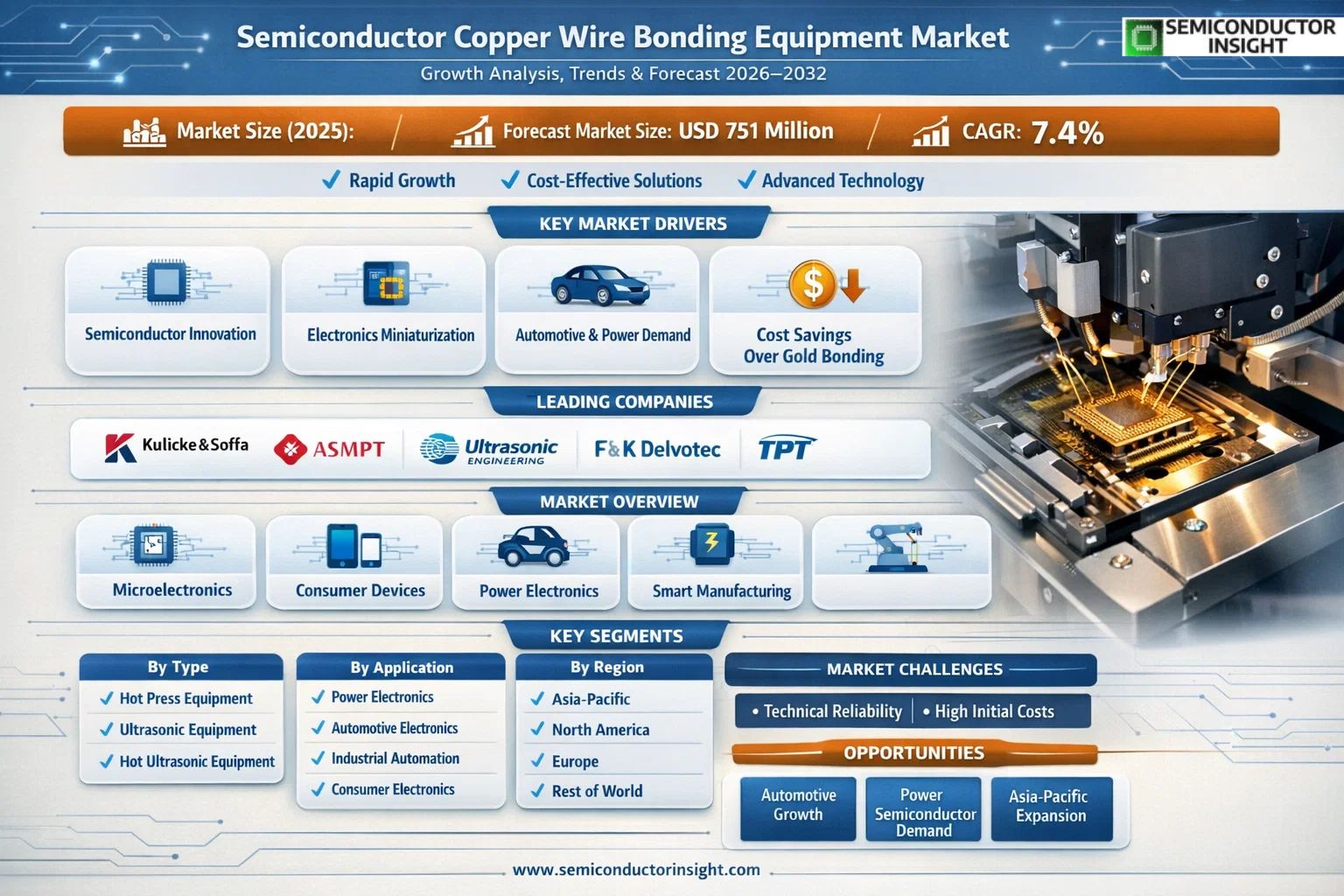
MARKET DRIVERS
Cost Efficiency Over Gold Wire Bonding
Semiconductor Copper Wire Bonding Equipment Market benefits significantly from the shift toward copper wires, which offer up to 30% cost savings compared to traditional gold wires, driving adoption in high-volume semiconductor packaging. This transition supports the production of affordable consumer electronics, automotive chips, and IoT devices where price sensitivity is high.
Rising Demand from Electronics Miniaturization
Advancements in semiconductor packaging for 5G, AI, and electric vehicles fuel the need for precise copper wire bonding equipment, capable of handling fine-pitch interconnections below 25 microns. The market sees robust growth as manufacturers optimize yields in advanced nodes like 7nm and below.
➤ Global semiconductor production reached 1.15 trillion units in 2023, with copper bonding capturing over 40% share in mature processes.
Additionally, supply chain diversification away from gold-dependent regions enhances the appeal of copper bonding systems, positioning Semiconductor Copper Wire Bonding Equipment Market for sustained expansion amid geopolitical shifts.
MARKET CHALLENGES
Technical Reliability Concerns
Semiconductor Copper Wire Bonding Equipment Market faces hurdles from copper’s higher hardness, leading to challenges like pad cratering and Kirkendall voiding during long-term reliability tests. Equipment must incorporate advanced plasma cleaning and forming gas treatments to mitigate these issues effectively.
Other Challenges
Equipment Complexity and High Initial Costs
Sophisticated ultrasonic transducers and bond force control systems increase upfront investments, slowing adoption among smaller fabs. Training for operators on copper-specific parameters adds to operational challenges in Semiconductor Copper Wire Bonding Equipment Market.
Skill gaps in handling copper’s oxidation sensitivity further complicate high-throughput production, necessitating ongoing R&D for automated process controls.
MARKET RESTRAINTS
Competition from Alternative Technologies
Emerging interconnect methods like copper clip bonding and wafer-level packaging limit Semiconductor Copper Wire Bonding Equipment Market by offering superior electrical performance in power devices. These alternatives reduce reliance on traditional wire bonding for high-current applications.
Regulatory pressures on material purity and environmental compliance for copper processing add compliance costs, restraining smaller players in the market.
Market fragmentation with dominant players controlling 60% share creates entry barriers through proprietary technologies and patents, hindering broader innovation.
MARKET OPPORTUNITIES
Expansion in Automotive and Power Semiconductors
Semiconductor Copper Wire Bonding Equipment Market holds strong potential in EV power modules and SiC/GaN devices, where copper enables higher current densities up to 200A. Demand surges with automotive electrification projected to add 15% annual growth.
Development of hybrid bonding equipment integrating copper with advanced molding compounds opens doors for heterogeneous integration in HPC and edge AI chips.
Asia-Pacific’s OSAT capacity expansion, exceeding 50% of global output, creates ripe opportunities for localized copper bonding solutions amid supply chain resilience efforts.
Semiconductor Copper Wire Bonding Equipment Market Trends
Shift to Copper Wire Bonding for Enhanced Performance
Copper wire bonding has emerged as a dominant technique in Semiconductor Copper Wire Bonding Equipment Market, replacing traditional aluminum wires due to superior electrical conductivity and cost advantages. This transition connects tiny electrodes on semiconductor chips to external circuits using copper wires through heating, pressure, and ultrasound processes. Equipment ensures appropriate wire diameter, equal lengths, firm connections, and even distribution to meet electrical performance and reliability standards in modules like IGBT. Optimizing parameters such as material, diameter, bonding pressure, time, and temperature is critical, as oversized diameters increase parasitic inductance affecting high-frequency performance, while undersized ones compromise bonding strength and module reliability.
Other Trends
Advancements in Bonding Technologies
Diverse bonding methods including hot press, ultrasonic, and hot ultrasonic bonding are driving equipment evolution in Semiconductor Copper Wire Bonding Equipment Market. Ultrasonic bonding equipment leverages high-frequency vibrations for solid-state connections, ideal for delicate semiconductor pads. Hot ultrasonic variants combine heat and ultrasound for robust bonds in power electronics applications. These technologies address demands across automotive electronics, industrial automation, consumer electronics, and others, where bonding quality directly impacts chip performance and module longevity.
Growth in Key Applications
Expanding applications fuel demand for semiconductor copper wire bonding equipment, particularly in power electronics and automotive sectors. In power modules, precise wire bonding enhances current flow and thermal dissipation. Automotive electronics benefit from reliable connections in high-vibration environments, while industrial automation requires durable bonds for consistent operation. Key manufacturers like Kulicke & Soffa, ASM Pacific Technology, and Hesse GmbH lead innovations, focusing on equipment that supports aluminum clad copper wires alongside pure copper for balanced performance.
Integration of Intelligent Features
Semiconductor Copper Wire Bonding Equipment Market is advancing towards intelligence and networking, incorporating sensors, IoT technology, and big data analytics. This enables remote monitoring, fault prediction, and predictive maintenance, boosting operational efficiency and reducing downtime. Higher precision, efficiency, reliability, and cost reductions are core focuses, aligning with semiconductor technology’s rapid development and broadening applications in microelectronics packaging and manufacturing.
COMPETITIVE LANDSCAPE
Key Industry Players
Top Manufacturers Driving Semiconductor Copper Wire Bonding Equipment Market
Semiconductor Copper Wire Bonding Equipment Market is dominated by a few leading players, with Kulicke & Soffa (K&S) and ASM Pacific Technology commanding the largest shares. These industry giants leverage advanced ultrasonic and hot ultrasonic bonding technologies to serve high-volume semiconductor packaging needs in power electronics and automotive applications. The market structure is moderately concentrated, where the top five players account for a substantial portion of global revenue, benefiting from extensive R&D investments and strong supply chain integrations. K&S excels in high-precision equipment for copper wire processes, optimizing parameters like bonding pressure and ultrasound to enhance reliability in IGBT modules, while ASM Pacific focuses on scalable solutions for consumer electronics and industrial automation, driving market growth amid rising demand for cost-effective, high-efficiency bonding.
Beyond the leaders, several niche players contribute specialized innovations, such as Hesse GmbH’s advanced wire bonding systems for high-reliability applications and Palomar Technologies’ focus on manual and semi-automated equipment for prototyping. Companies like KAIJO Corporation and TPT provide competitive alternatives in ultrasonic bonding, targeting Asia-Pacific markets with tailored solutions for automotive and power semiconductors. Emerging firms including Hanxiantech and Wuxi Autowell Technology are gaining traction through intelligent, IoT-enabled equipment, emphasizing precision and lower costs. This diverse competitive landscape fosters innovation in copper wire bonding, addressing challenges like parasitic inductance and bonding strength while adapting to trends in higher precision and networking.
List of Key Semiconductor Copper Wire Bonding Equipment Companies Profiled
- Kulicke & Soffa
- ASM Pacific Technology
- Ultrasonic Engineering
- F & K Delvotec
- TPT
- Hesse GmbH
- West Bond
- Hybond
- KAIJO Corporation
- Palomar Technologies
- SBT Ultrasonic
- Hanxiantech
- Wuxi Autowell Technology
- Green Intelligent Equipment
- Teda
- Ningbo Advance Automation Technology
Segment Analysis:
| Segment Category | Sub-Segments | Key Insights |
| By Type |
|
Hot Ultrasonic Bonding Equipment
|
| By Application |
|
Power Electronics
|
| By End User |
|
OSAT Providers
|
| By Bonding Technique |
|
Ball Bonding
|
| By Automation Level |
|
Fully Automatic Bonding Equipment
|
Regional Analysis: Semiconductor Copper Wire Bonding Equipment Market
Asia-Pacific
Taiwan and South Korea dominate with integrated facilities optimizing copper wire bonding for power and logic semiconductors. Dense clusters enable seamless technology transfer, reducing costs and boosting efficiency in high-mix production environments.
Japanese firms lead in precision bonding tools, incorporating plasma cleaning and real-time monitoring to mitigate intermetallic voids, elevating process stability for finer pitches in advanced packages.
China’s expanding role integrates upstream wire producers with downstream assemblers, streamlining material flows and enabling faster iteration on bonding parameters for diverse applications.
Subsidies and incentives in key nations spur investments in copper wire bonding equipment, fostering local innovation hubs and reducing reliance on imported technologies.
North America
North America plays a strategic role in Semiconductor Copper Wire Bonding Equipment Market, emphasizing high-performance applications in data centers, AI accelerators, and defense electronics. Leading chip designers and equipment innovators drive demand for sophisticated bonding systems that support heterogeneous integration. The region’s strength lies in R&D prowess, where advancements in copper palladium doping enhance bond integrity for harsh environments. Collaborative ecosystems between universities, national labs, and firms accelerate process optimization, focusing on yield improvement for complex multi-die packages. While production volumes trail Asia-Pacific, North America’s focus on premium, low-volume runs with stringent quality standards sustains steady equipment uptake. Supply chain diversification efforts mitigate global disruptions, positioning the region as a hub for next-gen bonding innovations tailored to edge computing and automotive autonomy.
Europe
Europe’s Semiconductor Copper Wire Bonding Equipment Market thrives on automotive and industrial semiconductor demands, with Germany and the Netherlands at the forefront. Emphasis on reliability for power modules and sensors drives adoption of robust copper bonding processes resistant to thermal cycling. Regional strengths include stringent regulatory frameworks that promote sustainable manufacturing, influencing equipment designs with lower energy footprints. Collaborative projects across borders enhance interoperability of bonding tools in smart manufacturing lines. While facing talent shortages, Europe’s precision engineering heritage supports customization for niche markets like medical devices. Investments in reshoring initiatives bolster local assembly capabilities, gradually expanding copper wire bonding’s footprint amid a shift toward diversified supply chains.
South America
South America emerges as a growing contender in Semiconductor Copper Wire Bonding Equipment Market, centered on Brazil and Mexico’s electronics assembly sectors. Cost-sensitive consumer goods and automotive electronics fuel demand for affordable copper bonding solutions. The region benefits from nearshoring trends, attracting investments in packaging facilities that leverage copper’s economics over gold alternatives. Challenges like infrastructure limitations are offset by partnerships with global vendors for technology transfer. Local adaptations focus on humidity-resistant bonding parameters suited to tropical climates. Expanding trade agreements enhance equipment imports, while workforce training programs build operational expertise, setting the stage for broader participation in semiconductor value chains.
Middle East & Africa
The Middle East & Africa region in Semiconductor Copper Wire Bonding Equipment Market is nascent yet promising, driven by UAE and Israel’s innovation hubs. Focus areas include oil & gas sensors and renewable energy chips requiring durable copper bonds. Sovereign wealth funds support fabless design and assembly ventures, importing advanced equipment to build capabilities. Africa’s potential lies in mobile communications and IoT devices, where cost-effective bonding aligns with mass-market needs. Geopolitical investments accelerate infrastructure development, fostering joint ventures for localized maintenance. Emphasis on skill development and energy-efficient processes positions the region for gradual integration into global semiconductor ecosystems.
Report Scope
This market research report provides a comprehensive analysis of Semiconductor Copper Wire Bonding Equipment Market, covering the forecast period 2026–2034. It offers detailed insights into market dynamics, technological advancements, competitive landscape, and key trends shaping the industry.
Key focus areas of the report include:
- Market Overview: The report begins with an overview outlining its current market scenario, key growth indicators, and industry transformation drivers. It discusses macroeconomic factors, demand–supply balance, regulatory landscape, and the strategic role of semiconductors in powering advancements across industries such as automotive, telecommunications, consumer electronics, and industrial automation.
- Market Size & Forecast: Historical data and future projections for revenue, unit shipments, and market value across major regions and segments.
- Segmentation Analysis: Detailed breakdown by product type, technology, application, and end-user industry to identify high-growth segments and investment opportunities.
- Regional Insights: Insights into market performance across North America, Europe, Asia-Pacific, Latin America, and the Middle East & Africa, including country-level analysis where relevant.
- Competitive Landscape: Profiles of leading market participants, including their product offerings, R&D focus, manufacturing capacity, pricing strategies, and recent developments such as mergers, acquisitions, and partnerships.
- Technology Trends & Innovation: Assessment of emerging technologies, integration of AI/IoT, semiconductor design trends, fabrication techniques, and evolving industry standards.
- Market Drivers & Restraints: Evaluation of factors driving market growth along with challenges, supply chain constraints, regulatory issues, and market-entry barriers.
- Stakeholder Insights: Insights for component suppliers, OEMs, system integrators, investors, and policymakers regarding the evolving ecosystem and strategic opportunities.
Primary and secondary research methods are employed, including interviews with industry experts, data from verified sources, and real-time market intelligence to ensure the accuracy and reliability of the insights presented.
FREQUENTLY ASKED QUESTIONS:
What is the current market size of Semiconductor Copper Wire Bonding Equipment Market?
-> Global Semiconductor Copper Wire Bonding Equipment market was valued at USD 461 million in 2025 and is projected to reach USD 751 million by 2032, at a CAGR of 7.4% during the forecast period.
Which key companies operate in Semiconductor Copper Wire Bonding Equipment Market?
-> Key players include Kulicke & Soffa, ASM Pacific Technology, Ultrasonic Engineering, F & K Delvotec, TPT, Hesse GmbH, West Bond, Hybond, KAIJO Corporation, Palomar Technologies, among others.
What are the key growth drivers?
-> Key growth drivers include continuous development of semiconductor technology, expansion of application fields in microelectronics packaging and semiconductor manufacturing, and increasing demand for copper wire bonding equipment.
Which region dominates the market?
-> Asia is the fastest-growing region, while North America remains a dominant market.
What are the emerging trends?
-> Emerging trends include higher precision, higher efficiency, higher reliability, lower cost, intelligence, networking, integration of sensors, IoT technology, and big data analysis for remote monitoring and intelligent maintenance.

Get Sample Report PDF for Exclusive Insights
Report Sample Includes
- Table of Contents
- List of Tables & Figures
- Charts, Research Methodology, and more...
 Download Sample Report PDF