Semiconductor Circuit Breaker Market Insights
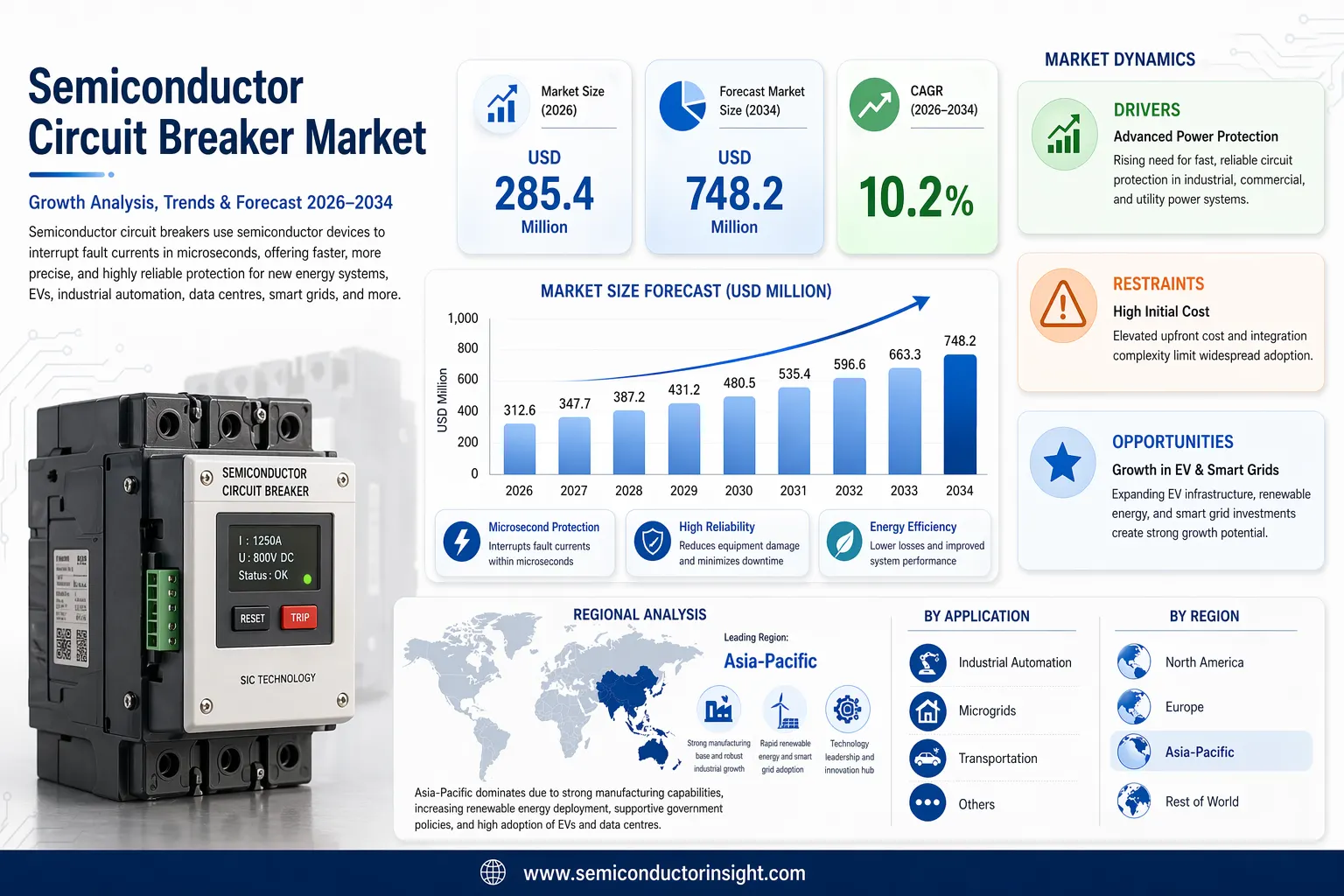
Global Semiconductor Circuit Breaker market size was valued at USD 285.4 million in 2026. The market is projected to grow from USD 312.6 million in 2026 to USD 748.2 million by 2034, exhibiting a CAGR of 10.2% during the forecast period.
Semiconductor circuit breakers are advanced protection devices built on semiconductor components such as transistors, thyristors, and insulated-gate bipolar transistors (IGBTs), designed to replace traditional mechanical or electromagnetic circuit breakers with faster, more precise, and highly reliable alternatives. Unlike conventional breakers, semiconductor circuit breakers are capable of interrupting fault currents within microseconds, dramatically reducing equipment damage and system downtime. These devices are widely deployed across applications requiring high stability and precision, including new energy systems, electric vehicles, industrial automation, data centres, smart grids, photovoltaic power generation systems, and wind power generation systems. The upstream supply chain encompasses key components such as semiconductor devices, heat dissipation materials, and high-voltage capacitors, while the average unit price in the market stands at approximately USD 500 per unit, with next-generation products based on silicon carbide (SiC) and gallium nitride (GaN) commanding premium pricing due to their superior technical performance.
The market is witnessing strong momentum as power system requirements for fast response and high reliability continue to intensify across industries. The accelerating global transition toward renewable energy, combined with rapid growth in electric vehicle infrastructure and expanding data centre capacity, is broadening the application scope of semiconductor circuit breakers considerably. Key manufacturers operating in this space include ABB, Siemens, Fuji Electric, Eaton, Atom Power, Shanghai KingSi Power, Fullde Electric, and Sun.King Technology, among others, each contributing to an increasingly competitive and innovation-driven global landscape.
MARKET DRIVERS
Rising Demand for Advanced Power Protection in Industrial and Commercial Infrastructure
Semiconductor Circuit Breaker Market is experiencing robust growth driven by the accelerating need for reliable, high-speed overcurrent protection across industrial, commercial, and utility-scale power systems. Unlike conventional electromechanical breakers, semiconductor-based solutions offer microsecond-level response times, significantly reducing the risk of equipment damage and downtime in sensitive electrical environments. As industrial automation and smart manufacturing expand globally, the demand for precise, electronically controlled protection devices continues to intensify.
Growth of Renewable Energy Integration and Smart Grid Deployment
One of the most significant forces shaping Semiconductor Circuit Breaker Market is the rapid global transition toward renewable energy sources such as solar and wind power. These energy systems require advanced protection mechanisms capable of handling variable and bidirectional power flows, where traditional mechanical breakers fall short. Smart grid modernization programs across North America, Europe, and Asia-Pacific are increasingly specifying semiconductor-based protection devices to ensure grid stability, fault isolation, and system resilience. Government-backed infrastructure investment programs are further accelerating adoption across utility networks.
➤ The proliferation of electric vehicles and EV charging infrastructure is emerging as a high-growth application segment for Semiconductor Circuit Breaker Market, requiring compact, fast-acting protection solutions capable of operating reliably in high-voltage DC environments.
The expansion of data centers and mission-critical facilities represents another pivotal driver for Semiconductor Circuit Breaker Market. These facilities demand uninterrupted power availability and fault response times that mechanical breakers cannot consistently deliver. The rise of edge computing, 5G network infrastructure, and cloud services has intensified the requirement for electronic protection devices that combine high switching speed with digital monitoring capabilities, enabling predictive maintenance and remote fault management.
MARKET CHALLENGES
High Initial Cost and Integration Complexity Limiting Widespread Adoption
Despite the clear performance advantages, Semiconductor Circuit Breaker Market faces considerable challenges related to the elevated upfront cost of solid-state protection devices compared to conventional mechanical alternatives. The sophisticated power electronics, gate drivers, and thermal management components involved in semiconductor breaker design contribute to a higher bill of materials, making cost-sensitive end users hesitant to transition from established mechanical solutions. This pricing disparity remains a notable barrier, particularly in price-competitive emerging markets and retrofit applications where existing infrastructure investments are substantial.
Other Challenges
Thermal Management and Heat Dissipation
Semiconductor circuit breakers generate considerable heat during normal operation due to conduction losses across switching elements such as IGBTs and MOSFETs. Managing this thermal load requires carefully engineered heat sinking and cooling systems, adding to system size, weight, and overall cost. In environments with limited space or restricted airflow, effective thermal management becomes a significant engineering challenge that can constrain deployment flexibility within Semiconductor Circuit Breaker Market.
Standardization and Industry Certification Gaps
Semiconductor Circuit Breaker Market continues to navigate an evolving landscape of industry standards and regulatory certifications. The absence of universally adopted testing and performance standards specific to solid-state breakers creates uncertainty among system integrators and end users regarding long-term reliability, interoperability, and compliance. Harmonizing certification frameworks across regions such as North America, Europe, and Asia-Pacific remains an ongoing challenge that affects procurement decisions and slows market penetration in regulated sectors including utilities and transportation.
MARKET RESTRAINTS
Entrenched Preference for Conventional Electromechanical Breakers Among End Users
A significant restraint in Semiconductor Circuit Breaker Market is the deeply established reliance on conventional electromechanical circuit breakers among engineers, facility managers, and procurement teams. Decades of familiarity, extensive field performance data, and a well-developed supply chain give mechanical breakers a strong incumbency advantage. Many end users remain cautious about adopting semiconductor-based alternatives without long-term operational track records in their specific application environments, slowing the pace of technology transition across established industries.
Limited Availability of Skilled Technical Expertise for Design and Commissioning
The design, installation, and commissioning of semiconductor circuit breaker systems demands a level of power electronics expertise that is not uniformly available across all markets. The shortage of qualified engineers with hands-on experience in solid-state protection technology presents a tangible restraint, particularly in developing regions where technical training infrastructure is still maturing. This skills gap can lead to suboptimal system configurations, increased commissioning timelines, and elevated post-installation support costs, collectively discouraging adoption among smaller operators and system integrators within Semiconductor Circuit Breaker Market.
MARKET OPPORTUNITIES
Expansion into DC Microgrid and Energy Storage System Applications
The growing deployment of DC microgrids, battery energy storage systems, and behind-the-meter power architectures presents a compelling opportunity for Semiconductor Circuit Breaker Market. DC systems are inherently more challenging for mechanical breakers due to the absence of natural current zero-crossings, making semiconductor-based solutions the technically preferred choice for fault protection in these architectures. As corporate sustainability commitments and energy resilience requirements drive investment in distributed energy resources, semiconductor circuit breakers are positioned to capture a growing share of this high-value application segment.
Integration of Digital Intelligence and IoT Connectivity for Predictive Protection
The convergence of semiconductor circuit breaker technology with digital monitoring, IoT connectivity, and AI-driven analytics represents one of the most transformative opportunities in the market. Next-generation semiconductor breakers equipped with real-time current sensing, remote tripping capability, and predictive fault analytics can deliver significant operational value to utilities, industrial plants, and commercial facilities. The ability to integrate protection devices into building management systems and industrial control platforms aligns with the broader trend toward digitalized, data-driven infrastructure management, opening new revenue streams for manufacturers and solution providers active in Semiconductor Circuit Breaker Market.
Trends
Rising Demand for Fast-Response Power Protection Drives Semiconductor Circuit Breaker Market
Semiconductor Circuit Breaker Market is experiencing a period of rapid development, driven by the increasing need for fast, precise, and reliable circuit protection across modern power systems. Unlike traditional mechanical circuit breakers, semiconductor circuit breakers leverage advanced devices such as transistors and thyristors to interrupt fault currents within microseconds, minimizing equipment damage and downtime. This superior response capability is becoming a critical requirement as power infrastructure grows more complex and sensitive, particularly across new energy systems, industrial automation, electric vehicle charging networks, and data centres. The expanding deployment of photovoltaic and wind power generation systems has further reinforced demand, as these renewable energy installations require high-stability protection solutions capable of handling dynamic and variable loads.
Other Trends
Adoption of Wide Bandgap Semiconductors
A notable trend shaping Semiconductor Circuit Breaker Market is the growing adoption of wide bandgap materials, specifically silicon carbide (SiC) and gallium nitride (GaN), in next-generation circuit breaker designs. These materials offer significant advantages in switching speed, thermal performance, and energy efficiency compared to conventional silicon-based components. Products built on SiC and GaN technology are commanding premium pricing in the market, reflecting their advanced technical capabilities. As manufacturing processes for these materials mature and production scales up, broader commercial adoption is anticipated, particularly in high-voltage and high-frequency applications within smart grids and electric vehicle infrastructure.
Expansion Across Smart Grid and EV Charging Infrastructure
Semiconductor Circuit Breaker Market is witnessing accelerated uptake within smart grid deployments and electric vehicle charging pile installations. Smart grids require real-time fault detection and isolation capabilities that mechanical breakers cannot reliably provide at the required speed. Semiconductor circuit breakers address this gap effectively, enabling grid operators to maintain stability and minimize outage durations. Simultaneously, the rapid global rollout of EV charging infrastructure is generating sustained demand, as high-power charging stations require robust and responsive protection systems to ensure operational safety and equipment longevity.
Competitive Landscape and Regional Market Dynamics
Semiconductor Circuit Breaker Market features a competitive landscape with established global players including ABB, Siemens, Fuji Electric, Eaton, and Atom Power, alongside growing regional manufacturers such as Shanghai KingSi Power, Fullde Electric, and Sun.King Technology. The top five global players collectively held a significant share of market revenue in 2026, reflecting the industry’s moderately consolidated nature. Geographically, both North America and Asia, particularly China, represent key demand centers, supported by active investments in grid modernization, industrial automation, and clean energy transition initiatives. The low voltage segment remains a strong contributor to overall market volume, driven by widespread industrial and commercial applications requiring cost-effective and responsive circuit protection solutions.
COMPETITIVE LANDSCAPE
Key Industry Players
Global Semiconductor Circuit Breaker Market: Competitive Dynamics, Leading Manufacturers, and Strategic Positioning
Global semiconductor circuit breaker market is characterized by the strong presence of established multinational electrical equipment giants alongside agile, technology-focused innovators. ABB and Siemens lead the competitive landscape, leveraging their extensive R&D capabilities, global distribution networks, and diversified power protection portfolios to maintain dominant market positions. These companies benefit from decades of expertise in power electronics and have been early movers in transitioning from conventional electromechanical breaker technologies toward advanced semiconductor-based solutions utilizing silicon carbide (SiC) and gallium nitride (GaN) technologies. Eaton and Fuji Electric also command significant market share, with well-established presences across industrial automation, smart grid infrastructure, and high-reliability power systems — all key downstream application segments driving demand for semiconductor circuit breakers. As of 2026, the top five global players collectively account for a substantial share of total market revenue, underscoring the moderately consolidated nature of this rapidly expanding sector.
Beyond the dominant tier, a growing cohort of niche and regional players is intensifying competitive dynamics within Semiconductor Circuit Breaker Market. Atom Power, a U.S.-based innovator, has drawn considerable industry attention for its digitally controlled, solid-state circuit breaker platforms designed for data centers and EV charging infrastructure — two of the fastest-growing application segments globally. In the Asia-Pacific region, particularly China, manufacturers such as Shanghai KingSi Power, Fullde Electric, and Sun.King Technology are scaling rapidly, capitalizing on strong domestic demand from photovoltaic power generation, wind energy systems, and the burgeoning electric vehicle charging ecosystem. These regional players offer competitive pricing while progressively closing the technology gap with Western incumbents, contributing to accelerating market innovation and broader adoption across low, medium, and high voltage segments. The competitive environment continues to evolve as players pursue strategic investments in next-generation wide-bandgap semiconductor technologies to differentiate their product offerings.
List of Key Semiconductor Circuit Breaker Companies Profiled
- ABB
- Siemens
- Fuji Electric
- Eaton
- Atom Power
- Shanghai KingSi Power
- Fullde Electric
- Sun.King Technology
Segment Analysis:
| Segment Category | Sub-Segments | Key Insights |
| By Type |
|
Low Voltage semiconductor circuit breakers represent the dominant segment in the market, driven by their widespread adoption across consumer electronics, commercial infrastructure, and light industrial applications.
|
| By Application |
|
Industrial Automation stands as the leading application segment, as modern manufacturing environments increasingly demand circuit protection solutions that can respond instantaneously to electrical faults without disrupting continuous production cycles.
|
| By End User |
|
Energy & Power Utilities emerge as the dominant end user category, as grid operators and renewable energy developers prioritize next-generation protection devices capable of supporting the evolving demands of modern power networks.
|
| By Technology |
|
Silicon-Based (IGBT/MOSFET) technology currently holds the leading position in the market due to its mature manufacturing ecosystem, established reliability credentials, and broad compatibility with existing power electronics platforms.
|
| By Installation Type |
|
New Installation leads the market in terms of adoption volume, primarily fueled by the rapid expansion of greenfield energy infrastructure projects, newly constructed data centers, and purpose-built electric vehicle manufacturing plants worldwide.
|
Regional Analysis: Semiconductor Circuit Breaker Market
Asia-Pacific
China’s position as the world’s largest electronics manufacturing hub gives it a decisive advantage in Semiconductor Circuit Breaker Market. National initiatives focused on clean energy integration and smart grid upgrades are compelling utilities and industrial operators to transition from conventional electromechanical breakers toward semiconductor-based alternatives, fostering a competitive and innovation-rich domestic supply chain.
Japan and South Korea contribute substantially to semiconductor circuit breaker market advancement through deep R&D investment and precision engineering expertise. Both nations are pioneering solid-state circuit breaker architectures suited for high-frequency switching environments, including electric vehicle charging infrastructure and next-generation industrial automation, giving the broader Asia-Pacific region a strong technological edge in Global market.
India represents one of the fastest-growing demand centers for Semiconductor Circuit Breaker Market within Asia-Pacific. Rapid electrification programs, expanding renewable energy capacity, and urban infrastructure development are creating significant procurement activity. Indian grid operators and industrial facilities are increasingly recognizing the advantages of semiconductor circuit breakers in minimizing downtime and improving fault isolation response times across critical networks.
Southeast Asian economies including Vietnam, Thailand, and Indonesia are emerging as important growth corridors for Semiconductor Circuit Breaker Market. Rising foreign direct investment in electronics manufacturing, combined with accelerating grid modernization projects and expanding data center ecosystems, is stimulating demand for advanced power protection technologies suited to both industrial and commercial applications across the sub-region.
North America
North America represents a highly mature and technologically sophisticated segment of Semiconductor Circuit Breaker Market. The United States leads regional demand, underpinned by extensive investment in grid resilience, the accelerating deployment of electric vehicle infrastructure, and the rapid expansion of hyperscale data centers that require precision power management. Regulatory frameworks promoting energy efficiency and grid modernization are compelling utilities and large industrial operators to evaluate semiconductor circuit breakers as viable replacements for legacy mechanical protection devices. Canada contributes through its growing renewable energy sector, where reliable fault protection is essential for maintaining grid stability. The North American semiconductor circuit breaker market is also shaped by a robust ecosystem of technology developers and systems integrators who are advancing solid-state and hybrid designs tailored to North American grid standards. Defense and aerospace applications further differentiate regional demand, with military procurement representing a specialized but strategically important end-use segment through the forecast period.
Europe
Europe occupies a prominent position in Semiconductor Circuit Breaker Market, driven by the region’s ambitious energy transition agenda and stringent regulatory standards governing electrical safety and grid performance. The European Union’s commitment to decarbonization has accelerated investment in renewable energy integration, microgrids, and smart distribution networks — all of which serve as key application areas for semiconductor-based circuit protection technologies. Germany, France, and the Nordic countries are particularly active adopters, leveraging advanced industrial automation and high-voltage direct current infrastructure projects that demand fast-response, low-arc protection solutions. The European semiconductor circuit breaker market also benefits from a strong base of specialized power electronics manufacturers and active collaboration between academia and industry. Regulatory pressure to phase out legacy electrical components with lower performance profiles is creating a favorable long-term replacement cycle across the region’s industrial, commercial, and utility sectors.
South America
South America presents a developing yet increasingly promising landscape for Semiconductor Circuit Breaker Market. Brazil leads regional activity, supported by one of the largest power grids in the Western Hemisphere and a growing focus on modernizing aging transmission and distribution infrastructure. Argentina and Chile are making measured progress in renewable energy adoption, particularly in wind and solar sectors, where reliable protection systems are an operational necessity. While budget constraints and economic volatility have historically tempered the pace of technology adoption, improving macroeconomic conditions and increased multilateral investment in energy infrastructure are gradually expanding the addressable market. Awareness of the long-term operational benefits of semiconductor circuit breakers — including reduced maintenance requirements and faster fault response — is gradually influencing procurement decisions among regional utilities and industrial end-users operating within Semiconductor Circuit Breaker Market landscape.
Middle East & Africa
The Middle East and Africa region occupies an emerging position in Semiconductor Circuit Breaker Market, with growth anchored primarily in large-scale energy infrastructure development and urban electrification programs. Gulf Cooperation Council nations, particularly Saudi Arabia and the UAE, are investing heavily in smart city initiatives, diversified energy generation, and industrial zones that require advanced electrical protection technologies. Africa’s vast electrification deficit, combined with increasing off-grid and microgrid deployments, creates a distinctive demand profile for compact and reliable semiconductor-based protection solutions. South Africa serves as the most mature market within the African continent, with established industrial and mining sectors driving procurement of advanced circuit protection equipment. While overall adoption within Semiconductor Circuit Breaker Market remains at an early stage compared to other global regions, long-term infrastructure investment trends and supportive government policies point toward steady growth through 2034.
Report Scope
This market research report provides a comprehensive analysis of Semiconductor Circuit Breaker Market, covering the forecast period 2026–2034. It offers detailed insights into market dynamics, technological advancements, competitive landscape, and key trends shaping the industry.
Key focus areas of the report include:
- Market Overview: The report begins with an overview outlining its current market scenario, key growth indicators, and industry transformation drivers. It discusses macroeconomic factors, demand–supply balance, regulatory landscape, and the strategic role of semiconductor circuit breakers in powering advancements across industries such as new energy systems, electric vehicles, industrial automation, and data centres.
- Market Size & Forecast: Historical data and future projections for revenue, unit shipments, and market value across major regions and segments.
- Segmentation Analysis: Detailed breakdown by product type (Low Voltage, Medium Voltage, High Voltage), application (Industrial Automation, Microgrids, Transportation, Others), and end-user industry to identify high-growth segments and investment opportunities.
- Regional Insights: Insights into market performance across North America, Europe, Asia-Pacific, Latin America, and the Middle East & Africa, including country-level analysis where relevant.
- Competitive Landscape: Profiles of leading market participants, including their product offerings, R&D focus, manufacturing capacity, pricing strategies, and recent developments such as mergers, acquisitions, and partnerships.
- Technology Trends & Innovation: Assessment of emerging technologies including silicon carbide (SiC) and gallium nitride (GaN) based circuit breakers, integration of AI/IoT, semiconductor design trends, fabrication techniques, and evolving industry standards.
- Market Drivers & Restraints: Evaluation of factors driving market growth along with challenges, supply chain constraints, regulatory issues, and market-entry barriers.
- Stakeholder Insights: Insights for component suppliers, OEMs, system integrators, investors, and policymakers regarding the evolving ecosystem and strategic opportunities.
Primary and secondary research methods are employed, including interviews with industry experts, data from verified sources, and real-time market intelligence to ensure the accuracy and reliability of the insights presented.
FREQUENTLY ASKED QUESTIONS:
What is the current market size of Semiconductor Circuit Breaker Market?
-> Semiconductor Circuit Breaker Market was valued at USD million in 2026 and is projected to reach USD million by 2032, growing at a CAGR of % during the forecast period.
Which key companies operate in Semiconductor Circuit Breaker Market?
-> Key players include ABB, Siemens, Fuji Electric, Eaton, Atom Power, Shanghai KingSi Power, Fullde Electric, and Sun.King Technology, among others. In 2026, Global top five players held a share of approximately % in terms of revenue.
What are the key growth drivers?
-> Key growth drivers include increasing power system requirements for fast response and high reliability, rapid expansion of new energy systems, rising adoption of electric vehicles, growth in industrial automation, and the proliferation of data centres and smart grids. The market is also driven by the superior performance of semiconductor circuit breakers, which can cut off current within microseconds compared to traditional mechanical alternatives.
Which region dominates the market?
-> Asia is among the fastest-growing regions, with China representing a significant share of the market. North America, particularly the U.S., also holds a notable market position, with the U.S. market size estimated at USD million in 2026.
What are the emerging trends?
-> Emerging trends include silicon carbide (SiC) and gallium nitride (GaN) based semiconductor circuit breakers, expansion into photovoltaic power generation systems and wind power generation systems, smart grid integration, and the growing deployment of semiconductor circuit breakers in electric vehicle charging piles and microgrid applications. The average market price is approximately USD 500 per unit, with advanced SiC/GaN products commanding premium pricing.

Get Sample Report PDF for Exclusive Insights
Report Sample Includes
- Table of Contents
- List of Tables & Figures
- Charts, Research Methodology, and more...
 Download Sample Report PDF