MARKET INSIGHTS
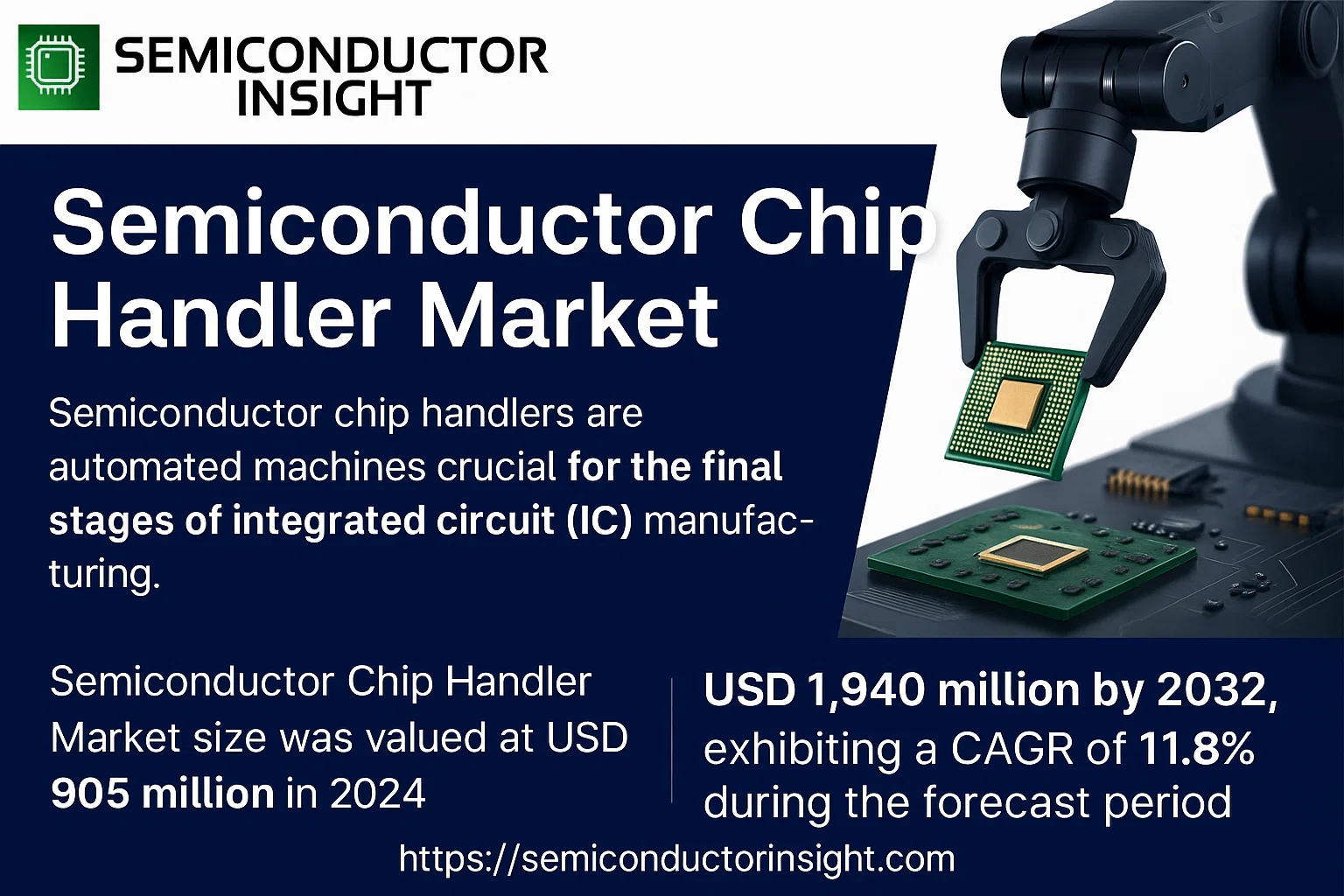
Global Semiconductor Chip Handler Market size was valued at USD 905 million in 2024 to USD 1,940 million by 2032, exhibiting a CAGR of 11.8% during the forecast period.
Semiconductor chip handlers are automated machines crucial for the final stages of integrated circuit (IC) manufacturing. These systems are designed for sorting, testing, and transferring packaged semiconductor chips using a standard electrical interface flow: ATE (Automatic Test Equipment) to ITA (Interface Test Adapter) to DUT (Device Under Test). Capable of processing thousands of units per hour, they place devices on customized interface boards for final electrical performance tests and then sort the chips into categories like “good,” “bad,” or other bins based on the results.
The market is experiencing robust growth due to rising global production and significant government investment in the semiconductor industry. For instance, the global semiconductor market reached USD 574 billion in 2022, and this expansion directly fuels demand for backend test equipment like handlers. Furthermore, major legislative initiatives such as the European Chips Act, which comprises up to USD 43 billion in funding, and the U.S. CHIPS Act of 2022 are key drivers bolstering domestic manufacturing capabilities. The competitive landscape is concentrated, with top players like Advantest, Cohu, and ASM Pacific Technology collectively occupying a significant share of the market.
MARKET DRIVERS
Proliferation of Advanced Packaging Technologies
The demand for semiconductor chip handlers is significantly driven by the rapid adoption of advanced packaging technologies like 2.5D/3D ICs, fan-out wafer-level packaging (FOWLP), and system-in-package (SiP). These complex packaging methods require highly sophisticated handlers capable of precise handling, testing, and sorting of delicate, high-pin-count devices. As the semiconductor industry pushes for greater performance and miniaturization, chip handlers must evolve to support fine-pitch interconnects and handle thinner, more fragile dies, creating sustained demand for advanced equipment.
Expansion of Automotive and AI Sectors
The automotive industry’s transformation towards electrification and autonomy, coupled with the explosive growth of artificial intelligence (AI) and high-performance computing (HPC), is a major market driver. These applications demand a massive volume of robust and reliable semiconductors, including microcontrollers, sensors, and powerful processors. Chip handlers are essential for the final test and quality assurance of these components, which must operate reliably in harsh conditions and meet stringent automotive-grade standards.
➤ Global market for automotive semiconductors is projected to grow at a CAGR of over 9% through 2030, directly fueling demand for test handlers.
Furthermore, continuous investment in semiconductor manufacturing capacity worldwide, including new fabs and test facilities, generates direct capital expenditure on backend equipment. This build-out is essential to address the persistent demand for chips across all electronic segments, ensuring a steady pipeline for chip handler manufacturers.
MARKET CHALLENGES
High Capital Investment and Cost of Ownership
Semiconductor chip handlers represent a significant capital investment for test houses and integrated device manufacturers (IDMs). The high initial purchase price is compounded by substantial costs for maintenance, calibration, and consumables like contactors and sockets. For many smaller or medium-sized enterprises, this high total cost of ownership can be a barrier to upgrading to the latest generation of equipment, potentially limiting market growth.
Other Challenges
Technical Complexity and Rapid Technological Obsolescence
The pace of innovation in semiconductor packaging and device architectures necessitates frequent upgrades to handler platforms. Manufacturers face the challenge of developing handlers that are not only compatible with today’s devices but also future-proof to some extent, requiring significant and continuous R&D investment. The technical complexity of handling next-generation chips, such as those with ultra-fine bump pitches or heterogeneous integration, presents substantial engineering hurdles.
Supply Chain Vulnerabilities and Long Lead Times
The market is susceptible to disruptions in the supply chain for critical components, such as precision mechanics, robotics, and specialized sensors. Geopolitical tensions and logistical bottlenecks can lead to extended lead times for both the handler manufacturers and their customers, delaying production ramps and impacting time-to-market for new semiconductor products.
MARKET RESTRAINTS
Cyclical Nature of the Semiconductor Industry
chip handler market is inherently tied to the cyclicality of the broader semiconductor industry. Periods of oversupply and reduced capital expenditure during downturns directly impact orders for capital equipment. This cyclicality creates uncertainty for handler manufacturers, making long-term planning and capacity investment challenging. The memory market, in particular, is known for its pronounced cycles, which can lead to sharp declines in demand for test handlers when memory prices fall.
Intense Price Pressure and Competition
The market is highly competitive, with several established global players and emerging regional competitors. This intense competition places constant pressure on pricing and profit margins. Customers, especially large OSATs and IDMs, have significant bargaining power and often demand cost reductions, forcing handler manufacturers to optimize their production costs continuously while maintaining high levels of performance and reliability.
MARKET OPPORTUNITIES
Growth in Outsourced Semiconductor Assembly and Test (OSAT)
The trend of fabless semiconductor companies outsourcing their assembly, test, and packaging needs to OSAT providers represents a significant opportunity. As OSATs expand their capacities and technological capabilities to serve a diverse client base, they are major buyers of chip handlers. The increasing complexity of devices being outsourced drives the need for advanced handling solutions, creating a robust and growing market segment for handler suppliers.
Development of Advanced Handler Platforms
There is a substantial opportunity in developing next-generation handlers tailored for specific high-growth applications. This includes handlers for high-bandwidth memory (HBM), AI accelerators, and power semiconductors for electric vehicles. Equipment that offers higher throughput, improved thermal management for high-power testing, and greater flexibility to handle multiple device types will be in high demand. The integration of Industry 4.0 principles, such as IoT connectivity and data analytics for predictive maintenance, also presents a key area for differentiation and growth.
Semiconductor Chip Handler Market Trends
Robust Market Growth Fueled by Global Semiconductor Investments
Global Semiconductor Chip Handler market, valued at USD 905 million in 2024, is on a trajectory of significant expansion, projected to reach USD 1,940 million by 2032. This growth, representing a compound annual growth rate (CAGR) of 11.8%, is primarily fueled by substantial investments and rising production within the global semiconductor industry. These machines, which sort, test, and transfer thousands of chips per hour, are critical for ensuring the quality and performance of semiconductor devices. The process follows a clear sequence: Automatic Test Equipment (ATE) connects to the Device Under Test (DUT) through an Interface Test Adapter (ITA) managed by the handler, which then sorts chips into categories based on test results.
Other Trends
Geographical Market Concentration
The market is heavily concentrated in specific regions, with Asia-Pacific and North America collectively accounting for approximately 90% of the global market. This dominance is driven by the presence of major semiconductor fabrication plants and Outsourced Semiconductor Assembly and Test (OSAT) facilities. Supportive government policies, such as the US CHIPS Act of 2022 and the European Chips Act, which earmarked up to USD 43 billion, are further accelerating regional investments. These legislative measures are designed to strengthen domestic manufacturing, design, and research capabilities, thereby directly stimulating demand for advanced chip handling equipment.
Product and Application Segmentation Dynamics
In terms of product types, Pick-and-Place Handlers lead the market, holding a dominant share of about 45%. Their versatility and efficiency in handling various package types make them a preferred choice. Regarding applications, the OSAT (Outsourced Semiconductor Assembly and Test) segment is the largest consumer, accounting for roughly 65% of the market. This underscores the critical role of third-party testing and assembly services in the semiconductor supply chain. The market is also characterized by a competitive landscape where the top three players—Advantest, Cohu, and ASM Pacific Technology—collectively hold a significant share of approximately 45% of the global market.
COMPETITIVE LANDSCAPE
Key Industry Players
A Consolidated Market Led by Test Equipment Giants
Global Semiconductor Chip Handler Market exhibits a moderately consolidated structure, with the top three players collectively holding a significant market share of approximately 45%. Advantest Corporation, a global leader in semiconductor test equipment, is a dominant force in the chip handler segment, leveraging its strong integration with automatic test equipment (ATE) platforms. Similarly, Cohu, Inc., following its acquisition of Xcerra and others, possesses a broad portfolio of handlers catering to a wide range of semiconductor devices. ASM Pacific Technology also maintains a strong position, supported by its extensive reach in assembly and packaging equipment. These leaders primarily compete on technological innovation, handler throughput, and reliability for high-volume manufacturing environments, with a strong focus on serving major Outsourced Semiconductor Assembly and Test (OSAT) providers and Integrated Device Manufacturers (IDMs).
Beyond the market leaders, a cohort of specialized and regional players holds significant niches. Companies like ChangChuan Technology, MCT (Multitest), and Boston Semi Equipment are established providers known for their robust and specialized handler solutions for various package types and test requirements. Other key participants, such as Chroma ATE, TESEC Corporation, and Pentamaster, offer competitive products, often focusing on specific applications or geographic markets like Asia-Pacific, which dominates global demand. Emerging players, including several from China like Shenkeda Semiconductor, are increasingly active, supported by regional government initiatives to bolster semiconductor self-sufficiency. This diverse competitive field ensures continuous innovation in handling speed, thermal management, and compatibility with increasingly complex semiconductor packages.
List of Key Semiconductor Chip Handler Companies Profiled
- Advantest
- Cohu, Inc.
- ASM Pacific Technology
- ChangChuan Technology
- MCT (Multitest)
- Boston Semi Equipment
- Exis Tech
- Hon Precision
- Chroma ATE
- SRM Integration
- TESEC Corporation
- SYNAX
- CST
- Pentamaster
- Techwing
Segment Analysis:
| Segment Category | Sub-Segments | Key Insights |
| By Type |
|
Pick-and-Place Handlers dominate the market owing to their versatility and high-throughput capabilities, making them suitable for testing a wide range of semiconductor package types. This versatility is critical for outsourced assembly and test providers and integrated device manufacturers who handle diverse product portfolios. The robust mechanical design allows for precise manipulation of delicate chips, minimizing damage during the high-speed sorting and testing process. Continuous innovation focuses on increasing speed and accuracy to keep pace with the growing complexity and miniaturization of semiconductor devices. |
| By Application |
|
OSATs represent the primary application segment, driven by the pervasive industry trend of outsourcing backend semiconductor manufacturing processes. These facilities require highly efficient and scalable chip handling solutions to manage the immense volume of devices from numerous fabless companies and IDMs. The demand is further amplified by the capital-intensive nature of advanced test equipment, making outsourcing an economically attractive option. This segment’s growth is intrinsically linked to the overall expansion of global semiconductor production capacity and the strategic focus of many companies on their core competencies in design and front-end fabrication. |
| By End User |
|
Consumer Electronics is the leading end-user segment, fueled by insatiable demand for smartphones, laptops, tablets, and wearable devices. The high volume and rapid product lifecycle in this sector necessitate extremely efficient and reliable chip testing and handling solutions. The automotive industry is emerging as a significant growth driver, with increasing semiconductor content per vehicle for advanced driver-assistance systems, infotainment, and electrification, which demands handlers capable of meeting stringent quality and reliability standards. The telecommunications sector also contributes strongly, driven by the rollout of 5G infrastructure and networking equipment. |
| By Handler Temperature |
|
Standard Temperature handlers are the most prevalent, covering the majority of testing applications for commercial-grade components. However, the demand for high-temperature and low-temperature handlers is growing significantly, driven by the need to test device reliability under extreme environmental conditions. Automotive and industrial applications, in particular, require components that can operate reliably across a wide temperature range, necessitating specialized handlers for burn-in and environmental stress testing. This segment’s growth reflects the increasing performance and reliability demands of modern electronic systems. |
| By Automation Level |
|
Fully Automated systems represent the dominant and fastest-growing segment, as manufacturers relentlessly pursue higher throughput, improved consistency, and reduced labor costs. These systems are essential for high-volume production environments like OSATs and large IDMs. The trend is moving towards even more sophisticated integrated test cells that combine handling, testing, and data analysis into a seamless, lights-out manufacturing operation. This shift is crucial for maintaining competitiveness and meeting the scale requirements of the global semiconductor industry, though manual systems remain relevant for low-volume, high-mix, or research and development scenarios. |
Regional Analysis: Semiconductor Chip Handler Market
The Asia-Pacific region’s leadership is rooted in its dense concentration of semiconductor fabrication plants and OSAT facilities. Countries like Taiwan and South Korea are home to world-leading foundries and memory manufacturers whose high-volume production lines necessitate robust, high-throughput chip handlers for final test and system-level test processes. This creates a built-in, demanding customer base that drives local innovation and adoption.
Soaring demand for semiconductors from the region’s massive consumer electronics manufacturing base, burgeoning automotive sector (especially for electric vehicles), and strong data center and computing markets creates persistent pressure for efficient testing. Chip handlers are critical for ensuring the quality and reliability of components destined for these high-growth applications, sustaining market expansion.
National governments in China, Japan, and South Korea have implemented significant policies and funding initiatives to achieve semiconductor self-sufficiency and strengthen their domestic industries. These efforts, which include subsidies for new fab construction and R&D, indirectly boost the chip handler market by expanding the manufacturing base and encouraging the adoption of advanced, locally-sourced equipment.
The push towards advanced packaging solutions, such as fan-out wafer-level packaging and chiplet-based architectures, requires handlers capable of dealing with thinner, more fragile, and heterogeneous die. Local equipment suppliers are at the forefront of developing handlers with enhanced thermal management, finer placement accuracy, and the ability to handle these complex new package types.
North America
North America holds a significant position in the Semiconductor Chip Handler Market, characterized by a strong focus on R&D and the presence of leading fabless semiconductor companies and integrated device manufacturers. The market dynamics are driven by the demand for highly sophisticated handlers used in the development and low-to-medium volume production of cutting-edge chips, particularly for applications in artificial intelligence, high-performance computing, and aerospace and defense. The region’s emphasis on innovation and early adoption of new technologies creates a need for flexible and precise handlers that can accommodate a wide variety of package types and testing protocols. While overall manufacturing volume is lower than in Asia-Pacific, the high value and complexity of the devices produced sustain a robust market for advanced handling solutions.
Europe
The European market for semiconductor chip handlers is shaped by its well-established automotive industry and strong focus on industrial and medical applications. The region’s stringent quality and reliability standards for components, especially in the automotive sector, drive demand for highly accurate and reliable test handlers. There is a notable emphasis on handlers capable of testing power semiconductors, sensors, and microcontrollers that are critical for automotive electronics and industrial automation. Collaborative R&D initiatives supported by entities like the European Union also foster advancements in specialized handling equipment for emerging technologies, ensuring a steady, though more niche-oriented, demand compared to the high-volume markets in Asia.
South America
The Semiconductor Chip Handler Market in South America is relatively nascent but exhibits potential for gradual growth. The market is primarily driven by the increasing local assembly of consumer electronics and the growing automotive manufacturing sector in countries like Brazil. Demand is largely for standard, cost-effective handlers used in final product assembly and basic functional testing. The region’s market development is closely tied to broader economic stability and increased foreign investment in local manufacturing capabilities, which would subsequently drive the need for more sophisticated semiconductor testing infrastructure over the long term.
Middle East & Africa
The Middle East & Africa region represents an emerging market for semiconductor chip handlers, with growth prospects linked to strategic economic diversification plans, particularly in Gulf Cooperation Council (GCC) countries. Investments in technology infrastructure, smart city projects, and a nascent but growing electronics manufacturing base are beginning to create demand for basic semiconductor assembly and test equipment. While the current market size is small, long-term government visions aimed at developing knowledge-based economies could lead to the establishment of more advanced semiconductor-related facilities, potentially increasing the need for chip handling solutions in the future.
Report Scope
This market research report provides a comprehensive analysis of the Semiconductor Chip Handler Market , covering the forecast period 2025–2032. It offers detailed insights into market dynamics, technological advancements, competitive landscape, and key trends shaping the industry.
Key focus areas of the report include:
- Market Overview: The report begins with an overview outlining its current market scenario, key growth indicators, and industry transformation drivers. It discusses macroeconomic factors, demand–supply balance, regulatory landscape, and the strategic role of semiconductors in powering advancements across industries such as automotive, telecommunications, consumer electronics, and industrial automation.
- Market Size & Forecast: Historical data and future projections for revenue, unit shipments, and market value across major regions and segments.
- Segmentation Analysis: Detailed breakdown by product type, technology, application, and end-user industry to identify high-growth segments and investment opportunities.
- Regional Insights: Insights into market performance across North America, Europe, Asia-Pacific, Latin America, and the Middle East & Africa, including country-level analysis where relevant.
- Competitive Landscape: Profiles of leading market participants, including their product offerings, R&D focus, manufacturing capacity, pricing strategies, and recent developments such as mergers, acquisitions, and partnerships.
- Technology Trends & Innovation: Assessment of emerging technologies, integration of AI/IoT, semiconductor design trends, fabrication techniques, and evolving industry standards.
- Market Drivers & Restraints: Evaluation of factors driving market growth along with challenges, supply chain constraints, regulatory issues, and market-entry barriers.
- Stakeholder Insights: Insights for component suppliers, OEMs, system integrators, investors, and policymakers regarding the evolving ecosystem and strategic opportunities.
Primary and secondary research methods are employed, including interviews with industry experts, data from verified sources, and real-time market intelligence to ensure the accuracy and reliability of the insights presented.
FREQUENTLY ASKED QUESTIONS:
What is the current market size of Semiconductor Chip Handler Market?
-> Global Semiconductor Chip Handler Market was valued at USD 905 million in 2024 and is expected to reach USD 1940 million by 2032, at a CAGR of 11.8% during the forecast period.
Which key companies operate in Semiconductor Chip Handler Market?
-> Key players include Advantest, Cohu, ASM Pacific Technology, ChangChuan Technology, MCT, Boston Semi Equipment, Exis Tech, Hon Precision, and Chroma, among others.
What are the key growth drivers?
-> Key growth drivers include rising production and investment in the global semiconductor industry, supported by government initiatives like the EU Chips Act and the U.S. CHIPS Act of 2022, which are strengthening semiconductor manufacturing, design, and research.
Which region dominates the market?
-> Asia-Pacific and North America are the main markets, occupying about 90% of the global market share.
What are the emerging trends?
-> Emerging trends include increased automation in chip testing and sorting, integration with advanced ATE systems, and the push for higher throughput in semiconductor fabrication facilities.

Get Sample Report PDF for Exclusive Insights
Report Sample Includes
- Table of Contents
- List of Tables & Figures
- Charts, Research Methodology, and more...
 Download Sample Report PDF