MARKET INSIGHTS
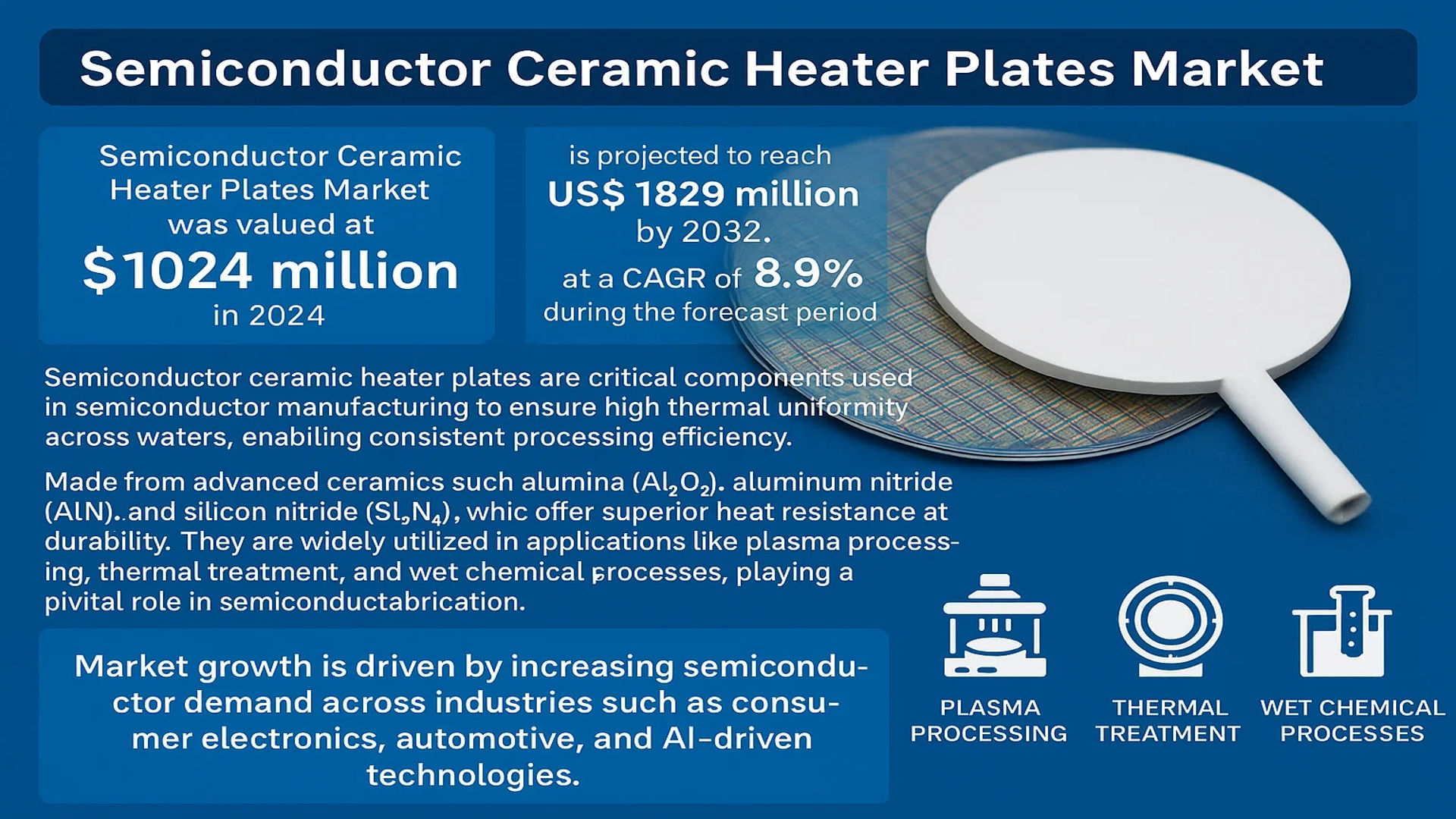
The global Semiconductor Ceramic Heater Plates Market was valued at 1024 million in 2024 and is projected to reach US$ 1829 million by 2032, at a CAGR of 8.9% during the forecast period.
Semiconductor ceramic heater plates are critical components used in semiconductor manufacturing to ensure high thermal uniformity across wafers, enabling consistent processing efficiency. These plates are made from advanced ceramics such as alumina (Al₂O₃), aluminum nitride (AlN), and silicon nitride (Si₃N₄), which offer superior heat resistance and durability. They are widely utilized in applications like plasma processing, thermal treatment, and wet chemical processes, playing a pivotal role in ensuring precision in semiconductor fabrication.
Market growth is driven by increasing semiconductor demand across industries such as consumer electronics, automotive, and AI-driven technologies. Despite a slowdown in 2022, where the global semiconductor market grew only 4.4% to USD 580 billion (down from 26.2% in 2021), ceramic heater plates remain essential for advanced node manufacturing. Key players like Sumitomo Electric, NGK Insulators, and CoorsTek are investing in material innovations to enhance performance, particularly for applications in 5G, IoT, and electric vehicles.
MARKET DYNAMICS
MARKET DRIVERS
Advancements in Semiconductor Manufacturing Processes Fuel Demand for Ceramic Heater Plates
The semiconductor industry’s rapid transition to advanced process nodes below 7nm is driving substantial growth in ceramic heater plate adoption. These components provide critical temperature control during wafer processing, with their ability to maintain uniformity within ±1°C being essential for yield optimization. As foundries invest heavily in extreme ultraviolet (EUV) lithography capabilities – with over $120 billion committed to new fabs globally through 2026 – the need for precision thermal management solutions is accelerating. Ceramic heater plates, particularly aluminum nitride variants, demonstrate superior performance in high-temperature deposition and etch processes compared to traditional metal heaters.
Expansion of 300mm Wafer Production Capacity Creates Sustained Demand
Global 300mm wafer fabrication capacity is projected to increase by approximately 25% from 2024-2030, representing the strongest growth segment in semiconductor manufacturing. Each new 300mm fab typically requires between 500-1,200 ceramic heater plates depending on process complexity, creating a robust demand pipeline. The shift toward larger wafers intensifies the technical requirements for heating elements – 300mm ceramic plates must maintain thermal uniformity across 30% greater surface area while resisting warping and degradation. Market leaders are responding with innovative multilayer ceramic designs that integrate heating elements directly into the substrate structure.
Furthermore, the increasing miniaturization of semiconductor devices demands more sophisticated thermal processing capabilities.
➤ Advanced packaging techniques like 3D IC integration require ceramic heaters capable of precise temperature cycling between -40°C to 600°C without performance degradation.
This technological evolution is prompting manufacturers to develop composite ceramic materials with enhanced thermal conductivity and mechanical stability.
MARKET RESTRAINTS
High Manufacturing Costs and Long Lead Times Restrict Market Accessibility
The specialized nature of semiconductor-grade ceramic heater production creates significant barriers to market entry. Processing high-purity aluminum nitride or silicon nitride requires controlled atmosphere sintering at temperatures exceeding 1800°C, with cycle times often exceeding 72 hours. Yield rates for complex multilayer designs frequently fall below 60%, contributing to unit costs 3-5 times higher than conventional heating solutions. These economic factors make ceramic heaters prohibitive for all but the most demanding semiconductor applications, limiting their adoption in price-sensitive segments.
Additionally, the precision machining required to achieve sub-micron flatness specifications results in lead times of 12-16 weeks for custom configurations. This extended timeframe creates challenges for equipment manufacturers working with just-in-time production models and rapid technology transitions.
MARKET CHALLENGES
Material Science Limitations Present Technical Hurdles
While ceramic heaters offer superior thermal performance, their inherent brittleness creates reliability concerns in high-vibration semiconductor tools. Fracture rates approaching 2-3% during installation and maintenance drive up total cost of ownership. The industry’s push toward higher operating temperatures – now exceeding 650°C for advanced oxidation processes – exacerbates these mechanical challenges through thermal cycling stress.
Other Challenges
Supply Chain Vulnerabilities
The concentrated production of high-purity ceramic raw materials creates single-point failure risks. Over 85% of aluminum nitride powder supply originates from just three global suppliers, making the market susceptible to geopolitical and trade conflicts.
Technical Labor Shortage
The specialized knowledge required for ceramic heater design and integration remains scarce, with an estimated 30% skills gap in advanced materials engineering positions according to industry workforce analyses.
MARKET OPPORTUNITIES
Emerging Compound Semiconductor Applications Open New Growth Avenues
The rapid expansion of gallium nitride (GaN) and silicon carbide (SiC) device manufacturing presents significant opportunities for ceramic heater plate suppliers. These wide-bandgap semiconductors require processing temperatures between 400-800°C higher than traditional silicon, creating demand for specialized thermal solutions. The SiC power device market alone is projected to require over 15,000 new heater plates annually by 2026 as electric vehicle adoption accelerates.
Additionally, advances in ceramic metallization techniques are enabling direct integration of temperature sensors and control circuitry into heater assemblies. This innovation reduces system complexity while improving process monitoring capabilities – a development particularly valuable for heterogenous integration and MEMS manufacturing applications.
The growing emphasis on sustainable semiconductor manufacturing is also driving innovation in ceramic heater technology, with manufacturers developing longer-lasting formulations that reduce replacement frequency and associated waste.
SEMICONDUCTOR CERAMIC HEATER PLATES MARKET TRENDS
Advancements in Semiconductor Manufacturing Drive Ceramic Heater Plate Demand
The semiconductor industry’s rapid evolution, marked by shrinking node sizes and increasing process complexity, has significantly boosted the need for precise thermal management solutions. Semiconductor ceramic heater plates, which ensure uniform wafer heating during critical fabrication steps, are witnessing heightened adoption. With the global market projected to grow at a CAGR of 8.9% from 2024 to 2032, reaching $1.83 billion, manufacturers are focusing on enhancing thermal uniformity and durability. Recent innovations include multilayer ceramic designs with improved thermal conductivity, catering to advanced 3D NAND and EUV lithography processes that demand sub-nanometer precision in temperature control.
Other Trends
Material Innovation for Extreme Conditions
Aluminum Nitride (AlN) ceramic heater plates are gaining prominence due to their exceptional thermal conductivity (170-200 W/mK) and resistance to plasma corrosion in etch and deposition chambers. While Al2O3-based heaters still dominate with 45-50% market share in 2024, AlN variants are growing at nearly 12% annually, particularly in advanced logic and memory fabrication. This shift reflects the industry’s move toward extreme process conditions, where temperature stability below ±0.5°C across 300mm wafers becomes critical for yield optimization.
Regional Semiconductor Expansion Shaping Demand
Geopolitical shifts in semiconductor manufacturing are reshaping ceramic heater plate demand patterns. While Asia-Pacific remains the largest consumer (accounting for 60% of 2024 sales), recent fab construction booms in North America and Europe are driving 17% and 12.6% year-on-year growth respectively in those regions. The U.S. CHIPS Act investments have accelerated adoption of next-generation heaters compatible with GaN and SiC power device production. Meanwhile, Taiwan and South Korea’s focus on 5nm and below nodes necessitates heater plates with reduced thermal hysteresis for atomic layer deposition applications.
COMPETITIVE LANDSCAPE
Key Industry Players
Innovation and Expansion Drive Competition in Semiconductor Ceramic Heater Plates Market
The global semiconductor ceramic heater plates market is characterized by a mix of well-established players and emerging competitors, all vying for market share through technological advancements and strategic partnerships. Among the industry leaders, Sumitomo Electric stands out with its cutting-edge ceramic heater solutions, particularly in the Asia-Pacific region where semiconductor manufacturing expansion remains strong despite recent market fluctuations.
NGK Insulators and CoorsTek have maintained strong positions in the market, leveraging their decades of expertise in advanced ceramic materials. These companies benefit from increased demand for aluminum nitride (AlN) heaters, which offer superior thermal conductivity for high-temperature semiconductor processes. Recent capacity expansions by these firms underscore the market’s long-term growth potential.
The competitive intensity is further heightened by specialized manufacturers like Mico Ceramics and BACH Resistor Ceramics, which focus on niche applications requiring extreme temperature uniformity. These companies compete through customization capabilities and rapid prototyping services that cater to semiconductor equipment manufacturers’ evolving requirements.
Emerging players, particularly from China including BOBOO Hitech and Semixicon, are making notable strides through cost-competitive offerings and government-supported semiconductor initiatives. While currently holding smaller market shares, their aggressive pricing strategies and improving technical capabilities position them as potential disruptors in the medium term.
List of Key Semiconductor Ceramic Heater Plates Companies Profiled
- Sumitomo Electric Industries, Ltd. (Japan)
- NGK Insulators, Ltd. (Japan)
- Mico Ceramics GmbH (Germany)
- BACH Resistor Ceramics GmbH (Germany)
- BOBOO Hitech Co., Ltd. (China)
- Semixicon LLC (U.S.)
- CoorsTek, Inc. (U.S.)
- Oasis Materials, Inc. (U.S.)
- Cactus Materials, Inc. (U.S.)
Segment Analysis:
By Type
Alumina (Al2O3) Segment Dominates Due to Superior Thermal Conductivity and Mechanical Strength
The market is segmented based on type into:
- Alumina (Al2O3)
- Aluminum Nitride (AlN)
- Subtypes: High thermal conductivity grade, Standard grade
- Silicon Nitride (Si3N4)
- Others
- Subtypes: Composite ceramics, Specialized materials
By Application
Plasma Process Application Leads Due to Critical Role in Semiconductor Manufacturing
The market is segmented based on application into:
- Plasma Process
- Subtypes: Etching, Deposition
- Thermal Treatment
- Wet Chemical Process
- Testing & Measurement
By End User
Foundry Segment Holds Major Share Due to High Volume Semiconductor Production
The market is segmented based on end user into:
- Semiconductor Foundries
- IDM (Integrated Device Manufacturers)
- Research Institutes
- Testing Laboratories
Regional Analysis: Semiconductor Ceramic Heater Plates Market
Asia-Pacific
The Asia-Pacific region dominates the global semiconductor ceramic heater plates market, accounting for over 45% of total revenue in 2024. This leadership position stems from concentrated semiconductor manufacturing hubs in China, Taiwan, South Korea, and Japan, coupled with aggressive government support for domestic semiconductor self-sufficiency. China’s $143 billion semiconductor investment plan and Taiwan’s TSMC expansion projects are driving massive demand for precision ceramic heating components. While Alumina-based heaters remain prevalent for cost efficiency, there’s growing adoption of Aluminum Nitride variants in advanced nodes below 7nm. The region also benefits from strong vertical integration, with material suppliers like BOBOO Hitech and NGK Insulators located near major foundries.
North America
North America shows robust growth in high-performance ceramic heater plates, particularly for AI accelerator chips and compound semiconductors. The U.S. CHIPS Act’s $52 billion in subsidies is accelerating fab construction, with Intel, Samsung, and TSMC all establishing advanced facilities in Arizona and Texas. This fuels demand for Silicon Nitride-based heaters capable of 1000°C+ thermal cycling. Regulatory emphasis on supply chain resilience favors local providers like CoorsTek, though Japanese suppliers still hold significant market share. The region also leads in R&D for next-generation heater designs integrating IoT monitoring capabilities.
Europe
Europe’s market focuses on specialty applications in power electronics and MEMS manufacturing, with Germany and France as key demand centers. Stringent EU regulations on industrial emissions drive adoption of energy-efficient AlN heaters in SiC wafer production. The region’s strength in automotive semiconductors supports steady demand, though growth is tempered by higher energy costs compared to Asia. Collaborative R&D initiatives like the EU’s Key Digital Technologies program aim to develop ceramic heating solutions for emerging photonics applications.
South America
The South American market remains nascent but shows potential in legacy node semiconductor packaging applications. Brazil’s modest but growing electronics manufacturing sector creates opportunities for mid-range Alumina heaters, though reliance on imports from Asia persists. Economic instability and limited local technical expertise constrain market expansion, but regional trade agreements could gradually improve access to advanced ceramic heating technologies for industrial applications beyond semiconductors.
Middle East & Africa
MEA presents a developing market with strategic investments in semiconductor test and packaging facilities in Israel and the UAE. Saudi Arabia’s $6 billion semiconductor initiative signals long-term potential, though current demand primarily stems from oil & gas sensor applications rather than wafer processing. The region serves as a secondary market for refurbished ceramic heater plates, with localized maintenance services emerging as a growth niche. Infrastructure constraints and limited fab presence will likely maintain the region’s status as a minor consumer in the near term.
Report Scope
This market research report provides a comprehensive analysis of the global Semiconductor Ceramic Heater Plates market, covering the forecast period 2025–2032. It offers detailed insights into market dynamics, technological advancements, competitive landscape, and key trends shaping the industry.
Key focus areas of the report include:
- Market Size & Forecast: Historical data and future projections for revenue, unit shipments, and market value across major regions and segments. The global Semiconductor Ceramic Heater Plates market was valued at USD 1,024 million in 2024 and is projected to reach USD 1,829 million by 2032, growing at a CAGR of 8.9%.
- Segmentation Analysis: Detailed breakdown by product type (Alumina, Silicon Nitride, Aluminum Nitride, Others), application (Plasma Process, Thermal Treatment, Wet Chemical Process), and end-user industry to identify high-growth segments and investment opportunities.
- Regional Outlook: Insights into market performance across North America, Europe, Asia-Pacific, Latin America, and the Middle East & Africa, including country-level analysis where relevant. Asia-Pacific dominates the market, accounting for over 45% of global demand in 2024.
- Competitive Landscape: Profiles of leading market participants, including their product offerings, R&D focus, manufacturing capacity, pricing strategies, and recent developments such as mergers, acquisitions, and partnerships.
- Technology Trends & Innovation: Assessment of emerging technologies, integration of advanced materials, semiconductor design trends, fabrication techniques, and evolving industry standards.
- Market Drivers & Restraints: Evaluation of factors driving market growth along with challenges, supply chain constraints, regulatory issues, and market-entry barriers.
- Stakeholder Analysis: Insights for component suppliers, OEMs, system integrators, investors, and policymakers regarding the evolving ecosystem and strategic opportunities.
Primary and secondary research methods are employed, including interviews with industry experts, data from verified sources, and real-time market intelligence to ensure the accuracy and reliability of the insights presented.
FREQUENTLY ASKED QUESTIONS:
What is the current market size of Global Semiconductor Ceramic Heater Plates Market?
-> Semiconductor Ceramic Heater Plates Market was valued at 1024 million in 2024 and is projected to reach US$ 1829 million by 2032, at a CAGR of 8.9% during the forecast period.
Which key companies operate in Global Semiconductor Ceramic Heater Plates Market?
-> Key players include Sumitomo Electric, NGK Insulators, Mico Ceramics, BACH Resistor Ceramics, BOBOO Hitech, Semixicon, CoorsTek, Oasis Materials, and Cactus Materials, among others.
What are the key growth drivers?
-> Key growth drivers include increasing semiconductor manufacturing, demand for high-precision thermal solutions, and advancements in ceramic materials technology.
Which region dominates the market?
-> Asia-Pacific is the dominant market, accounting for over 45% of global demand in 2024, driven by semiconductor manufacturing hubs in China, Japan, South Korea, and Taiwan.
What are the emerging trends?
-> Emerging trends include development of ultra-high purity materials, integration of IoT for smart heating control, and miniaturization of heater components.

Get Sample Report PDF for Exclusive Insights
Report Sample Includes
- Table of Contents
- List of Tables & Figures
- Charts, Research Methodology, and more...
 Download Sample Report PDF