MARKET INSIGHTS
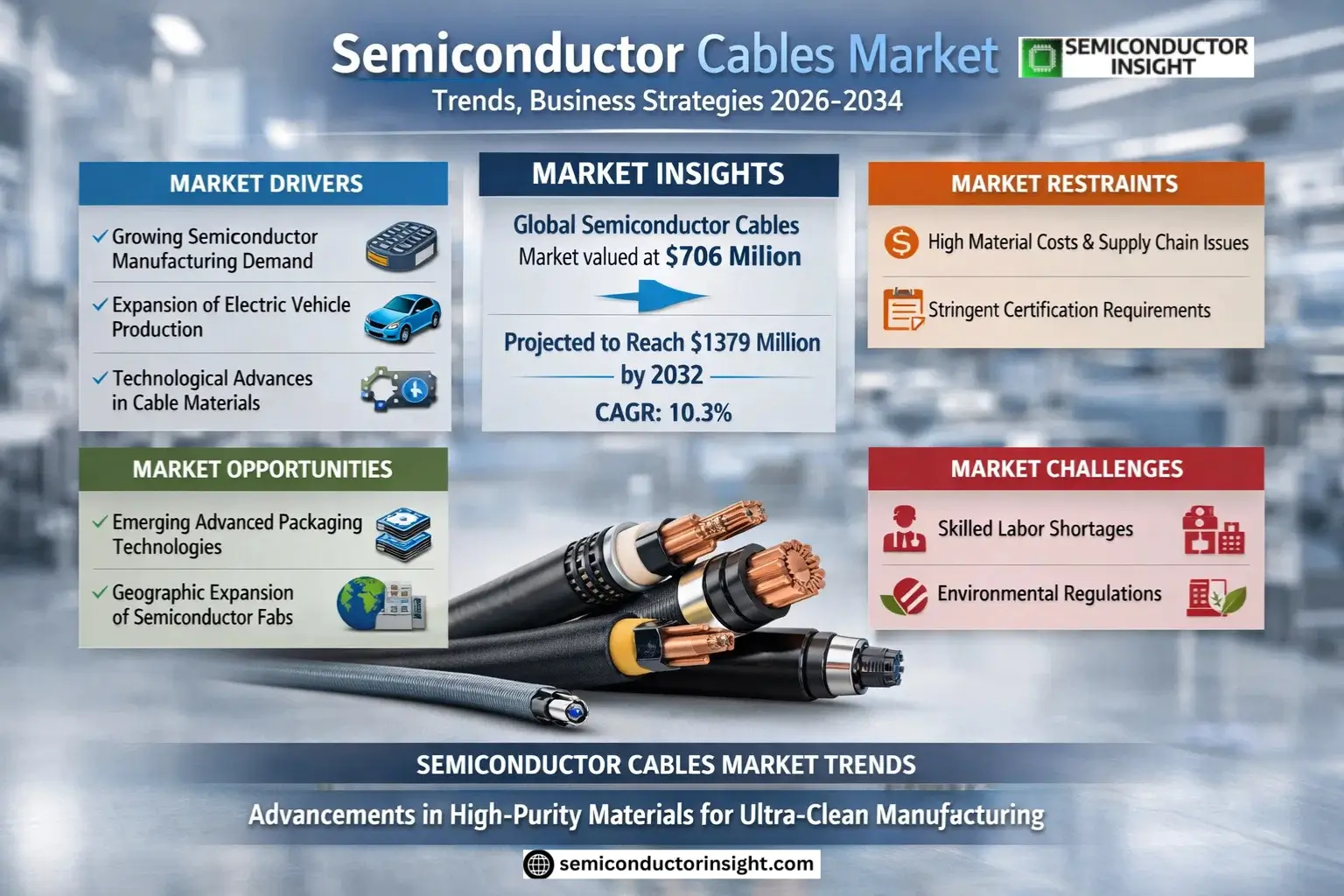
Global Semiconductor Cables Market was valued at 706 million in 2024 and is projected to reach USD 1379 million by 2032, at a CAGR of 10.3% during the forecast period.
Semiconductor cables are specialized wiring solutions designed to meet the stringent requirements of semiconductor manufacturing environments. These high-performance cables must endure rapid, precise movements while preventing particle contamination that could compromise chip integrity. Key product categories include low voltage, medium voltage, and high voltage cables, which are critical for applications in mechanical equipment, information transmission systems, and power systems.
Market growth is driven by the expanding semiconductor industry, which reached USD 580 billion in 2022 despite a moderated 4.4% growth rate following record 26.2% expansion in 2021. Regional dynamics show strong performance in the Americas (17% growth) and Europe (12.6% growth), while Asia Pacific the largest market experienced a 2.9% decline. Leading manufacturers including Helukabel, Gore, and Staubli are innovating to meet rising demand from foundries and equipment manufacturers, particularly as advanced node production requires cables with enhanced durability and contamination control.
MARKET DYNAMICS
MARKET DRIVERS
Rising Demand for Advanced Semiconductor Manufacturing to Fuel Cable Market Growth
The semiconductor industry is experiencing unprecedented demand, driven by the rapid adoption of 5G, IoT devices, and artificial intelligence applications. This increased production output directly boosts the requirement for high-performance semiconductor cables that can endure extreme processing conditions while maintaining signal integrity. Global semiconductor market, valued at around D 580 billion in 2022, continues to expand despite economic headwinds, with sectors like Analog and Logic showing particularly strong double-digit growth. Semiconductor cables play a critical role in wafer processing equipment, inspection tools, and vacuum systems where they must resist chemical corrosion, high temperatures, and particle contamination.
Expansion of Electric Vehicle Production Accelerates Specialized Cable Needs
The automotive semiconductor market is undergoing fundamental transformation as electric vehicles become mainstream, requiring more sophisticated power management systems. EVs contain semiconductor content worth 3-4 times that of conventional vehicles, with Global EV market projected to grow at a compound annual rate exceeding 25% through 2030. This creates substantial demand for medium and high voltage semiconductor cables capable of handling increased power loads while minimizing electromagnetic interference. Cable manufacturers are responding with innovations in materials science to meet automotive industry standards for durability and safety.
Technological Advancements in Cable Materials Drive Performance Improvements
Material science breakthroughs are enabling semiconductor cable manufacturers to overcome traditional limitations. New fluoropolymer compounds, ceramic coatings, and nanocomposite materials demonstrate superior resistance to extreme temperatures (up to 300°C continuous operation) while maintaining flexibility and dielectric properties. These innovations are critical as semiconductor fabrication nodes shrink below 5nm, where even minor cable outgassing can contaminate cleanroom environments. Leading manufacturers report productivity gains of 15-20% when upgrading to latest-generation cable systems, making the investment increasingly attractive despite higher upfront costs.
MARKET RESTRAINTS
High Material Costs and Supply Chain Volatility Constrain Market Expansion
Semiconductor Cables Market faces significant pressure from fluctuating raw material prices, particularly for specialized polymers and rare earth metals used in conductive elements. Copper prices have shown 30-40% annual volatility in recent years, while fluoropolymer resins remain constrained by limited production capacity. These material challenges compound with extended lead times for semiconductor manufacturing equipment, where cables represent critical but sometimes delayed components. Fabrication plant operators report that cable-related delays accounted for approximately 8-12% of unplanned equipment downtime in recent semiconductor facility audits.
Technical Certification Requirements Create Barriers to Market Entry
Stringent qualification processes for semiconductor-grade cables present a major hurdle for new market entrants. Cables must undergo 12-18 months of rigorous testing for outgassing properties, particulate generation, and electrical performance under vacuum conditions before being approved for use in fabrication facilities. The certification costs alone can exceed D 500,000 per cable type, favoring large established players with dedicated testing laboratories. Additionally, semiconductor equipment manufacturers increasingly require cables to demonstrate compatibility with specific OEM platforms, further narrowing the supplier pool.
MARKET OPPORTUNITIES
Emerging Semiconductor Packaging Technologies Create New Cable Applications
Advanced packaging methods like 3D IC and chiplet architectures are driving innovation in interconnects and cabling solutions. The heterogeneous integration trend requires specialized low-profile cables capable of high-density signal transmission between stacked dies. Market analysis indicates that packaging-related cable demand will grow at nearly twice the rate of traditional front-end cabling solutions through 2030. Leading cable manufacturers are developing ultra-thin coaxial and ribbon cable variants with pitch dimensions below 100μm to meet these emerging requirements.
Geographic Expansion of Semiconductor Fabs Opens New Regional Markets
Global semiconductor industry’s geographical diversification presents substantial growth potential for cable suppliers. With over D 200 billion in new fab construction planned across North America, Europe, and Southeast Asia through 2025, cable manufacturers have opportunities to establish local supply chains near major production clusters. This regional expansion is particularly significant given that semiconductor cables often require customized solutions based on facility design and local environmental conditions. Suppliers establishing early presence in emerging semiconductor hubs can secure long-term maintenance and replacement business.
MARKET CHALLENGES
Technical Workforce Shortages Impact Cable Manufacturing Capacity
The specialized nature of semiconductor cable production faces growing human capital constraints. Skilled technicians capable of operating precision extrusion and braiding equipment remain in short supply, with industry surveys indicating a 15-20% vacancy rate for these positions. The problem exacerbates in regions with multiple semiconductor supply chain operations competing for the same labor pool. Training programs require 6-9 months for basic competency and 2-3 years for full proficiency, creating persistent bottlenecks in production capacity expansion.
Environmental Regulations Increase Compliance Costs
Evolving environmental standards present ongoing challenges for cable material formulations. Restrictions on perfluorinated compounds (PFCs) and halogenated flame retardants require costly reformulation efforts while maintaining performance standards. The European Union’s latest REACH chemical regulations alone are estimated to add 7-10% to material costs for compliant semiconductor cables. These regulatory pressures coincide with growing customer demands for sustainable manufacturing practices, forcing suppliers to balance performance, compliance, and cost considerations.
SEMICONDUCTOR CABLES MARKET TRENDS
Advancements in High-Purity Materials Driving Semiconductor Cable Demand
Semiconductor Cables Market is experiencing significant growth due to stringent requirements for high-performance materials in chip manufacturing. As semiconductor nodes shrink to 3nm and below, the need for ultra-pure cabling solutions that minimize particle contamination has become critical. Global semiconductor manufacturers now demand cables with particle emission rates below 0.1 particles/cm³ for particles larger than 0.1 micron. This has led to innovations in fluoropolymer and silicone-based insulation materials that combine superior mechanical properties with exceptional cleanliness standards. The transition to extreme ultraviolet (EUV) lithography has further intensified these requirements, as even nanometer-scale contaminants can disrupt the precision patterning process.
Other Trends
Automation and Industry 4.0 Integration
The semiconductor industry’s rapid adoption of automation and smart factory technologies is creating sustained demand for specialized cabling solutions. Modern fabrication facilities require flexible, high-speed data cables capable of withstanding millions of motion cycles while maintaining signal integrity. According to industry reports, automated material handling systems now account for over 35% of cable demand in new wafer fabs. This trend is particularly prominent in memory chip production, where vertical integration and continuous process optimization demand robust interconnection solutions. The rise of IoT-enabled equipment monitoring further drives the need for cables with embedded sensors that can provide real-time performance data.
Geopolitical Influences on Supply Chain Resilience
Recent shifts in global trade policies and semiconductor supply chain realignments are reshaping the cables market landscape. With major economies establishing domestic semiconductor manufacturing capabilities, regional cable suppliers are expanding production capacities to reduce import dependencies. The CHIPS Act in the United States alone has allocated D 52 billion towards domestic semiconductor manufacturing, creating new opportunities for localized cable suppliers. Meanwhile, Southeast Asian markets are experiencing 18-20% year-over-year growth in semiconductor cable demand as multinational corporations diversify their manufacturing footprints. These developments are accelerating technological collaborations between cable manufacturers and fab equipment providers to develop application-specific solutions.
Environmental and Regulatory Compliance
Increasing environmental regulations are prompting significant material innovations in semiconductor cables. Restrictions on per- and polyfluoroalkyl substances (PFAS) are driving research into alternative fluoropolymer formulations that maintain chemical resistance without environmental persistence. The industry is simultaneously shifting towards halogen-free flame retardant compounds to meet stricter safety standards in cleanroom environments. These regulatory pressures coincide with growing emphasis on cable recycling and circular economy principles, with leading manufacturers now offering take-back programs for end-of-life cabling components.
COMPETITIVE LANDSCAPE
Key Industry Players
Innovation and Precision Drive Market Leadership in Semiconductor Cables
Semiconductor Cables Market is characterized by a mix of established multinational corporations and specialized manufacturers, all competing to enhance production efficiency and precision. With Global Semiconductor Cables Market valued at D 706 million in 2024 and projected to reach D 1,379 million by 2032, companies are aggressively investing in high-performance cable solutions to meet the demands of the semiconductor industry’s rigorous environments.
Helukabel and Gore dominate the competitive landscape, leveraging their expertise in producing ultra-low particulate emission cables that meet stringent semiconductor manufacturing requirements. These companies have secured significant market share due to their ability to customize cables for high-frequency, high-vacuum, and extreme temperature applications, critical for advanced semiconductor fabrication.
Meanwhile, Staubli and Pfeiffer Vacuum are reinforcing their positions through strategic collaborations with semiconductor equipment manufacturers, developing integrated cable solutions that minimize contamination risks. Their focus on vacuum-compatible and ESD-safe cables positions them strongly in the market, particularly for next-generation chip manufacturing.
Regionally, Asian players like Shanghai Electric and Tatsuta are gaining traction by offering cost-competitive solutions while maintaining quality benchmarks, especially in the fast-growing Asia-Pacific semiconductor hub. Their localized production capabilities help address the region’s specific needs while offering shorter lead times than global competitors.
The market has also seen MKS Instruments and Agilent Technologies expand their semiconductor cable portfolios through acquisitions, such as MKS’s purchase of Atotech and Agilent’s strategic partnerships with foundries. These moves enable deeper integration into the semiconductor manufacturing ecosystem while enhancing technical capabilities.
List of Key Semiconductor Cables Companies Profiled
- Helukabel (Germany)
- Gore (U.S.)
- Staubli (Switzerland)
- Comet (Austria)
- Totoku (Japan)
- JEM Electronics (U.S.)
- Schmalz (Germany)
- BizLink (U.S.)
- CeramTec (Germany)
- Allectra (Germany)
- Tatsuta (Japan)
- Pfeiffer Vacuum (Germany)
- Accu-Glass Products (U.S.)
- LEONI (Germany)
- VACOM (Germany)
- Agilent (U.S.)
- Gamma Vacuum (Atlas Copco) (U.S.)
- MKS Instruments (U.S.)
- Keycom (Japan)
- MDC Precision (U.S.)
- Kurt J. Lesker (U.S.)
- LewVac (U.S.)
- Shanghai Electric (China)
- Luoyang Zhengqi Machinery Co (China)
- Hefei Huaerte (China)
Segment Analysis:
By Type
Low Voltage Cables Lead Market Share Due to High Demand in Semiconductor Equipment
The market is segmented based on type into:
- Low Voltage
- Medium Voltage
- High Voltage
By Application
Mechanical Equipment and Instrumentation System Segment Dominates Owing to Critical Usage in Wafer Processing
The market is segmented based on application into:
- Mechanical Equipment and Instrumentation System
- Information Transmission System
- Power System
By Material
Copper-Based Cables Remain Prevalent for High Conductivity Requirements
The market is segmented based on material into:
- Copper
- Aluminum
- Fiber Optic
- Others
By End-User
Semiconductor Fabrication Plants Drive Majority of Demand
The market is segmented based on end-user into:
- Foundries
- IDMs (Integrated Device Manufacturers)
- OSAT (Outsourced Semiconductor Assembly and Test)
- Research Facilities
Regional Analysis: Semiconductor Cables Market
Asia-Pacific
The Asia-Pacific region dominates Global Semiconductor Cables Market, accounting for over 45% of total demand. China leads with aggressive semiconductor manufacturing expansion, supported by government initiatives like the China Integrated Circuit Industry Investment Fund with D 50 billion allocated to boost domestic production. South Korea and Taiwan follow closely, where major foundries like TSMC and Samsung drive demand for ultra-pure, contamination-free cables. Japan maintains a strong position in high-reliability specialty cables. While cost competitiveness remains crucial, the region shows increasing adoption of advanced cable solutions to support next-gen chip fabrication.
North America
North America represents the second-largest Semiconductor Cables Market, driven by leading-edge semiconductor fabs and R&D centers. The U.S. CHIPS and Science Act’s D 52 billion investment is accelerating domestic semiconductor production, creating demand for specialized, high-performance cabling solutions. Major tech hubs in Silicon Valley, Arizona (Intel’s D 20 billion fab expansion), and Texas require cables with exceptional EMI shielding and signal integrity. The region emphasizes stringent quality standards and innovation, with key players like Gore and MKS Instruments developing advanced semiconductor-grade cables.
Europe
Europe maintains a strong position in semiconductor cable manufacturing, particularly for specialized applications. Germany’s precision engineering expertise supports demand for ultra-clean vacuum and instrumentation cables in semiconductor equipment. The EU Chips Act’s €43 billion investment plan is stimulating regional semiconductor capacity growth, which will drive cable demand. While facing competition from Asian manufacturers, European suppliers like Helukabel and LEONI differentiate through high-reliability products meeting strict EU environmental and safety regulations.
South America
Semiconductor Cables Market in South America is emerging but constrained by limited local semiconductor production. Brazil shows potential with developing electronics manufacturing, while Argentina sees niche demand for industrial automation applications. The region primarily relies on imports, though local cable manufacturers are beginning to develop semiconductor-grade products. Market growth faces challenges from economic volatility and infrastructure limitations, but increasing foreign investment in electronics manufacturing could spur future opportunities.
Middle East & Africa
This region represents the smallest but fastest-growing Semiconductor Cables Market, with 8-10% YoY growth. Israel leads in high-tech applications, while the UAE and Saudi Arabia invest in semiconductor-related infrastructure through economic diversification programs. Limited local production creates import dependence, though regional players are emerging to serve growing electronics manufacturing needs. While still in early stages, strategic investments in technology hubs could boost semiconductor cable demand in coming years.
Regional Market Outlook:
Semiconductor Cables Market shows strong regional divergence. Asia-Pacific’s dominance will continue with ongoing chip manufacturing expansion, while North America and Europe focus on technological advancement. Emerging markets, though currently small, present long-term growth opportunities as global semiconductor supply chains diversify. Regional specialization is evident, with Asia leading in volume production and Western markets emphasizing high-value, specialized cable solutions.
Report Scope
This market research report provides a comprehensive analysis of Global Semiconductor Cables Market, covering the forecast period 2024–2032. It offers detailed insights into market dynamics, technological advancements, competitive landscape, and key trends shaping the industry.
Key focus areas of the report include:
- Market Size & Forecast: Historical data and future projections for revenue, unit shipments, and market value across major regions and segments.
- Segmentation Analysis: Detailed breakdown by product type (Low Voltage, Medium Voltage, High Voltage), application (Mechanical Equipment, Information Transmission, Power Systems), and end-user industries.
- Regional Outlook: Insights into market performance across North America, Europe, Asia-Pacific, Latin America, and the Middle East & Africa, with country-level analysis for key markets.
- Competitive Landscape: Profiles of 25+ leading market participants, including their product portfolios, manufacturing capabilities, R&D investments, and strategic developments.
- Technology Trends: Analysis of material innovations, high-performance cable solutions, and integration with advanced semiconductor manufacturing processes.
- Market Dynamics: Evaluation of growth drivers (semiconductor industry expansion, automation trends) and challenges (material costs, supply chain complexities).
- Stakeholder Analysis: Strategic insights for cable manufacturers, semiconductor equipment providers, and investors in the value chain.
The research methodology combines primary interviews with industry experts and analysis of verified market data from authoritative sources to ensure accuracy and reliability.
FREQUENTLY ASKED QUESTIONS:
What is the current market size of Global Semiconductor Cables Market?
-> Semiconductor Cables Market was valued at 706 million in 2024 and is projected to reach USD 1379 million by 2032, at a CAGR of 10.3% during the forecast period.
Which key companies operate Global Semiconductor Cables Market?
-> Key players include Helukabel, Gore, Staubli, BizLink, LEONI, MKS Instruments, and Pfeiffer Vacuum, among 25+ profiled companies.
What are the key growth drivers?
-> Primary drivers include rising semiconductor manufacturing capacity, increasing automation in fabs, and demand for high-performance cabling solutions in advanced chip production.
Which region dominates the market?
-> Asia-Pacific leads the market with 58% share in 2024, driven by semiconductor manufacturing hubs in China, Taiwan, South Korea and Japan.
What are the emerging trends?
-> Emerging trends include ultra-clean cable solutions, high-flex designs for automation, and integration with Industry 4.0 systems in semiconductor fabs.
Get Sample Report PDF for Exclusive Insights
Report Sample Includes
- Table of Contents
- List of Tables & Figures
- Charts, Research Methodology, and more...
 Download Sample Report PDF