Secure element chip with physically unclonable function (PUF) Market Insights
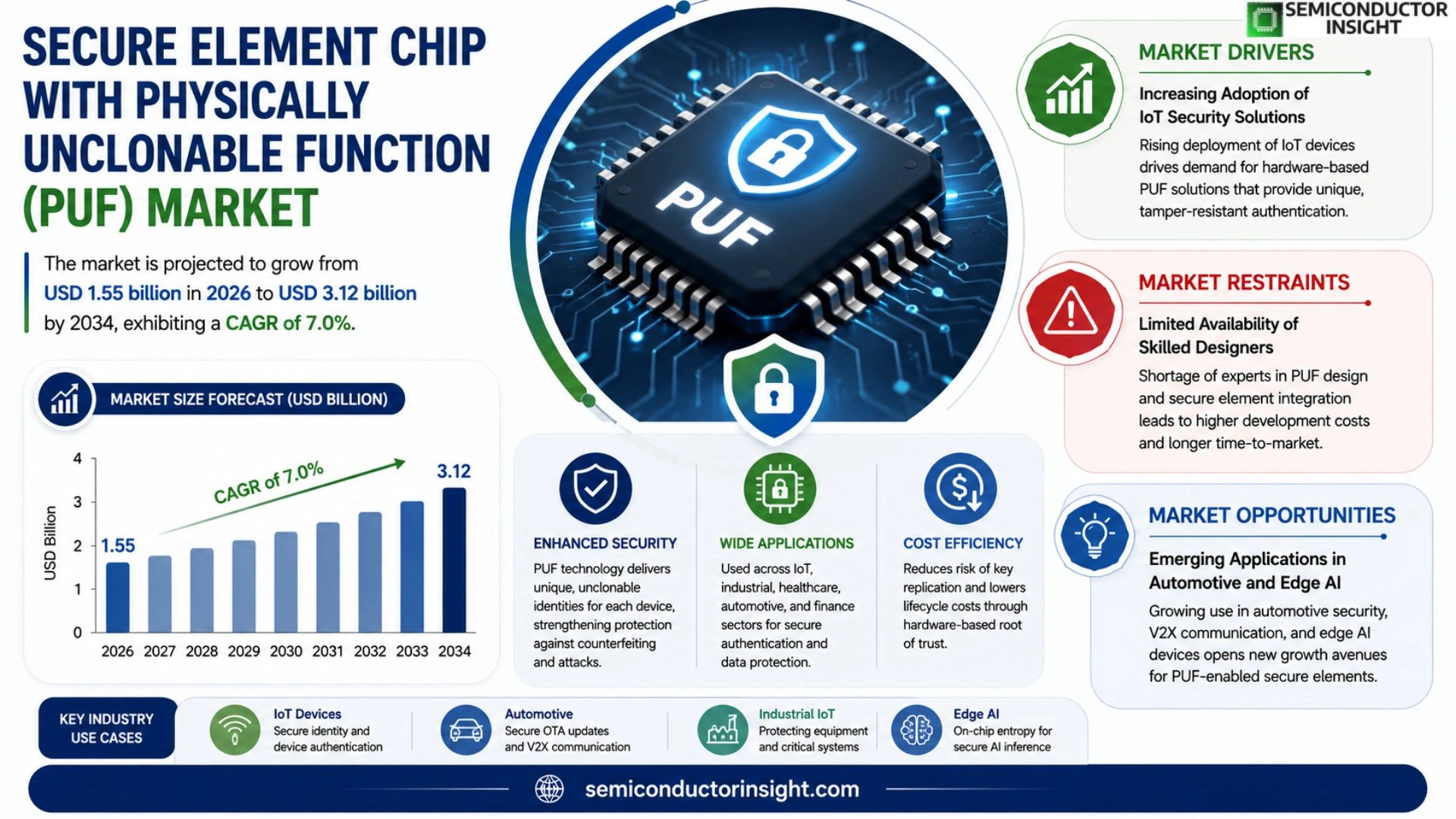
Global Secure element chip with physically unclonable function (PUF) market size was valued at USD 1.42 billion in 2025. The market is projected to grow from USD 1.55 billion in 2026 to USD 3.12 billion by 2034, exhibiting a CAGR of 7.0% during the forecast period.
Secure element chips integrated with PUF technology are tamper‑resistant microcontrollers that generate unique cryptographic keys from intrinsic manufacturing variations. These chips provide hardware‑based authentication, key storage, and anti‑counterfeiting capabilities without requiring external key provisioning.
The market is experiencing rapid growth because enterprises are accelerating digital transformation while demanding stronger device‑level security for IoT, automotive, and mobile applications. Furthermore, rising regulatory pressure,such as Europe’s GDPR‑aligned security standards,and increasing adoption of contactless payment solutions are driving investment in PUF‑enabled secure elements.
MARKET DRIVERS
Increasing Adoption of IoT Security Solutions
Secure element chip with physically unclonable function (PUF) market is being propelled by the rapid expansion of IoT devices that require tamper‑resistant authentication. Enterprises are recognizing that traditional software keys are vulnerable, and hardware‑based PUF technology offers a unique fingerprint for each device, dramatically reducing cloning risk.
Regulatory Push for Hardware‑based Authentication
New data‑privacy regulations across North America and Europe mandate stronger hardware security, prompting manufacturers to embed secure element chips with PUF in consumer electronics, medical devices, and industrial controllers. Compliance pressures are accelerating product redesign cycles toward integrated PUF solutions.
➤ “Hardware‑rooted security is no longer optional; it is becoming a compliance baseline for high‑value IoT deployments.”
Analysts forecast a compound annual growth rate of roughly 12% for the sector, driven by converging demands for secure authentication, low‑power operation, and scalability across mass‑produced devices.
MARKET CHALLENGES
High Development Costs and Integration Complexity
Designing and validating secure element chips with PUF requires specialized silicon expertise and extensive testing, which inflates R&D expenditures. Small‑to‑mid‑size OEMs often lack the capital to sustain long development cycles, slowing market penetration.
Other Challenges
Supply Chain Constraints
Global semiconductor shortages have limited the availability of raw wafers and packaging services, creating lead times of up to six months for PUF‑enabled components. This bottleneck restrains timely product launches.
MARKET RESTRAINTS
Limited Availability of Skilled Designers
The niche expertise required to implement physically unclonable functions in secure elements remains scarce. Educational pipelines have not yet produced a sufficient workforce, leading to higher labor costs and extended project timelines.
MARKET OPPORTUNITIES
Emerging Applications in Automotive and Edge AI
Automotive manufacturers are integrating PUF‑enabled secure elements to protect over‑the‑air updates and secure vehicle‑to‑infrastructure communication. Simultaneously, edge AI devices benefit from on‑chip entropy sources that enable lightweight, tamper‑proof machine learning inference.
Secure element chip with physically unclonable function (PUF) Market Trends
Growth Driven by IoT Expansion and Regulatory Pressure
Secure element chip with physically unclonable function (PUF) technology is witnessing a pronounced upward trajectory as enterprises accelerate digital transformation initiatives. Device‑level security has become a prerequisite for IoT deployments, automotive electronics, and mobile payment solutions, prompting manufacturers to embed PUF‑enabled secure elements that can generate intrinsic cryptographic keys without external provisioning. Concurrently, regulatory frameworks such as Europe’s GDPR‑aligned security standards are compelling organizations to adopt tamper‑resistant hardware that can demonstrate compliance and protect sensitive data. These combined forces are encouraging a steady inflow of capital toward research, development, and volume production of PUF‑based secure chips.
Other Trends
Automotive Security Integration
Automotive OEMs are increasingly selecting PUF‑enabled secure elements to safeguard vehicle‑to‑cloud communications and protect over‑the‑air update mechanisms. The intrinsic uniqueness of each chip offers a robust defense against cloning attacks, which is critical for protecting encrypted firmware and authentication tokens in connected cars. As electric and autonomous vehicle platforms mature, the demand for hardware‑rooted trust anchors is expected to expand, reinforcing the role of PUF technology within the broader automotive cybersecurity ecosystem.
Strategic Partnerships Expanding the Ecosystem
Major semiconductor players are leveraging strategic collaborations to accelerate market penetration. Notably, a March 2024 joint development agreement between NXP Semiconductors and Microsoft aims to integrate PUF‑based secure elements into Azure Sphere devices, providing a unified hardware security layer for edge computing and IoT applications. Similar alliances among Infineon Technologies, STMicroelectronics, and Samsung Electronics focus on co‑creating reference designs and standardized APIs that simplify integration for device manufacturers. These partnerships not only broaden the addressable market but also cultivate an ecosystem of compatible solutions that ease adoption across diverse industry verticals.
COMPETITIVE LANDSCAPE
Key Industry Players
Secure element chip with PUF: Market Outlook and Competitive Dynamics
Secure element chip with physically unclonable function (PUF) market is led by a handful of global semiconductor powerhouses that dominate both revenue and technology road‑maps. NXP Semiconductors commands a leading share through its aggressive Azure Sphere partnership, leveraging PUF‑enabled secure elements for IoT devices, while Infineon Technologies strengthens its foothold with automotive‑grade solutions that meet stringent functional safety standards. Samsung Electronics and STMicroelectronics round out the core quartet, offering high‑volume production capacities and deep integrations with mobile and wearables ecosystems. Collectively these firms benefit from the market’s projected CAGR of 7 % and the shift toward hardware‑rooted authentication, positioning the market’s structure as an oligopoly where scale, IP portfolios, and strategic alliances dictate competitive advantage.
Beyond the dominant tier, a diverse set of niche innovators enriches the ecosystem with specialized capabilities. Microchip Technology focuses on low‑power PUF‑based microcontrollers for embedded sensors, while Qualcomm exploits its SoC dominance to embed PUF primitives in 5G smartphones. Texas Instruments provides mixed‑signal secure elements for industrial IoT, and Renesas delivers automotive‑grade PUF chips compliant with ISO‑26262. Additional contributors include ROHM Semiconductor, Cypress Semiconductor (now part of Infineon), Goodix, AuthenTec, Nuvoton Technology, Broadcom, and STMicroelectronics’ subsidiary, STMicroelectronics Imaging. These players drive differentiation through application‑specific features, regional market penetration, and collaborative R&D, ensuring a vibrant competitive landscape that supports rapid adoption across IoT, payment, and automotive sectors.
List of Key Secure element chip with physically unclonable function (PUF) Companies Profiled
- NXP Semiconductors
- Infineon Technologies
- Samsung Electronics
- STMicroelectronics
- Microchip Technology
- Qualcomm
- Texas Instruments
- Renesas Electronics
- ROHM Semiconductor
- Cypress Semiconductor
- Goodix
- AuthenTec
- Nuvoton Technology
- Broadcom
Segment Analysis:
| Segment Category | Sub-Segments | Key Insights |
| By Type |
|
PUF‑enabled Secure Element ASICs dominate this category because they provide the highest level of tamper resistance and are ideal for high‑volume, cost‑sensitive IoT deployments. They enable intrinsic key generation without external provisioning, fostering trust in device authentication. • Robust against physical attacks and invasive probing. • Seamlessly integrates into existing ASIC design flows, accelerating time‑to‑market. • Preferred by manufacturers seeking a minimal‑footprint security solution. |
| By Application |
|
IoT devices represent the leading application segment as edge‑connected products require hardware‑rooted trust. PUF‑based secure elements simplify key lifecycle management and strengthen anti‑cloning measures. • Enable device‑level authentication without exposing secret keys. • Support scalable deployment across heterogeneous sensor networks. • Align with regulatory expectations for data integrity and privacy. |
| By End User |
|
Device manufacturers are the primary end‑users, driven by the need to embed immutable security primitives directly into silicon. Their focus on cost‑efficiency and rapid product cycles makes PUF‑enabled secure elements a compelling choice. • Reduce bill‑of‑materials by eliminating external key storage modules. • Accelerate certification processes through built‑in compliance features. • Foster brand trust by offering tamper‑evident solutions to downstream customers. |
| By Security Architecture |
|
Hardware root of trust emerges as the dominant architecture because it establishes an immutable foundation for all subsequent security functions. PUF technology reinforces this foundation by creating device‑unique keys at manufacturing. • Guarantees that each device possesses a non‑replicable cryptographic identity. • Enables seamless integration with secure boot and firmware attestation. • Enhances resilience against supply‑chain attacks and cloning attempts. |
| By Deployment Scenario |
|
Edge devices lead the deployment scenario segment as they require autonomous security capabilities without reliance on constant cloud connectivity. PUF‑enabled secure elements deliver local key derivation and verification, supporting offline trust. • Facilitate secure over‑the‑air updates by authenticating firmware at the edge. • Reduce latency and bandwidth consumption for security checks. • Align with privacy‑focused regulations by keeping sensitive operations on device. |
Regional Analysis: North America
The proliferation of mobile payment systems and digital wallets necessitates highly secure elements, creating substantial demand for PUF-enhanced chips. The need for secure authentication and transaction processing in these platforms is a primary growth driver.
The automotive industry is increasingly integrating sophisticated electronic systems, making PUF technology crucial for securing vehicle access, communication, and data. The growing complexity of connected and autonomous vehicles is a key factor in this demand.
The exponential growth of IoT devices, spanning various sectors, creates a significant vulnerability to security threats. PUF technology offers a strong layer of security for these devices, making it essential for market expansion.
The increasing reliance on digital identities requires robust authentication and authorization mechanisms. PUF technology provides a unique and secure way to manage digital identities and control access to sensitive information.
Europe
Europe presents a steady and evolving market for secure element chip with PUF. Stringent data protection regulations, such as GDPR, are driving the adoption of advanced security solutions across various industries. The region’s strong focus on innovation and research contributes to the development and implementation of new PUF-based technologies. Key application areas include financial services, government infrastructure, and industrial control systems. While the growth rate may be moderate compared to North America, Europe offers a stable and mature market with long-term potential.
Asia-Pacific
Asia-Pacific is poised for substantial growth in the secure element chip with PUF market. The region’s burgeoning digital economy, high smartphone penetration, and increasing e-commerce activity are key drivers. Governments across Asia-Pacific are actively investing in cybersecurity initiatives, further boosting demand. The growing adoption of PUF technology in automotive, industrial automation, and IoT applications is also contributing to market expansion. However, the fragmented nature of the market and varying regulatory landscapes present certain challenges.
South America
South America represents a relatively nascent market for secure element chip with PUF. The increasing adoption of mobile banking and e-commerce platforms is creating initial demand. However, factors such as limited technological infrastructure and economic uncertainties pose challenges to growth. The region’s potential lies in leveraging PUF technology to enhance security in financial services and government applications as digital transformation progresses.
Middle East & Africa
The Middle East & Africa region is an emerging market with significant growth potential for secure element chip with PUF. Rapid urbanization, increasing investments in infrastructure, and a growing focus on cybersecurity are driving demand. The region’s expanding financial sector and increasing adoption of digital services are key growth drivers. The deployment of secure elements in government systems and critical infrastructure is also contributing to market expansion.
Report Scope
This market research report provides a comprehensive analysis of the Secure element chip with physically unclonable function (PUF) Market , covering the forecast period 2026–2034. It offers detailed insights into market dynamics, technological advancements, competitive landscape, and key trends shaping the industry.
Key focus areas of the report include:
- Market Overview: The report begins with an overview outlining its current market scenario, key growth indicators, and industry transformation drivers. It discusses macroeconomic factors, demand–supply balance, regulatory landscape, and the strategic role of semiconductors in powering advancements across industries such as automotive, telecommunications, consumer electronics, and industrial automation.
- Market Size & Forecast: Historical data and future projections for revenue, unit shipments, and market value across major regions and segments.
- Segmentation Analysis: Detailed breakdown by product type, technology, application, and end-user industry to identify high-growth segments and investment opportunities.
- Regional Insights: Insights into market performance across North America, Europe, Asia-Pacific, Latin America, and the Middle East & Africa, including country-level analysis where relevant.
- Competitive Landscape: Profiles of leading market participants, including their product offerings, R&D focus, manufacturing capacity, pricing strategies, and recent developments such as mergers, acquisitions, and partnerships.
- Technology Trends & Innovation: Assessment of emerging technologies, integration of AI/IoT, semiconductor design trends, fabrication techniques, and evolving industry standards.
- Market Drivers & Restraints: Evaluation of factors driving market growth along with challenges, supply chain constraints, regulatory issues, and market-entry barriers.
- Stakeholder Insights: Insights for component suppliers, OEMs, system integrators, investors, and policymakers regarding the evolving ecosystem and strategic opportunities.
Primary and secondary research methods are employed, including interviews with industry experts, data from verified sources, and real-time market intelligence to ensure the accuracy and reliability of the insights presented.
FREQUENTLY ASKED QUESTIONS:
What is the current market size of Secure element chip with physically unclonable function (PUF) Market?
-> Secure element chip with physically unclonable function (PUF) market is projected to grow from USD 1.55 billion in 2026 to USD 3.12 billion by 2034.
Which key companies operate in Secure element chip with physically unclonable function (PUF) Market?
-> Key players include NXP Semiconductors, Infineon Technologies, STMicroelectronics, Samsung Electronics, among others.
What are the key growth drivers?
-> Key growth drivers include accelerated digital transformation, increasing demand for device‑level security in IoT, automotive and mobile applications, regulatory pressures such as GDPR‑aligned standards, and rising adoption of contactless payment solutions.
Which region dominates the market?
-> Asia‑Pacific is the fastest‑growing region, while Europe remains a dominant market.
What are the emerging trends?
-> Emerging trends include integration of PUF technology with AI‑enabled security frameworks, expansion of secure element usage in edge computing devices, and development of standardized PUF‑based authentication protocols.
Get Sample Report PDF for Exclusive Insights
Report Sample Includes
- Table of Contents
- List of Tables & Figures
- Charts, Research Methodology, and more...