Satellite Internet Semiconductor Market Insights
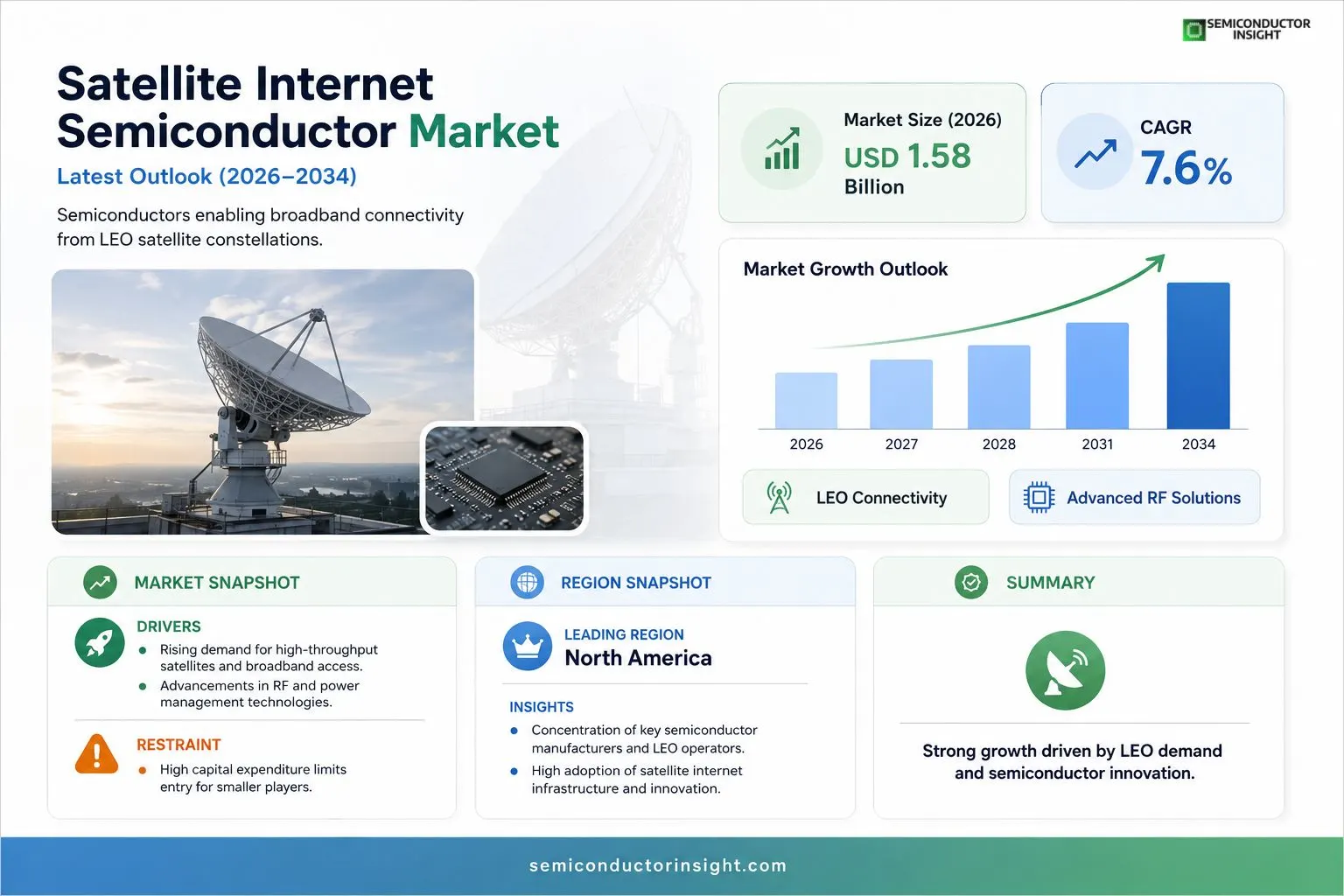
Global Satellite Internet Semiconductor Market is projected to grow from USD 1.58 billion in 2026 to USD 3.04 billion by 2034, exhibiting a CAGR of 7.6% during the forecast period.
Satellite Internet Semiconductors include RF front‑end modules, phased‑array beam‑forming chips, power amplifiers and digital baseband processors that enable broadband connectivity from low‑Earth‑orbit constellations such as Starlink, OneWeb and Kuiper.The market is accelerating because of massive capital deployment in LEO constellations, rising demand for broadband in underserved regions, and regulatory support for spectrum allocation. Furthermore, collaborations such as Qualcomm’s partnership with SpaceX to integrate custom RF solutions (2023) and Skyworks’ launch of a Ka‑band antenna suite (2024) illustrate how leading players,Qualcomm, Skyworks Solutions, Analog Devices and Intel,are driving technology adoption.
MARKET DRIVERS
Increasing Demand for High‑Throughput Satellites
Satellite Internet Semiconductor Market is being propelled by a surge in high‑throughput satellite (HTS) deployments that require more efficient RF front‑ends, power amplifiers, and beam‑forming chips. Service providers are expanding broadband coverage to remote regions, driving manufacturers to innovate silicon‑based solutions that reduce weight and power consumption.
Advancements in RF and Power Management
Recent breakthroughs in gallium‑nitride (GaN) and silicon‑on‑insulator (SOI) technologies enable higher linearity and thermal resilience, directly benefiting Satellite Internet Semiconductor Market. These advances lower the bill of materials and shorten time‑to‑market for new satellite platforms.
➤ Integration of next‑generation semiconductor devices is accelerating satellite broadband capacity while cutting launch mass.
Overall, the convergence of demand for ubiquitous connectivity and semiconductor performance gains creates a robust growth trajectory for the market.
MARKET CHALLENGES
Technical Complexity and Integration
Designing semiconductor components that operate reliably in the harsh space environment remains a core challenge. Radiation hardening, thermal cycling, and stringent qualification processes increase development cycles for Satellite Internet Semiconductor Market.
Other Challenges
Supply Chain Constraints
Global shortages of high‑purity substrates and specialized packaging materials can delay production, raising costs for satellite manufacturers and limiting rapid rollout of new services.
MARKET RESTRAINTS
High Capital Expenditure
Deploying satellite constellations demands substantial upfront investment in launch services, ground infrastructure, and qualifying semiconductor components. The financial intensity can restrain smaller players from entering Satellite Internet Semiconductor Market, concentrating market share among a few large manufacturers.
MARKET OPPORTUNITIES
Emerging Low‑Earth‑Orbit Constellations
Low‑Earth‑Orbit (LEO) networks require compact, high‑efficiency semiconductor solutions to support massive antenna arrays and rapid beam steering. The shift toward LEO constellations opens new design opportunities for integrated RF‑system‑on‑chips, presenting a sizable growth avenue for Satellite Internet Semiconductor Market.
Satellite Internet Semiconductor Market Trends
Scaling RF Front‑End Capabilities for LEO Constellations
Satellite Internet Semiconductor Market is being reshaped by the rapid expansion of low‑Earth‑orbit constellations. As operators deploy thousands of satellites, demand for compact, high‑efficiency RF front‑end modules has surged. Integrated designs now deliver broader bandwidth and lower power consumption, enabling providers to increase throughput while keeping payload mass within launch constraints.
Other Trends
Advanced Beam‑Forming Architectures
Phased‑array beam‑forming chips are moving from prototype to volume production. These chips steer multiple narrow beams electronically, improving link reliability for users in remote regions. Recent generations support Ka‑band and Q‑band frequencies, offering higher data rates without requiring larger antennas on the ground.
Digital Baseband Processor Consolidation
Digital baseband processors are consolidating functions that previously required separate ASICs. By integrating modulation, error correction, and channel coding into a single silicon die, manufacturers reduce board complexity and lower bill‑of‑materials costs. This trend accelerates time‑to‑market for new satellite services.
Strategic Partnerships Driving Innovation
Collaboration between semiconductor firms and satellite operators is a defining feature of the market. Qualcomm’s partnership with SpaceX introduced custom RF solutions that optimize link margin for high‑throughput satellites. Similarly, Skyworks launched a Ka‑band antenna suite tailored for next‑generation LEO platforms, demonstrating how joint engineering reduces development cycles.Other leading players such as Analog Devices and Intel are expanding their product portfolios to include power amplifiers capable of handling the extreme temperature swings experienced in space. These amplifiers employ novel semiconductor materials that sustain high linearity while minimizing thermal drift.
Regulatory Momentum and Spectrum Allocation
Regulatory bodies worldwide are allocating additional spectrum bands for non‑geostationary satellite services. This regulatory momentum encourages semiconductor manufacturers to design multiband solutions that can operate across newly assigned frequencies, offering flexibility for operators to scale services without hardware redesign.Overall, Satellite Internet Semiconductor Market is transitioning from niche, custom‑built components to a more standardized ecosystem. The convergence of advanced RF front‑ends, versatile beam‑forming chips, and consolidated baseband processors, coupled with strong industry partnerships, positions the market for sustained growth in the coming years.
COMPETITIVE LANDSCAPEKey Industry Players
Satellite Internet Semiconductor Market Competitive Overview
Satellite Internet Semiconductor Market is dominated by a handful of large integrated circuit providers that supply RF front‑end modules, phased‑array beam‑forming chips, power amplifiers and digital baseband processors for low‑Earth‑orbit constellations. Qualcomm leads the space with its custom RF solutions for SpaceX’s Starlink, leveraging a deep portfolio in 5G and mmWave technologies. Skyworks Solutions follows closely, having introduced a Ka‑band antenna suite in 2024 that targets both commercial and defense LEO projects. Analog Devices and Intel also command significant share; Analog Devices focuses on high‑performance mixed‑signal and data converters, while Intel’s acquisition of a satellite‑communications chip design house expands its foothold in the modem segment. These four firms shape the market’s architecture, dictate pricing trends, and drive the majority of R&D spend, creating a tiered structure where tier‑1 suppliers partner directly with constellation operators and Tier‑2 manufacturers source sub‑components.Beyond the tier‑1 leaders, a robust ecosystem of niche players adds depth and specialization. Broadcom supplies high‑speed silicon photonics interconnects for onboard data routing. NXP Semiconductors and STMicroelectronics deliver power management ICs optimized for space‑qualified operation. Murata and Qorvo provide compact, high‑efficiency antenna modules that enable smaller payloads. L3Harris Technologies and Infineon Technologies focus on ruggedized RF front‑ends for defense‑grade satellites, while Texas Instruments, MaxLinear, Marvell and AMS contribute mixed‑signal and sensor solutions that enhance telemetry and navigation. This diverse set of companies ensures a resilient supply chain and fosters innovation across the satellite internet value chain.
List of Key Satellite Internet Semiconductor Companies Profiled
- Qualcomm
- Skyworks Solutions
- Analog Devices
- Intel
- Broadcom
- NXP Semiconductors
- Murata Manufacturing
- Qorvo
- L3Harris Technologies
- Infineon Technologies
- Texas Instruments
- MaxLinear
- Marvell Technology Group
- AMS AG
- STMicroelectronics
Segment Analysis:
| Segment Category | Sub-Segments | Key Insights |
| By Type |
|
RF front‑end modules are pivotal because:
|
| By Application |
|
LEO broadband connectivity drives growth through:
|
| By End User |
|
Enterprise and industry benefit from:
|
| By Frequency Band |
|
Ka‑band solutions dominate because:
|
| By Technology Integration |
|
Integrated RF solutions are gaining traction due to:
|
Regional Analysis: North America
North America
The demand for specialized semiconductors in ground stations is steadily increasing, driven by the need for enhanced signal processing and data handling capabilities. Manufacturers are focusing on developing high-performance processors and FPGAs to improve the efficiency of ground station operations.
Semiconductors in user terminals are undergoing rapid innovation, with a focus on miniaturization, power efficiency, and integration of advanced communication protocols. The development of sophisticated chipsets is crucial for delivering seamless and reliable satellite internet experiences to end-users.
RF front-end semiconductors play a critical role in the performance of satellite internet systems. Innovations in this area are focused on improving sensitivity, linearity, and dynamic range to enhance signal reception and transmission.
Efficient power management is essential for the longevity and performance of satellite internet equipment. Advancements in power semiconductors are contributing to reduced power consumption and improved system reliability.
Europe
The European market for satellite internet semiconductors is experiencing notable growth, spurred by government initiatives to bridge the digital divide and enhance connectivity in rural and remote areas. The focus is on developing cost-effective and energy-efficient solutions. There’s a strong emphasis on fostering innovation through collaborative research and development projects. The semiconductor ecosystem in Europe is characterized by a mix of established players and agile startups, all contributing to the advancement of satellite internet technology. Business strategies in Europe often involve leveraging existing infrastructure and partnerships to accelerate market adoption. The increasing demand for backhaul solutions in conjunction with satellite internet services is also a key driver of semiconductor demand.
Asia-Pacific
Asia-Pacific represents a rapidly expanding market for satellite internet semiconductors, fueled by large populations and increasing internet penetration rates. The region is witnessing significant investments in satellite constellations and ground infrastructure, driving demand for a wide range of semiconductor components. China, India, and Southeast Asian countries are key markets, each with unique regulatory environments and consumer preferences. The focus is on providing affordable and accessible satellite internet services to a vast and diverse population. Semiconductor manufacturers are adapting their strategies to cater to the specific needs of the Asia-Pacific market, emphasizing cost competitiveness and localized production capabilities.
Middle East & Africa
The Middle East & Africa region presents a promising growth opportunity for satellite internet semiconductors. Several countries in the region are actively investing in expanding internet infrastructure and improving connectivity. The demand for satellite internet services is particularly strong in remote and underserved areas, where terrestrial infrastructure is limited. Business strategies in this region often involve partnerships with local operators and governments to facilitate market entry and adoption. The focus is on providing reliable and affordable satellite internet solutions to meet the growing digital needs of the region’s population.
South America
South America is emerging as a key market for satellite internet semiconductors, driven by the need to overcome infrastructure limitations and provide internet access to remote communities. Government initiatives and private investments are fueling the expansion of satellite internet services across the region. The focus is on developing cost-effective and robust solutions that can withstand challenging environmental conditions. Semiconductor manufacturers are adapting their product offerings to meet the specific requirements of the South American market, emphasizing durability and reliability.
Report Scope
This market research report provides a comprehensive analysis of the Satellite Internet Semiconductor Market , covering the forecast period 2026–2034. It offers detailed insights into market dynamics, technological advancements, competitive landscape, and key trends shaping the industry.
Key focus areas of the report include:
- Market Overview: The report begins with an overview outlining its current market scenario, key growth indicators, and industry transformation drivers. It discusses macroeconomic factors, demand–supply balance, regulatory landscape, and the strategic role of semiconductors in powering advancements across industries such as automotive, telecommunications, consumer electronics, and industrial automation.
- Market Size & Forecast: Historical data and future projections for revenue, unit shipments, and market value across major regions and segments.
- Segmentation Analysis: Detailed breakdown by product type, technology, application, and end-user industry to identify high-growth segments and investment opportunities.
- Regional Insights: Insights into market performance across North America, Europe, Asia-Pacific, Latin America, and the Middle East & Africa, including country-level analysis where relevant.
- Competitive Landscape: Profiles of leading market participants, including their product offerings, R&D focus, manufacturing capacity, pricing strategies, and recent developments such as mergers, acquisitions, and partnerships.
- Technology Trends & Innovation: Assessment of emerging technologies, integration of AI/IoT, semiconductor design trends, fabrication techniques, and evolving industry standards.
- Market Drivers & Restraints: Evaluation of factors driving market growth along with challenges, supply chain constraints, regulatory issues, and market-entry barriers.
- Stakeholder Insights: Insights for component suppliers, OEMs, system integrators, investors, and policymakers regarding the evolving ecosystem and strategic opportunities.
Primary and secondary research methods are employed, including interviews with industry experts, data from verified sources, and real-time market intelligence to ensure the accuracy and reliability of the insights presented.
FREQUENTLY ASKED QUESTIONS:
What is the current market size of Satellite Internet Semiconductor Market?
-> Satellite Internet Semiconductor Market was valued at USD 1.52 billion in 2025 and is expected to reach USD 3.04 billion by 2034.
Which key companies operate in Satellite Internet Semiconductor Market?
-> Key players include Qualcomm, Skyworks Solutions, Analog Devices, and Intel, among others.
What are the key growth drivers?
-> Key growth drivers include massive capital deployment in LEO constellations, rising demand for broadband in underserved regions, and regulatory support for spectrum allocation.
Which region dominates the market?
-> North America is a leading region due to the concentration of semiconductor manufacturers and major LEO constellation operators.
What are the emerging trends?
-> Emerging trends include custom RF solutions for satellite constellations, Ka‑band antenna integration, and advanced phased‑array beam‑forming technologies.
Get Sample Report PDF for Exclusive Insights
Report Sample Includes
- Table of Contents
- List of Tables & Figures
- Charts, Research Methodology, and more...
 Download Sample Report PDF