Safety Relay and Timers Market Insights
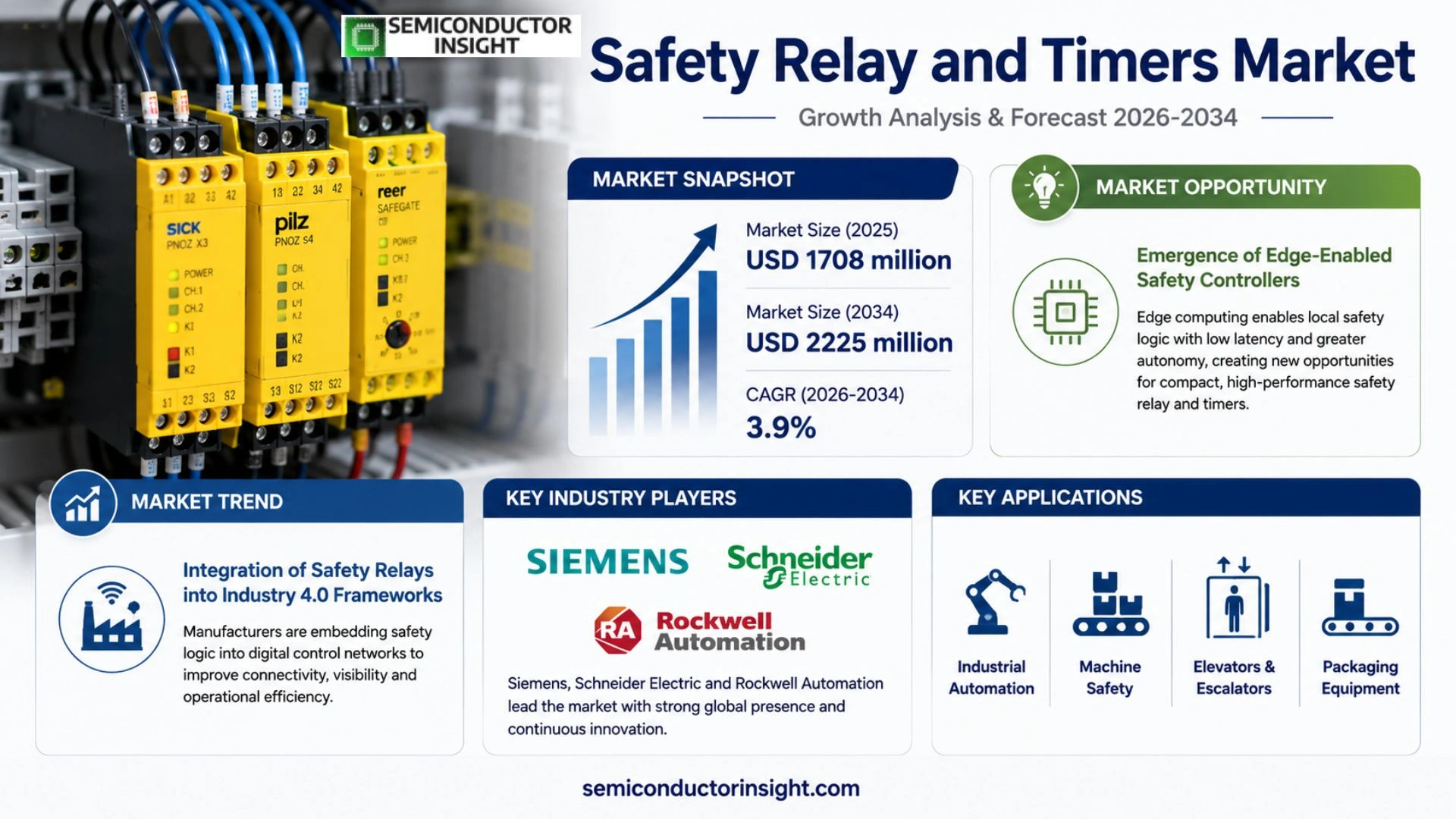
Global Safety Relay and Timers market size was valued at USD 1708 million in 2025. The market is projected to reach USD 2225 million by 2034, exhibiting a CAGR of 3.9 % during the forecast period.
Safety relays and safety timers are foundational components in industrial safety control systems that monitor safety‑related inputs from devices such as emergency‑stop buttons, safety interlocks, light curtains, and two‑hand control stations. A safety relay incorporates redundant internal circuits and self‑monitoring logic to reduce risk by detecting unsafe conditions and initiating a safe state,typically disconnecting energy or stopping hazardous motion. These devices must comply with functional‑safety standards such as EN ISO 13849‑1 and IEC 62061 to achieve recognized Performance Levels (PL) and Safety Integrity Levels (SIL). Safety timers add controlled delay functions, enabling sequenced shutdowns where immediate power loss could create additional hazards.
The market is gaining momentum because manufacturers are integrating higher‑level automation, robotics, and Industry 4.0 concepts that require certified safety logic elements. Regulatory mandates across North America, Europe, and rapidly industrializing regions of Asia‑Pacific compel machine builders to adopt components that meet stringent PL/SIL requirements, creating steady demand for both electromechanical and electronic safety solutions.
MARKET DRIVERS
Growing Industrial Automation Requirements
The rise of smart factories compels equipment manufacturers to embed higher levels of protection. Safety relay and timers become indispensable as they synchronize shutdown sequences, preventing equipment damage and worker injury. Companies that adopt these devices early gain a competitive edge by meeting stricter compliance standards.
Regulatory Pressure on Hazardous Environments
Recent revisions to international safety codes have tightened permissible exposure times for high‑risk machinery. As a result, system integrators are re‑engineering control panels to include redundant timing mechanisms, a shift that directly fuels demand for advanced safety relay solutions.
➤ “Clients are paying a premium for devices that combine rapid response with diagnostic transparency, because downtime translates into measurable revenue loss.”
Moreover, the convergence of IoT connectivity with legacy relay hardware enables predictive maintenance. Organizations that leverage real‑time health data can schedule service before a fault manifests, turning safety components into strategic assets rather than merely compliance tools.
MARKET CHALLENGES
Technical Complexity and Integration Costs
Designing circuits that meet both timing precision and fail‑safe criteria demands specialized engineering talent. Smaller OEMs often lack the resources to validate these systems, leading to slower adoption rates and higher per‑unit costs.
Other Challenges
Supply‑Chain Volatility
Fluctuations in semiconductor availability have introduced lead‑time uncertainty for critical components, pressuring manufacturers to hold larger inventories or seek alternative suppliers.
MARKET RESTRAINTS
High Capital Expenditure for Upgrades
Retrofitting existing production lines with modern safety relay and timers often entails extensive redesign of control architecture. The upfront financial outlay can deter firms operating under tight margin constraints, especially in regions where labor costs remain low.
MARKET OPPORTUNITIES
Emergence of Edge‑Enabled Safety Controllers
Edge computing platforms are beginning to host safety logic locally, reducing latency and eliminating dependence on centralized PLCs. This architectural shift opens a niche for compact, high‑performance safety relay and timers that can operate autonomously, a prospect that several start‑ups are already exploring.
Safety Relay and Timers Market Trends
Integration of Safety Relays into Industry 4.0 Frameworks
Safety Relay and Timers Market is experiencing a shift as manufacturers embed safety logic directly into digital control networks. Redundant circuitry and self‑diagnostic features now communicate with PLCs, edge devices, and cloud platforms, allowing real‑time condition monitoring and predictive maintenance. This convergence reduces unplanned downtime because a fault in a safety relay triggers an immediate diagnostic alert instead of a hidden shutdown. Companies that adopt network‑ready safety relays gain clearer visibility into risk exposure, which in turn shortens engineering cycles for new production lines. Consequently, the market is gravitating toward modules that satisfy IEC 62061 while offering OPC UA or MQTT interfaces, positioning safety components as integral data sources rather than isolated hardware.
Other Trends
Regulatory Convergence and Certification Simplification
Across North America, Europe, and emerging Asian economies, safety authorities are aligning functional‑safety standards to streamline product approval. Harmonized testing protocols for EN ISO 13849‑1 and IEC 62061 mean a single safety relay design can achieve compliance in multiple jurisdictions, lowering duplicate engineering effort. This regulatory alignment encourages OEMs to source globally certified parts, expanding the addressable market for suppliers with a broad certification portfolio. At the same time, manufacturers benefit from reduced time‑to‑market for new equipment because they no longer need country‑specific safety kits. The net effect is a modest acceleration in procurement cycles and an incremental rise in demand for versatile, globally vetted safety relays and timers.
Emergence of Modular Safety Solutions for Flexible Production
Flexibility has become a decisive factor as factories reconfigure lines to accommodate short product runs. Modular safety systems,comprising plug‑in relay blocks and stackable timer units,allow engineers to rewire safety logic without extensive rewiring or recertification. This approach aligns with the broader trend toward reconfigurable automation, where production cells can be repurposed within days rather than weeks. Suppliers that offer interchangeable safety modules benefit from higher order values, as customers purchase complete kits that can evolve with their processes. The market response is a gradual migration away from monolithic safety devices toward scalable architectures that support rapid changeover, thereby reinforcing the strategic importance of adaptable safety components in modern manufacturing ecosystems.
COMPETITIVE LANDSCAPE
Key Industry Players
Global Safety Relay and Timers Competitive Overview
Siemens, Schneider Electric and Rockwell Automation dominate the safety relay and timer segment, leveraging extensive global distribution networks and deep R&D capabilities. These incumbents capture a sizeable share of the $1.7 billion 2025 market by offering certified product families that satisfy EN ISO 13849‑1 and IEC 62061 across multiple safety integrity levels. Their scale enables rapid rollout of integrated safety modules that align with Industry 4.0 platforms, giving OEMs a one‑stop solution for both hardware and diagnostic services. The concentration around a handful of tier‑one suppliers creates a market structure in which price pressure is modest, but differentiation hinges on functional safety certifications, modularity and the ability to embed predictive diagnostics into the control loop.
Beyond the majors, a robust cohort of specialist manufacturers fuels niche growth. Pilz and Banner Engineering focus on high‑performance safety relays for robotics and collaborative‑cell environments, while Dold and IDEC excel in electromechanical solutions prized for ruggedness in heavy‑industry settings. Eaton and Panasonic bring strong electrical‑distribution expertise, complementing safety logic with power‑management portfolios. Phoenix Contact, Schmersal and Sick address sensor‑driven safety applications, embedding advanced monitoring into safety timers. Wieland Electric and Delixi Group round out the field with cost‑effective modules targeting emerging markets, where regulatory adoption is accelerating but price sensitivity remains high.
List of Key Safety Relay and Timers Companies Profiled
- Siemens
- Schneider Electric
- Rockwell Automation
- Pilz
- Banner Engineering
- Dold
- IDEC
- Omron
- Panasonic
- Phoenix Contact
- Schmersal
- Sick
- Wieland Electric
- Delixi Group
- Eaton
Segment Analysis:
| Segment Category | Sub-Segments | Key Insights |
| By Type |
|
Electronic safety relays are increasingly preferred because they:
|
| By Application |
|
Industrial Automation drives demand through:
|
| By End User |
|
Machine Tool Manufacturers prioritize safety relays that:
|
| By Safety Standard |
|
EN ISO 13849‑1 remains a cornerstone because it:
|
| By Integration Capability |
|
Networked Smart Modules are gaining traction as they:
|
Regional Analysis: Safety Relay and Timers Market
North America
Tier‑1 manufacturers are standardizing safety relay logic across multi‑site operations, leveraging common configuration tools that accelerate commissioning while maintaining compliance across jurisdictions.
Recent amendments to the ANSI/UL 508 standard have raised performance thresholds, prompting a wave of redesigns that embed diagnostic feedback directly into timer modules.
Digital twins of safety relay networks are being piloted, allowing engineers to simulate fault scenarios and validate timing sequences before field deployment.
Manufacturers are diversifying component sources, incorporating silicon‑carbide switches to mitigate the impact of semiconductor shortages on relay production.
Europe
European markets exhibit a cautious but progressive stance, where the convergence of the Machinery Directive and the upcoming EU Safety Act is intensifying the requirement for certified relay solutions. German and French system integrators are prioritizing modular designs that enable quick re‑qualification for different machinery classes, a tactic that reduces engineering overhead and shortens time‑to‑market. The region’s focus on energy efficiency is also evident in the growing use of timer‑based load‑shedding functions within smart grid pilots in the Nordics. While overall spend growth is modest, the appetite for high‑integrity, cybersecurity‑enabled relays is rising, especially among firms seeking to comply with the IEC 62443 series.
Asia‑Pacific
Asia‑Pacific’s industrial expansion, particularly in China, India, and Vietnam, is reshaping demand for safety relay and timers. Plants are transitioning from legacy electromechanical devices to programmable logic modules that support remote monitoring, a shift accelerated by government incentives for Industry 4.0 adoption. In Japan, the precise timing requirements of high‑speed assembly lines have spurred collaborations between relay manufacturers and robotics firms to embed safety logic directly into motion controllers. Meanwhile, Southeast Asian manufacturers are attracted to cost‑effective, locally‑sourced relay families that still meet IEC 60947 standards, balancing price pressure with compliance imperatives.
South America
In South America, Brazil and Chile dominate the safety relay conversation, largely because of expanding petrochemical complexes and mining operations. Operators in these sectors are increasingly aware of the financial implications of unplanned shutdowns, prompting investments in timer modules that feature self‑diagnostic alerts and predictive maintenance hooks. The region’s regulatory environment is maturing, with Brazil’s NR‑12 standard gaining traction beyond its traditional scope, thereby encouraging broader adoption of certified safety relays across manufacturing verticals. Despite currency volatility, vendors that offer flexible financing and localized support are finding competitive advantage.
Middle East & Africa
The Middle East & Africa region is witnessing a diversification of its industrial portfolio, moving from oil‑centric projects toward renewable‑energy infrastructure and water‑treatment facilities. In the United Arab Emirates, large‑scale solar farms require timers that can withstand extreme temperature swings while delivering precise start‑stop sequencing for inverters. South Africa’s growing automotive assembly sector is introducing safety relay packages that integrate with legacy PLCs, ensuring a smoother transition for manufacturers hesitant to overhaul existing control architectures. The key strategic challenge remains the development of a skilled after‑sales network capable of supporting sophisticated safety solutions in geographically dispersed sites.
Report Scope
This market research report provides a comprehensive analysis of the Safety Relay and Timers Market , covering the forecast period 2026–2034. It offers detailed insights into market dynamics, technological advancements, competitive landscape, and key trends shaping the industry.
Key focus areas of the report include:
- Market Overview: The report begins with an overview outlining its current market scenario, key growth indicators, and industry transformation drivers. It discusses macroeconomic factors, demand–supply balance, regulatory landscape, and the strategic role of semiconductors in powering advancements across industries such as automotive, telecommunications, consumer electronics, and industrial automation.
- Market Size & Forecast: Historical data and future projections for revenue, unit shipments, and market value across major regions and segments.
- Segmentation Analysis: Detailed breakdown by product type, technology, application, and end-user industry to identify high-growth segments and investment opportunities.
- Regional Insights: Insights into market performance across North America, Europe, Asia-Pacific, Latin America, and the Middle East & Africa, including country-level analysis where relevant.
- Competitive Landscape: Profiles of leading market participants, including their product offerings, R&D focus, manufacturing capacity, pricing strategies, and recent developments such as mergers, acquisitions, and partnerships.
- Technology Trends & Innovation: Assessment of emerging technologies, integration of AI/IoT, semiconductor design trends, fabrication techniques, and evolving industry standards.
- Market Drivers & Restraints: Evaluation of factors driving market growth along with challenges, supply chain constraints, regulatory issues, and market-entry barriers.
- Stakeholder Insights: Insights for component suppliers, OEMs, system integrators, investors, and policymakers regarding the evolving ecosystem and strategic opportunities.
Primary and secondary research methods are employed, including interviews with industry experts, data from verified sources, and real-time market intelligence to ensure the accuracy and reliability of the insights presented.
FREQUENTLY ASKED QUESTIONS:
What is the current market size of Safety Relay and Timers Market?
-> Safety Relay and Timers market is projected to reach USD 2225 million by 2034, exhibiting a CAGR of 3.9 % during the forecast period.
Which key companies operate in Safety Relay and Timers Market?
-> Key players include Banner Engineering, Delixi Group, Dold, Eaton, IDEC, Omron, Panasonic, Phoenix Contact, Pilz, Rockwell Automation, Schmersal, Schneider Electric, Sick, Siemens, Wieland Electric.
What are the key growth drivers?
-> Key growth drivers include industrial automation and digitalization, stringent safety regulations and functional safety standards (EN ISO 13849‑1, IEC 62061), adoption of smart manufacturing and robotics, and the need for predictive diagnostics and integrated safety logic.
Which region dominates the market?
-> Asia‑Pacific is the fastest‑growing region, while Europe remains a dominant market.
What are the emerging trends?
-> Emerging trends include integration of safety relays with IoT and AI for predictive maintenance, development of programmable and networked safety timers, and convergence with Industry 4.0 digital diagnostics.
Get Sample Report PDF for Exclusive Insights
Report Sample Includes
- Table of Contents
- List of Tables & Figures
- Charts, Research Methodology, and more...
 Download Sample Report PDF