MARKET INSIGHTS
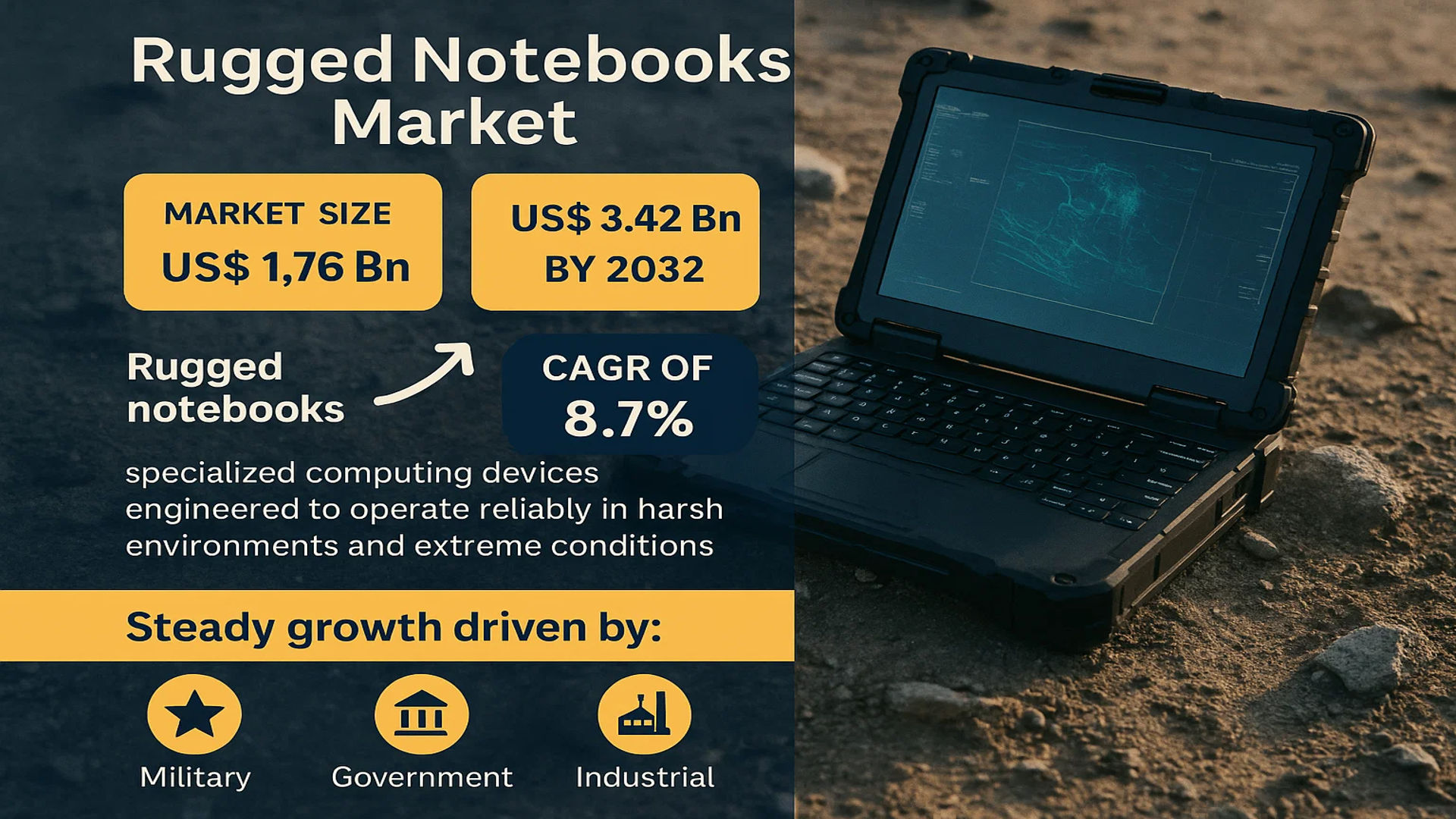
The global Rugged Notebooks Market size was valued at US$ 1.76 billion in 2024 and is projected to reach US$ 3.42 billion by 2032, at a CAGR of 8.7% during the forecast period 2025-2032.
Rugged notebooks are specialized computing devices engineered to operate reliably in harsh environments and extreme conditions, including strong vibrations, extreme temperatures, and wet or dusty settings. These devices are designed from inception for durability, incorporating reinforced external housings, shock-resistant internal components, and advanced cooling systems to ensure performance under duress. While the terms ruggedized and hardened are often used interchangeably, both signify a high degree of design robustness intended for demanding field use.
The market is experiencing steady growth driven by increasing demand from sectors such as military, government, and industrial applications, where reliability in challenging conditions is non-negotiable. Furthermore, advancements in technology and the expansion of field-based operations in areas like public safety, healthcare, and logistics are contributing to market expansion. Key players, including Panasonic, Dell, and Getac, dominate the landscape, collectively holding over 80% of the market share, and continue to innovate with enhanced durability and performance features to meet evolving customer needs.
MARKET DYNAMICS
MARKET DRIVERS
Rising Defense Expenditure and Modernization Initiatives to Propel Market Growth
Increased global defense spending is a primary driver for the rugged notebooks market, particularly within military applications. Nations worldwide are modernizing their armed forces with advanced digital infrastructure, including rugged computing solutions designed for harsh battlefield conditions. Global military expenditure reached approximately $2.2 trillion in 2023, with significant allocations toward digital transformation and equipment modernization. These devices are essential for real-time data processing, communication, and command operations in extreme environments where standard commercial devices would fail. The integration of advanced technologies such as GPS, encrypted communications, and biometric authentication in rugged notebooks further enhances their utility in defense applications, driving consistent demand from military sectors globally.
Expansion of Industrial Automation and Field Service Operations to Boost Adoption
The rapid expansion of industrial automation and field service operations across sectors such as manufacturing, energy, and logistics is significantly driving demand for rugged notebooks. These devices are built to withstand extreme conditions including high temperatures, dust, moisture, and mechanical shocks, making them ideal for use in industrial environments. The global industrial automation market is projected to grow at a compound annual growth rate of over 9% through 2030, creating substantial opportunities for rugged computing solutions. Field service technicians, maintenance crews, and quality control inspectors rely on these durable devices for real-time data access, inventory management, and diagnostic applications, improving operational efficiency and reducing downtime. The ability to function reliably in challenging conditions positions rugged notebooks as critical tools in industrial digitalization efforts.
Government Investments in Public Safety and Emergency Services to Fuel Demand
Government investments in public safety and emergency services infrastructure are creating robust demand for rugged notebooks globally. Police departments, fire services, emergency medical teams, and disaster response agencies require reliable computing devices that can operate in adverse conditions during critical missions. Many governments are increasing their budgets for public safety technology upgrades, with rugged devices forming an essential component of mobile command centers and first responder equipment. These notebooks enable real-time access to databases, communication systems, and mapping services during emergencies, enhancing coordination and response effectiveness. The growing frequency of natural disasters and security incidents worldwide is further accelerating procurement of rugged computing solutions for public safety applications.
Furthermore, technological advancements in rugged notebooks, including improved battery life, sunlight-readable displays, and enhanced connectivity options, are making them more capable and attractive to government and public safety users. The integration of 5G connectivity and advanced sensors is expanding their functionality in field operations, supporting market growth across multiple public sector applications.
MARKET CHALLENGES
High Initial Investment and Total Cost of Ownership to Constrain Market Penetration
The rugged notebooks market faces significant challenges due to the high initial investment required for these specialized devices. Fully rugged notebooks typically cost between $2,000 and $4,000 per unit, which is substantially higher than commercial-grade alternatives. This premium pricing creates barriers for budget-conscious organizations, particularly in price-sensitive markets and smaller enterprises. The total cost of ownership extends beyond initial purchase prices to include specialized maintenance, repair services, and potential downtime during device failures. While rugged devices offer long-term durability benefits, the upfront financial commitment can deter organizations from widespread adoption, especially when commercial devices might suffice for less demanding environments.
Other Challenges
Rapid Technological Obsolescence
The rapid pace of technological advancement presents ongoing challenges for rugged notebook manufacturers and users. Military and industrial users typically expect devices to remain operational for 5-7 years, but consumer technology refreshes occur every 1-2 years. This creates compatibility issues with newer software applications and connectivity standards. The lengthy certification processes for rugged devices in regulated industries further exacerbate this challenge, as devices may incorporate outdated components by the time they reach end-users. This technological lag can limit functionality and interoperability with modern systems, creating operational constraints for organizations relying on rugged computing solutions.
Weight and Ergonomics Limitations
The reinforced construction necessary for durability often results in heavier and bulkier devices compared to commercial notebooks. Fully rugged models typically weigh between 4-8 pounds, which can create ergonomic challenges for field personnel who need to carry devices for extended periods. This weight disadvantage becomes particularly significant in mobile applications where personnel are already carrying substantial equipment. While semi-rugged options offer some compromise, they may not provide the level of protection required for extreme environments, creating a persistent challenge in balancing durability with user comfort and mobility requirements.
MARKET RESTRAINTS
Competition from Rugged Tablets and Smartphones to Limit Market Expansion
The growing capabilities and adoption of rugged tablets and smartphones are restraining growth in the rugged notebooks segment. Many field applications that previously required full computing capabilities can now be handled by advanced mobile devices offering similar durability features at lower price points. Rugged tablets typically cost 30-40% less than comparable rugged notebooks while providing adequate processing power for most field applications. The convenience of smaller form factors, touch interfaces, and longer battery life makes tablets increasingly attractive for inventory management, data collection, and basic computing tasks in harsh environments. This competitive pressure is particularly evident in sectors such as logistics, field service, and healthcare, where mobility and convenience often outweigh the need for full keyboard functionality.
Additionally, the improvement in consumer-grade device durability through protective cases and accessories provides cost-effective alternatives for organizations operating in moderately challenging conditions. These solutions offer adequate protection at significantly lower costs, diverting potential customers from investing in fully ruggedized computing equipment.
MARKET OPPORTUNITIES
Integration of Advanced Technologies to Create New Application Areas
The integration of advanced technologies such as artificial intelligence, Internet of Things connectivity, and edge computing capabilities presents significant growth opportunities for the rugged notebooks market. Manufacturers are developing next-generation devices that incorporate AI processors for real-time data analysis, enhanced sensors for environmental monitoring, and robust connectivity options for seamless integration with IoT ecosystems. These technological enhancements enable new applications in predictive maintenance, autonomous operations, and remote monitoring across industrial, military, and emergency response sectors. The ability to process data locally on rugged devices reduces latency and improves decision-making in field operations where cloud connectivity may be limited or unreliable.
Furthermore, the development of specialized software solutions tailored for rugged environments is creating additional value propositions. Industry-specific applications for asset tracking, field service management, and situational awareness are driving demand for rugged computing platforms that can host these specialized software solutions effectively.
Emerging Markets and Infrastructure Development to Offer Expansion Opportunities
Significant opportunities exist in emerging markets where infrastructure development and industrial growth are driving demand for rugged computing solutions. Countries in Asia, Latin America, and the Middle East are investing heavily in transportation infrastructure, energy projects, and industrial facilities that require durable computing equipment for construction, maintenance, and operations. The increasing adoption of digital technologies in these regions’ military and public safety sectors further expands the addressable market for rugged notebooks. Manufacturers can capitalize on these opportunities by developing cost-optimized products tailored to the specific requirements and budget constraints of emerging markets while maintaining essential durability features.
Additionally, the growing emphasis on environmental sustainability and corporate responsibility is driving demand for rugged devices with longer lifecycles and reduced electronic waste. Manufacturers that prioritize repairability, upgradeability, and environmentally conscious manufacturing processes can differentiate their products and capture value-conscious customers seeking sustainable computing solutions.
RUGGED NOTEBOOKS MARKET TRENDS
Integration of Advanced Connectivity and IoT Capabilities to Emerge as a Trend in the Market
The proliferation of 5G technology and the expansion of Internet of Things (IoT) ecosystems are fundamentally reshaping the rugged notebooks market. These devices are increasingly being equipped with advanced communication modules that enable real-time data transmission from remote or harsh field locations directly to centralized cloud platforms. This connectivity is crucial for sectors like utilities, where smart grid management requires constant monitoring, and in public safety, where immediate access to critical information can be life-saving. Furthermore, the integration of GPS and GNSS capabilities has become almost standard, allowing for precise asset tracking and geofencing in logistics and construction applications. This trend is driving a shift from standalone computing tools to interconnected nodes within larger, data-driven operational frameworks, enhancing situational awareness and decision-making speed in environments where reliability is non-negotiable.
Other Trends
Rise in Field Mobility and Digital Transformation Across Industrial Sectors
The global push for digital transformation is a powerful catalyst for the rugged notebooks market, particularly within industrial and field service sectors. Companies are moving away from traditional paper-based processes and deploying rugged mobile computing solutions to capture data at the source, thereby improving accuracy and operational efficiency. In manufacturing, for instance, these devices are integral to predictive maintenance programs, allowing technicians to access machinery histories and diagnostic data on the factory floor. The market is also benefiting from the growth of automated guided vehicles (AGVs) and robotics, which often use rugged computing units for control and data processing in demanding warehouse environments. This trend is not just about replacing old equipment but is a strategic investment towards creating more agile, data-centric, and responsive field operations.
Increasing Military and Defense Expenditures Worldwide
Geopolitical tensions and modernization initiatives are leading to increased defense budgets globally, which directly fuels demand for rugged computing solutions. Military applications require equipment that can withstand extreme conditions, including shock, vibration, sand, dust, and temperature extremes, while also meeting stringent security standards for sensitive communications. Rugged notebooks are essential for command, control, communications, computers, intelligence, surveillance, and reconnaissance (C4ISR) systems. Recent developments have seen a focus on lighter, more power-efficient models that do not compromise on performance, allowing for greater mobility for personnel. The ongoing replacement of legacy systems with modern, networked equipment ensures a steady pipeline of demand from this sector, which historically accounts for a significant portion of the market’s revenue.
COMPETITIVE LANDSCAPE
Key Industry Players
Leading Manufacturers Focus on Innovation and Strategic Expansion to Secure Market Position
The global rugged notebooks market exhibits a semi-consolidated structure, dominated by a handful of major players while also accommodating several specialized medium and smaller enterprises. Panasonic Corporation stands as the unequivocal market leader, commanding a significant revenue share. This dominance is largely attributable to its extensive, MIL-STD-810G certified product portfolio and its deeply entrenched supply channels within critical sectors like defense, public safety, and industrial field services across North America, Europe, and Asia-Pacific.
Dell Technologies and Getac Technology Corporation also hold considerable market shares, competing aggressively through a blend of technological innovation and robust distribution networks. Their growth is propelled by continuous investments in R&D, leading to the launch of devices with enhanced durability, superior processing power, and longer battery life tailored for harsh environments. Furthermore, these companies are actively pursuing strategic contracts with government agencies and large industrial corporations, which provides a stable and recurring revenue stream.
Additionally, growth initiatives such as geographical expansion into emerging markets and the introduction of new product variants—like semi-rugged and ultra-rugged notebooks designed for specific verticals—are expected to significantly augment these companies’ market presence over the forecast period. For instance, recent launches have focused on integrating advanced features such as sunlight-readable displays, hot-swappable batteries, and 5G connectivity to meet evolving end-user demands.
Meanwhile, players like Lenovo and Twinhead (Durabook) are strengthening their positions through significant investments in R&D and strategic partnerships. Lenovo, for example, has been expanding its ThinkPad line of rugged devices, leveraging its brand reputation in commercial computing to capture a larger share of the rugged segment. Their strategy often involves forming alliances with software providers and system integrators to offer comprehensive mobility solutions rather than just hardware.
List of Key Rugged Notebook Companies Profiled
- Panasonic Corporation (Japan)
- Dell Technologies Inc. (U.S.)
- Getac Technology Corporation (Taiwan)
- Amrel (U.S.)
- ACME Portable Machines, Inc. (U.S.)
- Twinhead International Corporation (Durabook) (Taiwan)
- Lenovo Group Limited (China)
Segment Analysis:
By Type
Fully Rugged Notebooks Segment Dominates the Market Due to Superior Durability in Extreme Conditions
The market is segmented based on type into:
- Fully Rugged Notebooks
- Semi Rugged Notebooks
- Ultra-rugged Notebooks
By Application
Military Segment Leads Due to Critical Operational Requirements in Harsh Environments
The market is segmented based on application into:
- Military
- Government
- Industrial
- Others
By End User
Public Safety and Defense Sector Represents the Largest End User Segment
The market is segmented based on end user into:
- Public Safety and Defense
- Field Services
- Industrial Manufacturing
- Healthcare
- Transportation and Logistics
By Screen Size
Standard Screen Size (14-15.6 inches) Segment Holds Major Market Share
The market is segmented based on screen size into:
- Small Screen (Below 14 inches)
- Standard Screen (14-15.6 inches)
- Large Screen (Above 15.6 inches)
Regional Analysis: Rugged Notebooks Market
North America
North America represents the largest and most mature market for rugged notebooks, driven by significant defense and public safety expenditures. The United States, in particular, accounts for a dominant share of the regional market, with the Department of Defense being a primary end-user. The region’s stringent requirements for equipment durability and data security in sectors like law enforcement, utilities, and field services fuel demand for high-specification fully rugged devices. Market leaders such as Dell and Panasonic have a strong operational presence, catering to a sophisticated customer base that prioritizes performance and compliance with military standards (MIL-STD-810). While the market is well-established, continuous technological upgrades and the replacement of aging fleets sustain steady growth.
Europe
The European market is characterized by a strong emphasis on regulatory compliance, data privacy laws such as GDPR, and a growing adoption across industrial and emergency services. Countries like Germany, France, and the U.K. are key contributors, with their advanced manufacturing sectors and well-funded public safety organizations integrating rugged mobile computing into their operations. The market is highly competitive, with vendors focusing on developing devices that meet specific EU environmental and safety directives. There is a notable trend towards semi-rugged devices in cost-conscious commercial applications, though fully rugged notebooks remain essential for critical military and field-force deployments.
Asia-Pacific
Asia-Pacific is the fastest-growing region for rugged notebooks, propelled by rapid industrialization, extensive infrastructure development, and increasing military modernization programs. China and India are the primary growth engines, with their large manufacturing bases and expanding public sector initiatives creating substantial demand. Government investments in defense and smart city projects are particularly significant drivers. While price sensitivity leads to strong competition and a market for semi-rugged and value-oriented models, there is a parallel and growing demand for high-end devices from sectors requiring utmost reliability, such as oil and gas exploration and transportation logistics.
South America
The South American market for rugged notebooks is developing, with growth opportunities primarily in the natural resources and public security sectors. Brazil and Argentina are the main markets, where industries like mining and agriculture require durable computing solutions for operations in remote and challenging environments. However, economic volatility and budgetary constraints often limit large-scale procurement, leading to a longer replacement cycle for existing equipment. The market is characterized by a preference for proven, cost-effective solutions rather than cutting-edge technology, presenting both a challenge and a specific niche for suppliers.
Middle East & Africa
The market in the Middle East and Africa is emerging, with demand largely concentrated in the defense, oil and gas, and construction sectors. The Gulf Cooperation Council (GCC) countries, with their significant energy wealth and large-scale infrastructure projects, represent the most active sub-region. Rugged notebooks are essential for operations in extreme desert conditions. In Africa, market development is more fragmented and is often tied to specific mining or infrastructure projects funded by foreign investment. While the overall market is smaller, the necessity for durable technology in harsh climates provides a solid foundation for long-term, albeit gradual, growth.
Report Scope
This market research report provides a comprehensive analysis of the global and regional Rugged Notebooks markets, covering the forecast period 2025–2032. It offers detailed insights into market dynamics, technological advancements, competitive landscape, and key trends shaping the industry.
Key focus areas of the report include:
- Market Size & Forecast: Historical data and future projections for revenue, unit shipments, and market value across major regions and segments.
- Segmentation Analysis: Detailed breakdown by product type, technology, application, and end-user industry to identify high-growth segments and investment opportunities.
- Regional Outlook: Insights into market performance across North America, Europe, Asia-Pacific, Latin America, and the Middle East & Africa, including country-level analysis where relevant.
- Competitive Landscape: Profiles of leading market participants, including their product offerings, R&D focus, manufacturing capacity, pricing strategies, and recent developments such as mergers, acquisitions, and partnerships.
- Technology Trends & Innovation: Assessment of emerging technologies, integration of AI/IoT, semiconductor design trends, fabrication techniques, and evolving industry standards.
- Market Drivers & Restraints: Evaluation of factors driving market growth along with challenges, supply chain constraints, regulatory issues, and market-entry barriers.
- Stakeholder Analysis: Insights for component suppliers, OEMs, system integrators, investors, and policymakers regarding the evolving ecosystem and strategic opportunities.
Primary and secondary research methods are employed, including interviews with industry experts, data from verified sources, and real-time market intelligence to ensure the accuracy and reliability of the insights presented.
FREQUENTLY ASKED QUESTIONS:
What is the current market size of Global Rugged Notebooks Market?
-> Rugged Notebooks Market size was valued at US$ 1.76 billion in 2024 and is projected to reach US$ 3.42 billion by 2032, at a CAGR of 8.7% during the forecast period 2025-20322032.
Which key companies operate in Global Rugged Notebooks Market?
-> Key players include Panasonic, Dell, Getac, Lenovo, Amrel, ACME, and Twinhead (Durabook), among others.
What are the key growth drivers?
-> Key growth drivers include increased defense spending, expansion of industrial automation, and growing demand for field force mobility solutions.
Which region dominates the market?
-> North America is the largest market, with the United States holding over 35% market share, while Asia-Pacific is the fastest-growing region.
What are the emerging trends?
-> Emerging trends include integration of 5G connectivity, enhanced cybersecurity features, and development of lightweight ultra-rugged designs.

Get Sample Report PDF for Exclusive Insights
Report Sample Includes
- Table of Contents
- List of Tables & Figures
- Charts, Research Methodology, and more...
 Download Sample Report PDF