
RTD Wafer Temperature Measurement Systems Market Insights
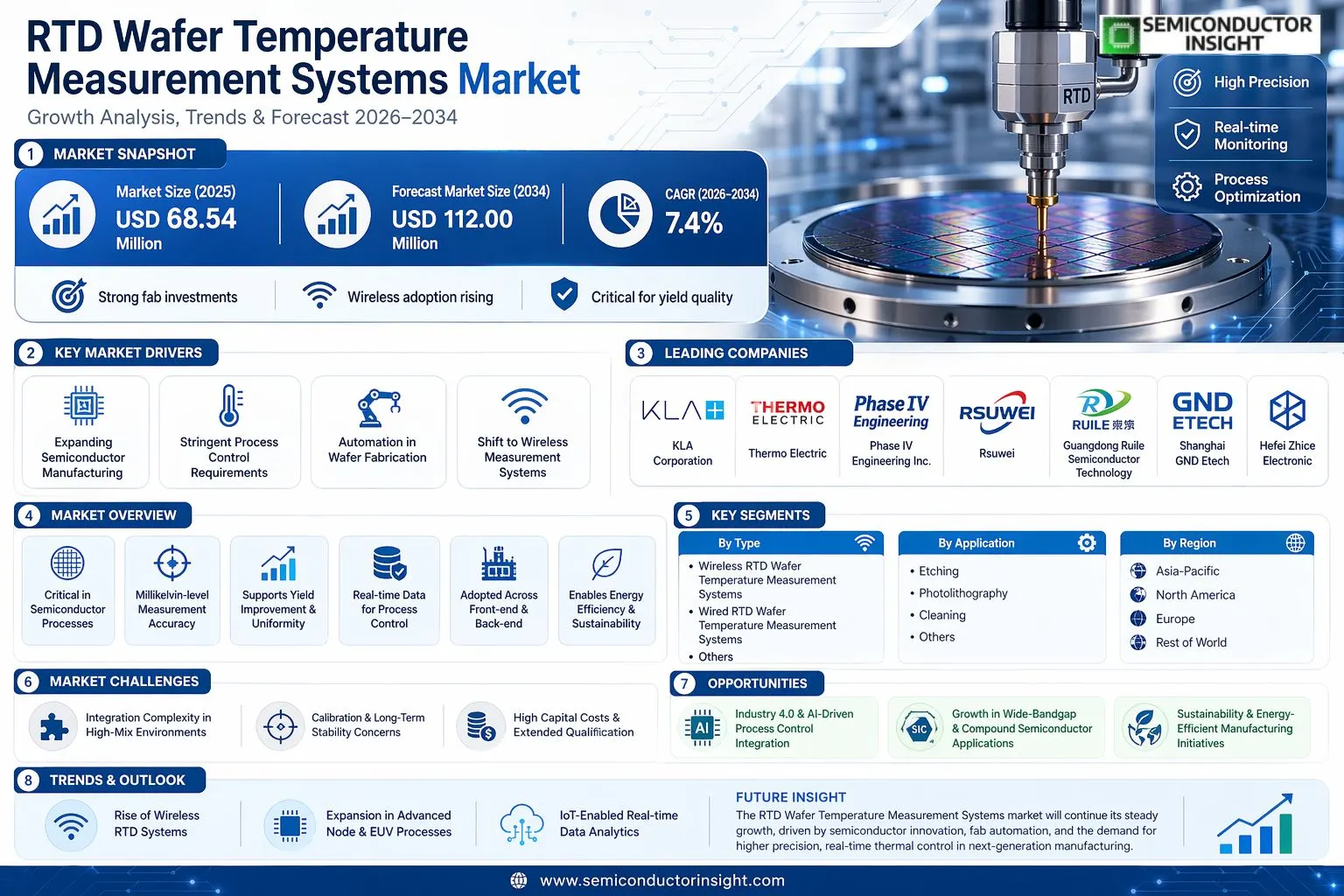
Global RTD Wafer Temperature Measurement Systems market size was valued at USD 68.54 million in 2025. The market is projected to grow from USD 73.61 million in 2026 to USD 112 million by 2034, exhibiting a CAGR of 7.4% during the forecast period.
RTD Wafer Temperature Measurement Systems are advanced metrology solutions that utilize Resistance Temperature Detectors (RTDs) to monitor and control wafer temperatures throughout semiconductor manufacturing processes. These systems rely on the principle of electrical resistance variation in materials , most commonly platinum , to deliver highly precise temperature readings across critical process steps. The systems are available in both wired and wireless configurations and are deployed across a range of applications, including etching, photolithography, and cleaning processes.
The market is witnessing steady growth driven by the accelerating global demand for semiconductors, the proliferation of advanced node fabrication technologies, and the increasing complexity of thermal management requirements in next-generation wafer processing. Furthermore, the rising adoption of wireless RTD systems is enabling greater process flexibility and real-time monitoring capabilities within cleanroom environments. Key manufacturers operating in this space include KLA Corporation, Thermo Electric, Phase IV Engineering Inc., Rsuwei, Guangdong Ruile Semiconductor Technology, Shanghai GND Etech, and Hefei Zhice Electronic, among others, collectively shaping a competitive and innovation-driven global landscape.
MARKET DRIVERS
Rising Demand for Precision Temperature Monitoring in Semiconductor Manufacturing
RTD Wafer Temperature Measurement Systems Market is experiencing sustained growth driven by the accelerating complexity of semiconductor fabrication processes. As chip geometries continue to shrink below 5nm and 3nm nodes, maintaining precise thermal control across wafer surfaces has become a non-negotiable requirement for yield optimization. Resistance Temperature Detector (RTD) based systems offer superior accuracy and repeatability compared to thermocouple alternatives, making them the preferred choice for advanced process nodes where even minor thermal deviations can result in significant yield losses.
Expansion of Semiconductor Fabrication Capacity Globally
Governments and private enterprises across the United States, Europe, South Korea, Japan, and Taiwan have committed substantial capital to expanding domestic semiconductor fabrication capacity. This wave of fab construction and capacity expansion directly fuels procurement of advanced process control instrumentation, including RTD wafer temperature measurement systems. New greenfield fabs require complete thermal metrology infrastructure from the ground up, while existing facilities undergoing technology node transitions are retrofitting legacy measurement systems with higher-precision RTD-based solutions to meet tighter process specifications.
➤ The proliferation of advanced packaging technologies such as 3D-IC, chiplets, and heterogeneous integration is creating additional demand for wafer-level thermal characterization, as thermal gradients in stacked architectures require multi-point RTD measurement capabilities that conventional single-point systems cannot adequately address.
The increasing adoption of silicon carbide (SiC) and gallium nitride (GaN) wafers in power electronics and electric vehicle applications is further broadening the addressable market for RTD wafer temperature measurement systems. These wide-bandgap semiconductor materials are processed at elevated temperatures compared to conventional silicon, requiring measurement systems with extended operating ranges and enhanced thermal stability , specifications that advanced RTD platforms are specifically engineered to fulfill.
MARKET CHALLENGES
Integration Complexity in High-Mix Semiconductor Production Environments
One of the foremost challenges confronting RTD Wafer Temperature Measurement Systems Market is the difficulty of seamless integration across heterogeneous process equipment platforms. Semiconductor fabs increasingly operate high-mix production environments where multiple wafer sizes , 150mm, 200mm, and 300mm , are processed simultaneously across different tool generations. Retrofitting RTD-based measurement systems into legacy process equipment often requires custom mechanical interfaces and signal conditioning hardware, increasing total integration cost and extending deployment timelines. Furthermore, the absence of universal communication protocols across equipment manufacturers creates interoperability challenges that slow adoption in mixed-vendor environments.
Other Challenges
Calibration and Maintenance Burden
RTD wafer temperature measurement systems require periodic recalibration to maintain measurement traceability to international temperature standards. In high-volume manufacturing environments, taking measurement systems offline for calibration represents a direct operational cost. The need for specialized metrology personnel to perform and validate calibration procedures adds to the total cost of ownership, particularly for smaller fabs and research institutions operating with constrained technical staffing.
Susceptibility to Contamination in Process Environments
Semiconductor process environments expose wafer temperature measurement systems to chemically aggressive atmospheres, including corrosive gases used in etch and deposition processes. RTD sensing elements and their associated wiring must be constructed from materials resistant to chemical attack, which increases component cost and may limit sensor placement flexibility within the process chamber. Particulate contamination originating from sensor assemblies also poses a yield risk, requiring careful materials qualification before deployment in cleanroom environments.
MARKET RESTRAINTS
High Capital Cost and Extended Return-on-Investment Timelines
The elevated capital cost associated with high-precision RTD wafer temperature measurement systems represents a meaningful restraint on market penetration, particularly among cost-sensitive customers such as university research centers, government laboratories, and smaller compound semiconductor manufacturers. Advanced multi-zone RTD measurement platforms incorporating real-time data acquisition, process control integration, and automated calibration verification carry significant per-unit pricing that extends capital recovery timelines. Budget allocation cycles in academic and government sectors further slow procurement decisions, limiting addressable demand in these segments relative to high-volume commercial fabs.
Competition from Alternative Wafer Temperature Measurement Technologies
RTD Wafer Temperature Measurement Systems Market faces competitive pressure from alternative thermal metrology approaches, including non-contact infrared pyrometry, thermoreflectance imaging, and acoustic thermometry techniques. Pyrometric methods offer the advantage of non-invasive measurement without physical contact with the wafer surface, eliminating contamination risk and enabling real-time in-situ monitoring during active deposition and etch processes. While RTD-based systems maintain accuracy advantages under controlled conditions, the continued performance improvement and cost reduction of pyrometric systems are narrowing the differentiation gap in certain application segments, potentially constraining RTD system adoption in processes where non-contact measurement is technically feasible.
MARKET OPPORTUNITIES
Growth in Advanced Node and Emerging Semiconductor Material Processing
The transition of leading semiconductor manufacturers to sub-3nm process nodes, combined with the rapid commercialization of wide-bandgap semiconductor devices, presents a compelling growth opportunity for RTD Wafer Temperature Measurement Systems Market. Advanced nodes demand thermal uniformity specifications that are increasingly difficult to achieve without dense multi-point RTD measurement arrays providing closed-loop feedback to process control systems. Suppliers capable of delivering high-density, low-thermal-mass RTD wafer solutions compatible with next-generation process equipment will be well positioned to capture design wins as leading-edge fabs qualify new toolsets.
Digitalization and Industry 4.0 Integration in Semiconductor Fabs
The ongoing digitalization of semiconductor manufacturing under Industry 4.0 frameworks creates a significant opportunity for RTD wafer temperature measurement system providers to offer value-added software capabilities alongside core sensing hardware. Integration of RTD measurement data streams with advanced process control (APC) platforms, machine learning-based fault detection and classification (FDC) systems, and digital twin process models enables customers to extract substantially greater value from thermal measurement investments. Vendors that develop open-architecture data integration solutions compatible with industry-standard manufacturing execution system (MES) platforms will differentiate effectively and command stronger customer retention in long-term supply relationships.
Emerging Demand from Electric Vehicle and Power Electronics Wafer Processing
The electrification of transportation and the associated surge in demand for high-power semiconductor devices based on silicon carbide and gallium nitride substrates represent an important emerging end-market for RTD Wafer Temperature Measurement Systems Market. SiC and GaN device fabrication requires thermal process steps at temperatures and in atmospheres that differ substantially from conventional silicon processing, creating requirements for specialized RTD measurement solutions engineered for these conditions. As dedicated SiC and GaN wafer fabs scale capacity to serve the electric vehicle supply chain, procurement of purpose-built thermal metrology infrastructure , including advanced RTD wafer measurement systems , will represent a growing and structurally durable revenue opportunity for market participants.
Trends
Rising Demand in Semiconductor Manufacturing Drives RTD Wafer Temperature Measurement Systems Market
RTD Wafer Temperature Measurement Systems Market is witnessing notable growth driven by the expanding global semiconductor manufacturing sector. As chip fabrication processes become increasingly complex and miniaturized, the need for highly accurate, real-time temperature monitoring during critical production stages has intensified. Resistance Temperature Detectors, primarily platinum-based, offer exceptional measurement precision, making RTD Wafer Temperature Measurement Systems an indispensable component in modern semiconductor fabs. Key process steps such as etching, photolithography, and cleaning demand tightly controlled thermal environments, and RTD-based systems are increasingly deployed to ensure process consistency, yield improvement, and defect reduction across wafer production lines.
Other Trends
Shift Toward Wireless RTD Systems
A significant trend shaping RTD Wafer Temperature Measurement Systems Market is the growing adoption of wireless configurations over traditional wired setups. Wireless RTD systems eliminate cabling complexities within cleanroom environments, reduce installation costs, and enable more flexible sensor deployment across process chambers. As semiconductor manufacturers pursue higher levels of automation and remote process monitoring, wireless RTD solutions are gaining traction, particularly in advanced fab facilities across Asia and North America. This transition reflects a broader industry movement toward smart manufacturing and Industry 4.0 integration within semiconductor production ecosystems.
Regional Expansion Led by Asia-Pacific
Asia-Pacific continues to emerge as the dominant region in RTD Wafer Temperature Measurement Systems Market, with China, Japan, South Korea, and Southeast Asia serving as major demand centers. Significant government investments in domestic semiconductor capacity, coupled with the expansion of fab facilities by leading chipmakers, are driving regional adoption of precision temperature measurement technologies. China, in particular, is accelerating its semiconductor self-sufficiency initiatives, which is expected to sustain strong demand for RTD Wafer Temperature Measurement Systems across local manufacturing operations. North America and Europe also represent important markets, supported by the presence of established semiconductor equipment manufacturers and research-driven fabrication facilities.
Competitive Landscape and Technological Development Among Key Manufacturers
RTD Wafer Temperature Measurement Systems Market features a competitive landscape shaped by both global and regional players. Companies such as KLA Corporation, Thermo Electric, Phase IV Engineering Inc., Rsuwei, Guangdong Ruile Semiconductor Technology, Shanghai GND Etech, and Hefei Zhice Electronic are among the key participants actively contributing to product innovation and market development. Manufacturers are focusing on enhancing sensor accuracy, system integration capabilities, and compatibility with advanced process nodes. Ongoing product development efforts, strategic partnerships, and geographic expansion remain central to competitive strategies within RTD Wafer Temperature Measurement Systems Market as end-user requirements continue to evolve alongside semiconductor technology advancements.
COMPETITIVE LANDSCAPE
Key Industry Players
RTD Wafer Temperature Measurement Systems Market , Competitive Intelligence and Manufacturer Positioning Analysis
Global RTD Wafer Temperature Measurement Systems market, valued at USD 68.54 million in 2025 and projected to reach USD 112 million by 2034 at a CAGR of 7.4%, is characterized by a moderately consolidated competitive landscape. KLA Corporation stands out as the dominant force, leveraging its deep-rooted expertise in semiconductor process control, advanced metrology technologies, and an extensive global distribution network. The company’s stronghold across key application segments , including etching, photolithography, and wafer cleaning , reinforces its market leadership. The top five global players collectively accounted for a significant share of total market revenue in 2025, reflecting the market’s tendency toward consolidation among technologically advanced and capital-intensive manufacturers capable of meeting the stringent precision requirements of modern semiconductor fabrication environments.
Beyond the market leader, several specialized and regional players command meaningful niches within the RTD Wafer Temperature Measurement Systems space. Companies such as Phase IV Engineering Inc. and Thermo Electric have established credible positions by offering highly accurate platinum RTD-based sensing solutions tailored for both wired and wireless configurations used across semiconductor fabs. Meanwhile, Chinese manufacturers including Guangdong Ruile Semiconductor Technology, Shanghai GND Etech, Hefei Zhice Electronic, and Rsuwei are increasingly competitive, benefiting from strong domestic semiconductor investment, government-backed industrial initiatives, and cost-efficient manufacturing capabilities. As demand from Asia-Pacific , particularly China, South Korea, Japan, and Southeast Asia , continues to rise, these regional players are expected to expand their global footprints, intensifying competition and driving further innovation in wireless RTD wafer temperature sensing technologies through the forecast period to 2034.
List of Key RTD Wafer Temperature Measurement Systems Companies Profiled
- KLA Corporation
- Thermo Electric
- Phase IV Engineering Inc.
- Rsuwei
- Guangdong Ruile Semiconductor Technology
- Shanghai GND Etech
- Hefei Zhice Electronic
Segment Analysis:
| Segment Category | Sub-Segments | Key Insights |
| By Type |
|
Wireless RTD Systems represent the leading and fastest-growing type segment in RTD Wafer Temperature Measurement Systems Market, driven by evolving semiconductor fabrication demands.
Wired RTD Systems continue to maintain a strong foothold, particularly in legacy semiconductor manufacturing setups where reliability and signal stability are paramount, making them a preferred choice for precision-critical processes requiring continuous and uninterrupted temperature monitoring. |
| By Application |
|
Etching stands as the dominant application segment for RTD Wafer Temperature Measurement Systems, reflecting its critical role in semiconductor fabrication processes.
Photolithography is also a significant application, where thermal stability of wafers directly impacts pattern resolution and overlay accuracy, while Cleaning applications increasingly leverage RTD systems to ensure optimal chemical reaction temperatures during wafer surface preparation processes. |
| By End User |
|
Foundries emerge as the leading end user segment in RTD Wafer Temperature Measurement Systems Market, underpinned by the massive scale and process complexity of modern contract semiconductor manufacturing.
Integrated Device Manufacturers (IDMs) remain a substantial end user group, leveraging RTD systems across proprietary production lines, while Research & Development Institutions utilize these systems for experimental process development and novel materials characterization at pilot scales. |
| By Technology |
|
Platinum RTD (Pt100/Pt1000) Based Systems lead the technology segment, reflecting the material’s exceptional stability, reproducibility, and accuracy across the wide temperature ranges encountered in semiconductor wafer processing.
Thin-Film RTD Systems are gaining traction for applications requiring fast thermal response times and minimal sensor footprint, while Wire-Wound RTD Systems continue to serve high-stability applications where long-term measurement drift must be minimized. |
| By Wafer Size Compatibility |
|
300 mm Wafer Compatible Systems represent the dominant segment by wafer size compatibility, aligning with the industry’s mainstream production standard for advanced semiconductor manufacturing.
200 mm Wafer Compatible Systems remain relevant for mature node production and specialty semiconductor applications, while 450 mm Compatible Systems represent an emerging frontier being explored in preparation for potential future industry transitions to larger wafer formats. |
Regional Analysis: RTD Wafer Temperature Measurement Systems Market
Asia-Pacific hosts the densest cluster of wafer fabrication plants globally, creating an unmatched installed base for RTD wafer temperature measurement systems. Taiwan and South Korea alone account for a significant share of cutting-edge logic and memory production, where thermal uniformity during deposition, etching, and annealing stages is critical to achieving high device yields and process repeatability.
National semiconductor strategies across China, Japan, South Korea, and India are channeling substantial public funding into fab construction and equipment upgrades. These policy frameworks directly benefit RTD Wafer Temperature Measurement Systems Market by mandating advanced process control standards and encouraging domestic technology adoption to reduce dependence on imported measurement solutions.
As Asia-Pacific fabs aggressively migrate toward sub-5nm and sub-3nm process nodes, the tolerance for thermal variation across wafer surfaces narrows dramatically. This technological progression significantly elevates the demand for ultra-precise RTD wafer temperature measurement systems capable of delivering repeatable, high-resolution thermal data to support tighter process windows and enhanced yield management protocols.
Beyond the established semiconductor powerhouses, countries such as India, Malaysia, and Vietnam are rapidly developing their electronics manufacturing sectors. These emerging markets are gradually integrating RTD wafer temperature measurement systems into their production environments, creating a secondary growth layer that further amplifies the region’s overall market expansion trajectory through 2034.
North America
North America represents a strategically vital market for RTD wafer temperature measurement systems, anchored by a robust ecosystem of semiconductor equipment developers, leading-edge chip designers, and an expanding network of domestic fabrication facilities. The United States has intensified its focus on onshoring critical semiconductor manufacturing capabilities, with major fab construction projects underway across Arizona, Ohio, and Texas, all of which demand sophisticated process control instrumentation including precision RTD-based thermal measurement systems. The region’s strength is further reinforced by its concentration of tier-one semiconductor equipment manufacturers and technology innovators who actively develop and validate next-generation wafer temperature measurement methodologies. Defense and aerospace applications, which mandate particularly stringent thermal process controls, also contribute meaningfully to sustained demand. Canada’s growing photonics and compound semiconductor research activities add a supplementary dimension to the regional market, positioning North America as a critical growth corridor in Global RTD wafer temperature measurement systems market through the 2026–2034 period.
Europe
Europe occupies a significant position in RTD Wafer Temperature Measurement Systems Market, underpinned by a mature industrial base, strong regulatory emphasis on manufacturing precision, and a strategic push to enhance regional semiconductor sovereignty. The European Chips Act has catalyzed substantial investment in domestic wafer fabrication capacity, particularly in Germany, the Netherlands, France, and Ireland, directly stimulating procurement of advanced process control equipment. European semiconductor manufacturers maintain a strong tradition of engineering excellence, driving high standards for thermal measurement accuracy in wafer processing environments. The region also benefits from a well-established base of precision instrument manufacturers who supply RTD temperature sensing solutions tailored to the exacting demands of semiconductor fabs. Research institutions and public-private partnerships across Europe further accelerate the development and commercialization of innovative wafer temperature measurement technologies, reinforcing the region’s competitive standing in Global market landscape.
South America
South America represents an emerging frontier in Global RTD wafer temperature measurement systems market, with its participation currently concentrated in early-stage electronics manufacturing and academic research activities. Brazil leads the regional landscape, supported by government initiatives aimed at developing a domestic semiconductor design and packaging industry. While full-scale wafer fabrication remains limited across the continent, growing investments in electronics assembly, power semiconductor applications, and university-level semiconductor research are gradually creating foundational demand for precision thermal measurement tools. Regional trade agreements and foreign direct investment flows are expected to further stimulate the development of electronics manufacturing infrastructure over the coming decade. As South American economies diversify their industrial bases and increase technology intensity, RTD Wafer Temperature Measurement Systems Market is anticipated to gain incremental traction, particularly in segments tied to power electronics and sensor manufacturing through the 2026–2034 forecast period.
Middle East & Africa
The Middle East and Africa region currently represents a nascent but strategically noteworthy segment of Global RTD wafer temperature measurement systems market. The Middle East, led by the United Arab Emirates, Saudi Arabia, and Israel, is witnessing growing interest in semiconductor and advanced electronics manufacturing as part of broader economic diversification agendas. Israel’s established high-technology sector and semiconductor design capabilities provide a credible foundation for gradual adoption of advanced wafer temperature measurement systems. In Africa, South Africa maintains the most developed electronics manufacturing sector on the continent, though broader regional participation in wafer-level semiconductor production remains at an early stage. Long-term growth prospects for RTD Wafer Temperature Measurement Systems Market in this region are tied to the trajectory of technology investment, infrastructure development, and the maturation of regional electronics value chains, all of which are expected to progress steadily through the 2034 horizon.
Report Scope
This market research report provides a comprehensive analysis of RTD Wafer Temperature Measurement Systems Market, covering the forecast period 2026–2034. It offers detailed insights into market dynamics, technological advancements, competitive landscape, and key trends shaping the industry.
Key focus areas of the report include:
- Market Overview: The report begins with an overview outlining its current market scenario, key growth indicators, and industry transformation drivers. It discusses macroeconomic factors, demand–supply balance, regulatory landscape, and the strategic role of semiconductors in powering advancements across industries such as automotive, telecommunications, consumer electronics, and industrial automation.
- Market Size & Forecast: Historical data and future projections for revenue, unit shipments, and market value across major regions and segments.
- Segmentation Analysis: Detailed breakdown by product type, technology, application, and end-user industry to identify high-growth segments and investment opportunities.
- Regional Insights: Insights into market performance across North America, Europe, Asia-Pacific, Latin America, and the Middle East & Africa, including country-level analysis where relevant.
- Competitive Landscape: Profiles of leading market participants, including their product offerings, R&D focus, manufacturing capacity, pricing strategies, and recent developments such as mergers, acquisitions, and partnerships.
- Technology Trends & Innovation: Assessment of emerging technologies, integration of AI/IoT, semiconductor design trends, fabrication techniques, and evolving industry standards.
- Market Drivers & Restraints: Evaluation of factors driving market growth along with challenges, supply chain constraints, regulatory issues, and market-entry barriers.
- Stakeholder Insights: Insights for component suppliers, OEMs, system integrators, investors, and policymakers regarding the evolving ecosystem and strategic opportunities.
Primary and secondary research methods are employed, including interviews with industry experts, data from verified sources, and real-time market intelligence to ensure the accuracy and reliability of the insights presented.
FREQUENTLY ASKED QUESTIONS:
What is the current market size of RTD Wafer Temperature Measurement Systems Market?
-> Global RTD Wafer Temperature Measurement Systems Market was valued at USD 68.54 million in 2025 and is expected to reach USD 112 million by 2034, growing at a CAGR of 7.4% during the forecast period.
Which key companies operate in RTD Wafer Temperature Measurement Systems Market?
-> Key players include KLA Corporation, Thermo Electric, Phase IV Engineering Inc., Rsuwei, Guangdong Ruile Semiconductor Technology, Shanghai GND Etech, and Hefei Zhice Electronic, among others.
What are the key growth drivers?
-> Key growth drivers include rising demand for precise wafer temperature monitoring in semiconductor manufacturing, increasing adoption of RTD-based sensing technologies, growing investments in semiconductor fabrication facilities, and expanding applications across etching, photolithography, and cleaning processes.
Which region dominates the market?
-> Asia is the fastest-growing region driven by semiconductor manufacturing hubs in China, Japan, South Korea, and Southeast Asia, while North America remains a significant market led by the United States with its advanced semiconductor ecosystem.
What are the emerging trends?
-> Emerging trends include wireless RTD wafer temperature measurement systems, integration of IoT-enabled real-time monitoring, increasing use of platinum-based RTD sensors for higher accuracy, and growing adoption of advanced temperature measurement solutions across semiconductor etching and photolithography applications.

Get Sample Report PDF for Exclusive Insights
Report Sample Includes
- Table of Contents
- List of Tables & Figures
- Charts, Research Methodology, and more...
 Download Sample Report PDF




