Rotation Angle Sensor Market Insights
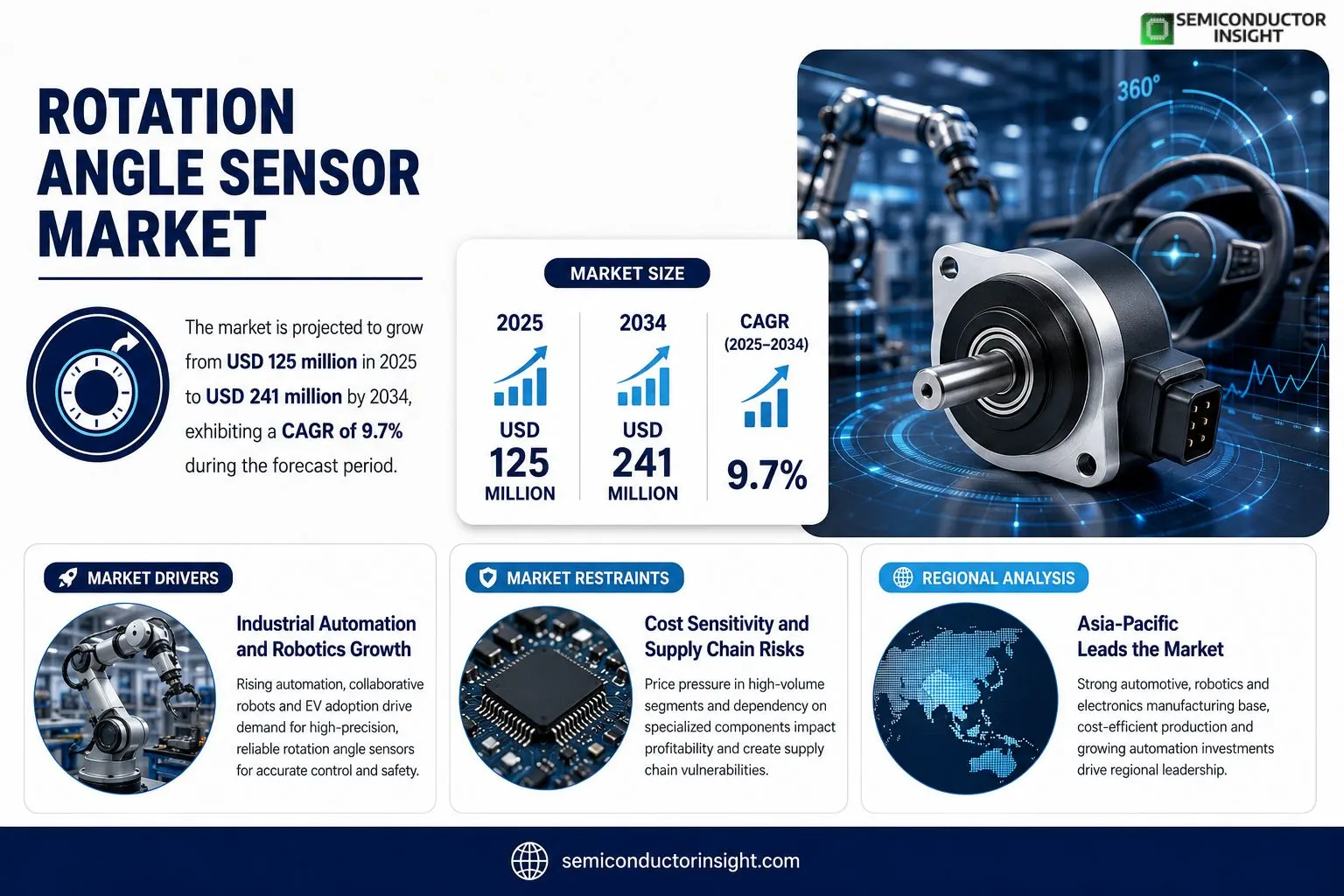
Rotation Angle Sensor market size was valued at USD 125 million in 2025. The market is projected to grow from USD 125 million in 2025 to USD 241 million by 2034, exhibiting a CAGR of 9.7% during the forecast period.
Rotation Angle Sensor refers to a sensor used to detect the angular position, rotational displacement, rotation direction, or movement of a rotating object such as a shaft, motor, steering wheel, valve, robotic joint, or industrial equipment. It converts rotational motion into electrical signals for monitoring and control purposes.The market is experiencing growth due to increasing adoption in electric vehicles, industrial robots, drones,and automation equipment. Non‑contact technologies such as Hall‑effect and optical sensors are gaining traction because they offer longer life and higher reliability. High‑precision and multi‑turn detection are becoming important as robotics and motor control demand finer resolution. Miniaturizationand integration with MCUs are accelerating while digital interfaces like SPI,I2C,and CAN add intelligent features. Automotiveand industrial sectors drive upgrades through steer‑by‑wireand brake‑by‑wire systems.
MARKET DRIVERS
Industrial Automation Adoption
The surge in automated assembly lines has heightened the requirement for precise angular feedback. Manufacturers are replacing traditional potentiometers with digital rotation angle sensors to achieve tighter tolerance control, which directly translates into higher throughput and reduced scrap rates. This shift is evident in automotive and electronics factories where line downtime is a critical cost factor.
Growth of Robotics and Cobots
Robotic arms now operate in shared spaces with humans, demanding real‑time position monitoring. The integration of compact, high‑resolution rotation angle sensors enables smooth trajectory planning and collision avoidance. Consequently, system integrators are prioritizing sensor modules that couple low latency with robust environmental sealing.
➤ “Customers are willing to pay a premium for sensors that combine durability with sub‑degree accuracy, because the downstream savings on re‑work and warranty claims are substantial.”
Beyond factories, renewable‑energy installations such as wind‑turbine pitch systems rely on accurate angle measurements to optimize power capture. As turbine capacities climb, the importance of reliable rotation angle sensors in the control loop intensifies, reinforcing the overall positive momentum of Rotation Angle Sensor Market.
MARKET CHALLENGES
Cost Sensitivity in Tier‑1 Suppliers
Supplier negotiations for large‑volume contracts often center on unit price, especially in commodity‑driven segments like consumer‑appliance manufacturing. While high‑performance sensors deliver measurable benefits, the incremental expense can trigger push‑back when OEMs operate under thin margin pressures. Balancing performance gains against price expectations remains a delicate exercise.
Other Challenges
Supply‑Chain Vulnerabilities
The reliance on specialized semiconductor wafers and rare‑earth magnets introduces exposure to geopolitical fluctuations. Recent disruptions have highlighted the need for diversified sourcing strategies, which can increase lead times and inventory costs for end users.
MARKET RESTRAINTS
Technical Integration Barriers
Legacy equipment frequently runs on analog interfaces, making the migration to digital rotation angle sensors a non‑trivial engineering effort. Retrofitting often requires redesign of PCB layouts, firmware updates, and validation cycles that extend project timelines. These integration hurdles temper the speed at which newer sensor technologies can be adopted across established production lines.
MARKET OPPORTUNITIES
Smart‑Infrastructure Deployments
Municipal projects that incorporate intelligent transportation systems, building‑automation façades, and precision agriculture are opening fresh avenues for Rotation Angle Sensor Market. Sensors that embed AI‑ready data streams enable predictive maintenance platforms, offering service providers a recurring‑revenue model rather than a one‑off sale. Investors eye these verticals as high‑growth prospects where sensor accuracy directly influences operational efficiency.
Rotation Angle Sensor Market Trends
Non‑Contact Sensing Gains Traction in Automotive and Robotics
The industry is moving away from traditional potentiometer constructions toward Hall‑effect, magnetoresistive, inductive and optical designs. These technologies remove mechanical wear points, extend service intervals and align with the reliability expectations of electric‑vehicle powertrains and collaborative robot joints. In 2025, manufacturers produced roughly 11.4 million units at an average price of US$12, generating a gross margin near 44 %. The shift to contact‑less architectures is prompting original equipment manufacturers to redesign electronic control units, creating opportunities for sensor suppliers that can deliver sealed packages and longer mean‑time‑between‑failures. Companies that fail to adapt risk losing contracts in steer‑by‑wire and brushless‑motor applications, where downtime translates directly into warranty costs and brand perception losses.
Other Trends
Miniaturization and Integrated Digital Interfaces
Device footprints are shrinking to accommodate space‑constrained electric‑vehicle dashboards and drone actuators. At the same time, integration with MCU families and standardized communication protocols such as SPI, I²C and CAN is becoming the norm. This convergence reduces bill‑of‑materials and simplifies board‑level design, allowing system integrators to consolidate multiple sensing functions into a single silicon package. The result is a faster time‑to‑market for new vehicle models and a competitive edge for suppliers that bundle self‑diagnostic algorithms and remote‑monitoring firmware with the sensor hardware.
Precision and Multi‑Turn Capability as Differentiators
Clients in high‑speed motor control and industrial automation increasingly demand resolution finer than 0.1°, repeatability under thermal stress, and reliable multi‑turn counting for gear‑box feedback loops. Vendors that invest in tighter tolerance manufacturing and robust calibration procedures are seeing higher price acceptance, particularly in aerospace and defense programs where positional error margins are tightly regulated. The business implication is clear: differentiation will hinge on the ability to guarantee sub‑microradian accuracy while maintaining the 44 % margin observed in 2025, thereby justifying premium positioning within Rotation Angle Sensor Market.
COMPETITIVE LANDSCAPE
Key Industry Players
Competitive Overview of the Rotation Angle Sensor Market
Honeywell remains the dominant force in the rotation‑angle sensor arena, leveraging a diversified portfolio that spans automotive, aerospace, and industrial automation. Its ability to integrate sensor modules with proprietary signal‑conditioning ASICs has generated a gross margin around 44 % and enabled the company to command premium pricing in high‑reliability segments such as steer‑by‑wire and brake‑by‑wire systems. The firm’s extensive manufacturing footprintspanning North America, Europe, and Asiaallows it to meet the roughly 11,400 k units produced annually while maintaining a tight cost base near US $7 per unit. This scale advantage forces smaller entrants to focus on niche applications or differentiated technology stacks, reinforcing a market structure where a handful of Tier‑1 suppliers capture the majority of volume and value.Beyond Honeywell, a constellation of specialists is reshaping the competitive set. TE Connectivity and Sensata Technologies have hardened their positions through aggressive rollout of non‑contact Hall‑effect and magnetoresistive designs that reduce wear and extend service life, a critical attribute for electric‑vehicle drivetrains and collaborative robots. European players such as Bosch and Continental emphasize automotive‑grade certifications, positioning themselves as preferred suppliers for OEMs adopting steer‑by‑wire architectures. Meanwhile, Asian manufacturersincluding ams OSRAM, Wuxi i‑Sensing Technology, Shanghai Yuan BEN Magnetoelectric Tech., Changchun Yuheng Optics, and NSD Corporationare exploiting rapid prototyping capabilities and cost‑effective production lines to capture mid‑tier market share, especially in consumer‑electronics and lower‑cost industrial equipment. The resulting ecosystem is a blend of high‑margin leaders and agile regional firms, each pursuing distinct value propositions ranging from ultra‑high precision multi‑turn detection to ultra‑compact, integrated sensor‑IC solutions.
List of Key Rotation Angle Sensor Companies Profiled
- Honeywell International Inc.
- TE Connectivity Ltd.
- Sensata Technologies
- Bosch Sensortec GmbH
- Continental AG
- ams OSRAM GmbH
- Novotechnik GmbH
- Baumer Group
- ifm electronic GmbH
- Pepperl+Fuchs GmbH
- Panasonic Corporation
- Nidec Corporation
- MinebeaMitsumi Inc.
- OMRON Corporation
- TDK Corporation
- Murata Manufacturing Co., Ltd.
- Melexis NV
- Asahi Kasei Microdevices Corp.
- Wuxi i‑Sensing Technology Co., Ltd.
- Shanghai Yuan BEN Magnetoelectric Tech. Co., Ltd.
- Changchun Yuheng Optics Co., Ltd.
- NSD Corporation
Segment Analysis:
| Segment Category | Sub-Segments | Key Insights |
| By Type |
|
Non‑Contact Sensors are rapidly becoming the preferred choice because:
|
| By Application |
|
Automotive drives the market due to:
|
| By End User |
|
Vehicle Manufacturers prioritize rotation angle sensors because:
|
| By Precision |
|
High‑Precision Type is gaining prominence due to:
|
| By Detection |
|
Multi‑Turn Detection is becoming critical because:
|
Regional Analysis: Rotation Angle Sensor Market
Europe
Germany’s dense network of precision engineering firms supplies the bulk of high‑accuracy sensors, while Italy focuses on cost‑effective designs for mass‑market devices. This geographic concentration drives rapid prototyping cycles and facilitates close cooperation between component makers and system integrators.
EU directives on electromagnetic compatibility and safety standards compel manufacturers to certify products early, fostering a market environment where compliance becomes a competitive advantage rather than a hurdle.
Automotive OEMs, particularly those developing electric drivetrains, are the primary drivers, while robotics and renewable energy installations represent fast‑growing secondary demand pools.
Near‑shoring trends see component suppliers establishing micro‑facilities in Eastern Europe, reducing lead times and mitigating geopolitical risk, which in turn improves overall market responsiveness.
North America
North America’s Rotation Angle Sensor Market is propelled by the United States’ expansive automotive manufacturing base and a burgeoning robotics sector in the Midwest. Companies here prioritize sensor miniaturization to accommodate space‑constrained electric vehicle platforms, while defense contractors demand ruggedized versions for aerospace applications. The regulatory context emphasizes safety certifications, encouraging firms to adopt design‑for‑compliance strategies early in development. Collaborative ecosystems across Silicon Valley and Detroit foster rapid integration of sensor data analytics, adding value beyond raw measurement capability and prompting OEMs to rethink system architecture.
Asia‑Pacific
In Asia‑Pacific, rapid industrialization and aggressive adoption of automation underpin market expansion. China’s production scale creates a high‑volume, cost‑driven segment, whereas Japan focuses on precision and reliability for high‑performance machinery. Emerging economies such as Vietnam and India are establishing local assembly lines, which introduce new opportunities for suppliers of mid‑range angle sensors tailored to infrastructure projects. Trade policies encouraging regional sourcing reduce dependency on distant manufacturers, thereby reshaping supply chains and heightening the importance of regional quality standards.
South America
South America presents a niche yet strategically important landscape for Rotation Angle Sensor Market. Brazil’s growing renewable energy sector, especially wind turbine farms, requires robust angle measurement for blade pitch control. Meanwhile, automotive assembly plants in Argentina are beginning to replace legacy sensors with smarter alternatives to meet emissions standards. Market participants note that investment in local R&D centers can unlock tailored solutions that address regional operating conditions, such as high humidity and temperature fluctuations.
Middle East & Africa
The Middle East & Africa region is distinguished by its focus on oil‑field equipment and emerging smart‑city initiatives. Sensor reliability under extreme temperature swings is a decisive factor for operators in Saudi Arabia and the United Arab Emirates, prompting a shift toward sensors with enhanced thermal stability. In Africa, infrastructure renewal projects drive demand for rugged angle sensors that can endure abrasive environments. Partnerships between multinational vendors and local engineering firms are increasingly viewed as essential to navigate regulatory nuances and to customize offerings for diverse end‑users across the region.
Report Scope
This market research report provides a comprehensive analysis of the Rotation Angle Sensor Market , covering the forecast period 2026–2034. It offers detailed insights into market dynamics, technological advancements, competitive landscape, and key trends shaping the industry.
Key focus areas of the report include:
- Market Overview: The report begins with an overview outlining its current market scenario, key growth indicators, and industry transformation drivers. It discusses macroeconomic factors, demand–supply balance, regulatory landscape, and the strategic role of semiconductors in powering advancements across industries such as automotive, telecommunications, consumer electronics, and industrial automation.
- Market Size & Forecast: Historical data and future projections for revenue, unit shipments, and market value across major regions and segments.
- Segmentation Analysis: Detailed breakdown by product type, technology, application, and end-user industry to identify high-growth segments and investment opportunities.
- Regional Insights: Insights into market performance across North America, Europe, Asia-Pacific, Latin America, and the Middle East & Africa, including country-level analysis where relevant.
- Competitive Landscape: Profiles of leading market participants, including their product offerings, R&D focus, manufacturing capacity, pricing strategies, and recent developments such as mergers, acquisitions, and partnerships.
- Technology Trends & Innovation: Assessment of emerging technologies, integration of AI/IoT, semiconductor design trends, fabrication techniques, and evolving industry standards.
- Market Drivers & Restraints: Evaluation of factors driving market growth along with challenges, supply chain constraints, regulatory issues, and market-entry barriers.
- Stakeholder Insights: Insights for component suppliers, OEMs, system integrators, investors, and policymakers regarding the evolving ecosystem and strategic opportunities.
Primary and secondary research methods are employed, including interviews with industry experts, data from verified sources, and real-time market intelligence to ensure the accuracy and reliability of the insights presented.
FREQUENTLY ASKED QUESTIONS:
What is the current market size of Rotation Angle Sensor Market?
-> Rotation Angle Sensor Market was valued at USD 125 million in 2025 and is expected to reach USD 241 million by 2034, at a CAGR of 9.7% during the forecast period.
Which key companies operate in Rotation Angle Sensor Market?
-> Key players include Honeywell, TE Connectivity, Sensata Technologies, Novotechnik, Baumer, ifm electronic, Pepperl+Fuchs, ams OSRAM, Bosch, Continental, Panasonic, Nidec, MinebeaMitsumi, OMRON, NSD Corporation, TDK, Murata Manufacturing, Melexis, Asahi Kasei Microdevices, Wuxi i‑Sensing Technology, Shanghai Yuan BEN Magnetoelectric Tech. Co., Ltd., Changchun Yuheng Optics Co., Ltd.
What are the key growth drivers?
-> Key growth drivers include rising adoption in electric vehicles, industrial and collaborative robots, drones, and automation equipment; increasing demand for motor‑control, steer‑by‑wire and brake‑by‑wire systems; shift toward non‑contact sensing technologies (Hall‑effect, magnetoresistive, inductive, optical); and the need for higher precision, multi‑turn detection, and miniaturization.
Which region dominates the market?
-> Asia‑Pacific currently holds the largest share, driven by strong automotive, robotics, and consumer electronics manufacturing bases, while Europe remains a significant market for industrial applications.
What are the emerging trends?
-> Emerging trends include non‑contact sensor technologies becoming mainstream, enhanced high‑precision and multi‑turn detection capabilities, further miniaturization and integration with MCUs and driver ICs, and the addition of intelligent digital interfaces such as SPI, I2C, CAN, and PWM with self‑diagnostics and remote monitoring.
Get Sample Report PDF for Exclusive Insights
Report Sample Includes
- Table of Contents
- List of Tables & Figures
- Charts, Research Methodology, and more...
 Download Sample Report PDF