MARKET INSIGHTS
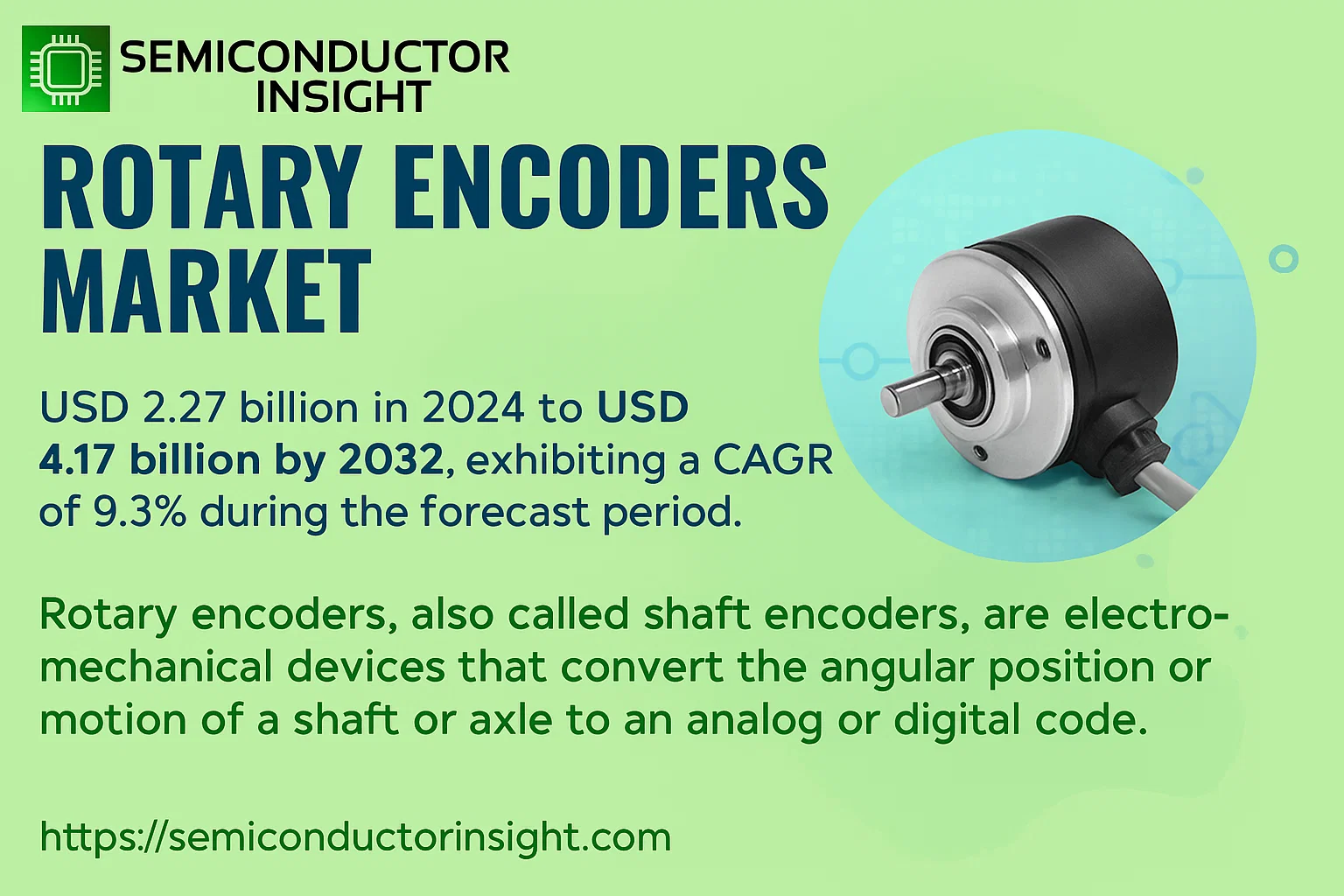
Global Rotary Encoders Market size was valued at USD 2.27 billion in 2024 to USD 4.17 billion by 2032, exhibiting a CAGR of 9.3% during the forecast period.
Rotary encoders, also called shaft encoders, are electro-mechanical devices that convert the angular position or motion of a shaft or axle to an analog or digital code. These components provide precise position feedback for rotational motion control across various industrial applications, enabling accurate speed and position measurement in automated systems.
The market is experiencing steady growth due to several factors, including increasing automation across manufacturing sectors, rising demand for high-precision motion control systems, and growing adoption in robotics and CNC machinery. Additionally, the expansion of Industry 4.0 initiatives and smart manufacturing technologies are contributing to market expansion. Europe represents the largest consumption region globally, accounting for approximately 36% of total market revenue due to its strong industrial automation base and advanced manufacturing infrastructure. Key players operating in this market include Heidenhain, Danaher, Tamagawa, Baumer, Omron, and Sick among others.
MARKET DRIVERS
Rising Demand for Industrial Automation and Robotics
Global push towards Industry 4.0 and smart manufacturing is a primary driver for the rotary encoder market. Rotary encoders are indispensable for providing precise feedback on position, speed, and direction in automated machinery, CNC machines, and robotic arms. The increasing deployment of industrial robots, projected to exceed 3 million units worldwide, directly fuels the demand for high-precision absolute and incremental encoders that ensure operational accuracy and efficiency.
Expansion of the Automotive Sector
The automotive industry is a significant consumer of rotary encoders, utilizing them in applications ranging from throttle position sensing and headlight leveling systems to advanced driver-assistance systems (ADAS) and electric power steering. The rapid growth in electric vehicle (EV) production, which relies heavily on encoders for motor control and battery management, further accelerates market growth. Automotive production of over 85 million vehicles annually creates a substantial and consistent demand.
Furthermore, technological advancements leading to the development of more robust, compact, and reliable encoders with higher resolutions are enabling their adoption in new and demanding environments, including aerospace, defense, and renewable energy systems.
MARKET CHALLENGES
Intense Price Pressure and Competition
Rotary Encoders Market is highly competitive, with numerous global and regional players. This intense competition, particularly from low-cost manufacturers, creates significant price pressure, often compressing profit margins for established companies. End-users in price-sensitive industries constantly demand higher performance at lower costs, challenging manufacturers to innovate while managing production expenses.
Other Challenges
Technical Complexity in Harsh Environments
Ensuring reliable operation of rotary encoders in extreme conditions—such as high temperatures, strong vibrations, exposure to contaminants like dust and moisture, and strong electromagnetic interference—poses a significant engineering challenge. Developing encoders with high ingress protection (IP) ratings and robust designs without compromising on precision or increasing size and cost is a persistent hurdle.
Supply Chain Volatility
Disruptions in Global supply chain for critical components, such as semiconductors, magnets, and specialized metals, can lead to production delays and increased costs. This volatility affects the ability of manufacturers to meet delivery timelines and maintain stable pricing for their encoder products.
MARKET RESTRAINTS
High Initial Investment and Maintenance Costs
High-performance rotary encoders, especially absolute encoders with sophisticated communication protocols like EtherCAT or PROFINET, involve significant initial costs. For small and medium-sized enterprises (SMEs), this high capital expenditure can be a major barrier to adoption. Additionally, the integration, calibration, and periodic maintenance of these precision devices add to the total cost of ownership, restraining market growth in cost-conscious segments.
Availability of Alternative Technologies
In certain applications, alternative sensing technologies like resolvers, potentiometers, or Hall-effect sensors can be used instead of rotary encoders. While encoders generally offer superior precision, these alternatives can be more cost-effective or robust in specific, less demanding scenarios. This availability of substitutes limits the potential market penetration for rotary encoders in some low-end applications.
MARKET OPPORTUNITIES
Growth in Emerging Economies
Rapid industrialization in emerging economies across Asia-Pacific, Latin America, and Eastern Europe presents substantial growth opportunities. Governments in these regions are investing heavily in infrastructure and manufacturing modernization, which will drive the adoption of automation technologies, including rotary encoders. The market in Asia-Pacific is already the largest and is expected to maintain the highest growth rate.
Advancements in IoT and Industry 4.0
The integration of rotary encoders with Internet of Things (IoT) platforms and Industrial IoT (IIoT) ecosystems creates new opportunities for predictive maintenance and data analytics. Smart encoders that can communicate real-time performance data enable condition monitoring, reduce unplanned downtime, and optimize machine efficiency. This trend towards intelligent, connected devices opens up new revenue streams and application areas.
Miniaturization and Development of New Applications
The ongoing trend towards miniaturization allows for the development of smaller, more efficient encoders suitable for compact consumer electronics, portable medical devices, and miniature robotics. This expansion into new application areas beyond traditional industrial uses represents a significant opportunity for market diversification and growth.
Rotary Encoders Market Trends
Strong Global Growth Trajectory
Global Rotary Encoders Market is currently valued at approximately USD 2270 million and is projected to reach USD 4173 million by 2032, demonstrating a strong Compound Annual Growth Rate (CAGR) of 9.3% during the forecast period. This significant growth is primarily fueled by increasing automation across key industrial sectors and the rising demand for precise motion control and position sensing. This trend underscores the critical role rotary encoders play in modern manufacturing and automation, acting as essential components for converting mechanical motion into digital signals.
Other Trends
Geographical Market Dominance
Europe has solidified its position as the largest consumption market for rotary encoders globally, accounting for a significant 36% share of total market revenue. This dominance is attributed to the region’s mature and technologically advanced industrial base, particularly in automotive, machine tool, and precision engineering sectors. The strong presence of leading manufacturers in countries like Germany and the UK further cements Europe’s leadership. Meanwhile, the Asia-Pacific region is experiencing rapid growth, driven by expanding manufacturing activities and industrial automation investments, particularly in China, Japan, and South Korea.
Incremental vs. Absolute Encoder Adoption
A key trend within the market is the segmentation between incremental and absolute rotary encoders. While incremental encoders are widely used for applications requiring speed and direction measurement, absolute encoders are gaining significant traction due to their ability to provide a unique position value immediately upon power-up, which is critical for applications where safety and precise positioning are paramount. This is driving their increased adoption in sectors like robotics, aerospace, and high-precision machine tools.
Application-Specific Demand Drivers
Demand is driven by diverse applications, with major sectors including the elevator industry, machine tools, motors, and food & packaging machinery. The elevator industry relies on encoders for precise floor leveling and safety systems. In machine tools, encoders are indispensable for controlling position and speed with extreme accuracy. The motor industry uses them for feedback in servo and stepper motors. The food and packaging sector utilizes encoders to ensure synchronization and precise control in automated packaging lines. Technological advancements are focusing on improving resolution, reliability, and enabling integration with Industrial Internet of Things (IIoT) platforms for predictive maintenance.
COMPETITIVE LANDSCAPE
Key Industry Players
A Fragmented Market with Global Leaders and Specialized Niche Players
Global Rotary Encoders Market features a competitive landscape characterized by a mix of established multinational corporations and specialized manufacturers. The market is moderately fragmented, with the top five players accounting for a significant portion of Global revenue share in 2024. Leading companies like Heidenhain and Danaher dominate the high-precision segments, leveraging their strong brand reputation, extensive R&D capabilities, and global distribution networks. These leaders primarily cater to demanding applications in machine tools, robotics, and automation, where reliability and accuracy are paramount. The competitive dynamics are heavily influenced by continuous technological innovation, with a focus on developing encoders with higher resolutions, better durability in harsh environments, and enhanced digital communication protocols. Europe remains the largest consumption market, which has historically favored the strong presence of European manufacturers.
Beyond the dominant leaders, a second tier of significant players competes effectively in specific geographic regions or application niches. Companies such as Baumer, Omron, and Sick have carved out strong positions by offering robust product portfolios that serve a wide range of industrial sectors, including food and packaging, elevators, and motor drives. Furthermore, niche players like Nemicon, Tamagawa, and Kubler specialize in particular encoder technologies or custom solutions, often achieving strong loyalty in their target markets. The Asia-Pacific region is a key growth area, fostering competition from local manufacturers who compete aggressively on price while steadily improving their technological offerings. Mergers and acquisitions have also been a strategic tool for companies seeking to expand their geographic footprint or technological expertise.
List of Key Rotary Encoders Companies Profiled
- Heidenhain
- Danaher
- Tamagawa
- Baumer
- Nemicon
- Pepperl+Fuchs (P+F)
- Kubler
- Koyo
- Omron
- Leine & Linde
- Sick
- TR Electronic
- BEI Sensors
- Rep Avago
- Yuheng Optics
Segment Analysis:
| Segment Category | Sub-Segments | Key Insights |
| By Type |
|
Absolute Rotary Encoders represent a critically important technology segment due to their inherent ability to provide a unique position value upon power-up, eliminating the need for a homing routine required by incremental types. This capability is paramount for applications where safety and operational integrity are non-negotiable, such as in robotics, medical devices, and aerospace systems. The demand is further propelled by the trend towards Industry 4.0 and smart manufacturing, which require devices that deliver precise, real-time positional data without any risk of data loss during a power cycle. |
| By Application |
|
Machine Tools are a dominant application area fueled by the relentless pursuit of precision in manufacturing processes like CNC milling, turning, and grinding. Rotary encoders are indispensable for providing precise feedback on spindle position and speed, which directly impacts machining accuracy and surface finish quality. The ongoing modernization of industrial infrastructure and the integration of advanced automation solutions are creating sustained demand from this sector, as manufacturers seek to enhance productivity and maintain competitive advantage through superior process control. |
| By End User |
|
Industrial Manufacturing stands as the largest end-user segment, driven by the extensive adoption of automation and robotics across countless production lines. Encoders are fundamental components in robotic arms, conveyor systems, and automated guided vehicles (AGVs), enabling precise motion control and coordination. The shift towards smart factories and the Industrial Internet of Things (IIoT) is intensifying the need for reliable feedback devices that can operate in harsh industrial environments while providing data for predictive maintenance and operational optimization. |
| By Signal Output |
|
Fieldbus & Ethernet-based outputs are rapidly gaining prominence as the leading interface technology. This shift is a direct response to the demands of modern industrial networks for high-speed communication, deterministic data transfer, and simplified wiring architectures. Protocols like PROFINET, EtherCAT, and Ethernet/IP allow encoders to be seamlessly integrated into sophisticated control systems, enabling real-time diagnostics, remote configuration, and enhanced data transparency, which are critical for efficient plant-wide operations and Industry 4.0 implementations. |
| By Construction |
|
Hollow Shaft encoders are the most sought-after construction type due to their significant installation advantages. Their through-bore design allows for direct mounting over motor shafts or axles, which simplifies assembly, reduces the need for couplings and mounting brackets, and minimizes potential alignment errors. This design is particularly valuable in space-constrained applications and for retrofitting existing machinery, as it offers a compact, robust, and mechanically straightforward solution that enhances overall system reliability and reduces maintenance requirements. |
Regional Analysis: Rotary Encoders Market
Asia-Pacific
The region is the world’s primary hub for industrial automation, with countries like China implementing extensive “Made in China 2025” policies. This drives massive demand for rotary encoders in automated production lines, CNC machinery, and robotic arms, where precise position and speed feedback are critical for efficiency and quality.
Asia-Pacific’s dominance in consumer electronics and semiconductor manufacturing creates a continuous need for high-resolution encoders used in precision equipment. The dense concentration of electronics factories ensures a steady, high-volume demand base that suppliers are well-positioned to serve with localized production and support.
National strategies focused on technological advancement and smart infrastructure provide a favorable environment. Government subsidies and initiatives for upgrading manufacturing capabilities directly benefit the adoption of advanced encoder technologies, encouraging local manufacturers to invest in higher-performance solutions.
The growth of the automotive industry, including the shift towards electric vehicles, is a significant driver. Rotary encoders are essential in automotive assembly robots, electric power steering systems, and transmission controls, with the region’s expanding vehicle production fueling consistent market growth.
North America
The North American Rotary Encoders Market is characterized by its advanced technological landscape and high adoption of cutting-edge automation solutions. Strong demand originates from well-established manufacturing sectors, particularly in aerospace, defense, and medical device industries, where precision and reliability are non-negotiable. The region’s focus on reshoring manufacturing and bolstering domestic supply chains is creating new opportunities for industrial automation components. Furthermore, the rapid growth of robotics in logistics and warehousing, driven by e-commerce, is a significant contributor to market dynamics. The presence of major encoder manufacturers and a culture of early adoption for innovative technologies ensures a mature yet steadily growing market.
Europe
Europe maintains a strong position in the Rotary Encoders Market, underpinned by its highly developed industrial base, particularly in Germany, Italy, and France. The region is a global leader in high-end machinery, automotive engineering, and robotics, all of which are heavy users of precision motion feedback devices. Strict regulatory standards for quality, safety, and energy efficiency drive the demand for high-performance encoders. There is a significant push towards digitalization and smart factories under initiatives like Industry 4.0, which promotes the integration of advanced sensors. The market is mature but is sustained by continuous technological upgrades and the region’s emphasis on precision engineering and high-value manufacturing.
South America
The Rotary Encoders Market in South America is emerging, with growth primarily driven by the industrialization efforts in countries like Brazil and Argentina. Demand is linked to the mining, agricultural machinery, and food processing industries, where automation is gradually being adopted to improve productivity. The market is less saturated compared to other regions, presenting opportunities for growth. However, market expansion is often tempered by economic volatility and infrastructural challenges. Investment in modernizing industrial facilities is a key factor that will influence the future adoption rates of rotary encoders and other automation components in the region.
Middle East & Africa
The Middle East & Africa region represents a developing market for rotary encoders, with growth potential tied to economic diversification efforts, particularly in the Gulf Cooperation Council (GCC) countries. The shift away from oil dependency is fostering investments in manufacturing, construction, and infrastructure projects, which require industrial automation equipment. In Africa, nascent industrial growth and mining activities create a small but growing demand. The market is characterized by a focus on rugged and reliable encoder solutions suited for harsh environments. Overall, while the current market size is modest, long-term growth prospects are linked to the region’s ongoing industrial development.
Report Scope
This market research report provides a comprehensive analysis of the Rotary Encoders Market, covering the forecast period 2025–2032. It offers detailed insights into market dynamics, technological advancements, competitive landscape, and key trends shaping the industry.
Key focus areas of the report include:
- Market Overview: The report begins with an overview outlining the current market scenario, key growth indicators, and industry transformation drivers. It discusses macroeconomic factors, demand–supply balance, regulatory landscape, and the strategic role of rotary encoders in powering advancements across industries such as elevator, machine tool, motor, food & packaging, and other industrial automation applications.
- Market Size & Forecast: Historical data and future projections for revenue, unit shipments, and market value across major regions and segments.
- Segmentation Analysis: Detailed breakdown by product type (Incremental and Absolute Rotary Encoders), technology, application, and end-user industry to identify high-growth segments and investment opportunities.
- Regional Insights: Insights into market performance across North America, Europe, Asia, South America, and the Middle East & Africa, including country-level analysis where relevant.
- Competitive Landscape: Profiles of leading market participants, including their product offerings, R&D focus, manufacturing capacity, pricing strategies, and recent developments such as mergers, acquisitions, and partnerships.
- Technology Trends & Innovation: Assessment of emerging technologies, integration of Industry 4.0, and evolving standards in measuring angular position and motion.
- Market Drivers & Restraints: Evaluation of factors driving market growth along with challenges, supply chain constraints, regulatory issues, and market-entry barriers.
- Stakeholder Insights: Insights for component suppliers, OEMs, system integrators, investors, and policymakers regarding the evolving ecosystem and strategic opportunities.
Primary and secondary research methods are employed, including interviews with industry experts, data from verified sources, and real-time market intelligence to ensure the accuracy and reliability of the insights presented.
FREQUENTLY ASKED QUESTIONS:
What is the current market size of Rotary Encoders Market?
->Rotary Encoders Market size was valued at USD 2.27 billion in 2024 to USD 4.17 billion by 2032, exhibiting a CAGR of 9.3% during the forecast period.
Which key companies operate in Rotary Encoders Market?
-> Key players include Heidenhain, Danaher, Tamagawa, Baumer, Nemicon, P+F, Kubler, Koyo, Omron, Leine & Linde, Sick, TR Electronic, BEI, Rep Avago, and Yuheng Optics, among others.
What are the key growth drivers?
-> Key growth drivers include industrial automation, demand from the elevator and machine tool industries, and increasing adoption in motor applications.
Which region dominates the market?
-> Europe is the largest consumption market, accounting for 36% of global total revenue.
What are the emerging trends?
-> Emerging trends include advancements in absolute encoder technology, integration with smart manufacturing systems, and miniaturization of components.

Get Sample Report PDF for Exclusive Insights
Report Sample Includes
- Table of Contents
- List of Tables & Figures
- Charts, Research Methodology, and more...
 Download Sample Report PDF