Robotics Embedded Systems Market Insights
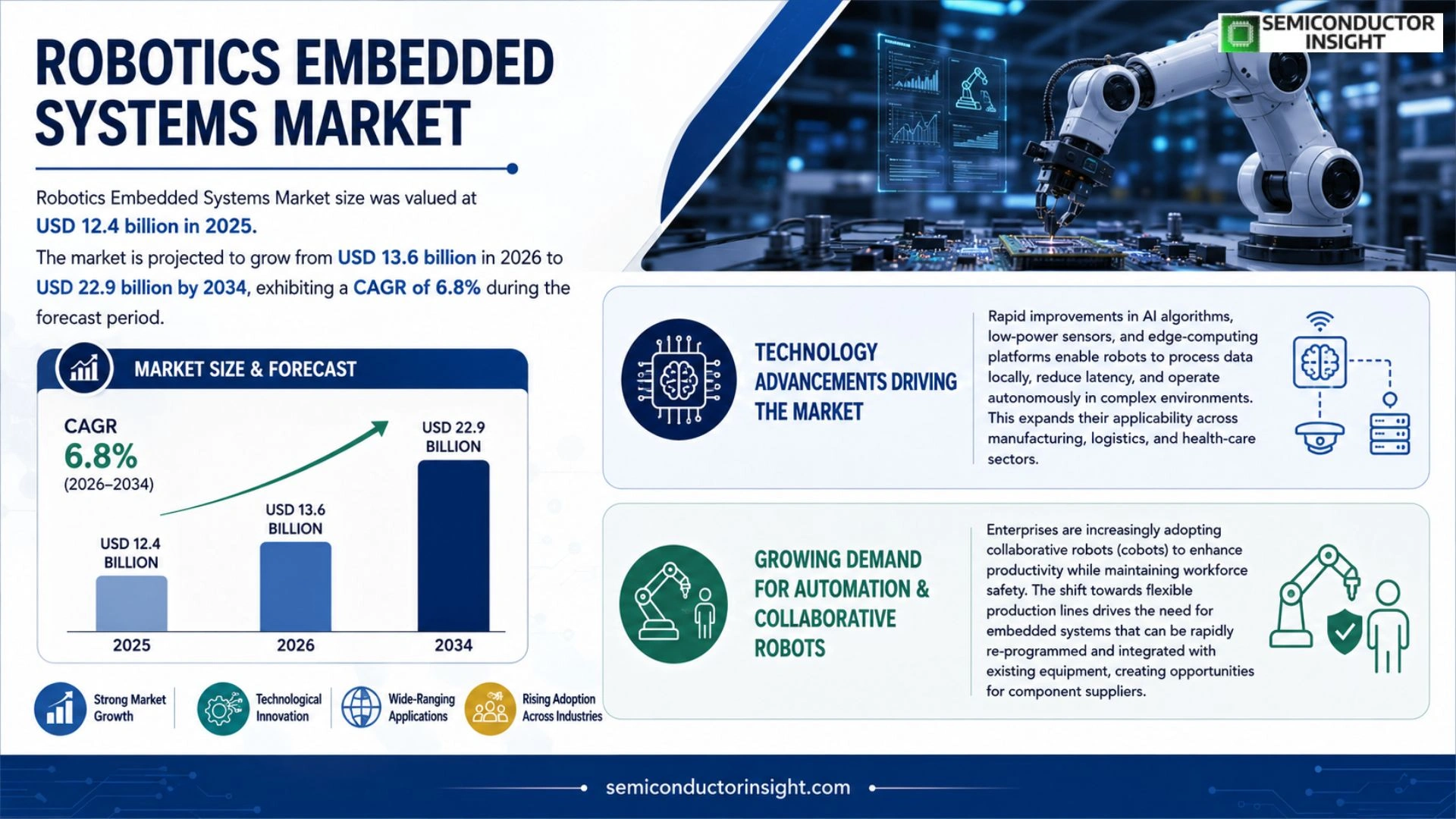
Global Robotics Embedded Systems Market size was valued at USD 12.4 billion in 2025. The market is projected to grow from USD 13.6 billion in 2026 to USD 22.9 billion by 2034, exhibiting a CAGR of 6.8% during the forecast period.
Robotics embedded systems are specialized hardware‑software platforms that provide real‑time processing, sensor integration, and deterministic control for robotic applications. These systems combine microcontrollers, field‑programmable gate arrays (FPGAs), and dedicated operating systems to enable precise motion control, perception, and decision‑making across industrial manipulators, autonomous mobile robots, and service robots.
The market is experiencing rapid growth because manufacturers are accelerating Industry 4.0 initiatives, while demand for collaborative robots and autonomous logistics solutions rises sharply. Furthermore, advances in artificial‑intelligence accelerators and edge‑computing architectures are expanding the functional envelope of embedded controllers. Key players such as NVIDIA, Intel, Bosch Rexroth, Siemens and Advantech are actively expanding their portfolios through strategic partnerships and platform‑as‑a‑service offerings.
MARKET DRIVERS
Technological Advancements in AI, Sensors, and Edge Computing
Robotics Embedded Systems Market is being propelled by rapid improvements in artificial intelligence algorithms, low‑power sensors, and edge‑computing platforms. These technologies enable robots to process data locally, reduce latency, and operate autonomously in complex environments, thereby expanding their applicability across manufacturing, logistics, and health‑care sectors.
Growing Demand for Automation and Collaborative Robots
Enterprises are increasingly adopting collaborative robots (cobots) to enhance productivity while maintaining workforce safety. The shift towards flexible production lines drives the need for embedded systems that can be rapidly re‑programmed and integrated with existing equipment, creating a steady stream of opportunities for component suppliers.
➤ “Edge‑enabled embedded controllers allow robots to make real‑time decisions, cutting cycle times by up to 30% in high‑mix, low‑volume production.”
In parallel, the rise of service‑oriented business models,such as robot‑as‑a‑service (RaaS),requires scalable, secure embedded platforms. These market dynamics collectively reinforce the growth trajectory of Robotics Embedded Systems Market.
MARKET CHALLENGES
Integration Complexity Across Heterogeneous Platforms
Designers must reconcile diverse hardware interfaces, communication protocols, and safety standards when building robotic solutions. This complexity increases development timelines and elevates the risk of integration failures, especially in legacy‑heavy industries.
Other Challenges
Supply Chain Constraints
Global shortages of semiconductors and specialized sensors can delay product launches and inflate bill‑of‑material costs, putting pressure on margins for system integrators.
MARKET RESTRAINTS
High Development and Certification Costs
Embedding advanced capabilities into robots requires extensive R&D investment, rigorous testing, and compliance with safety certifications such as ISO 10218 and IEC 61508. These cost barriers can deter smaller players from entering Robotics Embedded Systems Market.
Additionally, the need for continuous software updates to address security vulnerabilities adds ongoing operational expenses, which may limit adoption in cost‑sensitive segments.
Regulatory uncertainties around autonomous decision‑making in robotics further constrain market expansion, as manufacturers await clearer standards to mitigate liability risks.
MARKET OPPORTUNITIES
Expansion in Service Robotics for Healthcare and Elderly Care
The aging global population creates a compelling demand for service robots that can assist with patient monitoring, medication delivery, and daily living activities. Embedded systems offering reliable real‑time processing and secure connectivity are essential to realize these applications, opening a sizable opportunity for component manufacturers.
Furthermore, the convergence of 5G connectivity with embedded platforms enables remote robot control and telemetry, unlocking new business models such as centralized robot farms for warehousing and agricultural tasks.
Investments in open‑source middleware and standardized hardware abstraction layers are fostering faster time‑to‑market, allowing innovators to capture market share by delivering differentiated, cost‑effective robotic solutions.
Robotics Embedded Systems Market Trends
Industry 4.0 Momentum Drives Adoption
Robotics Embedded Systems Market is gaining traction as manufacturers embed real‑time processing, sensor fusion, and deterministic control into robotic platforms. Dedicated microcontrollers, FPGAs and specialized operating systems enable precise motion control for collaborative manipulators and autonomous mobile units. Accelerated Industry 4.0 initiatives are prompting factories to replace legacy controllers with embedded solutions that support flexible re‑programming and seamless integration with manufacturing execution systems. The modular nature of these embedded stacks also simplifies certification processes, allowing manufacturers to reuse validated blocks across multiple robot families. Real‑time Ethernet and time‑sensitive networking are being integrated to guarantee sub‑millisecond jitter.
Demand for collaborative robots in assembly lines and autonomous logistics vehicles is rising sharply, pushing system designers to prioritize reliability, low latency and deterministic behavior. Embedded platforms now provide the computational bandwidth required for on‑board perception and decision‑making without reliance on external cloud resources, thereby improving operational safety and throughput. Such deterministic loops are essential for applications that require tight synchronization between motion axes and sensor feedback, for example high‑speed pick‑and‑place cells.
Other Trends
AI Accelerator and Edge Computing Integration
Recent advances in AI accelerators and edge‑computing architectures are expanding the functional envelope of Robotics Embedded Systems Market. Neural‑processing units and heterogeneous compute fabrics allow robotic controllers to execute deep‑learning inference at the edge, supporting complex vision and navigation tasks in real time. Vendors are offering platform‑as‑a‑service models that bundle hardware, middleware and analytics, enabling end users to deploy intelligent capabilities rapidly and with predictable total cost of ownership. Edge deployment also mitigates cybersecurity exposure by keeping sensitive data on‑premise, a factor increasingly important for regulated sectors such as pharmaceuticals.
Strategic Partnerships Expand Ecosystem
Key players such as NVIDIA, Intel, Bosch Rexroth, Siemens and Advantech are deepening their portfolios through strategic alliances and joint development programs. These collaborations accelerate the introduction of standardized interfaces, safety‑certified modules and cloud‑enabled monitoring services. By aligning product roadmaps, ecosystem partners create a more cohesive development environment that reduces integration effort and shortens time‑to‑market for next‑generation robotic solutions. Looking ahead, the combined focus on open standards and AI‑ready hardware is expected to drive a wave of plug‑and‑play robotic solutions that can be configured by end users with minimal engineering effort. Investments in co‑development labs are accelerating the validation of new safety‑critical functions.
COMPETITIVE LANDSCAPE
Key Industry Players
Robotics Embedded Systems Market – Competitive Overview
Robotics Embedded Systems Market is dominated by technology conglomerates that combine deep semiconductor expertise with robust industrial automation portfolios. NVIDIA and Intel lead the high‑performance computing segment, offering AI‑accelerated edge processors that power collaborative robots and autonomous logistics platforms. Siemens and Bosch Rexroth provide end‑to‑end control solutions, integrating field‑programmable gate arrays and deterministic operating systems into factory‑floor robotic cells. Advantech, with its rugged embedded platforms, anchors the market’s growth in edge‑computing deployments for service robots, while ABB and Fanuc leverage their long‑standing robotics heritage to embed specialized controllers that improve motion precision and safety standards.
Beyond the Tier‑1 giants, a cohort of niche specialists contributes critical capabilities that enrich the ecosystem. Mitsubishi Electric and Yaskawa deliver advanced motion‑control modules tailored for high‑speed industrial manipulators. Texas Instruments and STMicroelectronics supply power‑efficient microcontrollers that enable lightweight autonomous mobile robots. Qualcomm’s Snapdragon Robotics platform and Google’s Cloud‑AI integration expand the frontier of intelligent perception at the edge. Emerging firms such as KUKA Innovation and Cognex add vision‑guided automation expertise, while Open‑Source initiatives like ROS‑Industrial foster a collaborative development environment that accelerates adoption across mid‑market players.
List of Key Robotics Embedded Systems Companies Profiled
- NVIDIA
- Intel
- Bosch Rexroth
- Siemens
- Advantech
- ABB
- Fanuc
- Mitsubishi Electric
- Yaskawa
- Texas Instruments
- STMicroelectronics
- Qualcomm
- Google (Boston Dynamics partnership)
- KUKA Innovation
- Cognex
Segment Analysis:
| Segment Category | Sub-Segments | Key Insights |
| By Type |
|
Industrial Manipulators
|
| By Application |
|
Autonomous Mobile Logistics
|
| By End User |
|
Automotive OEMs
|
| By Architecture |
|
FPGA‑based Platforms
|
| By Functionality |
|
Edge AI Processing
|
Regional Analysis: North America
The industrial sector is a primary driver for Robotics Embedded Systems in North America, with applications ranging from automated assembly lines to quality control and material handling. The need for increased productivity and reduced operational costs is fueling adoption across manufacturing facilities.
The healthcare industry is witnessing a growing demand for Robotics Embedded Systems in areas like surgical robotics, rehabilitation robots, and automated laboratory systems. These systems offer enhanced precision, minimally invasive procedures, and improved patient outcomes.
The logistics and warehousing sector is increasingly adopting Robotics Embedded Systems for automating tasks such as order fulfillment, inventory management, and transportation. This is driven by the need for faster delivery times, reduced labor costs, and improved efficiency in supply chain operations.
The defense and security sectors in North America are leveraging Robotics Embedded Systems for applications like unmanned aerial vehicles (UAVs), autonomous ground vehicles, and surveillance systems. These systems enhance operational capabilities and reduce risks in various scenarios.
North America
Robotics Embedded Systems Market in North America is characterized by a strong emphasis on innovation and the adoption of advanced technologies. Key trends include the increasing integration of artificial intelligence and machine learning to enhance the capabilities of robots, the growing demand for collaborative robots (cobots) that can work alongside humans, and the rise of cloud-based robotics platforms. Businesses are also focusing on developing customized solutions tailored to the specific needs of different industries. Sustainability is emerging as a significant factor, with a focus on energy-efficient robots and environmentally friendly materials. The regulatory landscape remains supportive of technological advancements, with government initiatives promoting research and development in robotics.
Europe
Europe represents another significant market for Robotics Embedded Systems, with a strong focus on industrial automation and advanced manufacturing. The region benefits from a highly skilled workforce and a robust ecosystem of technology providers. Key applications include automotive manufacturing, electronics production, and food processing. European companies are actively investing in research and development to create innovative robotics solutions that address challenges related to labor shortages and an aging population. The emphasis on data privacy and security is a crucial consideration in the European market.
Asia-Pacific
The Asia-Pacific region is the fastest-growing market for Robotics Embedded Systems, driven by rapid industrialization, increasing automation adoption, and rising labor costs. Countries like China, Japan, and South Korea are leading the way in the adoption of these systems across various industries. The demand for robots in manufacturing, logistics, and healthcare is particularly strong. Government initiatives promoting technological innovation and investment in robotics are further accelerating market growth. The region presents significant opportunities for both domestic and international robotics companies.
South America
Robotics Embedded Systems Market in South America is still in its early stages of development but offers promising growth potential. The increasing adoption of automation in agriculture, mining, and manufacturing is driving demand for robotics solutions. The region faces challenges related to infrastructure development and a less skilled workforce, but growing investments in technology are expected to fuel market expansion in the coming years.
Middle East & Africa
The Middle East & Africa region is witnessing a gradual increase in the adoption of Robotics Embedded Systems, primarily in sectors like oil and gas, construction, and logistics. The region’s focus on infrastructure development and automation investments is creating new opportunities for robotics solutions. However, challenges related to economic volatility and limited technological infrastructure need to be addressed to unlock the full potential of the market.
Report Scope
This market research report provides a comprehensive analysis of the Robotics Embedded Systems Market , covering the forecast period 2026–2034. It offers detailed insights into market dynamics, technological advancements, competitive landscape, and key trends shaping the industry.
Key focus areas of the report include:
- Market Overview: The report begins with an overview outlining its current market scenario, key growth indicators, and industry transformation drivers. It discusses macroeconomic factors, demand–supply balance, regulatory landscape, and the strategic role of semiconductors in powering advancements across industries such as automotive, telecommunications, consumer electronics, and industrial automation.
- Market Size & Forecast: Historical data and future projections for revenue, unit shipments, and market value across major regions and segments.
- Segmentation Analysis: Detailed breakdown by product type, technology, application, and end-user industry to identify high-growth segments and investment opportunities.
- Regional Insights: Insights into market performance across North America, Europe, Asia-Pacific, Latin America, and the Middle East & Africa, including country-level analysis where relevant.
- Competitive Landscape: Profiles of leading market participants, including their product offerings, R&D focus, manufacturing capacity, pricing strategies, and recent developments such as mergers, acquisitions, and partnerships.
- Technology Trends & Innovation: Assessment of emerging technologies, integration of AI/IoT, semiconductor design trends, fabrication techniques, and evolving industry standards.
- Market Drivers & Restraints: Evaluation of factors driving market growth along with challenges, supply chain constraints, regulatory issues, and market-entry barriers.
- Stakeholder Insights: Insights for component suppliers, OEMs, system integrators, investors, and policymakers regarding the evolving ecosystem and strategic opportunities.
Primary and secondary research methods are employed, including interviews with industry experts, data from verified sources, and real-time market intelligence to ensure the accuracy and reliability of the insights presented.
FREQUENTLY ASKED QUESTIONS:
What is the current market size of Robotics Embedded Systems Market?
-> Robotics Embedded Systems Market was valued at USD 12.4 billion in 2025 and is expected to reach USD 22.9 billion by 2034, representing a CAGR of 6.8%.
Which key companies operate Robotics Embedded Systems Market?
-> Key players include NVIDIA, Intel, Bosch Rexroth, Siemens and Advantech, among others.
What are the key growth drivers?
-> Key growth drivers include accelerating Industry 4.0 initiatives, rising demand for collaborative robots and autonomous logistics solutions, and advances in AI accelerators and edge‑computing architectures.
Which region dominates the market?
-> The reference material does not specify a dominant region for Robotics Embedded Systems Market.
What are the emerging trends?
-> Emerging trends include integration of artificial‑intelligence accelerators, edge‑computing platforms, platform‑as‑a‑service business models, and deeper AI/IoT convergence within embedded controller designs.

Get Sample Report PDF for Exclusive Insights
Report Sample Includes
- Table of Contents
- List of Tables & Figures
- Charts, Research Methodology, and more...
 Download Sample Report PDF