RISC-V AI Processor Market Insights
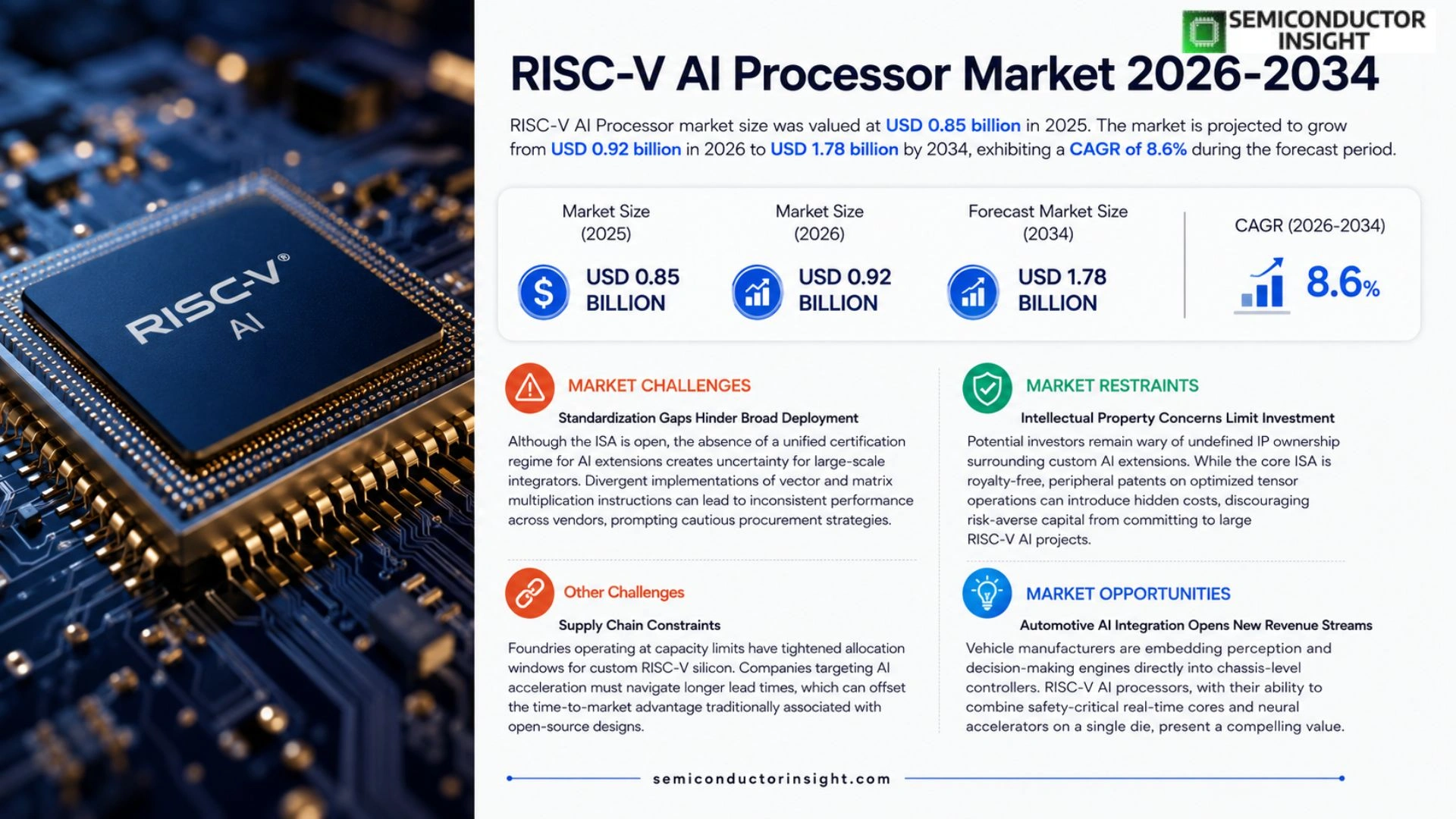
Global RISC‑V AI Processor market size was valued at USD 0.85 billion in 2025. The market is projected to grow from USD 0.92 billion in 2026 to USD 1.78 billion by 2034, exhibiting a CAGR of 8.6% during the forecast period.
RISC‑V AI processors are open‑source hardware accelerators built on the RISC‑V instruction set architecture, optimized for artificial‑intelligence workloads such as inference and training on edge devices, data‑center servers, and autonomous systems.
The expansion is largely due to increasing adoption of open‑source silicon by semiconductor firms seeking cost‑effective customization, coupled with rising demand for low‑power AI inference at the edge. Moreover, collaborations between chip designers and cloud providers are accelerating ecosystem development, while advances in compiler tooling are lowering barriers for software integration.
MARKET DRIVERS
Open‑Source Architecture Fuels Innovation
RISC‑V AI Processor Market benefits from an open‑source ISA that invites contributions from academia, startups, and established silicon vendors. This collaborative environment reduces development risk and accelerates the rollout of AI‑centric cores, allowing firms to differentiate products without negotiating costly licensing agreements.
Edge Computing Demands Drive Adoption
Edge devices increasingly require on‑device inference to meet latency and privacy expectations. RISC‑V’s modular instruction set enables designers to tailor processors for specific neural network shapes, resulting in power‑efficient silicon that fits constrained form factors. Consequently, OEMs are selecting RISC‑V solutions to power cameras, drones, and industrial sensors.
➤ “The flexibility of RISC‑V enables rapid customization for AI workloads, shortening time‑to‑market for edge products.”
Beyond technical merits, the ecosystem’s growing repository of verified IP blocks and software tools creates a virtuous loop: as more companies adopt RISC‑V AI cores, validation frameworks improve, further lowering entry barriers for newcomers.
MARKET CHALLENGES
Standardization Gaps Hinder Broad Deployment
Although the ISA is open, the absence of a unified certification regime for AI extensions creates uncertainty for large‑scale integrators. Divergent implementations of vector and matrix multiplication instructions can lead to inconsistent performance across vendors, prompting cautious procurement strategies.
Other Challenges
Supply Chain Constraints
Foundries operating at capacity limits have tightened allocation windows for custom RISC‑V silicon. Companies targeting AI acceleration must navigate longer lead times, which can offset the time‑to‑market advantage traditionally associated with open‑source designs.
MARKET RESTRAINTS
Intellectual Property Concerns Limit Investment
Potential investors remain wary of undefined IP ownership surrounding custom AI extensions. While the core ISA is royalty‑free, peripheral patents on optimized tensor operations can introduce hidden costs, discouraging risk‑averse capital from committing to large RISC‑V AI projects.
MARKET OPPORTUNITIES
Automotive AI Integration Opens New Revenue Streams
Vehicle manufacturers are embedding perception and decision‑making engines directly into chassis‑level controllers. RISC‑V AI processors, with their ability to combine safety‑critical real‑time cores and neural accelerators on a single die, present a compelling value proposition for autonomous driving stacks, offering both cost efficiency and compliance flexibility.
RISC-V AI Processor Market Trends
Open‑Source Silicon Gains Traction at the Edge
RISC‑V AI processor segment is witnessing a pronounced shift toward edge‑centric deployments. Companies are capitalising on the architecture’s inherent flexibility to tailor low‑power accelerators for inference workloads in automotive cameras, IoT gateways, and portable robotics. This move reduces bill‑of‑materials compared with proprietary silicon, while preserving the ability to iterate silicon features through community‑driven specifications. Manufacturers are also leveraging the modular ISA to embed domain‑specific extensions that accelerate quantised neural networks, thereby squeezing additional efficiency from the same silicon footprint. By 2032, forecasts suggest that edge devices powered by RISC‑V AI cores will represent over a third of all AI inference traffic, a shift that pressures traditional ASIC vendors to reconsider licensing models. The open‑source nature also facilitates security audits, a factor increasingly valued in regulated sectors such as medical imaging. For vendors, the consequence is a tighter margin on edge products and a faster time‑to‑market, which in turn encourages broader adoption across fragmented device ecosystems.
Other Trends
Collaboration with Cloud Service Providers
Major cloud operators have entered joint‑development programmes with RISC‑V chip designers, seeking to extend their infrastructure‑as‑a‑service offerings to include custom AI accelerators. The partnership model accelerates the maturation of toolchains and reference designs, creating a virtuous cycle where software stacks mature alongside hardware. The joint roadmap includes pre‑validated container images for popular frameworks such as TensorFlow Lite, which shortens deployment cycles for edge AI services. Enterprises that deploy hybrid workloads can now leverage a consistent instruction set from the data centre to the edge, simplifying application portability and reducing engineering overhead. Early adopters report a 15% reduction in power draw for comparable inference latency, reinforcing the business case for migration.
Compiler and Toolchain Evolution
Recent advances in RISC‑V compiler technology, particularly in vector extensions and mixed‑precision support, have lowered the barrier for machine‑learning developers to target these processors. As optimisation pipelines become more automated, software integration timelines shrink, making RISC‑V a viable alternative to entrenched GPU‑based solutions for specialised AI inference. Moreover, the emerging RISC‑V AI profile integrates heterogeneous memory access patterns, enabling cloud providers to offload bursty inference workloads from CPUs without sacrificing throughput. The practical upshot for system integrators is a broader selection of silicon partners and the ability to negotiate pricing based on performance‑per‑watt rather than legacy ecosystem lock‑in.
COMPETITIVE LANDSCAPE
Key Industry Players
RISC‑V AI Processor Market Competitive Overview
The sector is anchored by a handful of silicon vendors that have leveraged the openness of the RISC‑V ISA to assemble bespoke AI accelerators. SiFive, with its Freedom‑U series, has translated a configurable core into a family of edge‑oriented matrix engines, thereby setting a benchmark for time‑to‑market and cost efficiency. GreenWaves Technologies complements this approach through its GAP9 processor, which marries a low‑power RISC‑V cluster with a DSP‑style tensor engine, positioning the company as a preferred supplier for battery‑constrained vision workloads. Meanwhile, Esperanto Technologies’ high‑performance training processors illustrate how a vertically integrated design,spanning RTL, compiler, and software stack,can target data‑center inference while still exploiting RISC‑V’s modularity. This triad illustrates a market structure where a dominant platform provider coexists with a specialist niche player and an emerging performance‑centric challenger, each carving out distinct addressable segments based on power envelope, throughput, and integration depth.
Beyond the headline names, a cohort of smaller but technically sophisticated firms enriches the ecosystem. Andes Technology supplies compact RISC‑V cores that serve as the foundation for countless AI‑infused IoT chips, whereas Kneron offers a family of AI processors that integrate RISC‑V control logic with proprietary convolution engines for smart camera modules. PerceptIn focuses on autonomous‑driving perception stacks, embedding RISC‑V compute blocks within its sensor‑fusion SoCs. Flex Logix delivers embedded FPGA fabrics that can be programmed with RISC‑V soft cores, giving system designers the flexibility to tailor AI pipelines post‑silicon. UltraSoC, Efinix, and Syntiant round out the landscape, each delivering niche capabilities,from ultra‑low‑power keyword spotting to reconfigurable accelerators,thereby ensuring that the market remains fragmented yet collaborative, with cross‑licensing and joint‑development agreements accelerating time‑to‑solution.
List of Key RISC‑V AI Processor Companies Profiled
- SiFive
- GreenWaves Technologies
- Esperanto Technologies
- Andes Technology
- Kneron
- PerceptIn
- Flex Logix
- UltraSoC
- Efinix
- Syntiant
- RISC‑V International (Ecosystem Coordinator)
- OpenHW Group
Segment Analysis:
| Segment Category | Sub-Segments | Key Insights |
| By Type |
|
General‑purpose AI cores are valued for their flexibility across diverse workloads and for enabling rapid software integration.
|
| By Application |
|
Edge inference devices drive the narrative for low‑power, real‑time AI at the periphery of networks.
|
| By End User |
|
Semiconductor OEMs find RISC‑V AI processors attractive for differentiating product portfolios while maintaining cost discipline.
|
| By Deployment Model |
|
Edge‑node System‑on‑Chips are gaining traction because they blend the low‑power characteristics of edge devices with the flexibility of programmable logic.
|
| By Ecosystem Partner |
|
Open‑source compiler collectives play a pivotal role in lowering software barriers for RISC‑V AI.
|
Regional Analysis: RISC-V AI Processor Market
The European Union’s emphasis on security‑by‑design encourages designers to adopt open‑source architectures that can be audited end‑to‑end. Policy drafts that reward low‑power AI inference on compliant silicon are nudging firms toward RISC‑V, as it facilitates transparent verification processes while satisfying cross‑border data‑handling rules.
A dense network of universities specializing in computer architecture supplies a steady pipeline of engineers versed in RISC‑V extensions for machine learning. Collaborative research consortia blur the line between academia and industry, accelerating the translation of novel instruction‑set innovations into commercial AI processors.
Proximity to leading fab facilities in Germany and the Netherlands reduces lead times for prototype silicon. Coupled with a robust ecosystem of IP vendors offering ready‑made RISC‑V cores, European firms can iterate designs faster than peers relying on distant foundries.
Demand from automotive manufacturers for on‑board inference that meets strict safety certifications is prompting a migration toward customizable RISC‑V AI cores, which can be hardened without sacrificing performance.
North America
In the United States and Canada, venture capital continues to flow into RISC‑V AI startups, yet the market’s momentum is tempered by entrenched relationships with legacy architectures. While the openness of RISC‑V appeals to firms seeking to differentiate their AI solutions, the ecosystem still contends with fragmented software toolchains that hinder rapid deployment. Nonetheless, strategic partnerships between leading cloud providers and RISC‑V foundations are laying groundwork for server‑side inference workloads, suggesting a gradual shift toward open‑source AI silicon in data‑center environments.
Asia-Pacific
The Asia‑Pacific region exhibits a mosaic of adoption patterns. In Japan and South Korea, hardware manufacturers leverage RISC‑V’s modularity to embed AI accelerators within consumer electronics, capitalizing on the region’s strong emphasis on miniaturization. Meanwhile, China’s emphasis on self‑reliance drives aggressive standard‑setting for RISC‑V AI cores, though geopolitical considerations add uncertainty to cross‑border collaboration. Across the broader APAC landscape, the confluence of cost‑sensitive manufacturing and a burgeoning AI startup scene creates a distinct pathway for RISC‑V AI Processor Market to mature.
South America
Economic constraints have limited large‑scale investment in custom silicon, but niche players are exploring RISC‑V AI processors for agricultural tech and remote sensing. The ability to avoid hefty royalty fees makes the architecture attractive for cost‑conscious innovators seeking to embed edge AI in low‑margin products. Partnerships with European research institutes are beginning to surface, offering technical mentorship that could accelerate regional competency.
Middle East & Africa
In these markets, government initiatives aimed at building sovereign digital infrastructure are sparking early interest in open‑source processor designs. While the talent pool remains limited, training programs sponsored by multinational chip designers are raising awareness of RISC‑V’s potential for AI workloads in smart city projects and oil‑field monitoring. The market remains nascent, but strategic pilot projects hint at a longer‑term trajectory toward broader adoption.
Report Scope
This market research report provides a comprehensive analysis of the RISC-V AI Processor Market , covering the forecast period 2026–2034. It offers detailed insights into market dynamics, technological advancements, competitive landscape, and key trends shaping the industry.
Key focus areas of the report include:
- Market Overview: The report begins with an overview outlining its current market scenario, key growth indicators, and industry transformation drivers. It discusses macroeconomic factors, demand–supply balance, regulatory landscape, and the strategic role of semiconductors in powering advancements across industries such as automotive, telecommunications, consumer electronics, and industrial automation.
- Market Size & Forecast: Historical data and future projections for revenue, unit shipments, and market value across major regions and segments.
- Segmentation Analysis: Detailed breakdown by product type, technology, application, and end-user industry to identify high-growth segments and investment opportunities.
- Regional Insights: Insights into market performance across North America, Europe, Asia-Pacific, Latin America, and the Middle East & Africa, including country-level analysis where relevant.
- Competitive Landscape: Profiles of leading market participants, including their product offerings, R&D focus, manufacturing capacity, pricing strategies, and recent developments such as mergers, acquisitions, and partnerships.
- Technology Trends & Innovation: Assessment of emerging technologies, integration of AI/IoT, semiconductor design trends, fabrication techniques, and evolving industry standards.
- Market Drivers & Restraints: Evaluation of factors driving market growth along with challenges, supply chain constraints, regulatory issues, and market-entry barriers.
- Stakeholder Insights: Insights for component suppliers, OEMs, system integrators, investors, and policymakers regarding the evolving ecosystem and strategic opportunities.
Primary and secondary research methods are employed, including interviews with industry experts, data from verified sources, and real-time market intelligence to ensure the accuracy and reliability of the insights presented.
FREQUENTLY ASKED QUESTIONS:
What is the current market size of RISC-V AI Processor Market?
-> RISC-V AI Processor Market was valued at USD 0.85 billion in 2025 and is expected to reach USD 1.78 billion by 2034, with a CAGR of 8.6% during the forecast period.
Which key companies operate in RISC-V AI Processor Market?
-> Key players are not specified in the provided data.
What are the key growth drivers?
-> Key growth drivers include increasing adoption of open‑source silicon, rising demand for low‑power AI inference at the edge, collaborations between chip designers and cloud providers, and advances in compiler tooling.
Which region dominates the market?
-> Regional dominance is not detailed in the reference; the market outlook is presented on a global basis.
What are the emerging trends?
-> Emerging trends comprise ecosystem development through collaborations, improvements in compiler and tooling support, and expanding applications across edge devices, data‑center servers, and autonomous systems.
Get Sample Report PDF for Exclusive Insights
Report Sample Includes
- Table of Contents
- List of Tables & Figures
- Charts, Research Methodology, and more...
 Download Sample Report PDF