MARKET INSIGHTS
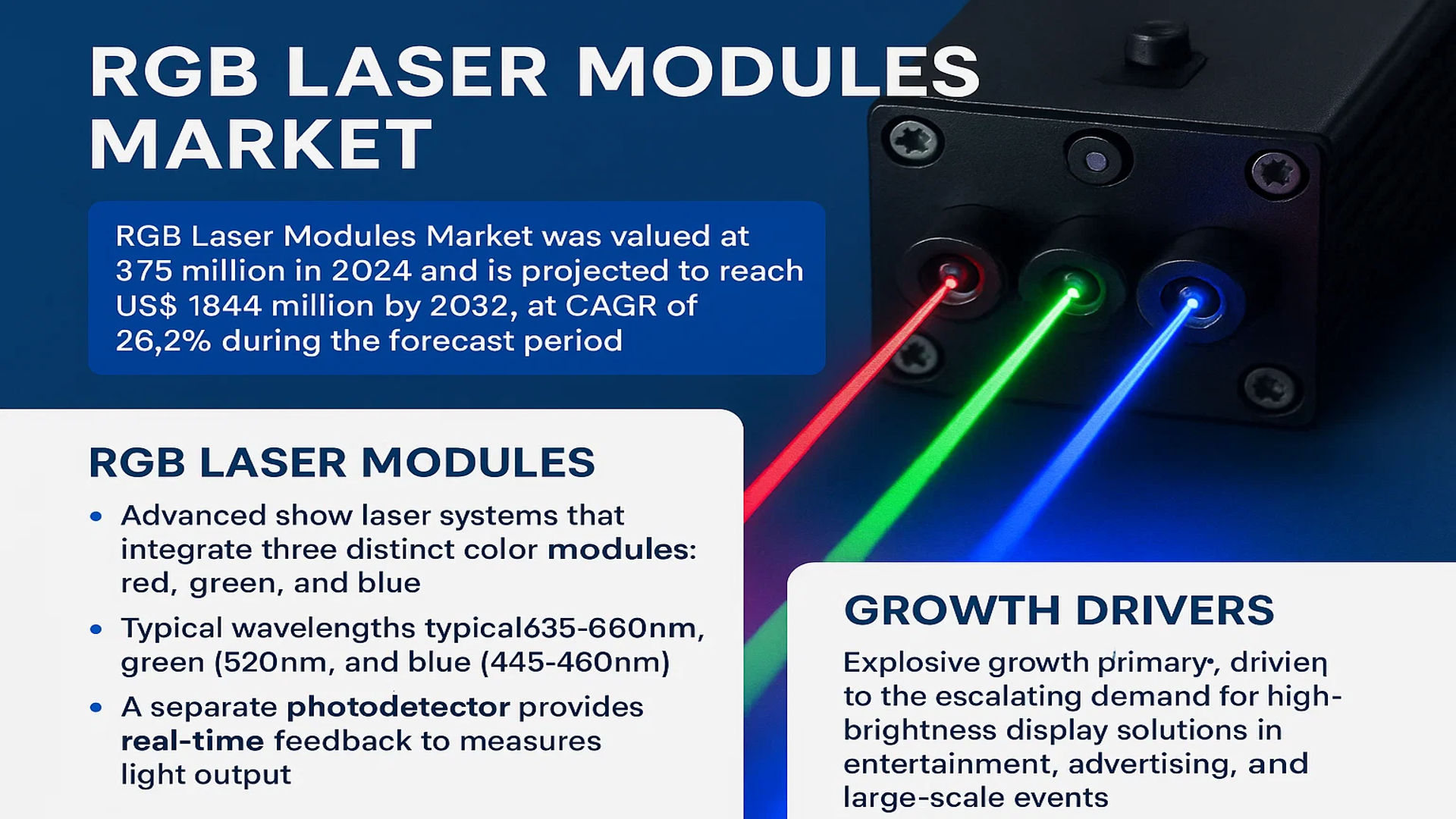
The global RGB Laser Modules Market was valued at 375 million in 2024 and is projected to reach US$ 1844 million by 2032, at a CAGR of 26.2% during the forecast period.
RGB laser modules are advanced show laser systems that integrate three distinct color modules: red, green, and blue. These systems utilize semiconductor laser diodes with specific wavelengths—typically 635-660nm for red, 520nm for green, and 445-460nm for blue—to produce a full spectrum of vibrant colors. A key component is a separate photodetector that measures light output and provides real-time feedback to the driver for exceptional stability. The inherent advantages of laser technology, including high definition, superior brightness, and focus-free projection, make these modules suitable for a diverse range of applications such as compact projectors, specialized laser lighting, and various industrial and medical light sources.
The market is experiencing explosive growth, primarily driven by the escalating demand for high-brightness display solutions in entertainment, advertising, and large-scale events. Furthermore, technological advancements leading to miniaturization and improved efficiency are expanding their use in portable devices. Europe currently dominates the market, holding approximately 50% of the global share, while the Asia-Pacific region is expected to witness the fastest growth due to rapid industrialization and increasing investments in display technologies.
MARKET DYNAMICS
MARKET DRIVERS
Rising Adoption in Laser Projection and Display Applications to Drive Market Expansion
The RGB laser modules market is experiencing robust growth driven by the increasing adoption of laser-based projection systems across entertainment, education, and corporate sectors. Laser projectors utilizing RGB modules offer superior color gamut, higher brightness levels exceeding 20,000 lumens in high-end models, and longer operational lifespans compared to traditional lamp-based systems. The global laser projector market is projected to grow at a compound annual growth rate of over 15%, creating substantial demand for RGB laser components. Major entertainment venues, including theme parks, concert halls, and large-scale public installations, are increasingly transitioning to laser-based projection systems due to their reliability and visual performance. The trend toward high-brightness, large-venue projection systems capable of operating in ambient light conditions is particularly driving demand for higher-power RGB laser modules in the 5W to 10W range.
Expansion of Augmented Reality and Holographic Display Technologies to Accelerate Growth
The proliferation of augmented reality (AR) and holographic display technologies represents a significant growth driver for RGB laser modules. These technologies require precise color control, high brightness, and compact form factors that RGB laser modules uniquely provide. The global AR market is expected to exceed $100 billion by 2028, with display technologies constituting a substantial portion of this growth. RGB lasers enable the creation of high-resolution, full-color holographic displays with wide viewing angles and excellent color saturation. Recent advancements in laser scanning technologies, including MEMS-based systems, have enabled the development of wearable AR devices and automotive heads-up displays that utilize RGB laser modules for their superior optical performance. The automotive sector alone is projected to account for over 25% of the laser-based display market by 2030, driven by the integration of advanced driver assistance systems and in-vehicle entertainment solutions.
Growing Medical and Industrial Applications to Fuel Market Development
Medical and industrial applications are emerging as significant growth areas for RGB laser modules, particularly in dermatology, ophthalmology, and precision manufacturing. In medical applications, RGB lasers enable multi-wavelength treatments that can target different tissue types simultaneously, improving treatment efficacy and reducing procedure times. The global medical laser market is anticipated to grow at approximately 12% annually, with dermatology applications representing the largest segment. Industrial applications include precision material processing, quality control systems, and spectroscopic analysis where the precise wavelength control and high power density of RGB laser modules provide distinct advantages. The ability to combine multiple wavelengths in a single compact module has enabled new applications in biotechnology and pharmaceutical research, where precise optical stimulation and imaging are required.
Furthermore, regulatory approvals for new laser-based medical devices and industrial applications are creating additional growth opportunities. The increasing number of clinical studies demonstrating the efficacy of multi-wavelength laser treatments is driving adoption across healthcare facilities worldwide.
➤ For instance, recent regulatory clearances for laser-based medical devices incorporating RGB modules have expanded treatment options for various dermatological conditions, contributing to market expansion.
Additionally, the trend toward automation and Industry 4.0 initiatives is driving demand for precision laser systems in manufacturing environments, further supporting market growth.
MARKET CHALLENGES
High Initial Costs and Complex Thermal Management to Challenge Market Penetration
Despite the growing adoption of RGB laser modules, the market faces significant challenges related to high initial costs and complex thermal management requirements. The production of high-quality laser diodes, particularly green laser diodes which require sophisticated frequency doubling techniques, involves substantial manufacturing costs. A complete RGB laser module system can cost 30-50% more than equivalent traditional light sources, creating adoption barriers in price-sensitive market segments. Thermal management presents another critical challenge, as laser diodes are highly sensitive to temperature variations that can affect wavelength stability and output power. Effective heat dissipation systems often constitute 20-30% of the total module cost and require sophisticated engineering solutions to maintain optimal operating temperatures.
Other Challenges
Technical Complexity in Color Balancing
Achieving precise color balance across the red, green, and blue channels requires sophisticated control electronics and calibration systems. Variations in diode efficiency, aging characteristics, and temperature dependencies make maintaining consistent color performance challenging throughout the product lifecycle. This technical complexity adds to development costs and requires specialized expertise that may not be readily available across all market segments.
Regulatory Compliance and Safety Requirements
Stringent laser safety regulations across different regions create compliance challenges for manufacturers. Class 4 laser products, which include many high-power RGB modules, require comprehensive safety systems including interlocks, beam shutters, and warning systems. Navigating the complex regulatory landscape and obtaining necessary certifications can delay product launches and increase development costs by 15-25%.
MARKET RESTRAINTS
Limited Lifetime of Green Laser Diodes to Restrain Market Growth
The RGB laser modules market faces significant restraints due to the relatively shorter operational lifetime of green laser diodes compared to their red and blue counterparts. Green laser diodes typically exhibit operational lifetimes of approximately 8,000-10,000 hours, while red and blue diodes can achieve 20,000-30,000 hours of operation. This disparity creates reliability concerns and increases the total cost of ownership for systems requiring balanced RGB output. The technical challenges in manufacturing direct green laser diodes with sufficient power and longevity have led many manufacturers to rely on frequency-doubled infrared lasers, which add complexity and cost to the system. This limitation particularly affects applications requiring continuous operation or high reliability, such as professional display systems and medical equipment.
Additionally, the rapid degradation of green laser components can lead to color imbalance over time, requiring frequent recalibration or component replacement. This maintenance requirement creates additional operational costs and downtime that may deter potential adopters in critical applications.
The technical limitations in green laser technology also restrict the maximum achievable output power for RGB systems, limiting their applicability in high-power projection and industrial applications where balanced high-power output is required.
MARKET OPPORTUNITIES
Emerging Applications in Automotive LiDAR and Sensing Technologies to Create Growth Opportunities
The expanding applications in automotive LiDAR and advanced sensing technologies represent significant growth opportunities for RGB laser modules. The autonomous vehicle market is projected to require millions of LiDAR units annually by 2030, with RGB laser technology enabling more sophisticated environmental perception and object recognition capabilities. The ability to provide multiple wavelengths in a compact form factor allows for improved discrimination between objects and better performance in various weather conditions. Recent advancements in solid-state LiDAR technology have created opportunities for RGB laser modules in both short-range and long-range sensing applications.
Additionally, the integration of RGB laser modules in consumer electronics for facial recognition, gesture control, and proximity sensing is creating new market segments. The smartphone industry alone represents a potential market of over 1 billion units annually for compact laser modules.
The development of miniaturized RGB laser modules with reduced power consumption is opening opportunities in portable and battery-operated devices, including wearable technology and mobile projection systems. These applications require the high optical performance of laser sources while addressing the constraints of size, power consumption, and thermal management.
RGB LASER MODULES MARKET TRENDS
Increasing Adoption in Entertainment and Projection Systems to Emerge as a Dominant Trend
The global RGB laser modules market is experiencing robust growth, primarily driven by their expanding adoption in high-end entertainment and professional projection systems. These modules, which combine red, green, and blue lasers to produce a full spectrum of colors, are increasingly favored over traditional lamp-based projectors due to their superior color gamut, higher brightness, and significantly longer operational lifespan. The market for laser projectors, a key application segment, is projected to grow at a compound annual growth rate exceeding 20%, directly fueling demand for integrated RGB modules. This surge is particularly evident in large-venue settings such as concert halls, planetariums, and digital cinemas, where the demand for vivid, high-definition visuals is paramount. Furthermore, the miniaturization of these modules is opening new opportunities in portable and ultra-compact projectors, a segment that is rapidly gaining traction in both consumer and enterprise markets.
Other Trends
Advancements in Industrial and Medical Applications
Beyond entertainment, RGB laser modules are finding significant utility in specialized industrial and medical applications, creating a substantial secondary growth vector for the market. In industrial settings, they are integral to machine vision systems, spectroscopy, and high-precision alignment tools, where their monochromaticity and ability to be focused to a very small spot are critical advantages. The medical field utilizes these modules in biostimulation, dermatology, and surgical guidance systems. The global market for medical lasers itself is a multi-billion dollar industry, and the integration of RGB modules into new therapeutic and diagnostic equipment is contributing to its expansion. This diversification of application areas is crucial for mitigating market risks associated with cyclical demand from the entertainment sector and ensures a more stable long-term growth trajectory.
Technological Innovation and Cost Reduction
A pivotal trend shaping the market is the continuous technological innovation aimed at improving efficiency and reducing the overall cost of ownership. While the initial investment for RGB laser systems is higher than traditional alternatives, the total cost of ownership is lower due to factors like energy efficiency, which can be up to 60% better than lamp-based systems, and a lifespan that often exceeds 20,000 hours. Manufacturers are heavily investing in R&D to enhance the wall-plug efficiency of laser diodes, particularly for the green wavelength, which has historically been more challenging and expensive to produce. Breakthroughs in direct green laser diode technology are gradually overcoming this hurdle, promising more compact and cost-effective modules in the near future. This relentless drive toward innovation is not only making the technology more accessible but is also expanding its potential use cases into more price-sensitive market segments.
COMPETITIVE LANDSCAPE
Key Industry Players
Companies Focus on Technological Innovation and Global Expansion to Secure Market Position
The global RGB laser modules market exhibits a semi-consolidated structure, dominated by a handful of established players that collectively hold a significant market share, while numerous smaller and medium-sized companies compete in niche segments. The market’s competitive intensity is heightened by rapid technological advancements and the diverse application spectrum spanning laser projectors, specialized lighting, and industrial systems. Opt Lasers (Tomorrow’s System) has emerged as a pivotal player, recognized for its high-precision modules and strong foothold in the European market, which accounts for approximately 50% of global demand. The company’s growth is largely driven by its continuous investment in R&D and its ability to offer customized solutions for high-end projection and display applications.
Similarly, Sumitomo Electric Industries and Kvant Lasers have secured substantial market shares, leveraging their extensive expertise in semiconductor laser technology and broad product portfolios. Sumitomo’s strong presence in Asia, particularly in Japan—a region holding about 20% of the market—complements its global strategy. Meanwhile, Kvant Lasers has strengthened its position through a focus on high-power RGB modules, especially in the 1W to 5W range, which represents the largest product segment with around 40% market share. Both companies are actively engaged in strategic initiatives, including partnerships and new product launches, to expand their customer base and application reach.
Additionally, players like SwissLas and Elite Optoelectronics are increasingly focusing on innovation to differentiate their offerings. SwissLas is noted for its reliability in industrial and medical light sources, while Elite Optoelectronics capitalizes on cost-effective solutions for consumer-grade laser projectors. These companies are bolstering their market presence through geographic expansion, particularly in growing regions such as China and North America, and by enhancing their production capabilities to meet rising demand.
Furthermore, emerging participants such as TriLite Technologies and RGB Laser System are advancing the competitive dynamics by introducing compact and energy-efficient laser modules, catering to the trend toward miniaturization in portable projectors and wearable displays. Their growth strategies often include collaborations with technology firms and focus on securing intellectual property to protect innovations. Overall, the competitive landscape is characterized by a blend of innovation, strategic expansion, and a continuous push toward improving product performance and affordability.
List of Key RGB Laser Modules Companies Profiled
- Opt Lasers (Tomorrow’s System) (Estonia)
- Sumitomo Electric Industries (Japan)
- SwissLas (Switzerland)
- Kvant Lasers (Slovakia)
- Elite Optoelectronics (China)
- RGB Laser System (Germany)
- TriLite Technologies (Austria)
- Aten Laser (China)
- CQ Laser Technologies (China)
Segment Analysis:
By Type
1W to 5W Segment Dominates the Market Due to Optimal Balance of Power and Cost-Efficiency
The market is segmented based on power output into:
- Below 1W
- 1W to 5W
- 5W to 10W
- Above 10W
By Application
Laser Projector Segment Leads Due to High Demand in Entertainment and Professional Display Systems
The market is segmented based on application into:
- Laser Projector
- Light Source
- Medical and Industrial Equipment
- Research and Development
- Others
By End User
Entertainment and Events Industry is the Largest End User Due to Widespread Adoption in Laser Shows and Large-Scale Projections
The market is segmented based on end user into:
- Entertainment and Events
- Industrial Manufacturing
- Healthcare and Medical
- Academic and Research Institutions
- Others
By Wavelength
520nm Green Laser Segment Holds Significant Share Due to High Visibility and Eye-Catching Properties in Display Applications
The market is segmented based on wavelength into:
- Red Lasers (635-660nm)
- Green Lasers (520nm)
- Blue Lasers (445-460nm)
Regional Analysis: RGB Laser Modules Market
Europe
Europe is the dominant market for RGB laser modules, holding approximately 50% of the global market share. This leadership is driven by a mature and technologically advanced manufacturing base, stringent quality standards, and strong demand from high-end application sectors. The region is a hub for entertainment and show laser technology, with companies like Kvant Lasers (Slovakia) and SwissLas (Switzerland) being key innovators. Furthermore, significant industrial and medical research applications in countries like Germany and the UK fuel demand for precision laser light sources. The market is characterized by a strong preference for high-power modules (1W to 5W and above) used in professional laser projectors and sophisticated lighting systems. While the market is well-established, continuous innovation in efficiency and miniaturization remains a key driver for sustained growth.
Asia-Pacific
The Asia-Pacific region is a major and rapidly growing consumer and producer of RGB laser modules, accounting for a significant portion of global volume. This is largely propelled by the massive electronics manufacturing ecosystems in China and Japan, which together hold about 20% of the global market share each. Japan is home to leading component manufacturers like Sumitomo Electric Industries, which supply high-quality laser diodes critical for module assembly. China, meanwhile, is a powerhouse in volume production and assembly, catering to cost-sensitive applications such as consumer-grade pico-projectors and entertainment lighting. The region benefits from a robust supply chain and increasing investments in R&D. However, the market is highly competitive, with a focus on cost-efficiency, which sometimes prioritizes volume over the premium performance seen in European markets.
North America
The North American market for RGB laser modules is characterized by high-value, innovative applications and stringent regulatory compliance, particularly from the U.S. Food and Drug Administration (FDA) for laser products. Demand is strongly driven by the defense, aerospace, and medical technology sectors, which require reliable and high-performance modules for specialized equipment, including medical diagnostic devices and advanced display systems. The region also has a vibrant entertainment industry that utilizes these modules for large-scale projections and events. While the manufacturing presence is less concentrated than in Asia or Europe, North America is a critical market for advanced R&D and the adoption of cutting-edge technologies. Companies operating here often focus on developing modules with enhanced reliability and integration capabilities for complex systems.
South America
The RGB laser modules market in South America is emerging, with growth primarily fueled by the expanding entertainment and advertising industries in countries like Brazil and Argentina. The demand is largely for mid-power modules (1W to 5W) used in nightclubs, concerts, and public displays. However, the market’s development is constrained by economic volatility, which impacts investment in new technologies, and a less mature industrial base for high-tech manufacturing. The region relies heavily on imports, making the cost of advanced modules a significant barrier. While there is potential for growth as digital signage and entertainment markets evolve, widespread adoption is currently slower compared to more developed regions, with price sensitivity being a major factor in purchasing decisions.
Middle East & Africa
The market in the Middle East & Africa is nascent but shows potential, particularly in the Gulf Cooperation Council (GCC) nations like the UAE and Saudi Arabia. Growth is driven by large-scale infrastructure projects, luxury entertainment venues, and tourism developments that incorporate advanced lighting and projection systems. There is a specific demand for high-brightness, durable modules suitable for outdoor installations and harsh environments. However, the market’s expansion is challenged by a lack of local manufacturing capabilities, leading to a complete reliance on imports, and by limited technical expertise for maintaining sophisticated laser systems. While the demand for high-end applications exists, the overall market volume remains low, with growth prospects tied to economic diversification and urban development projects in the region.
Report Scope
This market research report provides a comprehensive analysis of the global RGB Laser Modules market, covering the forecast period 2025–2032. It offers detailed insights into market dynamics, technological advancements, competitive landscape, and key trends shaping the industry.
Key focus areas of the report include:
- Market Size & Forecast: Historical data and future projections for revenue, unit shipments, and market value across major regions and segments.
- Segmentation Analysis: Detailed breakdown by product type, technology, application, and end-user industry to identify high-growth segments and investment opportunities.
- Regional Outlook: Insights into market performance across North America, Europe, Asia-Pacific, Latin America, and the Middle East & Africa, including country-level analysis where relevant.
- Competitive Landscape: Profiles of leading market participants, including their product offerings, R&D focus, manufacturing capacity, pricing strategies, and recent developments such as mergers, acquisitions, and partnerships.
- Technology Trends & Innovation: Assessment of emerging technologies, integration of AI/IoT, semiconductor design trends, fabrication techniques, and evolving industry standards.
- Market Drivers & Restraints: Evaluation of factors driving market growth along with challenges, supply chain constraints, regulatory issues, and market-entry barriers.
- Stakeholder Analysis: Insights for component suppliers, OEMs, system integrators, investors, and policymakers regarding the evolving ecosystem and strategic opportunities.
Primary and secondary research methods are employed, including interviews with industry experts, data from verified sources, and real-time market intelligence to ensure the accuracy and reliability of the insights presented.
FREQUENTLY ASKED QUESTIONS:
What is the current market size of Global RGB Laser Modules Market?
-> The global RGB Laser Modules market was valued at USD 375 million in 2024 and is expected to reach USD 1844 million by 2032.
Which key companies operate in Global RGB Laser Modules Market?
-> Key players include Opt Lasers (Tomorrow’s System), Sumitomo Electric Industries, SwissLas, Kvant Lasers, and Elite Optoelectronics, among others.
What are the key growth drivers?
-> Key growth drivers include rising demand for laser projectors, increasing adoption in medical and industrial light sources, and advancements in semiconductor laser diode technology.
Which region dominates the market?
-> Europe is the largest market, with a share of about 50%, followed by Japan and China.
What are the emerging trends?
-> Emerging trends include miniaturization of modules, integration with IoT and AI for smart lighting solutions, and development of higher power efficiency modules.

Get Sample Report PDF for Exclusive Insights
Report Sample Includes
- Table of Contents
- List of Tables & Figures
- Charts, Research Methodology, and more...
 Download Sample Report PDF