UHF RFID Inlays Market, Size, Trends, Business Strategies 2025-2032

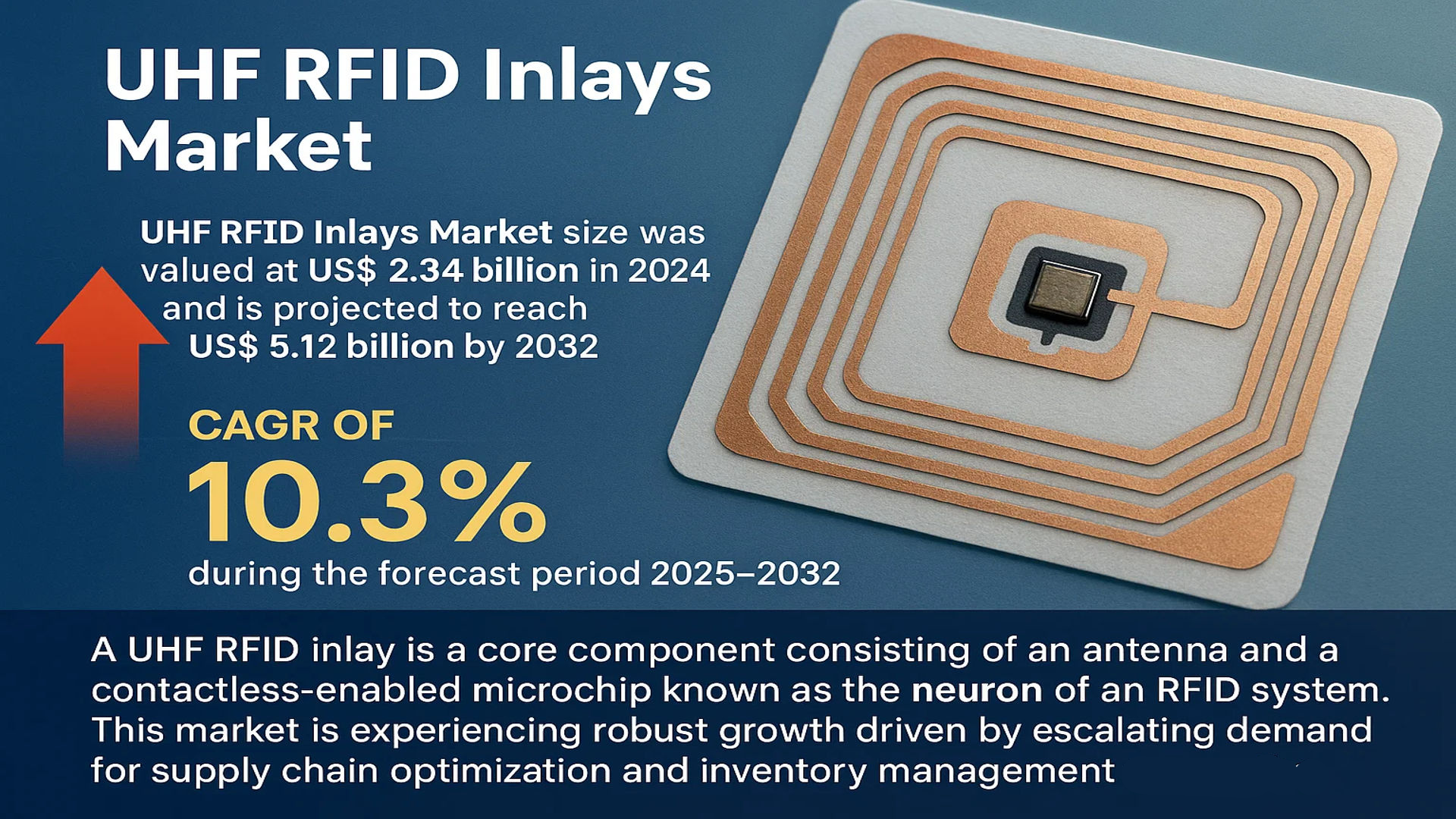
UHF RFID Inlays Market size was valued at US$ 2.34 billion in 2024 and is projected to reach US$ 5.12 billion by 2032, at a CAGR of 10.3% during the forecast period 2025-2032

PDF Icon Download Sample Report PDF
  • Quick Dispatch

    All Orders

  • Secure Payment

    100% Secure Payment

Price range: $1,500.00 through $4,250.00

Clear

MARKET INSIGHTS

The global UHF RFID Inlays Market size was valued at US$ 2.34 billion in 2024 and is projected to reach US$ 5.12 billion by 2032, at a CAGR of 10.3% during the forecast period 2025-2032.

A UHF RFID inlay is a core component consisting of an antenna and a contactless-enabled microchip, often referred to as the neuron of an RFID system. These inlays operate within the Ultra-High Frequency (UHF) band, typically from 860 MHz to 960 MHz, which enables longer read ranges and faster data transfer compared to other frequencies, making them ideal for high-volume item tracking applications.

This market is experiencing robust growth driven by the escalating demand for supply chain optimization and inventory management across the retail and logistics sectors. The Asia-Pacific region dominates the landscape, accounting for over 65% of the global market share in 2024, with China alone representing approximately 50%. Furthermore, UHF Wet Inlays are the predominant product type, holding a commanding 90% market share due to their cost-effectiveness and ease of integration into labels and tags. Key players such as Avery Dennison Inc., SMARTRAC, and Invengo are continuously innovating to enhance performance and reduce costs, further propelling market expansion.
UHF RFID Inlays Market

MARKET DYNAMICS

MARKET DRIVERS

Rising Demand for Supply Chain Automation and Inventory Management to Drive Market Expansion

The global push toward supply chain optimization and real-time inventory tracking is significantly accelerating the adoption of UHF RFID inlays. These components enable seamless item-level tracking with read ranges up to 10 meters, making them indispensable in retail, logistics, and manufacturing sectors. The retail industry alone accounts for over 45% of global UHF RFID inlay consumption, driven by the need to reduce stockouts, prevent theft, and enhance customer experiences through smart shelves and automated checkout systems. Major retail corporations have reported inventory accuracy improvements of up to 99% and a 25% reduction in out-of-stock instances after implementing UHF RFID systems. The technology’s ability to process hundreds of tags simultaneously without line-of-sight requirements creates operational efficiencies that traditional barcodes cannot match.

Growth in E-commerce and Logistics Sector to Fuel Market Growth

The exponential growth of e-commerce, which reached $5.2 trillion in global sales in 2024, has created unprecedented demand for efficient logistics and parcel tracking solutions. UHF RFID inlays provide enhanced visibility throughout the supply chain, from warehouse management to last-mile delivery. Logistics companies utilizing UHF RFID technology have demonstrated a 30% improvement in shipment processing speed and a 40% reduction in sorting errors. The technology enables automated scanning of entire pallets and containers without manual intervention, significantly reducing labor costs and improving accuracy. With the global logistics market projected to grow at 6.5% annually, the demand for UHF RFID inlays in this sector is expected to increase proportionally.

Technological Advancements and Cost Reduction to Accelerate Adoption

Continuous innovation in semiconductor technology and manufacturing processes has driven significant cost reductions in UHF RFID inlay production. The average price per inlay has decreased by approximately 60% over the past five years, making the technology accessible to a broader range of applications. Recent advancements include the development of thinner, more flexible inlays that can be embedded in various materials and withstand harsh environmental conditions. Manufacturers have achieved read ranges exceeding 15 meters while maintaining tag sizes under 2 square centimeters. These technological improvements, combined with enhanced durability and reliability, are expanding application possibilities beyond traditional retail into areas such as healthcare device tracking, automotive part identification, and smart packaging.

MARKET CHALLENGES

High Initial Implementation Costs and Integration Complexities to Hinder Market Penetration

Despite the declining cost of individual inlays, the comprehensive implementation of UHF RFID systems requires substantial capital investment in readers, antennas, software infrastructure, and system integration. Small and medium-sized enterprises often find the initial investment prohibitive, with complete system implementation costs ranging from $50,000 to $500,000 depending on scale and complexity. The integration of RFID systems with existing enterprise resource planning and warehouse management systems presents additional technical challenges, requiring specialized expertise and potentially disrupting ongoing operations. Many organizations face difficulties in achieving seamless data synchronization between RFID systems and legacy software platforms, creating implementation barriers that slow market adoption.

Other Challenges

Interference and Performance Issues in Metallic and Liquid Environments
UHF RFID systems experience significant performance degradation when deployed near metallic surfaces or liquid-containing items, which can attenuate or reflect radio signals. This limitation restricts application in industries such as automotive, beverage, and canned goods where metal and liquids are prevalent. Specialized tags and readers designed for these environments typically cost 3-5 times more than standard equipment, creating economic barriers for widespread adoption in these sectors.

Privacy and Security Concerns
The ability to read tags remotely without physical contact raises legitimate privacy concerns among consumers and regulatory bodies. Unauthorized scanning of RFID tags could potentially reveal sensitive information about purchased items or track individuals without consent. These concerns have led to increased regulatory scrutiny and the development of privacy-enhancing technologies such as kill commands and encryption, which add complexity and cost to implementation.

MARKET RESTRAINTS

Standardization Issues and Regional Frequency Variations to Limit Global Deployment

The lack of global frequency standardization presents a significant restraint for multinational companies seeking to implement consistent RFID systems across different regions. The UHF spectrum allocation varies considerably worldwide—North America uses 902-928 MHz, Europe operates at 865-868 MHz, while China employs 840-845 MHz and 920-925 MHz bands. These variations require manufacturers to produce region-specific inlays and equipment, increasing complexity and inventory costs. Companies operating internationally must maintain multiple product versions and ensure compliance with local regulations, which adds logistical challenges and reduces economies of scale. This fragmentation particularly affects global supply chains where items tagged in one region might need to be read in another, creating interoperability issues that hinder seamless cross-border implementation.

MARKET OPPORTUNITIES

Emerging Applications in Healthcare and Smart Manufacturing to Create New Growth Avenues

The healthcare sector presents substantial growth opportunities for UHF RFID inlays, particularly in medical device tracking, pharmaceutical authentication, and patient safety applications. The global healthcare RFID market is projected to grow at 15% annually, driven by increasing regulatory requirements for medical device Unique Device Identification and pharmaceutical track-and-trace mandates. Hospitals implementing RFID systems for equipment management have reported reducing equipment search time by 75% and decreasing rental costs by 30%. The technology enables real-time visibility of medical assets, ensures proper sterilization cycles, and prevents counterfeiting of high-value pharmaceuticals. These applications address critical needs in healthcare operations while improving patient safety and regulatory compliance.

Advancements in IoT and Industry 4.0 to Drive Future Market Expansion

The integration of UHF RFID technology with Internet of Things platforms and Industry 4.0 initiatives creates compelling opportunities for market expansion. Smart factories are increasingly adopting RFID systems for real-time asset tracking, work-in-progress monitoring, and automated production processes. The ability to collect and analyze data from RFID-tagged items enables predictive maintenance, quality control, and just-in-time manufacturing. Manufacturers report productivity improvements of 20-25% and reduced downtime through implementation of RFID-based tracking systems. The convergence of RFID with sensors, cloud computing, and artificial intelligence enables new applications in predictive analytics and automated decision-making, creating additional value propositions beyond basic identification and tracking.

Sustainability Initiatives and Circular Economy Applications to Open New Markets

Growing emphasis on sustainability and circular economy principles is driving innovation in RFID applications for waste management, recycling, and product lifecycle tracking. UHF RFID tags enable precise sorting of materials for recycling, identification of reusable components, and tracking of products throughout their lifecycle. Packaging manufacturers are incorporating RFID tags to facilitate reverse logistics and enable consumers to access product information via smartphones. These applications support environmental sustainability goals while creating new revenue streams for RFID technology providers. The ability to track products from manufacture through use and ultimately to recycling or disposal addresses growing regulatory requirements for extended producer responsibility and provides consumers with transparency regarding product origins and environmental impact.

UHF RFID INLAYS MARKET TRENDS

Rising Demand for Supply Chain Digitalization to Emerge as a Dominant Trend

The global push towards supply chain digitalization is significantly accelerating the adoption of UHF RFID inlays. These components are fundamental to achieving real-time inventory visibility, reducing out-of-stock scenarios, and combating counterfeiting. The retail sector, which commands the largest application share, relies heavily on these inlays for item-level tagging, enabling automated checkout processes and sophisticated inventory management systems. This trend is further amplified by the exponential growth of e-commerce, which necessitates highly efficient and accurate logistics operations. The integration of UHF RFID technology with IoT platforms and cloud-based analytics is creating smarter, more responsive supply chains, driving substantial market expansion as businesses seek to enhance operational efficiency and customer satisfaction.

Other Trends

Technological Advancements in Inlay Design and Performance

Continuous innovation in antenna design and chip miniaturization is a critical trend enhancing the performance and application scope of UHF RFID inlays. Manufacturers are developing thinner, more flexible, and more durable inlays that can be applied to a wider variety of surfaces, including metals and liquids, which were previously challenging. These advancements are crucial for expanding use cases beyond traditional retail into sectors like healthcare for asset tracking and manufacturing for process control. Furthermore, improvements in read range and data integrity are making the technology more reliable for mission-critical applications, thereby fostering greater confidence and investment from end-users across diverse industries.

Expansion in the Asia-Pacific Manufacturing Hub

The Asia-Pacific region, particularly China, is not only the largest consumer but also the primary manufacturing hub for UHF RFID inlays, accounting for approximately 50% of the global market. This dominance is fueled by a robust electronics manufacturing ecosystem, cost-effective production capabilities, and strong governmental support for industrial automation and smart technologies. The concentration of key players and suppliers in this region creates a synergistic environment that drives down costs and accelerates innovation. While this regional strength presents significant opportunities, it also introduces vulnerabilities related to supply chain concentration, prompting some companies to explore diversification strategies to mitigate geopolitical and logistical risks.

COMPETITIVE LANDSCAPE

Key Industry Players

Market Leaders Focus on Innovation and Geographic Expansion to Secure Position

The global UHF RFID inlays market exhibits a semi-consolidated structure, characterized by a dynamic mix of established multinational corporations and agile regional specialists. Avery Dennison Inc. stands as a dominant force, leveraging its extensive manufacturing capabilities, robust R&D investments, and a vast global distribution network. The company’s Smartrac brand is a recognized leader, particularly in the retail and logistics sectors, which together account for a substantial portion of the market’s application share.

SMARTRAC (now part of Avery Dennison) and Invengo also command significant market presence. Their leadership is largely attributed to deep technological expertise in antenna design and chip packaging, which are critical for inlay performance. Both companies have a strong foothold in the Asia-Pacific region, which is the largest market globally, contributing approximately 50% of total demand, driven primarily by China’s massive manufacturing and retail sectors.

Furthermore, these key players are actively pursuing growth through strategic initiatives. This includes expanding production capacity to meet the soaring demand, which is projected to push the market to US$ 5.12 billion by 2032, and developing next-generation products tailored for emerging Internet of Things (IoT) applications. Their focus on enhancing product durability and read-range for challenging environments, such as supply chain logistics, is a key differentiator.

Meanwhile, other notable participants like Alien Technology and Identiv are strengthening their positions through specialized innovations. Alien Technology is renowned for its high-performance Higgs® IC platform, while Identiv focuses on security-focused applications. These companies compete by offering specialized inlays for niche applications beyond retail, such as asset management and secure document tracking, ensuring vibrant competition across the market’s value chain.

List of Key UHF RFID Inlays Companies Profiled

Segment Analysis:

By Type

UHF Wet Inlay Segment Dominates the Market Due to Superior Performance and Cost-Effectiveness

The market is segmented based on type into:

  • UHF Wet Inlay
    • Subtypes: Standard wet inlays, high-memory wet inlays, and others
  • UHF Dry Inlay
    • Subtypes: Paper-faced dry inlays, synthetic dry inlays, and others

By Application

Retail Segment Leads Due to Massive Adoption for Inventory Management and Anti-Theft Systems

The market is segmented based on application into:

  • Retail
  • Asset Management/Inventory/Documents
  • Logistics
  • Others

By Frequency

860-960 MHz Band Dominates Owing to Global Standardization and Regulatory Compliance

The market is segmented based on frequency into:

  • 860-868 MHz (EU Standard)
  • 902-928 MHz (FCC Standard)
  • 920-925 MHz (Asia-Pacific Standard)
  • Other Regional Variations

By Form Factor

Label Inlays Lead the Market Driven by Integration With Packaging and Product Labeling

The market is segmented based on form factor into:

  • Label Inlays
  • Card Inlays
  • Implantable Inlays
  • Custom/Industrial Inlays

Regional Analysis: UHF RFID Inlays Market

Asia-Pacific
The Asia-Pacific region dominates the global UHF RFID inlays market, accounting for approximately 50% of the total market share. This leadership is driven by China’s massive manufacturing ecosystem and extensive adoption across retail, logistics, and asset management sectors. The region’s market is characterized by high-volume consumption, with UHF Wet Inlays holding a dominant 90% share due to their cost-effectiveness and suitability for high-speed application processes. Key local players, including XINDECO IOT, Invengo, and Shang Yang RFID Technology, have established strong production capabilities and compete effectively with global giants like Avery Dennison. Growth is further fueled by rapid urbanization, government initiatives promoting smart infrastructure, and the expanding e-commerce sector, which demands efficient inventory tracking and supply chain visibility.

North America
North America represents a mature yet steadily growing market for UHF RFID inlays, driven by advanced retail automation, stringent supply chain compliance requirements, and significant investments in IoT infrastructure. The region benefits from the presence of major technology providers such as Alien Technology and Avery Dennison, who focus on innovation and high-performance inlay solutions. Adoption is particularly strong in retail for inventory management and loss prevention, as well as in healthcare for asset tracking and pharmaceuticals. While the market is highly competitive and quality-conscious, there is a consistent demand for durable, high-memory inlays capable of integrating with complex enterprise software systems.

Europe
Europe’s UHF RFID inlays market is shaped by strong regulatory frameworks, particularly concerning data privacy and environmental standards, which influence product design and material selection. The region shows robust adoption in retail, manufacturing, and logistics, supported by the EU’s push for supply chain digitalization and sustainability. Leading companies like SMARTRAC and Identiv have a significant presence, offering advanced inlays that comply with regional frequency regulations and eco-design requirements. The market is also seeing increased use in access control and smart packaging applications. However, growth is sometimes tempered by slower economic conditions and the high cost of transitioning to RFID-based systems in established industries.

South America
The South American market for UHF RFID inlays is emerging, with growth primarily driven by retail modernization and increasing focus on supply chain efficiency in countries like Brazil and Argentina. The region presents opportunities for suppliers due to its expanding retail sector and gradual adoption of automated identification technologies. However, market penetration faces challenges, including economic instability, fluctuating currency values, and limited local manufacturing capabilities, which often lead to reliance on imported inlays. Cost sensitivity remains a key factor, with demand concentrated on economical UHF Wet Inlays for basic tracking applications rather than advanced, feature-rich products.

Middle East & Africa
The Middle East & Africa region is in the early stages of UHF RFID inlay adoption, with growth potential linked to infrastructure development, retail expansion, and government initiatives in transportation and logistics. Select countries, such as the UAE and Saudi Arabia, are investing in smart city projects and supply chain modernization, which drives demand for RFID solutions. However, the market is constrained by limited technical expertise, high initial investment costs, and a lack of standardized regulations. While international suppliers are exploring opportunities here, widespread adoption will depend on economic stability, increased awareness of RFID benefits, and the development of local support ecosystems.

Report Scope

This market research report provides a comprehensive analysis of the global and regional UHF RFID Inlays markets, covering the forecast period 2025–2032. It offers detailed insights into market dynamics, technological advancements, competitive landscape, and key trends shaping the industry.

Key focus areas of the report include:

  • Market Size & Forecast: Historical data and future projections for revenue, unit shipments, and market value across major regions and segments.
  • Segmentation Analysis: Detailed breakdown by product type, technology, application, and end-user industry to identify high-growth segments and investment opportunities.
  • Regional Outlook: Insights into market performance across North America, Europe, Asia-Pacific, Latin America, and the Middle East & Africa, including country-level analysis where relevant.
  • Competitive Landscape: Profiles of leading market participants, including their product offerings, R&D focus, manufacturing capacity, pricing strategies, and recent developments such as mergers, acquisitions, and partnerships.
  • Technology Trends & Innovation: Assessment of emerging technologies, integration of AI/IoT, semiconductor design trends, fabrication techniques, and evolving industry standards.
  • Market Drivers & Restraints: Evaluation of factors driving market growth along with challenges, supply chain constraints, regulatory issues, and market-entry barriers.
  • Stakeholder Analysis: Insights for component suppliers, OEMs, system integrators, investors, and policymakers regarding the evolving ecosystem and strategic opportunities.

Primary and secondary research methods are employed, including interviews with industry experts, data from verified sources, and real-time market intelligence to ensure the accuracy and reliability of the insights presented.

FREQUENTLY ASKED QUESTIONS:

What is the current market size of Global UHF RFID Inlays Market?

-> UHF RFID Inlays Market size was valued at US$ 2.34 billion in 2024 and is projected to reach US$ 5.12 billion by 2032, at a CAGR of 10.3% during the forecast period 2025-2032.

Which key companies operate in Global UHF RFID Inlays Market?

-> Key players include SMARTRAC, Avery Dennison, Invengo, XINDECO IOT, Shang Yang RFID Technology, Alien Technology, and Identiv, among others.

What are the key growth drivers?

-> Key growth drivers include increasing adoption in retail inventory management, supply chain optimization demands, rising e-commerce penetration, and government initiatives promoting digital infrastructure.

Which region dominates the market?

-> Asia-Pacific dominates the market with over 50% share, led by China, while North America and Europe represent significant mature markets.

What are the emerging trends?

-> Emerging trends include integration with IoT platforms, development of sustainable inlays, adoption of RFID in healthcare asset tracking, and advancements in chip miniaturization technology.

UHF RFID Inlays Market, Size, Trends, Business Strategies 2025-2032

Get Sample Report PDF for Exclusive Insights

Report Sample Includes

  • Table of Contents
  • List of Tables & Figures
  • Charts, Research Methodology, and more...

PDF Icon Download Sample Report PDF

Download Sample Report

Table of Content

Table of Contents
1 Research Methodology and Statistical Scope
1.1 Market Definition and Statistical Scope of RFID UHF Inlays
1.2 Key Market Segments
1.2.1 RFID UHF Inlays Segment by Type
1.2.2 RFID UHF Inlays Segment by Application
1.3 Methodology & Sources of Information
1.3.1 Research Methodology
1.3.2 Research Process
1.3.3 Market Breakdown and Data Triangulation
1.3.4 Base Year
1.3.5 Report Assumptions & Caveats
2 RFID UHF Inlays Market Overview
2.1 Global Market Overview
2.1.1 Global RFID UHF Inlays Market Size (M USD) Estimates and Forecasts (2019-2030)
2.1.2 Global RFID UHF Inlays Sales Estimates and Forecasts (2019-2030)
2.2 Market Segment Executive Summary
2.3 Global Market Size by Region
3 RFID UHF Inlays Market Competitive Landscape
3.1 Global RFID UHF Inlays Sales by Manufacturers (2019-2025)
3.2 Global RFID UHF Inlays Revenue Market Share by Manufacturers (2019-2025)
3.3 RFID UHF Inlays Market Share by Company Type (Tier 1, Tier 2, and Tier 3)
3.4 Global RFID UHF Inlays Average Price by Manufacturers (2019-2025)
3.5 Manufacturers RFID UHF Inlays Sales Sites, Area Served, Product Type
3.6 RFID UHF Inlays Market Competitive Situation and Trends
3.6.1 RFID UHF Inlays Market Concentration Rate
3.6.2 Global 5 and 10 Largest RFID UHF Inlays Players Market Share by Revenue
3.6.3 Mergers & Acquisitions, Expansion
4 RFID UHF Inlays Industry Chain Analysis
4.1 RFID UHF Inlays Industry Chain Analysis
4.2 Market Overview of Key Raw Materials
4.3 Midstream Market Analysis
4.4 Downstream Customer Analysis
5 The Development and Dynamics of RFID UHF Inlays Market
5.1 Key Development Trends
5.2 Driving Factors
5.3 Market Challenges
5.4 Market Restraints
5.5 Industry News
5.5.1 New Product Developments
5.5.2 Mergers & Acquisitions
5.5.3 Expansions
5.5.4 Collaboration/Supply Contracts
5.6 Industry Policies
6 RFID UHF Inlays Market Segmentation by Type
6.1 Evaluation Matrix of Segment Market Development Potential (Type)
6.2 Global RFID UHF Inlays Sales Market Share by Type (2019-2025)
6.3 Global RFID UHF Inlays Market Size Market Share by Type (2019-2025)
6.4 Global RFID UHF Inlays Price by Type (2019-2025)
7 RFID UHF Inlays Market Segmentation by Application
7.1 Evaluation Matrix of Segment Market Development Potential (Application)
7.2 Global RFID UHF Inlays Market Sales by Application (2019-2025)
7.3 Global RFID UHF Inlays Market Size (M USD) by Application (2019-2025)
7.4 Global RFID UHF Inlays Sales Growth Rate by Application (2019-2025)
8 RFID UHF Inlays Market Segmentation by Region
8.1 Global RFID UHF Inlays Sales by Region
8.1.1 Global RFID UHF Inlays Sales by Region
8.1.2 Global RFID UHF Inlays Sales Market Share by Region
8.2 North America
8.2.1 North America RFID UHF Inlays Sales by Country
8.2.2 U.S.
8.2.3 Canada
8.2.4 Mexico
8.3 Europe
8.3.1 Europe RFID UHF Inlays Sales by Country
8.3.2 Germany
8.3.3 France
8.3.4 U.K.
8.3.5 Italy
8.3.6 Russia
8.4 Asia Pacific
8.4.1 Asia Pacific RFID UHF Inlays Sales by Region
8.4.2 China
8.4.3 Japan
8.4.4 South Korea
8.4.5 India
8.4.6 Southeast Asia
8.5 South America
8.5.1 South America RFID UHF Inlays Sales by Country
8.5.2 Brazil
8.5.3 Argentina
8.5.4 Columbia
8.6 Middle East and Africa
8.6.1 Middle East and Africa RFID UHF Inlays Sales by Region
8.6.2 Saudi Arabia
8.6.3 UAE
8.6.4 Egypt
8.6.5 Nigeria
8.6.6 South Africa
9 Key Companies Profile
9.1 SMARTRAC N.V
9.1.1 SMARTRAC N.V RFID UHF Inlays Basic Information
9.1.2 SMARTRAC N.V RFID UHF Inlays Product Overview
9.1.3 SMARTRAC N.V RFID UHF Inlays Product Market Performance
9.1.4 SMARTRAC N.V Business Overview
9.1.5 SMARTRAC N.V RFID UHF Inlays SWOT Analysis
9.1.6 SMARTRAC N.V Recent Developments
9.2 Invengo Technology Pte. Ltd
9.2.1 Invengo Technology Pte. Ltd RFID UHF Inlays Basic Information
9.2.2 Invengo Technology Pte. Ltd RFID UHF Inlays Product Overview
9.2.3 Invengo Technology Pte. Ltd RFID UHF Inlays Product Market Performance
9.2.4 Invengo Technology Pte. Ltd Business Overview
9.2.5 Invengo Technology Pte. Ltd RFID UHF Inlays SWOT Analysis
9.2.6 Invengo Technology Pte. Ltd Recent Developments
9.3 XINDECO IOT
9.3.1 XINDECO IOT RFID UHF Inlays Basic Information
9.3.2 XINDECO IOT RFID UHF Inlays Product Overview
9.3.3 XINDECO IOT RFID UHF Inlays Product Market Performance
9.3.4 XINDECO IOT RFID UHF Inlays SWOT Analysis
9.3.5 XINDECO IOT Business Overview
9.3.6 XINDECO IOT Recent Developments
9.4 Avery Dennison Inc.
9.4.1 Avery Dennison Inc. RFID UHF Inlays Basic Information
9.4.2 Avery Dennison Inc. RFID UHF Inlays Product Overview
9.4.3 Avery Dennison Inc. RFID UHF Inlays Product Market Performance
9.4.4 Avery Dennison Inc. Business Overview
9.4.5 Avery Dennison Inc. Recent Developments
9.5 Shang Yang RFID Technology
9.5.1 Shang Yang RFID Technology RFID UHF Inlays Basic Information
9.5.2 Shang Yang RFID Technology RFID UHF Inlays Product Overview
9.5.3 Shang Yang RFID Technology RFID UHF Inlays Product Market Performance
9.5.4 Shang Yang RFID Technology Business Overview
9.5.5 Shang Yang RFID Technology Recent Developments
9.6 INLAYLINK
9.6.1 INLAYLINK RFID UHF Inlays Basic Information
9.6.2 INLAYLINK RFID UHF Inlays Product Overview
9.6.3 INLAYLINK RFID UHF Inlays Product Market Performance
9.6.4 INLAYLINK Business Overview
9.6.5 INLAYLINK Recent Developments
9.7 Alien Technology
9.7.1 Alien Technology RFID UHF Inlays Basic Information
9.7.2 Alien Technology RFID UHF Inlays Product Overview
9.7.3 Alien Technology RFID UHF Inlays Product Market Performance
9.7.4 Alien Technology Business Overview
9.7.5 Alien Technology Recent Developments
9.8 D and H SMART ID
9.8.1 D and H SMART ID RFID UHF Inlays Basic Information
9.8.2 D and H SMART ID RFID UHF Inlays Product Overview
9.8.3 D and H SMART ID RFID UHF Inlays Product Market Performance
9.8.4 D and H SMART ID Business Overview
9.8.5 D and H SMART ID Recent Developments
9.9 Junmp Technology
9.9.1 Junmp Technology RFID UHF Inlays Basic Information
9.9.2 Junmp Technology RFID UHF Inlays Product Overview
9.9.3 Junmp Technology RFID UHF Inlays Product Market Performance
9.9.4 Junmp Technology Business Overview
9.9.5 Junmp Technology Recent Developments
9.10 Identiv
9.10.1 Identiv RFID UHF Inlays Basic Information
9.10.2 Identiv RFID UHF Inlays Product Overview
9.10.3 Identiv RFID UHF Inlays Product Market Performance
9.10.4 Identiv Business Overview
9.10.5 Identiv Recent Developments
9.11 Sense Technology
9.11.1 Sense Technology RFID UHF Inlays Basic Information
9.11.2 Sense Technology RFID UHF Inlays Product Overview
9.11.3 Sense Technology RFID UHF Inlays Product Market Performance
9.11.4 Sense Technology Business Overview
9.11.5 Sense Technology Recent Developments
9.12 NETHOM
9.12.1 NETHOM RFID UHF Inlays Basic Information
9.12.2 NETHOM RFID UHF Inlays Product Overview
9.12.3 NETHOM RFID UHF Inlays Product Market Performance
9.12.4 NETHOM Business Overview
9.12.5 NETHOM Recent Developments
9.13 Zebra Technologies
9.13.1 Zebra Technologies RFID UHF Inlays Basic Information
9.13.2 Zebra Technologies RFID UHF Inlays Product Overview
9.13.3 Zebra Technologies RFID UHF Inlays Product Market Performance
9.13.4 Zebra Technologies Business Overview
9.13.5 Zebra Technologies Recent Developments
9.14 Honeywell
9.14.1 Honeywell RFID UHF Inlays Basic Information
9.14.2 Honeywell RFID UHF Inlays Product Overview
9.14.3 Honeywell RFID UHF Inlays Product Market Performance
9.14.4 Honeywell Business Overview
9.14.5 Honeywell Recent Developments
9.15 NXP Semiconductors
9.15.1 NXP Semiconductors RFID UHF Inlays Basic Information
9.15.2 NXP Semiconductors RFID UHF Inlays Product Overview
9.15.3 NXP Semiconductors RFID UHF Inlays Product Market Performance
9.15.4 NXP Semiconductors Business Overview
9.15.5 NXP Semiconductors Recent Developments
9.16 Impinj
9.16.1 Impinj RFID UHF Inlays Basic Information
9.16.2 Impinj RFID UHF Inlays Product Overview
9.16.3 Impinj RFID UHF Inlays Product Market Performance
9.16.4 Impinj Business Overview
9.16.5 Impinj Recent Developments
9.17 STARNFC
9.17.1 STARNFC RFID UHF Inlays Basic Information
9.17.2 STARNFC RFID UHF Inlays Product Overview
9.17.3 STARNFC RFID UHF Inlays Product Market Performance
9.17.4 STARNFC Business Overview
9.17.5 STARNFC Recent Developments
9.18 D.O RFID TAG
9.18.1 D.O RFID TAG RFID UHF Inlays Basic Information
9.18.2 D.O RFID TAG RFID UHF Inlays Product Overview
9.18.3 D.O RFID TAG RFID UHF Inlays Product Market Performance
9.18.4 D.O RFID TAG Business Overview
9.18.5 D.O RFID TAG Recent Developments
10 RFID UHF Inlays Market Forecast by Region
10.1 Global RFID UHF Inlays Market Size Forecast
10.2 Global RFID UHF Inlays Market Forecast by Region
10.2.1 North America Market Size Forecast by Country
10.2.2 Europe RFID UHF Inlays Market Size Forecast by Country
10.2.3 Asia Pacific RFID UHF Inlays Market Size Forecast by Region
10.2.4 South America RFID UHF Inlays Market Size Forecast by Country
10.2.5 Middle East and Africa Forecasted Consumption of RFID UHF Inlays by Country
11 Forecast Market by Type and by Application (2025-2030)
11.1 Global RFID UHF Inlays Market Forecast by Type (2025-2030)
11.1.1 Global Forecasted Sales of RFID UHF Inlays by Type (2025-2030)
11.1.2 Global RFID UHF Inlays Market Size Forecast by Type (2025-2030)
11.1.3 Global Forecasted Price of RFID UHF Inlays by Type (2025-2030)
11.2 Global RFID UHF Inlays Market Forecast by Application (2025-2030)
11.2.1 Global RFID UHF Inlays Sales (K Units) Forecast by Application
11.2.2 Global RFID UHF Inlays Market Size (M USD) Forecast by Application (2025-2030)
12 Conclusion and Key FindingsList of Tables
Table 1. Introduction of the Type
Table 2. Introduction of the Application
Table 3. Market Size (M USD) Segment Executive Summary
Table 4. RFID UHF Inlays Market Size Comparison by Region (M USD)
Table 5. Global RFID UHF Inlays Sales (K Units) by Manufacturers (2019-2025)
Table 6. Global RFID UHF Inlays Sales Market Share by Manufacturers (2019-2025)
Table 7. Global RFID UHF Inlays Revenue (M USD) by Manufacturers (2019-2025)
Table 8. Global RFID UHF Inlays Revenue Share by Manufacturers (2019-2025)
Table 9. Company Type (Tier 1, Tier 2, and Tier 3) & (based on the Revenue in RFID UHF Inlays as of 2022)
Table 10. Global Market RFID UHF Inlays Average Price (USD/Unit) of Key Manufacturers (2019-2025)
Table 11. Manufacturers RFID UHF Inlays Sales Sites and Area Served
Table 12. Manufacturers RFID UHF Inlays Product Type
Table 13. Global RFID UHF Inlays Manufacturers Market Concentration Ratio (CR5 and HHI)
Table 14. Mergers & Acquisitions, Expansion Plans
Table 15. Industry Chain Map of RFID UHF Inlays
Table 16. Market Overview of Key Raw Materials
Table 17. Midstream Market Analysis
Table 18. Downstream Customer Analysis
Table 19. Key Development Trends
Table 20. Driving Factors
Table 21. RFID UHF Inlays Market Challenges
Table 22. Global RFID UHF Inlays Sales by Type (K Units)
Table 23. Global RFID UHF Inlays Market Size by Type (M USD)
Table 24. Global RFID UHF Inlays Sales (K Units) by Type (2019-2025)
Table 25. Global RFID UHF Inlays Sales Market Share by Type (2019-2025)
Table 26. Global RFID UHF Inlays Market Size (M USD) by Type (2019-2025)
Table 27. Global RFID UHF Inlays Market Size Share by Type (2019-2025)
Table 28. Global RFID UHF Inlays Price (USD/Unit) by Type (2019-2025)
Table 29. Global RFID UHF Inlays Sales (K Units) by Application
Table 30. Global RFID UHF Inlays Market Size by Application
Table 31. Global RFID UHF Inlays Sales by Application (2019-2025) & (K Units)
Table 32. Global RFID UHF Inlays Sales Market Share by Application (2019-2025)
Table 33. Global RFID UHF Inlays Sales by Application (2019-2025) & (M USD)
Table 34. Global RFID UHF Inlays Market Share by Application (2019-2025)
Table 35. Global RFID UHF Inlays Sales Growth Rate by Application (2019-2025)
Table 36. Global RFID UHF Inlays Sales by Region (2019-2025) & (K Units)
Table 37. Global RFID UHF Inlays Sales Market Share by Region (2019-2025)
Table 38. North America RFID UHF Inlays Sales by Country (2019-2025) & (K Units)
Table 39. Europe RFID UHF Inlays Sales by Country (2019-2025) & (K Units)
Table 40. Asia Pacific RFID UHF Inlays Sales by Region (2019-2025) & (K Units)
Table 41. South America RFID UHF Inlays Sales by Country (2019-2025) & (K Units)
Table 42. Middle East and Africa RFID UHF Inlays Sales by Region (2019-2025) & (K Units)
Table 43. SMARTRAC N.V RFID UHF Inlays Basic Information
Table 44. SMARTRAC N.V RFID UHF Inlays Product Overview
Table 45. SMARTRAC N.V RFID UHF Inlays Sales (K Units), Revenue (M USD), Price (USD/Unit) and Gross Margin (2019-2025)
Table 46. SMARTRAC N.V Business Overview
Table 47. SMARTRAC N.V RFID UHF Inlays SWOT Analysis
Table 48. SMARTRAC N.V Recent Developments
Table 49. Invengo Technology Pte. Ltd RFID UHF Inlays Basic Information
Table 50. Invengo Technology Pte. Ltd RFID UHF Inlays Product Overview
Table 51. Invengo Technology Pte. Ltd RFID UHF Inlays Sales (K Units), Revenue (M USD), Price (USD/Unit) and Gross Margin (2019-2025)
Table 52. Invengo Technology Pte. Ltd Business Overview
Table 53. Invengo Technology Pte. Ltd RFID UHF Inlays SWOT Analysis
Table 54. Invengo Technology Pte. Ltd Recent Developments
Table 55. XINDECO IOT RFID UHF Inlays Basic Information
Table 56. XINDECO IOT RFID UHF Inlays Product Overview
Table 57. XINDECO IOT RFID UHF Inlays Sales (K Units), Revenue (M USD), Price (USD/Unit) and Gross Margin (2019-2025)
Table 58. XINDECO IOT RFID UHF Inlays SWOT Analysis
Table 59. XINDECO IOT Business Overview
Table 60. XINDECO IOT Recent Developments
Table 61. Avery Dennison Inc. RFID UHF Inlays Basic Information
Table 62. Avery Dennison Inc. RFID UHF Inlays Product Overview
Table 63. Avery Dennison Inc. RFID UHF Inlays Sales (K Units), Revenue (M USD), Price (USD/Unit) and Gross Margin (2019-2025)
Table 64. Avery Dennison Inc. Business Overview
Table 65. Avery Dennison Inc. Recent Developments
Table 66. Shang Yang RFID Technology RFID UHF Inlays Basic Information
Table 67. Shang Yang RFID Technology RFID UHF Inlays Product Overview
Table 68. Shang Yang RFID Technology RFID UHF Inlays Sales (K Units), Revenue (M USD), Price (USD/Unit) and Gross Margin (2019-2025)
Table 69. Shang Yang RFID Technology Business Overview
Table 70. Shang Yang RFID Technology Recent Developments
Table 71. INLAYLINK RFID UHF Inlays Basic Information
Table 72. INLAYLINK RFID UHF Inlays Product Overview
Table 73. INLAYLINK RFID UHF Inlays Sales (K Units), Revenue (M USD), Price (USD/Unit) and Gross Margin (2019-2025)
Table 74. INLAYLINK Business Overview
Table 75. INLAYLINK Recent Developments
Table 76. Alien Technology RFID UHF Inlays Basic Information
Table 77. Alien Technology RFID UHF Inlays Product Overview
Table 78. Alien Technology RFID UHF Inlays Sales (K Units), Revenue (M USD), Price (USD/Unit) and Gross Margin (2019-2025)
Table 79. Alien Technology Business Overview
Table 80. Alien Technology Recent Developments
Table 81. D and H SMART ID RFID UHF Inlays Basic Information
Table 82. D and H SMART ID RFID UHF Inlays Product Overview
Table 83. D and H SMART ID RFID UHF Inlays Sales (K Units), Revenue (M USD), Price (USD/Unit) and Gross Margin (2019-2025)
Table 84. D and H SMART ID Business Overview
Table 85. D and H SMART ID Recent Developments
Table 86. Junmp Technology RFID UHF Inlays Basic Information
Table 87. Junmp Technology RFID UHF Inlays Product Overview
Table 88. Junmp Technology RFID UHF Inlays Sales (K Units), Revenue (M USD), Price (USD/Unit) and Gross Margin (2019-2025)
Table 89. Junmp Technology Business Overview
Table 90. Junmp Technology Recent Developments
Table 91. Identiv RFID UHF Inlays Basic Information
Table 92. Identiv RFID UHF Inlays Product Overview
Table 93. Identiv RFID UHF Inlays Sales (K Units), Revenue (M USD), Price (USD/Unit) and Gross Margin (2019-2025)
Table 94. Identiv Business Overview
Table 95. Identiv Recent Developments
Table 96. Sense Technology RFID UHF Inlays Basic Information
Table 97. Sense Technology RFID UHF Inlays Product Overview
Table 98. Sense Technology RFID UHF Inlays Sales (K Units), Revenue (M USD), Price (USD/Unit) and Gross Margin (2019-2025)
Table 99. Sense Technology Business Overview
Table 100. Sense Technology Recent Developments
Table 101. NETHOM RFID UHF Inlays Basic Information
Table 102. NETHOM RFID UHF Inlays Product Overview
Table 103. NETHOM RFID UHF Inlays Sales (K Units), Revenue (M USD), Price (USD/Unit) and Gross Margin (2019-2025)
Table 104. NETHOM Business Overview
Table 105. NETHOM Recent Developments
Table 106. Zebra Technologies RFID UHF Inlays Basic Information
Table 107. Zebra Technologies RFID UHF Inlays Product Overview
Table 108. Zebra Technologies RFID UHF Inlays Sales (K Units), Revenue (M USD), Price (USD/Unit) and Gross Margin (2019-2025)
Table 109. Zebra Technologies Business Overview
Table 110. Zebra Technologies Recent Developments
Table 111. Honeywell RFID UHF Inlays Basic Information
Table 112. Honeywell RFID UHF Inlays Product Overview
Table 113. Honeywell RFID UHF Inlays Sales (K Units), Revenue (M USD), Price (USD/Unit) and Gross Margin (2019-2025)
Table 114. Honeywell Business Overview
Table 115. Honeywell Recent Developments
Table 116. NXP Semiconductors RFID UHF Inlays Basic Information
Table 117. NXP Semiconductors RFID UHF Inlays Product Overview
Table 118. NXP Semiconductors RFID UHF Inlays Sales (K Units), Revenue (M USD), Price (USD/Unit) and Gross Margin (2019-2025)
Table 119. NXP Semiconductors Business Overview
Table 120. NXP Semiconductors Recent Developments
Table 121. Impinj RFID UHF Inlays Basic Information
Table 122. Impinj RFID UHF Inlays Product Overview
Table 123. Impinj RFID UHF Inlays Sales (K Units), Revenue (M USD), Price (USD/Unit) and Gross Margin (2019-2025)
Table 124. Impinj Business Overview
Table 125. Impinj Recent Developments
Table 126. STARNFC RFID UHF Inlays Basic Information
Table 127. STARNFC RFID UHF Inlays Product Overview
Table 128. STARNFC RFID UHF Inlays Sales (K Units), Revenue (M USD), Price (USD/Unit) and Gross Margin (2019-2025)
Table 129. STARNFC Business Overview
Table 130. STARNFC Recent Developments
Table 131. D.O RFID TAG RFID UHF Inlays Basic Information
Table 132. D.O RFID TAG RFID UHF Inlays Product Overview
Table 133. D.O RFID TAG RFID UHF Inlays Sales (K Units), Revenue (M USD), Price (USD/Unit) and Gross Margin (2019-2025)
Table 134. D.O RFID TAG Business Overview
Table 135. D.O RFID TAG Recent Developments
Table 136. Global RFID UHF Inlays Sales Forecast by Region (2025-2030) & (K Units)
Table 137. Global RFID UHF Inlays Market Size Forecast by Region (2025-2030) & (M USD)
Table 138. North America RFID UHF Inlays Sales Forecast by Country (2025-2030) & (K Units)
Table 139. North America RFID UHF Inlays Market Size Forecast by Country (2025-2030) & (M USD)
Table 140. Europe RFID UHF Inlays Sales Forecast by Country (2025-2030) & (K Units)
Table 141. Europe RFID UHF Inlays Market Size Forecast by Country (2025-2030) & (M USD)
Table 142. Asia Pacific RFID UHF Inlays Sales Forecast by Region (2025-2030) & (K Units)
Table 143. Asia Pacific RFID UHF Inlays Market Size Forecast by Region (2025-2030) & (M USD)
Table 144. South America RFID UHF Inlays Sales Forecast by Country (2025-2030) & (K Units)
Table 145. South America RFID UHF Inlays Market Size Forecast by Country (2025-2030) & (M USD)
Table 146. Middle East and Africa RFID UHF Inlays Consumption Forecast by Country (2025-2030) & (Units)
Table 147. Middle East and Africa RFID UHF Inlays Market Size Forecast by Country (2025-2030) & (M USD)
Table 148. Global RFID UHF Inlays Sales Forecast by Type (2025-2030) & (K Units)
Table 149. Global RFID UHF Inlays Market Size Forecast by Type (2025-2030) & (M USD)
Table 150. Global RFID UHF Inlays Price Forecast by Type (2025-2030) & (USD/Unit)
Table 151. Global RFID UHF Inlays Sales (K Units) Forecast by Application (2025-2030)
Table 152. Global RFID UHF Inlays Market Size Forecast by Application (2025-2030) & (M USD)
List of Figures
Figure 1. Product Picture of RFID UHF Inlays
Figure 2. Data Triangulation
Figure 3. Key Caveats
Figure 4. Global RFID UHF Inlays Market Size (M USD), 2019-2030
Figure 5. Global RFID UHF Inlays Market Size (M USD) (2019-2030)
Figure 6. Global RFID UHF Inlays Sales (K Units) & (2019-2030)
Figure 7. Evaluation Matrix of Segment Market Development Potential (Type)
Figure 8. Evaluation Matrix of Segment Market Development Potential (Application)
Figure 9. Evaluation Matrix of Regional Market Development Potential
Figure 10. RFID UHF Inlays Market Size by Country (M USD)
Figure 11. RFID UHF Inlays Sales Share by Manufacturers in 2023
Figure 12. Global RFID UHF Inlays Revenue Share by Manufacturers in 2023
Figure 13. RFID UHF Inlays Market Share by Company Type (Tier 1, Tier 2 and Tier 3): 2023
Figure 14. Global Market RFID UHF Inlays Average Price (USD/Unit) of Key Manufacturers in 2023
Figure 15. The Global 5 and 10 Largest Players: Market Share by RFID UHF Inlays Revenue in 2023
Figure 16. Evaluation Matrix of Segment Market Development Potential (Type)
Figure 17. Global RFID UHF Inlays Market Share by Type
Figure 18. Sales Market Share of RFID UHF Inlays by Type (2019-2025)
Figure 19. Sales Market Share of RFID UHF Inlays by Type in 2023
Figure 20. Market Size Share of RFID UHF Inlays by Type (2019-2025)
Figure 21. Market Size Market Share of RFID UHF Inlays by Type in 2023
Figure 22. Evaluation Matrix of Segment Market Development Potential (Application)
Figure 23. Global RFID UHF Inlays Market Share by Application
Figure 24. Global RFID UHF Inlays Sales Market Share by Application (2019-2025)
Figure 25. Global RFID UHF Inlays Sales Market Share by Application in 2023
Figure 26. Global RFID UHF Inlays Market Share by Application (2019-2025)
Figure 27. Global RFID UHF Inlays Market Share by Application in 2023
Figure 28. Global RFID UHF Inlays Sales Growth Rate by Application (2019-2025)
Figure 29. Global RFID UHF Inlays Sales Market Share by Region (2019-2025)
Figure 30. North America RFID UHF Inlays Sales and Growth Rate (2019-2025) & (K Units)
Figure 31. North America RFID UHF Inlays Sales Market Share by Country in 2023
Figure 32. U.S. RFID UHF Inlays Sales and Growth Rate (2019-2025) & (K Units)
Figure 33. Canada RFID UHF Inlays Sales (K Units) and Growth Rate (2019-2025)
Figure 34. Mexico RFID UHF Inlays Sales (Units) and Growth Rate (2019-2025)
Figure 35. Europe RFID UHF Inlays Sales and Growth Rate (2019-2025) & (K Units)
Figure 36. Europe RFID UHF Inlays Sales Market Share by Country in 2023
Figure 37. Germany RFID UHF Inlays Sales and Growth Rate (2019-2025) & (K Units)
Figure 38. France RFID UHF Inlays Sales and Growth Rate (2019-2025) & (K Units)
Figure 39. U.K. RFID UHF Inlays Sales and Growth Rate (2019-2025) & (K Units)
Figure 40. Italy RFID UHF Inlays Sales and Growth Rate (2019-2025) & (K Units)
Figure 41. Russia RFID UHF Inlays Sales and Growth Rate (2019-2025) & (K Units)
Figure 42. Asia Pacific RFID UHF Inlays Sales and Growth Rate (K Units)
Figure 43. Asia Pacific RFID UHF Inlays Sales Market Share by Region in 2023
Figure 44. China RFID UHF Inlays Sales and Growth Rate (2019-2025) & (K Units)
Figure 45. Japan RFID UHF Inlays Sales and Growth Rate (2019-2025) & (K Units)
Figure 46. South Korea RFID UHF Inlays Sales and Growth Rate (2019-2025) & (K Units)
Figure 47. India RFID UHF Inlays Sales and Growth Rate (2019-2025) & (K Units)
Figure 48. Southeast Asia RFID UHF Inlays Sales and Growth Rate (2019-2025) & (K Units)
Figure 49. South America RFID UHF Inlays Sales and Growth Rate (K Units)
Figure 50. South America RFID UHF Inlays Sales Market Share by Country in 2023
Figure 51. Brazil RFID UHF Inlays Sales and Growth Rate (2019-2025) & (K Units)
Figure 52. Argentina RFID UHF Inlays Sales and Growth Rate (2019-2025) & (K Units)
Figure 53. Columbia RFID UHF Inlays Sales and Growth Rate (2019-2025) & (K Units)
Figure 54. Middle East and Africa RFID UHF Inlays Sales and Growth Rate (K Units)
Figure 55. Middle East and Africa RFID UHF Inlays Sales Market Share by Region in 2023
Figure 56. Saudi Arabia RFID UHF Inlays Sales and Growth Rate (2019-2025) & (K Units)
Figure 57. UAE RFID UHF Inlays Sales and Growth Rate (2019-2025) & (K Units)
Figure 58. Egypt RFID UHF Inlays Sales and Growth Rate (2019-2025) & (K Units)
Figure 59. Nigeria RFID UHF Inlays Sales and Growth Rate (2019-2025) & (K Units)
Figure 60. South Africa RFID UHF Inlays Sales and Growth Rate (2019-2025) & (K Units)
Figure 61. Global RFID UHF Inlays Sales Forecast by Volume (2019-2030) & (K Units)
Figure 62. Global RFID UHF Inlays Market Size Forecast by Value (2019-2030) & (M USD)
Figure 63. Global RFID UHF Inlays Sales Market Share Forecast by Type (2025-2030)
Figure 64. Global RFID UHF Inlays Market Share Forecast by Type (2025-2030)
Figure 65. Global RFID UHF Inlays Sales Forecast by Application (2025-2030)
Figure 66. Global RFID UHF Inlays Market Share Forecast by Application (2025-2030)