Market Insights
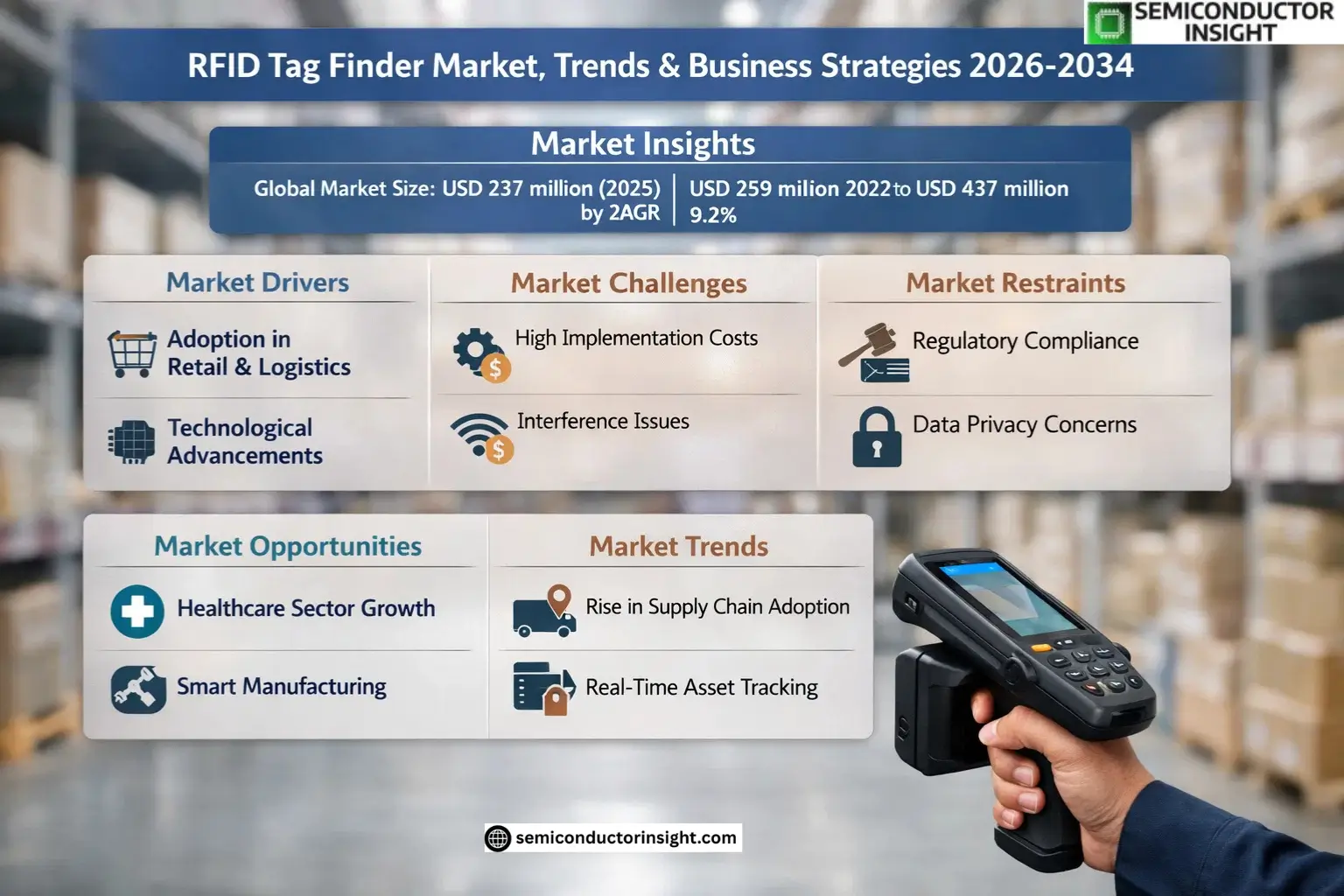
Global RFID Tag Finder Market size was valued at USD 237 million in 2025. The market is projected to grow from USD 259 million in 2026 to USD 437 million by 2032, exhibiting a CAGR of 9.2% during the forecast period.
RFID Tag Finder Market is a handheld or portable electronic device designed to detect, identify, and locate RFID-tagged objects by reading radio-frequency signals. These devices are widely used for asset tracking, inventory management, logistics verification, and equipment identification across industrial, commercial, and institutional environments. The technology supports multiple frequency bands (LF, HF, UHF) and offers varying read ranges depending on application requirements.
The market growth is driven by increasing adoption of digital asset management systems across logistics and retail sectors, where real-time inventory visibility significantly improves operational efficiency. Healthcare applications are also expanding as hospitals implement RFID solutions for equipment tracking and patient safety initiatives. While mid-range devices dominate current demand due to their cost-performance balance, manufacturers continue to innovate with enhanced firmware integration and multi-protocol compatibility to address diverse industry needs.
MARKET DRIVERS
Growing Adoption in Retail and Logistics
RFID Tag Finder Market is experiencing significant growth due to the increasing adoption of RFID technology in retail and logistics sectors. Businesses are leveraging RFID tag finders to improve inventory accuracy, reducing losses by up to 30% in high-value asset tracking applications. The demand for real-time location systems has accelerated adoption across supply chains.
Technological Advancements
Recent advancements in RFID Tag Finder technology have improved read ranges and accuracy, with modern systems achieving 99.9% tag detection rates. Enhanced battery life and smaller form factors are making handheld RFID tag finders more practical for field operations.
Integration with IoT platforms is creating new operational efficiencies, allowing RFID Tag Finder systems to connect with enterprise resource planning (ERP) software for seamless data flow.
MARKET CHALLENGES
High Implementation Costs
Despite their benefits, RFID Tag Finder systems face adoption barriers due to significant upfront costs. Complete system implementation can cost 3-5 times more than traditional barcode systems, including reader infrastructure and middleware expenses.
Other Challenges
Interference Issues
RFID Tag Finder performance can be affected by metal and liquid environments, requiring customized solutions that add to deployment complexity.
Skill Gaps
Many organizations lack personnel with specialized RFID expertise, slowing implementation timelines and increasing reliance on external consultants.
MARKET RESTRAINTS
Regulatory Compliance Hurdles
Regional variations in RFID frequency regulations create complexity for manufacturers developing global RFID Tag Finder solutions. Differing standards between North America (902-928 MHz), Europe (865-868 MHz), and Asia require product variations that increase R&D costs.
Data Privacy Concerns
Growing data protection regulations are impacting RFID implementations, particularly in sectors handling sensitive information. RFID Tag Finder Market must address encryption standards and access control features to maintain compliance.
MARKET OPPORTUNITIES
Healthcare Sector Expansion
Hospitals are adopting RFID Tag Finders for medical equipment tracking, with the healthcare segment growing at 18% CAGR. Solutions that integrate with sterilization tracking systems present significant opportunities.
Smart Manufacturing Applications
Industry 4.0 initiatives are driving demand for RFID Tag Finders in tool tracking and work-in-progress monitoring. Combined with AI analytics, these systems can reduce equipment search times by up to 75% in manufacturing environments.
RFID Tag Finder Market Trends
Growing Adoption Across Supply Chain Operations
RFID Tag Finder Market is witnessing increased adoption in supply chain optimization, with logistics and warehousing sectors accounting for over 40% of total demand. Enterprises are prioritizing real-time asset visibility, driving deployment of UHF RFID tag finders with 8-12 meter read ranges. Manufacturers are expanding protocol compatibility to include GS1 standards and RAIN RFID for seamless integration with existing inventory systems.
Other Trends
Healthcare Sector Expansion
Hospitals are adopting HF RFID tag finders for medical equipment tracking, with demand growing at 12% annually since 2022. Sterilization-resistant models with IP67 ratings are gaining traction in surgical inventory management, featuring enhanced antenna designs for metal environment performance.
Technological Advancements in Reader Capabilities
Leading manufacturers are incorporating dual-interface technology, allowing simultaneous NFC and RFID detection. The latest firmware updates support batch processing of up to 200 tags per second, significantly reducing inventory cycle times. Battery life improvements averaging 18-24 hours per charge align with shift-based operational requirements in industrial applications.
Regional Market Developments
Asia-Pacific maintains 48% market share, with Chinese manufacturers optimizing production of mid-range RFID tag finders. North America shows strong preference for enterprise-grade solutions with cloud integration, while European markets emphasize data security compliance through encrypted tag reading features.
Industry Consolidation and Partnerships
Strategic alliances between RFID chip producers and device manufacturers are optimizing component supply chains. Top 5 RFID Tag Finder companies now control 62% of the market, with Zebra Technologies and Impinj leading in industrial segment innovations through patented directional antenna technology.
COMPETITIVE LANDSCAPE
Key Industry Players
Global RFID Tag Finder Market Dominated by Specialized Technology Providers
Global RFID Tag Finder Market is characterized by strong competition among specialized RFID solution providers, with Zebra Technologies leading the sector with an estimated 18% market share in 2025. The market structure features established players with deep RFID expertise competing on technological differentiation, particularly in UHF and multi-protocol devices. Impinj and Alien Technology follow as major competitors, together accounting for approximately 22% of global revenues, leveraging their intellectual property in RFID chipsets and advanced reader technology.
Niche players are gaining traction by focusing on vertical-specific solutions, with HID Global and Avery Dennison Smartrac leading in access control and retail applications respectively. Asian manufacturers like Invengo International and UROVO are expanding their global footprint through competitive pricing and localized support networks. The market also sees increasing participation from industrial automation providers such as SICK and Omni-ID, integrating RFID finders with broader asset tracking systems.
List of Key RFID Tag Finder Companies Profiled
- Zebra Technologies
- Impinj
- Alien Technology
- HID Global
- SICK
- Ubisense
- Identec Solutions
- ThingMagic
- Omni-ID
- Avery Dennison Smartrac
- Checkpoint Systems
- Invengo International
- SunCreate
- AUTOID
- UROVO
Segment Analysis:
| Segment Category | Sub-Segments | Key Insights |
| By Type |
|
UHF RFID Tag Finder dominates the market due to its superior range and multi-tag reading capabilities:
|
| By Application |
|
Warehousing and Logistics represents the most significant application area:
|
| By End User |
|
Logistics Companies are driving market adoption:
|
| By Operation Mode |
|
Handheld Devices maintain market leadership:
|
| By Protocol Support |
|
Multi-Protocol Solutions are gaining traction:
|
Regional Analysis: RFID Tag Finder Market
North America
The retail industry accounts for the largest share of RFID tag finder usage in North America, with major chains implementing solutions for real-time inventory tracking and theft prevention. Retailers value the technology’s ability to reduce shrinkage and improve stock accuracy.
Hospitals and medical facilities increasingly deploy RFID tag finders for equipment tracking and patient safety. These systems help locate critical medical devices quickly and manage expensive equipment inventory efficiently across large healthcare campuses.
Warehousing and distribution centers utilize RFID tag finders to streamline operations and reduce search times for specific inventory items. The technology integrates well with existing WMS platforms, enhancing overall supply chain visibility.
North American companies lead in integrating RFID tag finders with IoT platforms and cloud-based analytics systems. This advanced integration creates additional value through predictive maintenance capabilities and asset utilization analytics.
Europe
Europe represents the second-largest RFID Tag Finder Market, driven by strong manufacturing and retail sectors. The region shows particular growth in Germany’s industrial applications and UK retail solutions. Stringent regulations regarding product authenticity and supply chain transparency boost adoption. European logistics companies implement RFID solutions to comply with tracking requirements and improve warehouse efficiency. The automotive industry uses tag finders for parts management in large manufacturing facilities. Emerging Eastern European markets show increasing adoption as multinational retailers expand operations.
Asia-Pacific
Asia-Pacific demonstrates rapid growth in RFID Tag Finder Market adoption, led by China’s manufacturing sector and Japan’s technological advancements. Smart city initiatives across Chinese and Indian cities incorporate RFID solutions for municipal asset tracking. Retail expansion and e-commerce growth create new opportunities for inventory management solutions. South Korean healthcare facilities implement RFID systems for medical equipment management. The region benefits from local manufacturing of RFID components, reducing solution costs. Government support for digital transformation accelerates adoption across multiple industries.
South America
South America shows moderate but steady growth in RFID Tag Finder Market adoption, primarily concentrated in Brazil’s retail and mining sectors. Large retail chains adopt the technology to combat theft and improve inventory accuracy. Mining operations utilize RFID for equipment tracking in remote locations. Limited technology budgets and infrastructure challenges restrain more widespread adoption. The pharmaceutical sector shows increasing interest for product authentication. Government initiatives for modernizing ports and logistics hubs drive some RFID implementations.
Middle East & Africa
The Middle East leads RFID Tag Finder Market adoption in this region, particularly in UAE’s retail and logistics sectors. Oil and gas companies implement RFID for equipment tracking across large facilities. African adoption remains limited but shows growth in South African retail and Kenyan logistics applications. Airport baggage handling systems drive some regional demand. Religious tourism management in Saudi Arabia creates specialized use cases. Infrastructure limitations and cost sensitivity remain adoption barriers in many African markets.
Report Scope
This market research report provides a comprehensive analysis of the RFID Tag Finder Market , covering the forecast period 2025–2032. It offers detailed insights into market dynamics, technological advancements, competitive landscape, and key trends shaping the industry.
Key focus areas of the report include:
- Market Overview: The report begins with an overview outlining its current market scenario, key growth indicators, and industry transformation drivers. It discusses macroeconomic factors, demand–supply balance, regulatory landscape, and the strategic role of RFID tag finders in powering advancements across industries such as logistics, retail, healthcare, manufacturing, and public institutions.
- Market Size & Forecast: Historical data and future projections for revenue, unit shipments, and market value across major regions and segments.
- Segmentation Analysis: Detailed breakdown by product type, operation mode, application, and end-user industry to identify high-growth segments and investment opportunities.
- Regional Insights: Insights into market performance across North America, Europe, Asia, South America, and the Middle East & Africa, including country-level analysis where relevant.
- Competitive Landscape: Profiles of leading market participants, including their product offerings, R&D focus, manufacturing capacity, pricing strategies, and recent developments such as mergers, acquisitions, and partnerships.
- Technology Trends & Innovation: Assessment of emerging technologies, integration of AI/IoT, RF calibration techniques, and evolving industry standards.
- Market Drivers & Restraints: Evaluation of factors driving market growth along with challenges, supply chain constraints, regulatory issues, and market-entry barriers.
- Stakeholder Insights: Insights for component suppliers, OEMs, system integrators, investors, and policymakers regarding the evolving ecosystem and strategic opportunities.
Primary and secondary research methods are employed, including interviews with industry experts, data from verified sources, and real-time market intelligence to ensure the accuracy and reliability of the insights presented.
FREQUENTLY ASKED QUESTIONS:
What is the current market size of RFID Tag Finder Market?
-> RFID Tag Finder Market size was valued at USD 237 million in 2025. The market is projected to grow from USD 259 million in 2026 to USD 437 million by 2032, exhibiting a CAGR of 9.2% during the forecast period.
What was the global production capacity of RFID tag finders in 2025?
-> In 2025, the global annual production capacity reached approximately 3.2 million units, with actual production of about 2.17 million units.
Which key companies operate in RFID Tag Finder Market?
-> Key players include Zebra Technologies, Impinj, Alien Technology, HID Global, SICK, Ubisense, Identec Solutions, ThingMagic, Omni-ID, Avery Dennison Smartrac, among others.
What are the key growth drivers?
-> Key growth drivers include digital asset management, inventory automation, strong demand in logistics/retail/healthcare sectors, and real-time visibility requirements.
What is the average price of RFID tag finders?
-> Global average market price was around USD 120 per unit in 2025.
Which region dominates the market?
-> Asia is the dominant production and consumption region, with manufacturing concentrated in China and Southeast Asia.
What are the gross margin ranges for leading manufacturers?
-> Gross profit margins range between 35% and 55%, depending on product specifications and features.
Get Sample Report PDF for Exclusive Insights
Report Sample Includes
- Table of Contents
- List of Tables & Figures
- Charts, Research Methodology, and more...
 Download Sample Report PDF