RF Transistor Market Insights
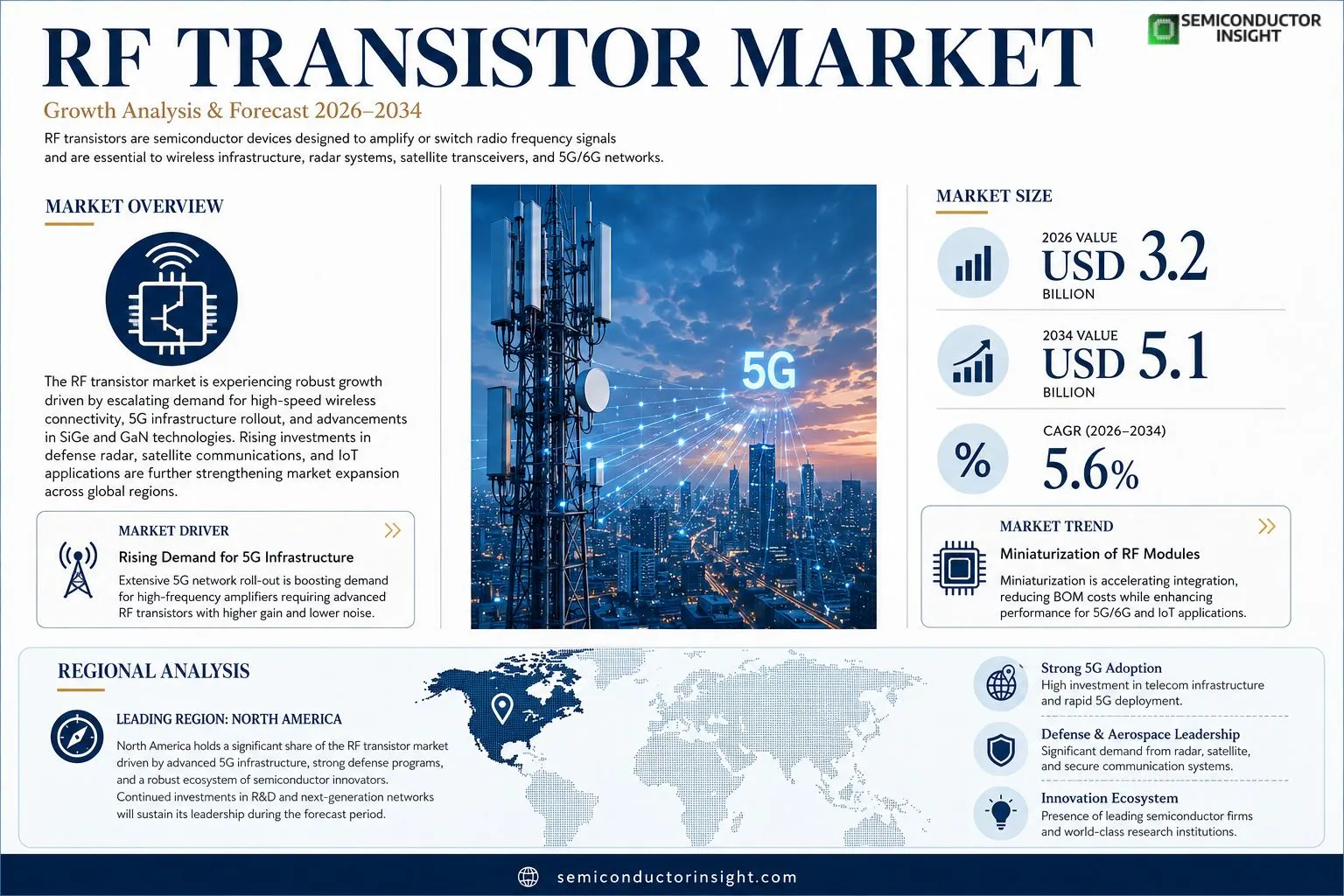
RF transistor market size was valued at USD 3.2 billion in 2025. The market is projected to grow from USD 3.2 billion in 2025 to USD 5.1 billion by 2034, exhibiting a CAGR of 5.6% during the forecast period.
RF transistors are semiconductor devices designed to amplify or switch radio frequency signals typically ranging from a few megahertz up to several gigahertz. They are essential components in wireless communication infrastructure, radar systems, satellite transceivers, and emerging 5G/6G networks because they provide high gain, low noise, and robust power handling capabilities.The market is experiencing rapid growth due to several factors, including escalating demand for high‑speed wireless connectivity, increased rollout of 5G networks worldwide, and rising investment in defense radar technologies. Furthermore, advancements in silicon‑germanium (SiGe) and gallium nitride (GaN) processes are enabling higher efficiency and smaller form‑factor solutions. Key players such as Qorvo Inc., Skyworks Solutions Inc., NXP Semiconductors, Infineon Technologies AG, and Analog Devices are actively expanding their RF transistor portfolios through strategic acquisitions and R&D initiatives.
MARKET DRIVERS
Rising Demand for 5G Infrastructure
RF Transistor Market is being propelled by extensive roll‑out of 5G networks worldwide. Telecom operators are upgrading base stations with high‑frequency amplifiers, which require advanced RF transistors capable of delivering higher gain and lower noise figures. This shift is creating a significant uplift in component orders across Asia‑Pacific and North America.
Growth in Automotive Radar and ADAS
Automotive manufacturers are integrating radar‑based advanced driver‑assistance systems (ADAS) that rely on robust RF front‑end modules. The adoption of mmWave radar in electric and autonomous vehicles fuels demand for miniature, high‑power RF transistors, positioning RF Transistor Market for steady expansion.
➤ Miniaturization of RF modules is accelerating component integration, reducing bill‑of‑materials costs while enhancing performance.
In addition, the proliferation of IoT devices operating in crowded spectrum bands requires transistors with superior linearity and efficiency. These technological pressures collectively drive higher production volumes and encourage R&D investments across the sector.
MARKET CHALLENGES
Stringent Performance Specifications
Designers must meet increasingly tight parameters for power consumption, gain compression, and thermal stability. Achieving these specifications often necessitates complex semiconductor processes, pushing up manufacturing costs and limiting supplier options for RF Transistor Market.
Other Challenges
Supply Chain Volatility
Fluctuations in raw material availability and geopolitical tensions can disrupt production schedules, leading to lead‑time extensions that affect end‑customer delivery commitments.
MARKET RESTRAINTS
High Capital Expenditure for Advanced Fabrication
Establishing or upgrading fabs to support silicon‑germanium (SiGe) and gallium nitride (GaN) RF transistor technologies requires substantial investment. This financial barrier can restrain entry of new players and slow capacity expansion, especially in emerging markets.
MARKET OPPORTUNITIES
Emerging Satellite Communication Constellations
Low‑Earth‑orbit (LEO) satellite constellations are driving demand for compact, high‑efficiency RF transistors that can operate reliably in harsh space environments. Companies that can tailor GaN‑based solutions for satellite payloads stand to capture a significant growth opportunity within RF Transistor Market.Furthermore, the convergence of edge computing and high‑frequency wireless backhaul creates niche markets where ultra‑low‑noise transistors are essential, opening avenues for specialized product development and premium pricing strategies.
RF Transistor Market Trends
Growth Fueled by 5G Rollout and High‑Speed Connectivity
RF Transistor Market is experiencing a pronounced upward trajectory as telecom operators expand 5G infrastructure worldwide. The need for components that can sustain higher frequencies while maintaining low noise and robust power handling has elevated the importance of RF transistors in base stations, small cells, and back‑haul equipment. Simultaneously, the proliferation of Internet‑of‑Things devices and the demand for ultra‑reliable low‑latency communication in industrial settings are prompting designers to integrate more compact, high‑efficiency transistors into edge solutions. These dynamics collectively shape a market environment where performance, miniaturization, and energy efficiency are the primary competitive levers.
Other Trends
Technology Advancements
Recent progress in silicon‑germanium (SiGe) and gallium‑nitride (GaN) fabrication processes is redefining the capability envelope of RF transistors. SiGe devices now deliver higher gain at reduced power consumption, enabling more densely packed antenna arrays in massive MIMO deployments. GaN technology, with its superior thermal conductivity and breakdown voltage, is becoming the preferred choice for power‑dense radar and satellite transceivers. The convergence of these material innovations is driving a shift toward integrated solutions that combine amplification, switching, and signal conditioning within a single chip footprint.
Competitive Landscape Evolution
Key industry players such as Qorvo, Skyworks, NXP Semiconductors, Infineon Technologies, and Analog Devices are actively broadening their RF transistor portfolios through targeted acquisitions and intensified R&D programs. The strategic focus is on delivering differentiated product lines that address emerging 6G research, defense‑grade radar systems, and high‑frequency satellite communications. Partnerships with foundries specializing in advanced III‑V and compound semiconductor processes are also accelerating time‑to‑market for next‑generation devices, reinforcing the competitive intensity across RF Transistor Market.
COMPETITIVE LANDSCAPEKey Industry Players
RF Transistor Market Competitive Overview
RF Transistor Market is anchored by a handful of large, vertically integrated manufacturers that command the majority of volume and pricing power. Qorvo Inc., Skyworks Solutions Inc., NXP Semiconductors, Infineon Technologies AG, and Analog Devices lead the segment through deep portfolios that span silicon‑germanium (SiGe) and gallium‑nitride (GaN) technologies. These firms leverage extensive R&D spend, strategic acquisitions of niche foundries, and long‑term supply agreements with major telecom equipment makers. Their scale enables rapid introduction of high‑performance devices required for 5G base stations, satellite transceivers, and advanced radar platforms, reinforcing a market structure that favors consolidated, technology‑rich players with sales networks.Beyond the core leaders, a diverse set of specialist firms contributes critical innovation and market breadth. Murata Manufacturing, ROHM Semiconductor, STMicroelectronics, MACOM Technology Solutions, Broadcom Inc., Texas Instruments, Taiyo Yuden, Nexperia, and Taiyo Yuden’s RF‑focused subsidiary provide niche SiGe, GaN, and compound‑semiconductor devices that address emerging 6G research, defense radar, and high‑frequency IoT applications. These companies often focus on custom ASIC integration, low‑noise amplifier (LNA) modules, or power‑efficient switch transistors, allowing them to capture differentiated segments despite limited overall volume. Their agility and targeted product roadmaps create a competitive pressure that drives continual performance improvements across the entire RF transistor ecosystem.
List of Key RF Transistor Companies Profiled
- Qorvo Inc.
- Skyworks Solutions Inc.
- NXP Semiconductors
- Infineon Technologies AG
- Analog Devices
- Broadcom Inc.
- Murata Manufacturing
- ROHM Semiconductor
- STMicroelectronics
- MACOM Technology Solutions
- Texas Instruments
- Taiyo Yuden
- Nexperia
Segment Analysis:
| Segment Category | Sub-Segments | Key Insights |
| By Type |
|
GaN RF Transistors
|
| By Application |
|
Wireless Infrastructure
|
| By End User |
|
Telecommunications Service Providers
|
| By Technology Trend |
|
MMIC Integration
|
| By Frequency Band |
|
Millimeter‑Wave
|
Regional Analysis: North America
The expansion of 5G networks is a primary driver for RF transistor demand. Upgrading existing infrastructure and deploying new base stations requires a consistent supply of high-performance RF components. This trend is expected to continue for the foreseeable future, creating a sustained need for advanced RF solutions.
The automotive industry is increasingly relying on RF transistors for applications like radar systems, wireless connectivity, and infotainment systems. The growing complexity of modern vehicles necessitates higher precision and reliability in RF components, presenting a lucrative opportunity for manufacturers.
The proliferation of Internet of Things (IoT) devices, from smart home appliances to industrial sensors, is significantly boosting the demand for RF transistors. These devices rely on wireless communication protocols, creating a continuous need for compact and energy-efficient RF components.
The aerospace and defense sectors utilize RF transistors in a wide range of applications, including communication systems, radar, and navigation equipment. The stringent requirements of these industries drive demand for high-reliability and high-performance RF components.
North America
RF Transistor Market in North America is characterized by a competitive landscape with established players and emerging startups vying for market share. Companies are focusing on developing advanced RF solutions, including wideband RF transistors and power amplifiers, to meet the evolving demands of various industries. Strategic collaborations and partnerships are becoming increasingly important for companies to enhance their product offerings and expand their market reach. A key trend is the growing emphasis on miniaturization and integration, leading to the development of more compact and integrated RF components. Furthermore, there is a rising focus on energy efficiency to reduce power consumption in wireless devices.
Europe
Europe’s RF transistor market is experiencing steady growth, driven by increasing investments in 5G infrastructure and the expanding IoT sector. The region’s strong focus on sustainability is influencing the development of energy-efficient RF solutions. Government initiatives promoting technological innovation and research are also contributing to market growth. Competition is intense, with a mix of large multinational corporations and specialized European companies.
Asia-Pacific
Asia-Pacific is the largest and fastest-growing market for RF transistors ly. The region’s rapid industrialization, increasing disposable incomes, and rising adoption of wireless technologies are driving strong demand. China, in particular, is a major consumer and manufacturer of RF transistors. The proliferation of 5G networks and the growth of the consumer electronics industry are key factors fueling this growth.
South America
South America’s RF transistor market is showing moderate growth, primarily driven by the expansion of telecommunications infrastructure and the increasing adoption of IoT devices. The growing demand for mobile broadband and the expansion of wireless communication networks are key factors boosting market growth. Government investments in infrastructure development are also playing a role.
Middle East & Africa
RF Transistor Market in the Middle East & Africa is emerging, with significant potential for growth. The region’s increasing investments in telecommunications infrastructure, particularly 5G, are driving demand. The expansion of the consumer electronics and automotive industries is also contributing to market growth. Government initiatives supporting technological advancement are expected to further stimulate market development.
Report Scope
This market research report provides a comprehensive analysis of the RF Transistor Market , covering the forecast period 2026–2034. It offers detailed insights into market dynamics, technological advancements, competitive landscape, and key trends shaping the industry.
Key focus areas of the report include:
- Market Overview: The report begins with an overview outlining its current market scenario, key growth indicators, and industry transformation drivers. It discusses macroeconomic factors, demand–supply balance, regulatory landscape, and the strategic role of semiconductors in powering advancements across industries such as automotive, telecommunications, consumer electronics, and industrial automation.
- Market Size & Forecast: Historical data and future projections for revenue, unit shipments, and market value across major regions and segments.
- Segmentation Analysis: Detailed breakdown by product type, technology, application, and end-user industry to identify high-growth segments and investment opportunities.
- Regional Insights: Insights into market performance across North America, Europe, Asia-Pacific, Latin America, and the Middle East & Africa, including country-level analysis where relevant.
- Competitive Landscape: Profiles of leading market participants, including their product offerings, R&D focus, manufacturing capacity, pricing strategies, and recent developments such as mergers, acquisitions, and partnerships.
- Technology Trends & Innovation: Assessment of emerging technologies, integration of AI/IoT, semiconductor design trends, fabrication techniques, and evolving industry standards.
- Market Drivers & Restraints: Evaluation of factors driving market growth along with challenges, supply chain constraints, regulatory issues, and market-entry barriers.
- Stakeholder Insights: Insights for component suppliers, OEMs, system integrators, investors, and policymakers regarding the evolving ecosystem and strategic opportunities.
Primary and secondary research methods are employed, including interviews with industry experts, data from verified sources, and real-time market intelligence to ensure the accuracy and reliability of the insights presented.
FREQUENTLY ASKED QUESTIONS:
What is the current market size of RF Transistor Market?
-> RF Transistor Market was valued at USD 3.2 billion in 2025 and is expected to reach USD 5.1 billion by 2034, representing a CAGR of 5.6% over the forecast period.
Which key companies operate in RF Transistor Market?
-> Key players include Qorvo Inc., Skyworks Solutions Inc., NXP Semiconductors, Infineon Technologies AG, and Analog Devices, among others.
What are the key growth drivers?
-> Key growth drivers include escalating demand for high‑speed wireless connectivity, rollout of 5G networks, rising investment in defense radar technologies, and advancements in silicon‑germanium (SiGe) and gallium nitride (GaN) processes.
Which region dominates the market?
-> The market is ly balanced, with strong contributions from North America, Europe, and Asia‑Pacific. Asia‑Pacific is emerging as the fastest‑growing region due to aggressive 5G deployments and semiconductor manufacturing expansion.
What are the emerging trends?
-> Emerging trends include the adoption of SiGe and GaN technologies for higher efficiency, miniaturization of RF modules for 5G/6G applications, and integration of AI‑driven design optimization in transistor development.

Get Sample Report PDF for Exclusive Insights
Report Sample Includes
- Table of Contents
- List of Tables & Figures
- Charts, Research Methodology, and more...
 Download Sample Report PDF