RF Inductor for High-Frequency Circuits Market Insights
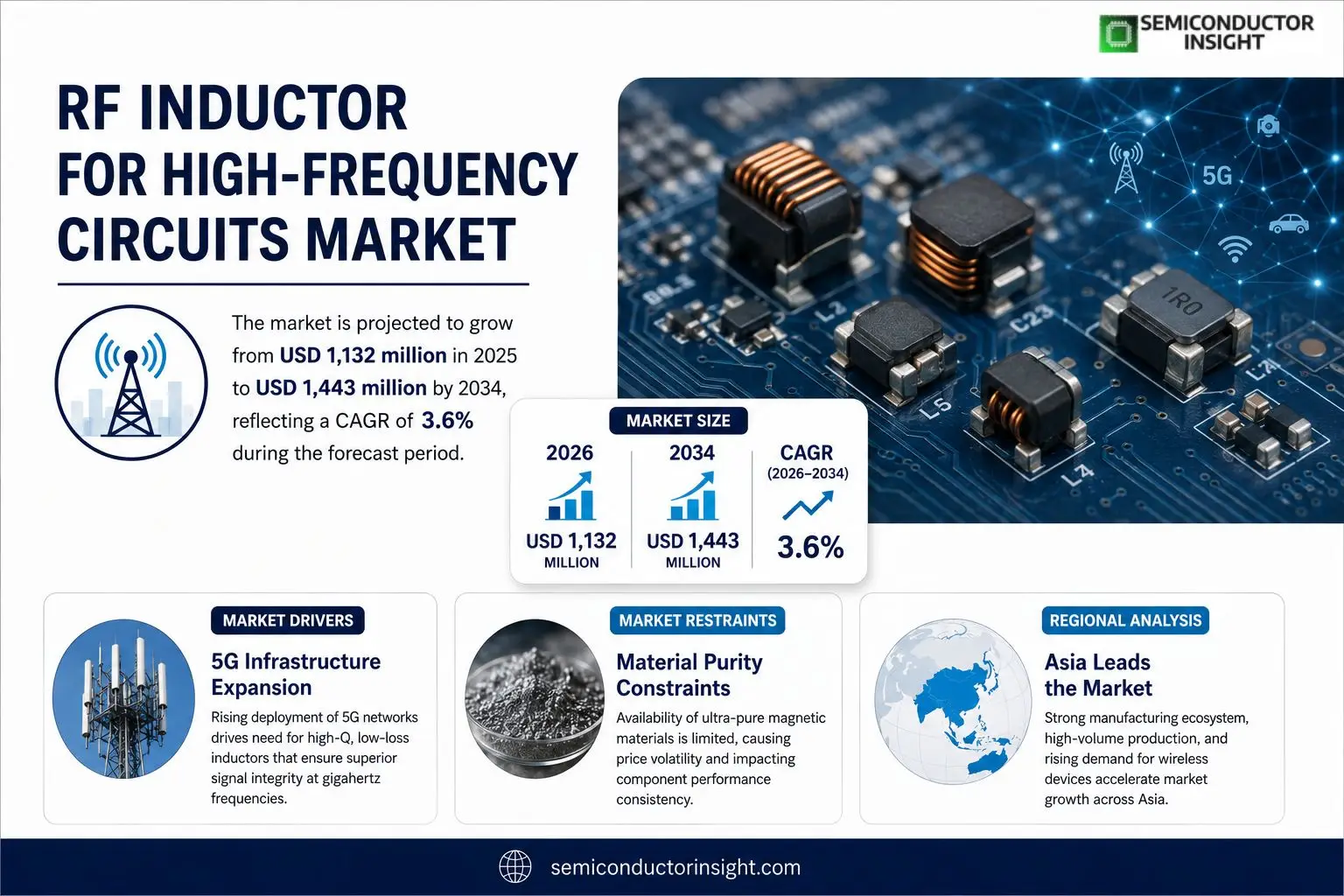
RF Inductor for High-Frequency Circuits market size was valued at USD 1,132 million in 2025. The market is expected to reach USD 1,443 million by 2034, reflecting a CAGR of 3.6% during the forecast period.
RF inductors for high‑frequency circuits serve as essential passive components within RF signal paths. They provide impedance matching, antenna tuning, resonance selection, bias isolation, RF choking and high‑frequency filtering while occupying minimal board space. Current product families span multilayer ceramic, thin‑film, wire‑wound ceramic, air‑core and ferrite designs, each delivering distinct advantages such as high Q factor, elevated self‑resonant frequency, low DC resistance and compact form factor.The growth trajectory stems from expanding demand in mobile front‑ends, Wi‑Fi/Bluetooth modules, GNSS units and automotive wireless links. As wireless standards migrate toward higher frequencies and device footprints shrink, OEMs increasingly require inductors with tighter tolerances and superior temperature stability. Suppliers that combine standardized catalog parts with automotive‑grade validation and rapid simulation support are gaining stronger design‑partner relationships.
MARKET DRIVERS
Demand from 5G Infrastructure Expansion
The rollout of 5G networks accelerates the need for components that can sustain gigahertz‑range signal integrity. RF Inductor for High-Frequency Circuits Market participants benefit from telecom operators upgrading base stations, where inductors must exhibit low loss and tight tolerance. The pressure to meet stringent latency thresholds pushes designers toward specialized high‑Q inductors, creating a measurable uplift in order volumes.
Adoption in Automotive Radar Systems
Advanced driver‑assistance systems (ADAS) increasingly rely on millimeter‑wave radar, a domain where the performance of inductors directly influences detection range and resolution. Automakers are integrating radar modules into a broader vehicle platform, and the resulting bill of materials now allocates a larger share to high‑frequency inductive components. This shift not only expands the addressable market but also raises entry barriers for new suppliers.
➤ Strategic OEM partnerships are converting firmware upgrades into hardware refresh cycles, effectively shortening the product refresh horizon for inductors.
Besides telecommunications and automotive, the surge in industrial IoT gateways demands compact, high‑performance inductors for signal conditioning. With edge devices processing data locally, manufacturers prioritize components that can operate reliably in noisy electromagnetic environments. The cumulative effect of these sectoral dynamics fuels a sustained upward trajectory for the market.
MARKET CHALLENGES
Material Purity Constraints
Achieving the loss specifications required for modern high‑frequency applications hinges on the availability of ultra‑pure magnetic alloys. Supply chain volatility for specialty powders can cause price spikes, forcing design teams to re‑evaluate component cost versus performance trade‑offs. This material bottleneck hampers the ability of smaller firms to compete on price while maintaining required specifications.
Other Challenges
Manufacturing Complexity
Fabrication of sub‑millimeter inductors involves precision lithography and controlled annealing processes. Any deviation can degrade Q‑factor, prompting re‑work or scrap. The capital intensity of these processes limits scaling, especially for entrants lacking deep fabs investment, and can constrain overall market growth.
MARKET RESTRAINTS
Regulatory and EMI Compliance Pressures
Stricter electromagnetic interference (EMI) regulations across regions compel designers to certify inductors against tighter emission limits. Meeting these standards often requires additional shielding or redesign, which adds bill‑of‑materials cost and elongates development cycles. Companies that cannot absorb these incremental expenses may defer product launches, thereby tempering market expansion.
MARKET OPPORTUNITIES
Emergence of Miniaturized Wearable Devices
Wearable technology is transitioning from lifestyle accessories to health‑monitoring platforms that demand ultra‑compact RF front‑ends. This evolution opens a niche for inductors that combine miniature footprints with high Q‑values at frequencies above 2 GHz. Companies that can deliver such components stand to capture a fast‑growing segment, leveraging the same design expertise applicable to larger‑scale applications.
RF Inductor for High-Frequency Circuits Market Trends
Emergence of Multi‑Technology Portfolios
Suppliers are increasingly offering mixed familiesmultilayer ceramic, thin‑film, wire‑wound ceramic, air‑core and ferritewithin a single catalog. This diversification reflects the fact that designers now fine‑tune inductance, Q factor and self‑resonant frequency for very narrow bandwidths while still battling board‑space constraints. The coexistence of these processes raises the technical threshold for entry, rewarding manufacturers that can guarantee tight tolerance, low DC resistance and reproducible performance across temperature extremes. As wireless standards push carrier frequencies upward, a single technology no longer satisfies all design windows; instead, customers select the architecture that aligns with their specific band and package footprint. The market consequence is a shift from pure volume sales toward value‑added solutions where component reliability, simulation models and rapid sampling become decisive differentiators.
Other Trends
Automotive Segment Gains Traction
Vehicle electrification and the rollout of advanced driver‑assistance systems have introduced new RF front‑end requirements. Unlike consumer gadgets, automotive modules must survive harsh thermal cycles and vibration while delivering stable impedance matching for telematics, radar and V2X communications. This demand has spurred a subset of suppliers to qualify their inductors to automotive‑grade standards and to provide long‑term supply guarantees. OEMs now prefer vendors that can bundle parts with design‑for‑reliability documentation and accelerated qualification kits, turning the component into a partnership asset rather than a commodity purchase. Consequently, profit margins in this segment are higher, and the competitive landscape is increasingly defined by certification breadth rather than sheer production capacity.
Regional Supply Chain Realignment
East Asian manufacturers continue to dominate the high‑volume segment because of their established foundries and close proximity to major device assemblers. Meanwhile, firms in the United States and Europe differentiate themselves through niche RF performance, such as ultra‑high Q for satellite‑grade applications or bespoke ferrite solutions for broadband choking. This geographic split has led to a dual‑track supply chain: mass‑market parts flow from Asian fabs to distributors, while specialized, low‑volume series are sourced from Western partners that emphasize engineering support and reliability testing. For downstream designers, the implication is a need to manage multiple sourcing strategiesbalancing cost efficiency with performance riskespecially as product lifecycles lengthen and regulatory scrutiny intensifies.
COMPETITIVE LANDSCAPE
Key Industry Players
RF Inductor Market Competitive Overview
Murata Manufacturing dominates the high‑frequency segment by leveraging an extensive multilayer ceramic portfolio that meets the stringent Q and self‑resonant frequency (SRF) requirements of modern smartphones and automotive telematics. Its ability to pair mass‑production capacity in Japan with dedicated automotive‑grade validation has forced rivals to adopt a similar blend of volume and reliability strategies. TDK and Taiyo Yuden follow closely, each emphasizing thin‑film and wire‑wound ceramic solutions that target the emerging 6 GHz‑plus spectrum used in 5G front‑ends. The competitive geometry of these three firms creates a de‑facto tiered structure: a volume tier, a high‑performance specialty tier, and a niche boutique tier that services low‑volume, ultra‑high‑frequency applications such as GNSS and test equipment.Beyond the tier leaders, a constellation of specialists adds depth to the market. Coilcraft and Vishay offer precision air‑core and ferrite‑based inductors that excel in low‑loss filtering for Wi‑Fi and Bluetooth modules. Shenzhen Sunlord and Kyocera AVX supply cost‑effective multilayer ceramic parts that capture the bulk of consumer‑electronics demand in mainland China and Southeast Asia. European players such as Wurth Elektronik and Viking Tech focus on high‑reliability variants for automotive infotainment and industrial IoT, while U.S. firms like Eaton and API Delevan contribute niche solutions for defense‑grade and aerospace programs. This diversified ecosystem ensures that design engineers can select components that align with both performance targets and supply‑chain risk considerations.
List of Key RF Inductor Companies Profiled
- Murata Manufacturing Co., Ltd.
- TDK Corporation
- Taiyo Yuden Co., Ltd.
- Coilcraft, Inc.
- Delta Electronics, Inc.
- Yageo Corporation
- Vishay Intertechnology, Inc.
- Shenzhen Sunlord Electronics Co., Ltd.
- Kyocera AVX Components Corporation
- TOKEN Electronics Industry Co., Ltd.
- Eaton Corporation
- Wurth Elektronik
- Viking Tech Corporation
- Johanson Technology, Inc.
- API Delevan
- INPAQ Technology Co., Ltd.
- TAI-TECH Advanced Electronics Co., Ltd.
- Bourns, Inc.
- Abracon LLC
Segment Analysis:
| Segment Category | Sub-Segments | Key Insights |
| By Type |
|
Multilayer Ceramic is favored for its high Q factor, superior self‑resonant frequency, and ability to be miniaturized for space‑constrained designs.
|
| By Application |
|
Consumer Electronics drives the broadest adoption due to pervasive Wi‑Fi, Bluetooth, and GNSS modules, demanding compact inductors with high Q and low loss.
|
| By End User |
|
RF Module Makers require tight parametric control and fast sampling programs to accelerate time‑to‑market for new wireless front‑ends.
|
| By Frequency Band |
|
mmWave segment is gaining prominence as next‑generation 5G and automotive radar push frequency limits, requiring inductors with ultra‑high self‑resonant frequency and minimal parasitic loss.
|
| By Reliability & Compliance |
|
Automotive‑Grade emerges as the leading segment because vehicle electrification and advanced driver‑assistance systems demand components that survive harsh thermal cycles and vibration while maintaining RF performance.
|
Regional Analysis: RF Inductor for High-Frequency Circuits Market
Europe
The European Union’s EMC and RoHS frameworks impose tight limits on magnetic‑field emissions and hazardous substances. Compliance testing cycles have been shortened, encouraging vendors to integrate built‑in shielding features directly into inductor packages, which in turn raises design complexity but also opens premium pricing space.
Telecom infrastructure accounts for the largest slice, especially in dense urban deployments. Automotive electrification follows closely, with power‑train control modules demanding inductors that balance inductance stability and thermal resilience.
Proximity to specialty alloy mills in the Ruhr Valley enables quick material swaps, while a robust network of PCB assemblers supports low‑volume, high‑specification runs, reducing the risk of bottlenecks during product launches.
Companies are investing in vertical integration, acquiring thin‑film core technology startups to secure control over loss‑characteristics. This approach positions them to win design‑win contracts where reliability outweighs cost.
North America
The United States remains a hotbed of innovation for high‑frequency passive components, largely because OEMs engage early in co‑development programs. Defense contractors, needing RF inductors for radar and communication suites, push performance envelopes that filter down to commercial products. Venture capital inflows have seeded several boutique firms focused on nano‑crystalline cores, offering low‑loss solutions for millimeter‑wave applications. However, the region’s fragmented supplier base can lead to longer qualification cycles, prompting larger players to acquire niche startups to streamline supply. Overall, North America’s market dynamics are defined by a blend of cutting‑edge research and a pragmatic drive toward cost‑effective scaling.
Asia‑Pacific
Rapid urbanization across China, India, and Southeast Asia fuels demand for compact wireless infrastructure, compelling manufacturers to prioritize miniaturized inductors with tight tolerances. Local fabs benefit from abundant low‑cost copper and ferrite sources, yet face pressure to upgrade process controls to meet international reliability standards. Strategic partnerships between domestic semiconductor houses and RF‑inductor designers have emerged, creating hybrid solutions that balance price with performance. The region’s growth trajectory is anchored in a burgeoning IoT ecosystem, where every connected device adds a marginal demand for high‑frequency passives.
South America
Brazil’s telecom rollout, backed by government incentives, creates a modest but steady market for RF inductors suitable for mid‑band spectrum. The automotive sector, though smaller than in other regions, is beginning to source inductors for hybrid‑electric prototypes, encouraging local distributors to stock higher‑spec components. Supply constraints often arise from reliance on imported magnetic materials, leading distributors to maintain safety stocks. Consequently, firms that can guarantee consistent lead times gain a competitive edge, even if their price points are slightly above regional averages.
Middle East & Africa
In the Gulf Cooperation Council, large‑scale data‑center projects drive demand for high‑frequency filtering components that can operate reliably in high‑temperature environments. African markets, still in early stages of mobile‑network densification, show incremental interest in rugged inductors for off‑grid power solutions. The scarcity of local manufacturing infrastructure pushes importers to seek suppliers with comprehensive certification packages, reducing time‑to‑market for telecom operators. Partnerships that bundle RF inductors with design‑support services are emerging as a differentiated value proposition in this diversified landscape.
Report Scope
This market research report provides a comprehensive analysis of the RF Inductor for High-Frequency Circuits Market , covering the forecast period 2026–2034. It offers detailed insights into market dynamics, technological advancements, competitive landscape, and key trends shaping the industry.
Key focus areas of the report include:
- Market Overview: The report begins with an overview outlining its current market scenario, key growth indicators, and industry transformation drivers. It discusses macroeconomic factors, demand–supply balance, regulatory landscape, and the strategic role of semiconductors in powering advancements across industries such as automotive, telecommunications, consumer electronics, and industrial automation.
- Market Size & Forecast: Historical data and future projections for revenue, unit shipments, and market value across major regions and segments.
- Segmentation Analysis: Detailed breakdown by product type, technology, application, and end-user industry to identify high-growth segments and investment opportunities.
- Regional Insights: Insights into market performance across North America, Europe, Asia-Pacific, Latin America, and the Middle East & Africa, including country-level analysis where relevant.
- Competitive Landscape: Profiles of leading market participants, including their product offerings, R&D focus, manufacturing capacity, pricing strategies, and recent developments such as mergers, acquisitions, and partnerships.
- Technology Trends & Innovation: Assessment of emerging technologies, integration of AI/IoT, semiconductor design trends, fabrication techniques, and evolving industry standards.
- Market Drivers & Restraints: Evaluation of factors driving market growth along with challenges, supply chain constraints, regulatory issues, and market-entry barriers.
- Stakeholder Insights: Insights for component suppliers, OEMs, system integrators, investors, and policymakers regarding the evolving ecosystem and strategic opportunities.
Primary and secondary research methods are employed, including interviews with industry experts, data from verified sources, and real-time market intelligence to ensure the accuracy and reliability of the insights presented.
FREQUENTLY ASKED QUESTIONS:
What is the current market size of RF Inductor for High-Frequency Circuits Market?
-> RF Inductor for High-Frequency Circuits Market was valued at USD 1132 million in 2025 and is expected to reach USD 1443 million by 2034, at a CAGR of 3.6% during the forecast period.
Which key companies operate in RF Inductor for High-Frequency Circuits Market?
-> Key players include Murata Manufacturing Co., Ltd., TDK Corporation, TAIYO YUDEN CO., LTD., Coilcraft, Inc., Delta Electronics, Inc., YAGEO Corporation, Vishay Intertechnology, Inc., Shenzhen Sunlord Electronics Co., Ltd., KYOCERA AVX Components Corporation, TOKEN Electronics Industry Co., Ltd., Eaton, Wurth Elektronik, Viking Tech Corporation, Johanson Technology, Inc., API Delevan, INPAQ Technology Co., Ltd., TAI-TECH Advanced Electronics Co., Ltd., Bourns, Inc., Abracon LLC.
What are the key growth drivers?
-> Key growth drivers include increasing demand for high‑frequency wireless modules in consumer electronics, expansion of automotive connectivity, adoption of IoT and 5G/6G standards, requirement for miniaturized high‑Q components, and the push for higher self‑resonant frequency and lower loss designs.
Which region dominates the market?
-> Asia dominates the market, driven by a strong concentration of manufacturers in Japan, Taiwan, China and the United States, offering extensive product portfolios and high volume production.
What are the emerging trends?
-> Emerging trends include coexistence of multiple technology routes (multilayer ceramic, thin‑film, wirewound, air‑core, ferrite), integration of simulation models and design‑service offerings, growth of automotive‑grade and high‑reliability variants, and a focus on higher Q and SRF to support next‑generation wireless standards.
Get Sample Report PDF for Exclusive Insights
Report Sample Includes
- Table of Contents
- List of Tables & Figures
- Charts, Research Methodology, and more...
 Download Sample Report PDF