RF Front-End Module Market Insights
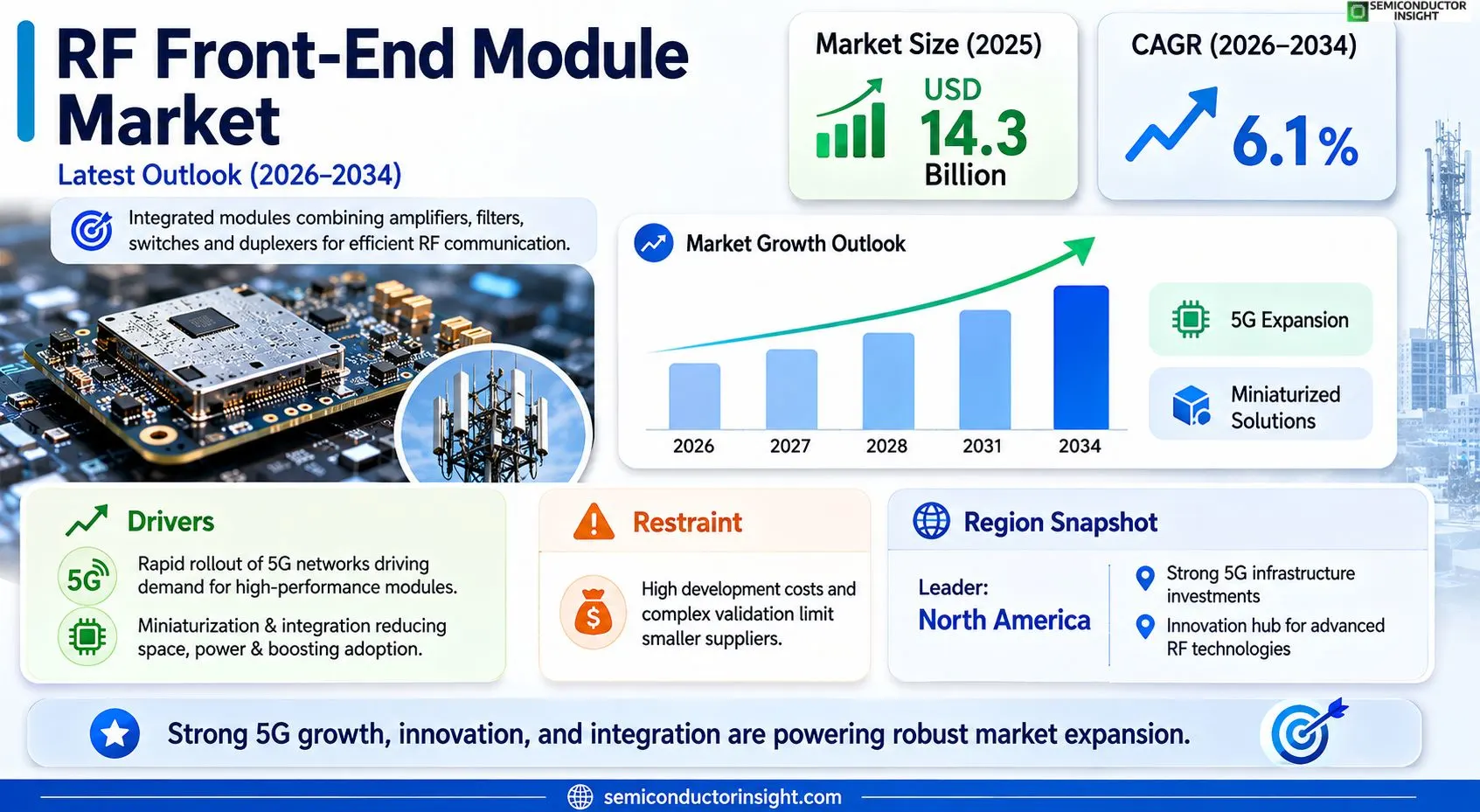
Global RF front‑end module market size was valued at USD 14.3 billion in 2025. The market is projected to grow from USD 15.1 billion in 2026 to USD 27.9 billion by 2034, exhibiting a CAGR of 6.1% during the forecast period.
RF front‑end modules are integrated subsystems that combine components such as power amplifiers, low‑noise amplifiers, switches, filters and duplexers into a single package to enable efficient transmission and reception of radio signals across multiple frequency bands.The market is experiencing rapid growth because of soaring demand for smartphones, expanding IoT deployments, and accelerating adoption of connected‑car technologies. Furthermore, the rollout of 5G networks drives higher performance requirements for miniaturized yet high‑power solutions. Key players,including Qorvo Inc., Skyworks Solutions Inc., Broadcom Inc., Murata Manufacturing Co., Ltd., and NXP Semiconductors,are investing heavily in advanced packaging and silicon‑based technologies to capture emerging opportunities.
MARKET DRIVERS
Growing Demand for 5G Infrastructure
The rollout of 5G networks is accelerating worldwide, creating a surge in demand for high‑performance RF components. Telecom operators require compact, multi‑band solutions to support diverse frequency bands, and RF Front-End Module Market is benefiting from this technology shift.
Miniaturization and Integration Trends
Device manufacturers are consolidating antennas, filters, and amplifiers into single modules to reduce board space and power consumption. This integration trend drives higher adoption rates, especially in smartphones and IoT devices, where size and efficiency are critical.
➤ Industry analysts project a compound annual growth rate of over 8% through 2030, reflecting the combined impact of 5G expansion and module integration.
In addition, stringent performance requirements for automotive radar and satellite communications are pushing suppliers to innovate, further boosting market growth.
MARKET CHALLENGES
Complex Supply Chain Management
Producing multi‑band modules involves sourcing rare‑earth materials and precision packaging, which creates vulnerabilities in the supply chain. Disruptions can lead to longer lead times and increased costs for equipment manufacturers.
Other Challenges
Regulatory Compliance
Regulatory standards for RF emissions vary across regions, requiring extensive testing and certification that add time and expense to product launches.
MARKET RESTRAINTS
High Development Costs
The design and validation of high‑frequency front‑end modules demand advanced simulation tools and specialized test equipment, leading to capital intensive projects.Furthermore, the need for continuous customization to meet diverse carrier specifications can strain smaller suppliers, limiting competitive participation.As a result, firms may postpone investment until clearer return‑on‑investment metrics are demonstrated.
MARKET OPPORTUNITIES
Emerging Edge‑Computing Applications
Edge devices for AI processing require reliable, low‑latency RF connectivity. The need for integrated front‑end solutions in these devices opens a new revenue stream for module manufacturers.Additionally, the growing prevalence of private LTE and CBRS networks in enterprise environments offers a niche market where tailored RF front‑end modules can command premium pricing.Strategic partnerships between semiconductor firms and antenna designers are expected to accelerate product rollouts, positioning RF Front-End Module Market for sustained expansion.
RF Front-End Module Market Trends
Smartphone Demand and 5G Expansion
RF Front-End Module Market is being reshaped by the unprecedented uptake of 5G‑enabled smartphones. Mobile manufacturers are consolidating multiple radio functions into single modules to meet the bandwidth, power‑efficiency, and form‑factor constraints imposed by modern handsets. This shift drives a move away from discrete component architectures toward highly integrated solutions that can operate across sub‑6 GHz and millimeter‑wave bands. As network operators roll out dense 5G coverage, device makers respond with tighter module footprints, higher linearity amplifiers, and low‑noise front‑ends that preserve battery life while delivering peak data rates. The cumulative effect is a rapid acceleration of module shipments and an elevation of design complexity that requires deeper collaboration between silicon designers and packaging specialists.
Other Trends
IoT and Connected‑Car Integration
Beyond smartphones, RF Front-End Module Market is expanding into massive IoT deployments and connected‑car ecosystems. Sensors, wearables, and industrial machines rely on compact, multi‑band modules that can switch seamlessly between LTE‑M, NB‑IoT, and emerging 5G narrowband standards. In automotive, radar, V2X communication, and infotainment systems demand modules that combine high‑power amplifiers with robust filtering to survive harsh environmental conditions. The convergence of these verticals pushes suppliers to offer modules that support a broader frequency spectrum while maintaining stringent automotive reliability qualifications.
Advanced Packaging and Silicon Technologies
Innovations in advanced packaging, such as system‑in‑package (SiP) and fan‑out wafer‑level packaging (FOWLP), are becoming the cornerstone of RF Front-End Module Market’s next growth phase. These techniques enable higher component density, reduced signal loss, and improved thermal management, all critical for delivering the performance required by 5G and beyond. Concurrently, silicon‑based RF solutions,leveraging CMOS, SiGe, and emerging GaN processes,are narrowing the gap with traditional III‑V technologies, offering cost‑effective paths to high‑power output and low‑noise performance. Leading vendors are investing heavily in co‑design methodologies that blend silicon RF front‑ends with innovative package designs, thereby shortening time‑to‑market and providing differentiated solutions for tier‑1 OEMs.
COMPETITIVE LANDSCAPEKey Industry Players
RF Front‑End Module Market Overview
RF front‑end module market is dominated by a handful of semiconductor powerhouses that have built deep IP portfolios and advanced packaging capabilities. Qorvo Inc. leads with its high‑efficiency GaN‑based power amplifiers, while Skyworks Solutions Inc. leverages a broad portfolio of RF switches and tunable filters to secure a large share of the 5G smartphone segment. Broadcom Inc. and NXP Semiconductors complement the landscape by offering highly integrated modules that combine PA, LNA and duplexers for automotive and IoT applications. Murata Manufacturing Co., Ltd. distinguishes itself through miniaturized RF modules that target wearables and edge‑computing devices. Collectively, these leaders drive consolidation as they pursue silicon‑based RF front‑end solutions, advanced system‑in‑package (SiP) technologies, and strategic acquisitions to expand their product breadth and address the escalating performance demands of 5G, 6G research, and connected‑car ecosystems.Beyond the tier‑one firms, a diverse set of niche players contributes essential specialization and regional market depth. Analog Devices, Inc. focuses on high‑linearity LNAs for broadband infrastructure, while Infineon Technologies AG supplies robust RF front‑end solutions for automotive radar. Samsung Electronics and MediaTek Inc. have entered the space with system‑level modules aimed at cost‑sensitive smartphone manufacturers. Texas Instruments and STMicroelectronics provide versatile RF front‑end building blocks that serve industrial IoT and private‑network deployments. Additional contributors such as Renesas Electronics, Qualcomm Technologies, and Qorvo’s recent spin‑off, RF360, deliver differentiated technologies ranging from digitally tunable filters to fully integrated 5G NR modules, enriching the competitive tapestry.
List of Key RF Front-End Module Companies Profiled
- Qorvo Inc.
- Skyworks Solutions Inc.
- Broadcom Inc.
- Murata Manufacturing Co., Ltd.
- NXP Semiconductors
- Analog Devices, Inc.
- Infineon Technologies AG
- Samsung Electronics
- MediaTek Inc.
- Texas Instruments
- STMicroelectronics
- Renesas Electronics
- Qualcomm Technologies, Inc.
Segment Analysis:
| Segment Category | Sub-Segments | Key Insights |
| By Type |
|
Active RF Front‑End Modules drive market momentum as manufacturers integrate amplifiers, filters and switches to meet performance demands.
|
| By Application |
|
Smartphones & Mobile Devices remain the dominant application due to relentless consumer demand for higher data rates.
|
| By End User |
|
Original Equipment Manufacturers (OEMs) shape design specifications and procurement strategies.
|
| By Technology |
|
Silicon‑Based RF Modules attract attention for their cost‑effectiveness and integration capability.
|
| By Frequency Band |
|
Sub‑6 GHz Bands dominate deployment because they balance coverage and capacity.
|
Regional Analysis: North America
United States
The US boasts a vibrant ecosystem of startups, established technology firms, and research labs actively contributing to RF Front-End Module innovation. This collaborative environment fosters rapid prototyping and the development of cutting-edge solutions for 6G applications.
Significant government and private sector investments in 5G and future 6G infrastructure are directly driving demand for advanced RF Front-End Modules. This includes the deployment of new base stations and the upgrades of existing networks.
The US market features a highly competitive landscape with established players and emerging companies vying for market share. Key strategies involve product differentiation, technological advancements, and strategic partnerships.
The regulatory landscape in the US plays a crucial role in shaping RF Front-End Module Market, particularly concerning spectrum allocation and device certification for 6G technologies.
Europe
Europe’s RF Front-End Module Market is characterized by a strong emphasis on energy efficiency and sustainable technologies. Driven by stringent environmental regulations and a focus on smart infrastructure, the region is witnessing a growing demand for power-optimized RF solutions for 6G networks. Business strategies prioritize the development of compact and energy-efficient modules.
Asia-Pacific
Asia-Pacific is emerging as the fastest-growing market for RF Front-End Modules, propelled by rapid 5G deployment and the anticipation of 6G rollout. The region’s expanding telecommunications infrastructure and high smartphone penetration rates are key drivers. Companies are focusing on cost-effective solutions to meet the demands of a large and price-sensitive market.
South America
South America presents a moderate growth opportunity for RF Front-End Module Market. The expanding mobile network infrastructure and increasing adoption of 4G and 5G are driving demand. The region’s economic growth and increasing internet penetration are expected to further boost the market in the coming years.
Middle East & Africa
The Middle East & Africa region offers promising growth potential for RF Front-End Module Market. The region is witnessing significant investments in telecommunications infrastructure and the rollout of 5G networks. The increasing adoption of mobile devices and the growing demand for high-speed data are key factors driving market expansion.
Report Scope
This market research report provides a comprehensive analysis of the RF Front-End Module Market , covering the forecast period 2026–2034. It offers detailed insights into market dynamics, technological advancements, competitive landscape, and key trends shaping the industry.
Key focus areas of the report include:
- Market Overview: The report begins with an overview outlining its current market scenario, key growth indicators, and industry transformation drivers. It discusses macroeconomic factors, demand–supply balance, regulatory landscape, and the strategic role of semiconductors in powering advancements across industries such as automotive, telecommunications, consumer electronics, and industrial automation.
- Market Size & Forecast: Historical data and future projections for revenue, unit shipments, and market value across major regions and segments.
- Segmentation Analysis: Detailed breakdown by product type, technology, application, and end-user industry to identify high-growth segments and investment opportunities.
- Regional Insights: Insights into market performance across North America, Europe, Asia-Pacific, Latin America, and the Middle East & Africa, including country-level analysis where relevant.
- Competitive Landscape: Profiles of leading market participants, including their product offerings, R&D focus, manufacturing capacity, pricing strategies, and recent developments such as mergers, acquisitions, and partnerships.
- Technology Trends & Innovation: Assessment of emerging technologies, integration of AI/IoT, semiconductor design trends, fabrication techniques, and evolving industry standards.
- Market Drivers & Restraints: Evaluation of factors driving market growth along with challenges, supply chain constraints, regulatory issues, and market-entry barriers.
- Stakeholder Insights: Insights for component suppliers, OEMs, system integrators, investors, and policymakers regarding the evolving ecosystem and strategic opportunities.
Primary and secondary research methods are employed, including interviews with industry experts, data from verified sources, and real-time market intelligence to ensure the accuracy and reliability of the insights presented.
FREQUENTLY ASKED QUESTIONS:
What is the current market size of RF Front-End Module Market?
-> RF Front-End Module Market was valued at USD 14.3 billion in 2025 and is expected to reach USD 27.9 billion by 2034, exhibiting a CAGR of 6.1% during the forecast period.
Which key companies operate in RF Front-End Module Market?
-> Key players include Qorvo Inc., Skyworks Solutions Inc., Broadcom Inc., Murata Manufacturing Co., Ltd., and NXP Semiconductors, among others.
What are the key growth drivers?
-> Key growth drivers include soaring demand for smartphones, expanding IoT deployments, accelerating adoption of connected‑car technologies, and the rollout of 5G networks.
Which region dominates the market?
-> The reference does not specify a dominant region for RF Front-End Module Market.
What are the emerging trends?
-> Emerging trends include advancements in advanced packaging, silicon‑based technologies, miniaturized high‑power solutions, and the integration of AI/IoT to support 5G and connected‑car ecosystems.

Get Sample Report PDF for Exclusive Insights
Report Sample Includes
- Table of Contents
- List of Tables & Figures
- Charts, Research Methodology, and more...
 Download Sample Report PDF