RF Filter Semiconductor Market Insights
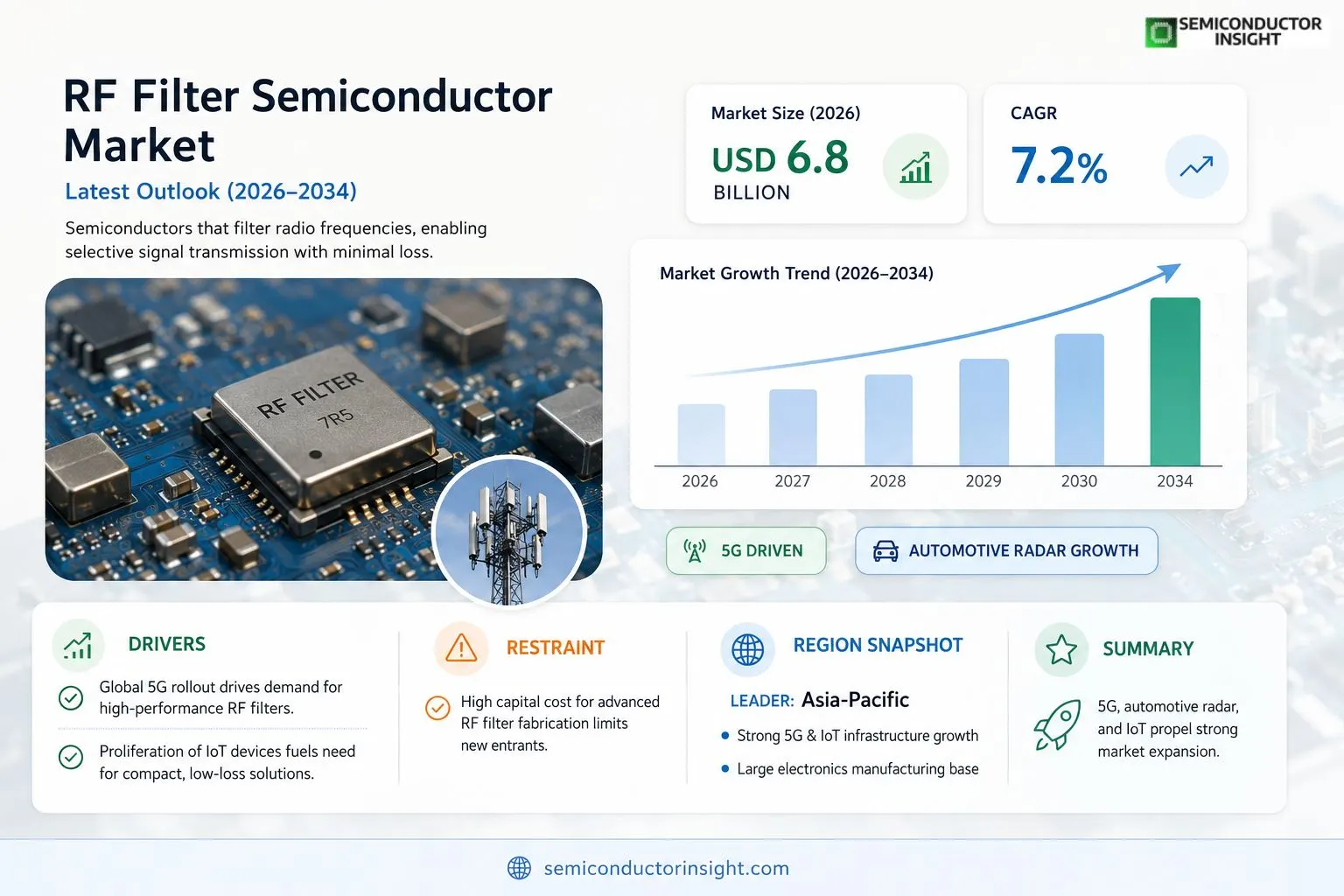
Global RF Filter Semiconductor Market is projected to grow from USD 6.8 billion in 2026 to USD 12.4 billion by 2034, exhibiting a CAGR of 7.2% during the forecast period.
RF filter semiconductors are critical components that enable selective transmission of radio‑frequency signals while attenuating unwanted frequencies. They are employed in wireless infrastructure, mobile devices, automotive radar, satellite communications, and emerging IoT applications, ensuring signal integrity and compliance with regulatory standards.The market is experiencing rapid expansion because the global rollout of 5G networks drives demand for high‑performance filters with tighter bandwidth specifications, while automotive manufacturers adopt advanced driver‑assistance systems that rely on millimeter‑wave radar modules. Furthermore, the proliferation of connected devices intensifies the need for compact, low‑loss solutions. Key players such as Qorvo, Skyworks Solutions, NXP Semiconductors, Murata Manufacturing and Taiyo Yuden are accelerating product development and strategic partnerships to capture this growth momentum.
MARKET DRIVERS
Growing Demand for 5G Infrastructure
The worldwide rollout of 5G networks is accelerating the need for high‑performance RF components. Manufacturers are seeking semiconductors that can deliver low loss and high selectivity, directly boosting RF filter semiconductor market.
Expansion of IoT and Edge Computing
IoT devices and edge‑computing gateways require compact, power‑efficient filters. This trend fuels innovations in miniaturized RF filter designs, expanding the addressable market.
➤ “The convergence of 5G and IoT is projected to double the demand for advanced RF filtering solutions within the next five years.”
Regulatory pushes for better spectrum efficiency are also compelling telecom operators to adopt newer filter technologies, ensuring sustained growth for RF filter semiconductor market.
MARKET CHALLENGES
Complexity of Manufacturing Advanced Filters
Producing high‑Q factor filters at sub‑millimeter scales demands sophisticated lithography and material processes. The associated costs can limit adoption in price‑sensitive segments.
Other Challenges
Supply Chain Volatility
Global semiconductor shortages and raw‑material price fluctuations create lead‑time uncertainties, hindering consistent product rollout.
MARKET RESTRAINTS
High Initial Capital Expenditure
Setting up fabs capable of producing advanced RF filter semiconductors requires significant investment, which can deter new entrants and slow market expansion.
Stringent Compliance Requirements
Regulatory standards for emissions and safety vary across regions, compelling manufacturers to customize designs, adding complexity and cost.Additionally, the need for extensive testing to meet reliability benchmarks can extend time‑to‑market, constraining rapid adoption.
MARKET OPPORTUNITIES
Emergence of AI‑Enabled Radio Systems
AI-driven adaptive radios demand reconfigurable filters that can dynamically adjust frequency bands. This creates a niche for programmable RF filter semiconductors.
Growth in Automotive Radar
Advanced driver‑assistance systems (ADAS) rely on radar frequencies that require precision filtering. The automotive sector’s push toward autonomous features presents a sizable opportunity.Collaborations between semiconductor firms and system integrators are accelerating the development of heterogeneous integration solutions, further expanding the market’s addressable applications.
RF Filter Semiconductor Market Trends
5G Network Expansion Drives Demand
The rollout of fifth‑generation mobile networks continues to reshape RF filter semiconductor market. 5G infrastructure requires filters that can handle tighter bandwidths and higher frequencies while maintaining low insertion loss. Operators are upgrading base‑station antennas and backhaul equipment, prompting vendors to introduce advanced ceramic and MEMS‑based filter families. These products improve signal integrity and enable the dense spectrum reuse that characterizes urban 5G deployments. Consequently, suppliers are accelerating design cycles and expanding production capacity to meet the surge in volume orders.
Other Trends
Automotive Radar Integration
Modern driver‑assistance systems rely on millimeter‑wave radar modules that operate in the 76‑81 GHz band. RF filter semiconductor market is responding with low‑profile, high‑Q resonators that fit within the constrained packaging of vehicle electronics. As OEMs introduce higher‑level autonomy features, filter performance becomes a safety‑critical parameter, driving collaborations between semiconductor manufacturers and automotive Tier‑1 suppliers. The focus is on reducing temperature drift and achieving consistent performance across the broad operating range of automotive environments.
IoT Device Proliferation and Miniaturization
Connected sensors, wearables, and edge gateways are proliferating across industrial and consumer segments. Each device incorporates a radio front‑end that demands compact, low‑loss filters to preserve battery life and maintain compliance with regional spectrum regulations. Vendors are therefore investing in silicon‑based filter technologies that combine high integration density with cost‑effective mass production. This trend is reinforced by the push for multi‑band operation, enabling a single device to support Wi‑Fi, Bluetooth, LTE‑M, and emerging sub‑6 GHz 5G bands without compromising form factor.Overall, RF filter semiconductor market is being reshaped by three interlocking forces: the aggressive rollout of 5G networks, the maturation of automotive radar systems, and the exponential growth of IoT endpoints. Companies that can deliver filters with superior linearity, reduced footprint, and reliable performance across temperature extremes will secure the strongest competitive positions. Strategic partnerships, accelerated R&D pipelines, and supply‑chain agility are emerging as the key differentiators for market leaders in the coming years.
COMPETITIVE LANDSCAPEKey Industry Players
RF Filter Semiconductor Market Competitive Overview
RF filter semiconductor market is presently dominated by a few large integrated‑device manufacturers that leverage extensive RF‑front‑end portfolios and deep connections with handset and infrastructure OEMs. Qorvo and Skyworks Solutions together capture a substantial share of the high‑frequency filter segment, driven by their advanced GaAs and SiGe technologies that meet 5G and automotive radar specifications. NXP Semiconductors and Murata Manufacturing also hold significant positions, offering a mix of ceramic and CMOS‑based filter solutions that cater to mobile, IoT and automotive applications. This concentration of capabilities creates a tiered structure where tier‑one players supply high‑performance, high‑volume components, while a secondary tier of specialized firms focuses on niche, low‑loss or miniature filter designs. These firms also benefit from strategic alliances with equipment manufacturers, ensuring rapid adoption of next‑generation filter topologies across global 5G roll‑outs.Beyond the tier‑one group, several niche players contribute critical innovations that broaden the market’s functional envelope. Taiyo Yuden and TDK provide high‑Q ceramic filters that excel in compact mobile devices. Analog Devices and Infineon Technologies extend the portfolio with mixed‑signal and silicon‑on‑insulator (SOI) filter technologies targeting automotive radar and satellite communications. STMicroelectronics and Broadcom add system‑level RF front‑end modules integrating filters with amplifiers and switches. Smaller but highly specialized firms such as MACOM, Renesas Electronics and Peregrine Semiconductor (now part of Skyworks) focus on mmWave and ultra‑wideband filter architectures that support emerging 5G‑Advanced use cases. Collectively, this diversified ecosystem enhances supply chain resilience and drives continuous performance improvements as the market advances toward 2034.
List of Key RF Filter Semiconductor Companies Profiled
- Qorvo
- Skyworks Solutions
- NXP Semiconductors
- Murata Manufacturing
- Taiyo Yuden
- TDK
- Analog Devices
- Infineon Technologies
- STMicroelectronics
- Broadcom
- MACOM
- Renesas Electronics
- Peregrine Semiconductor
- Texas Instruments
- Qualcomm
Segment Analysis:
| Segment Category | Sub-Segments | Key Insights |
| By Type |
|
RF MEMS Filters are gaining traction due to their superior tunability and low insertion loss, making them ideal for adaptive 5G front‑ends.
|
| By Application |
|
Wireless Infrastructure filters are central to base‑station modules, where stringent selectivity and low insertion loss are paramount.
|
| By End User |
|
Consumer Electronics Manufacturers prioritize compact, low‑loss filter solutions to meet slim device form‑factors while preserving signal fidelity.
|
| By Frequency Range |
|
Millimeter‑Wave segment is catalyzed by automotive radar and high‑capacity backhaul links, where low loss at extreme frequencies is critical.
|
| By Technology Trend |
|
Integrated Filter‑Amplifier Modules represent a convergence of filtering and amplification, streamlining RF front‑end architecture.
|
Regional Analysis: North America
North America
The mobile phone sector remains a dominant driver for RF filter semiconductors in North America. The continuous evolution of mobile communication standards, particularly the advancement towards 5G and beyond, necessitates sophisticated filter designs to ensure optimal signal quality and performance.
The automotive industry is increasingly reliant on RF filter semiconductors for various applications, including radar systems, wireless connectivity (Wi-Fi, Bluetooth), and telematics. The growing integration of advanced driver-assistance systems (ADAS) and autonomous driving technologies is further fueling demand for these components.
The expanding industrial Internet of Things (IIoT) is creating significant opportunities for RF filter semiconductors. Industrial applications require robust and reliable wireless communication for data transmission and control, driving demand for specialized filter solutions.
The aerospace and defense sectors utilize RF filter semiconductors in a wide range of applications, including communication systems, radar, and electronic warfare systems. These applications demand high-performance and reliability, with stringent quality control requirements.
Europe
Europe exhibits a strong and diversified market for RF Filter Semiconductor Market, driven by advancements in telecommunications and growing adoption of wireless technologies. The region’s focus on energy efficiency and sustainability presents unique opportunities for innovation in RF filter design. Key applications include automotive, industrial, and consumer electronics.
Asia-Pacific
Asia-Pacific is the fastest-growing market for RF Filter Semiconductor Market, fueled by rapid industrialization and increasing demand for mobile devices and 5G infrastructure. China, in particular, is a major contributor to this growth, with substantial investments in telecommunications and electronics manufacturing.
United States
The United States represents a significant market for RF Filter Semiconductor Market, characterized by strong research and development capabilities and a high level of technological innovation. The demand for these components is driven by applications in telecommunications, aerospace & defense, and automotive industries.
South America
South America presents a moderately growing market for RF Filter Semiconductor Market, with increasing demand for mobile devices and infrastructure development. The expansion of 4G and 5G networks is driving adoption of RF filter semiconductors in telecom infrastructure.
Middle East & Africa
The Middle East & Africa region is witnessing moderate growth in RF filter semiconductor market, driven by infrastructure development and increasing investments in telecommunications. The expansion of 5G networks is expected to further boost demand in the coming years.
Report Scope
This market research report provides a comprehensive analysis of the RF Filter Semiconductor Market , covering the forecast period 2026–2034. It offers detailed insights into market dynamics, technological advancements, competitive landscape, and key trends shaping the industry.
Key focus areas of the report include:
- ✅Market Overview: The report begins with an overview outlining its current market scenario, key growth indicators, and industry transformation drivers. It discusses macroeconomic factors, demand–supply balance, regulatory landscape, and the strategic role of semiconductors in powering advancements across industries such as automotive, telecommunications, consumer electronics, and industrial automation.
- ✅Market Size & Forecast: Historical data and future projections for revenue, unit shipments, and market value across major regions and segments.
- ✅Segmentation Analysis: Detailed breakdown by product type, technology, application, and end-user industry to identify high-growth segments and investment opportunities.
- ✅Regional Insights: Insights into market performance across North America, Europe, Asia-Pacific, Latin America, and the Middle East & Africa, including country-level analysis where relevant.
- ✅Competitive Landscape: Profiles of leading market participants, including their product offerings, R&D focus, manufacturing capacity, pricing strategies, and recent developments such as mergers, acquisitions, and partnerships.
- ✅Technology Trends & Innovation: Assessment of emerging technologies, integration of AI/IoT, semiconductor design trends, fabrication techniques, and evolving industry standards.
- ✅Market Drivers & Restraints: Evaluation of factors driving market growth along with challenges, supply chain constraints, regulatory issues, and market-entry barriers.
- ✅Stakeholder Insights: Insights for component suppliers, OEMs, system integrators, investors, and policymakers regarding the evolving ecosystem and strategic opportunities.
Primary and secondary research methods are employed, including interviews with industry experts, data from verified sources, and real-time market intelligence to ensure the accuracy and reliability of the insights presented.
FREQUENTLY ASKED QUESTIONS:
What is the current market size of RF Filter Semiconductor Market?
-> RF filter semiconductor market was valued at USD 6.3 billion in 2025 and is expected to reach USD 12.4 billion by 2034.
Which key companies operate in RF Filter Semiconductor Market?
-> Key players include Qorvo, Skyworks Solutions, NXP Semiconductors, Murata Manufacturing, and Taiyo Yuden.
What are the key growth drivers?
-> Key growth drivers include global rollout of 5G networks, adoption of advanced driver‑assistance systems in automotive, proliferation of connected IoT devices, demand for high‑performance low‑loss filters, and tighter bandwidth specifications.
Which region dominates the market?
-> The provided data does not specify a dominant region.
What are the emerging trends?
-> Emerging trends include integration of RF filters in 5G infrastructure, automotive millimeter‑wave radar modules, and compact low‑loss solutions for IoT applications.

Get Sample Report PDF for Exclusive Insights
Report Sample Includes
- Table of Contents
- List of Tables & Figures
- Charts, Research Methodology, and more...
 Download Sample Report PDF