RF Dielectrics Market Insights
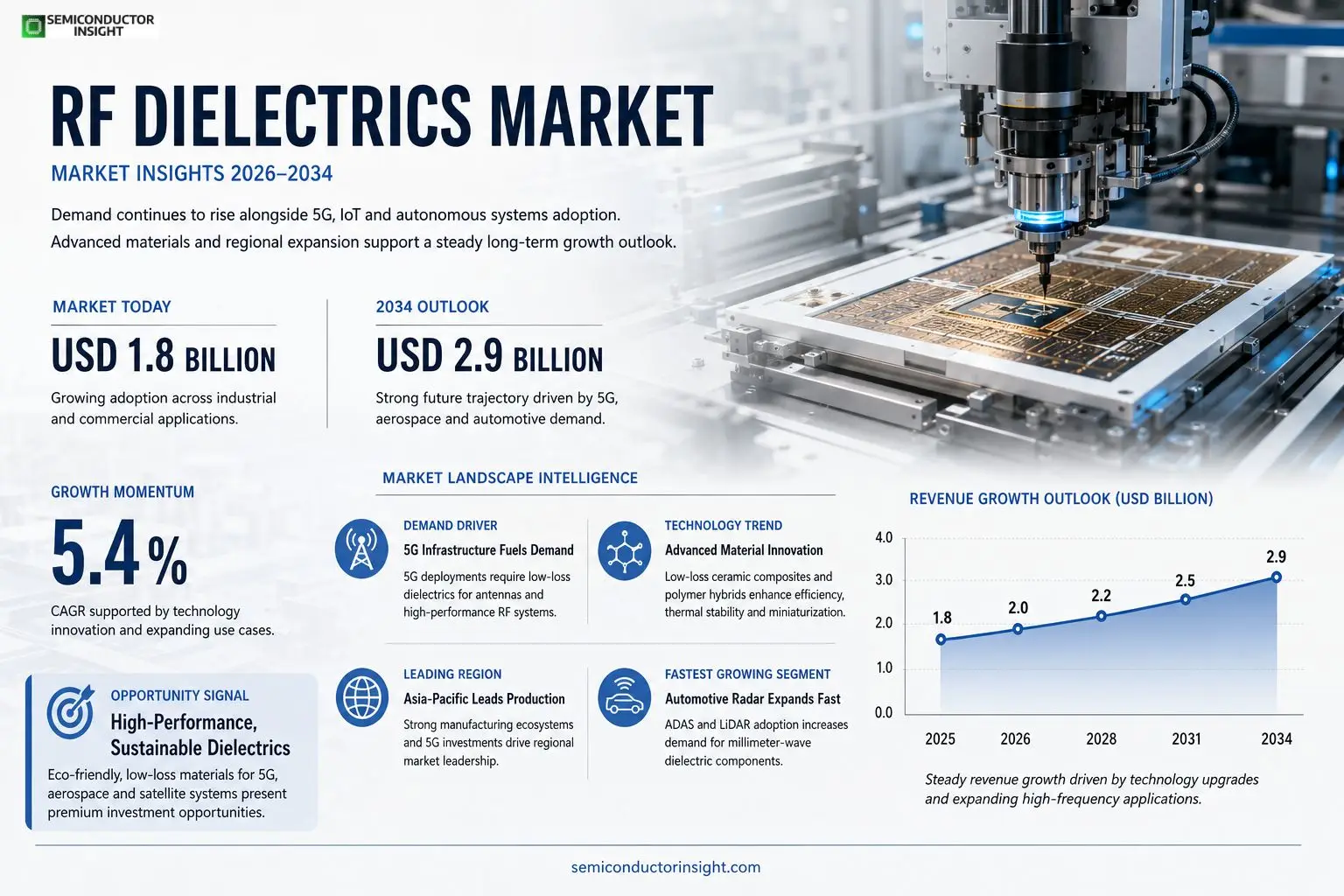
RF Dielectrics Market size was valued at USD 1.8 billion in 2025. The market is projected to grow from USD 2.0 billion in 2026 to USD 2.9 billion by 2034, exhibiting a CAGR of 5.4% during the forecast period.
RF dielectrics are specialized insulating materials engineered to support high‑frequency electromagnetic fields in components such as resonators, filters, antennas, and printed circuit boards. These materials offer low loss tangent, stable dielectric constant, and strong thermal resilience, enabling efficient signal transmission for wireless communications, radar and satellite systems.The market is experiencing robust growth because of expanding demand for 5G infrastructure, IoT devices and autonomous‑vehicle radar systems. Furthermore, advances in material science,such as low‑loss ceramic composites and polymer‑ceramic hybrids,are accelerating adoption across aerospace and defense sectors. Key players including Rogers Corporation, TDK Corporation, Murata Manufacturing Co., and AVX Corp. are investing heavily in R&D to launch next‑generation dielectric solutions that meet stringent performance standards.
MARKET DRIVERS
Increasing Adoption in 5G Infrastructure
RF Dielectrics Market is being propelled by telecom operators upgrading to 5G networks, which require high‑performance dielectric materials for microwave antennas and phased‑array systems. These deployments generate a compound annual growth rate above 7% and create demand for low‑loss, high‑k ceramic compositions.
Advancements in Material Science
Recent breakthroughs in nano‑engineered alumina‑titanate blends have improved thermal stability and reduced dielectric loss, enabling manufacturers to meet stricter efficiency targets. This technical progress gives RF Dielectrics Market a competitive edge over traditional polymer‑based solutions.
➤ Key driver: Cost‑effective, scalable manufacturing processes that lower unit costs by up to 15%.
Alongside these factors, the convergence of automotive radar and satellite communication systems expands the application base, reinforcing a sustainable growth trajectory for RF Dielectrics Market.
MARKET CHALLENGES
Regulatory and Technical Hurdles
Stringent electromagnetic compatibility (EMC) regulations across regions require dielectric materials to meet precise permittivity tolerances, driving up certification costs and extending time‑to‑market for new products.
Other Challenges
Supply Chain Vulnerabilities
Limited availability of high‑purity raw minerals and geopolitical tensions can disrupt the supply chain, prompting manufacturers to seek diversified sourcing strategies.Moreover, the need for consistent batch‑to‑batch performance places pressure on quality‑control systems, increasing operational expenditures for firms operating in RF Dielectrics Market.
MARKET RESTRAINTS
Supply Chain Constraints
Raw material scarcity, especially for rare‑earth oxides used in high‑k dielectrics, limits production scalability and can lead to price volatility, restraining market expansion.In addition, the capital intensity required for specialized sintering equipment deters new entrants, concentrating market share among a few established players in RF Dielectrics Market.These factors collectively act as a restraint, slowing the pace at which emerging applications can be commercialized.
MARKET OPPORTUNITIES
Emerging Applications in Autonomous Vehicles
Advanced driver‑assistance systems (ADAS) and LiDAR sensors rely on millimeter‑wave transceivers that demand low‑loss, high‑Q dielectric components. This creates a sizable opportunity for RF Dielectrics Market to capture a share of the rapidly growing automotive sectorFurthermore, the push toward miniaturized satellite constellations for broadband internet services fuels demand for lightweight, high‑performance dielectrics, presenting another growth avenue.Companies that invest in R&D for environmentally friendly ceramic formulations are poised to differentiate themselves and unlock premium pricing in these high‑growth segments.
RF Dielectrics Market Trends
Growth Driven by 5G and IoT Deployments
RF Dielectrics Market is experiencing a pronounced up‑trend as communications providers expand 5G antenna arrays and IoT manufacturers scale edge‑device production. Low‑loss ceramic composites and polymer‑ceramic hybrids now deliver the stability required for high‑frequency signal integrity, allowing network operators to increase cell‑site density without compromising thermal performance. Major suppliers such as Rogers Corporation and TDK Corporation have accelerated product roadmaps to meet tighter insertion‑loss specifications, while end‑users report measurable improvements in bandwidth efficiency and reduced power consumption. This confluence of demand and material capability is reinforcing a virtuous cycle: higher network capacity spurs further investment in dielectric research, which in turn feeds back into more resilient 5G and IoT hardware.
Other Trends
Material Innovation
Recent advances in low‑loss ceramic formulations are reshaping RF Dielectrics Market landscape. Researchers have introduced nano‑engineered silicate matrices that achieve tan δ values well below 0.001 at millimeter‑wave frequencies, a threshold that traditional polymers could not meet. Simultaneously, polymer‑ceramic hybrids now exhibit coefficient‑of‑thermal‑expansion (CTE) matches with copper traces, reducing mechanical stress during thermal cycling. These technical gains are being adopted across broadband filter modules and high‑Q resonators, where even marginal dielectric improvements translate into extended device lifetimes and lower maintenance costs. Adoption rates among aerospace OEMs have risen steadily, reflecting confidence in the new material classes for mission‑critical radar and satellite subsystems.
Aerospace and Defense Expansion
The RF Dielectiles Market is also being propelled by heightened activity in aerospace and defense programs. Radar systems for autonomous‑vehicle platforms and next‑generation fighter aircraft demand dielectric layers that sustain extreme temperature gradients while preserving low loss at Ku‑ and Ka‑band frequencies. Companies such as Murata Manufacturing and AVX Corp. have announced dedicated production lines for high‑performance dielectric substrates that meet stringent MIL‑SPEC criteria. The result is a noticeable shift from legacy alumina‑based dielectrics toward engineered composites that offer superior power‑handling capability. This sectoral momentum is expected to sustain the market’s upward trajectory as defense budgets prioritize electronic‑warfare resilience and satellite communication bandwidth.
COMPETITIVE LANDSCAPEKey Industry Players
RF Dielectrics Market Competitive Overview
RF Dielectrics Market is dominated by a handful of large, vertically integrated manufacturers that combine deep materials‑science expertise with extensive production capacity. Rogers Corporation leads the segment with its high‑performance ceramic and polymer‑based dielectric films, leveraging a broad portfolio that serves 5G base stations, aerospace radars and advanced wireless modules. TDK Corporation and Murata Manufacturing Co. follow closely, offering low‑loss ceramic composites that are integral to miniaturized filters and antenna modules. AVX Corp. and ADMA Innovative Materials round out the core tier, focusing on polymer‑ceramic hybrids that balance thermal stability with processability. These firms invest heavily in R&D, driving incremental improvements in dielectric constant stability and loss tangent, which underpin the market’s projected CAGR of over 5% through 2034.Beyond the leading tier, a diverse set of niche players contributes specialized solutions that address emerging sub‑segments such as autonomous‑vehicle radar and satellite‑grade components. Companies like Taiyo Yuden and Kyocera Corporation provide ultra‑low‑loss ceramic powders tailored for high‑frequency resonators. Skyworks Solutions and Qorvo, while primarily known for RF front‑end modules, have expanded into custom dielectric substrates to tighten integration. NXP Semiconductors, STMicroelectronics and Centellax focus on silicon‑based dielectric technologies that enable monolithic integration for IoT devices. These smaller yet highly innovative firms enhance the overall competitiveness of the RF dielectrics ecosystem.
List of Key RF Dielectrics Companies Profiled
- Rogers Corporation
- TDK Corporation
- Murata Manufacturing Co.
- AVX Corp.
- ADMA Innovative Materials
- Taiyo Yuden
- Kyocera Corporation
- Skyworks Solutions
- Qorvo, Inc.
- NXP Semiconductors
- STMicroelectronics
- Centellax
- Taiyo Electronics
- Vishay Intertechnology
- Amphenol Advanced Sensors
Segment Analysis:
| Segment Category | Sub-Segments | Key Insights |
| By Type |
|
Ceramic Dielectrics
|
| By Application |
|
RF Filters
|
| By End User |
|
Telecommunications
|
| By Performance Requirement |
|
Low Loss
|
| By Material Innovation |
|
Ceramic‑Polymer Hybrids
|
Regional Analysis: North America
United States
The telecommunications sector is the primary driver of RF dielectric demand in the US. The rollout of 5G networks necessitates advanced materials for antenna design, filter fabrication, and other critical components. The increasing bandwidth requirements and the need for enhanced signal transmission efficiency are propelling innovation in this area.
The aerospace and defense industries rely on RF dielectrics for a wide range of applications, including radar systems, satellite communication, and electronic warfare. These applications demand high-reliability dielectrics that can withstand extreme environmental conditions and operate at high frequencies.
Consumer electronics, including smartphones, tablets, and wireless devices, utilize RF dielectrics for antenna design and signal processing. The miniaturization trend in these devices is driving the demand for high-performance, low-profile dielectrics.
Industrial and automotive applications of RF dielectrics are gaining traction, with applications in radar systems, wireless sensors, and communication modules. The need for robust and reliable dielectrics in these environments is increasing.
Europe
Europe exhibits a steady growth trajectory in RF Dielectrics Market, underpinned by strong industrial foundations and increasing investments in advanced technologies. Key drivers include the expanding 5G infrastructure across the continent and the growing demand for RF components in automotive and aerospace applications. Several European nations have established centers of excellence in materials science and engineering, fostering innovation in dielectric materials. The region’s focus on energy efficiency and sustainable technologies is also creating new opportunities for RF dielectrics in applications such as power transmission and wireless energy transfer. While the market is segmented, the collective demand across Europe is substantial and anticipated to maintain a consistent growth rate.
Asia-Pacific
Asia-Pacific is emerging as the fastest-growing region within RF Dielectrics Market. This rapid expansion is primarily fueled by the burgeoning telecommunications infrastructure in China and India, coupled with substantial investments in manufacturing and electronics industries across Southeast Asia. The region’s cost-competitive manufacturing landscape attracts significant foreign direct investment, further boosting demand for RF dielectrics. The growing adoption of 5G technology and the proliferation of IoT devices are driving the need for high-performance dielectric materials. Furthermore, the increasing focus on electric vehicles in the region presents new opportunities for RF dielectrics in automotive applications.
South America
South America represents a smaller but gradually expanding market for RF Dielectrics. The growth is primarily driven by the expanding telecommunications sector, particularly in Brazil and Argentina, as these nations invest in upgrading their wireless infrastructure. The increasing adoption of mobile devices and the growing demand for data services are contributing to this growth. Furthermore, the region’s growing industrial sector is creating opportunities for RF dielectrics in applications such as radar systems and industrial automation. However, the market remains relatively fragmented, with opportunities for consolidation and increased investment.
Middle East & Africa
The Middle East & Africa region presents a niche market for RF Dielectrics, with growth linked to infrastructure development and expanding telecommunications networks. Several countries in the region are investing heavily in 5G deployments, driving demand for RF components and dielectric materials. The growth in the oil and gas sector also contributes to the demand for RF dielectrics in radar and communication systems. While the market is still developing, the region offers significant long-term growth potential, particularly as digital infrastructure continues to expand.
Report Scope
This market research report provides a comprehensive analysis of the RF Dielectrics Market , covering the forecast period 2026–2034. It offers detailed insights into market dynamics, technological advancements, competitive landscape, and key trends shaping the industry.
Key focus areas of the report include:
- Market Overview: The report begins with an overview outlining its current market scenario, key growth indicators, and industry transformation drivers. It discusses macroeconomic factors, demand–supply balance, regulatory landscape, and the strategic role of semiconductors in powering advancements across industries such as automotive, telecommunications, consumer electronics, and industrial automation.
- Market Size & Forecast: Historical data and future projections for revenue, unit shipments, and market value across major regions and segments.
- Segmentation Analysis: Detailed breakdown by product type, technology, application, and end-user industry to identify high-growth segments and investment opportunities.
- Regional Insights: Insights into market performance across North America, Europe, Asia-Pacific, Latin America, and the Middle East & Africa, including country-level analysis where relevant.
- Competitive Landscape: Profiles of leading market participants, including their product offerings, R&D focus, manufacturing capacity, pricing strategies, and recent developments such as mergers, acquisitions, and partnerships.
- Technology Trends & Innovation: Assessment of emerging technologies, integration of AI/IoT, semiconductor design trends, fabrication techniques, and evolving industry standards.
- Market Drivers & Restraints: Evaluation of factors driving market growth along with challenges, supply chain constraints, regulatory issues, and market-entry barriers.
- Stakeholder Insights: Insights for component suppliers, OEMs, system integrators, investors, and policymakers regarding the evolving ecosystem and strategic opportunities.
Primary and secondary research methods are employed, including interviews with industry experts, data from verified sources, and real-time market intelligence to ensure the accuracy and reliability of the insights presented.
FREQUENTLY ASKED QUESTIONS:
What is the current market size of RF Dielectrics Market?
-> RF Dielectrics Market was valued at USD 1.8 billion in 2025 and is expected to reach USD 2.9 billion by 2034, representing a CAGR of 5.4% during the forecast period.
Which key companies operate in RF Dielectrics Market?
-> Key players include Rogers Corporation, TDK Corporation, Murata Manufacturing Co., and AVX Corp.
What are the key growth drivers?
-> Growth is driven by expanding demand for 5G infrastructure, IoT devices, autonomous‑vehicle radar systems, and advances in material science such as low‑loss ceramic composites and polymer‑ceramic hybrids, particularly in the aerospace and defense sectors.
Which region dominates the market?
-> The reference does not specify a single dominant region for RF Dielectrics Market.
What are the emerging trends?
-> Emerging trends include the development of low‑loss ceramic composites, polymer‑ceramic hybrid materials, and high‑temperature stable dielectrics to meet the performance requirements of next‑generation wireless and radar applications.
Get Sample Report PDF for Exclusive Insights
Report Sample Includes
- Table of Contents
- List of Tables & Figures
- Charts, Research Methodology, and more...