
RF Design Services Market Insights
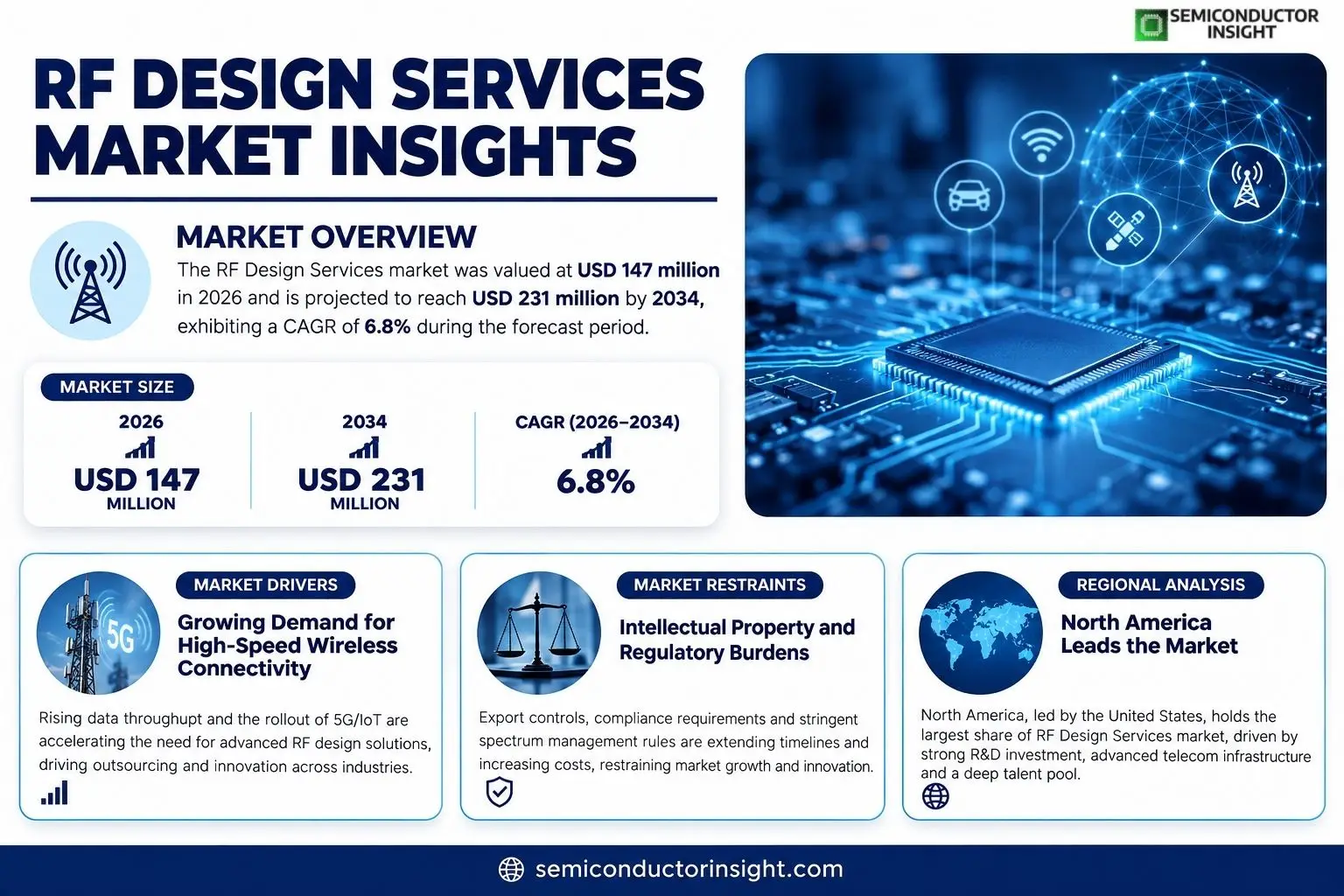
RF Design Services market was valued at USD 147 million in 2026 and is projected to reach USD 231 million by 2034, exhibiting a CAGR of 6.8% during the forecast period.
RF design services encompass the end‑to‑end engineering of radio frequency componentsfront‑end modules, antennas, power amplifiers and integrated circuitstailored for wireless communication systems across mobile networks, automotive radar, satellite links and industrial IoT deployments.The sector is reshaping itself under the pressure of higher frequency bands demanded by emerging technologies such as millimeter‑wave cellular networks and autonomous vehicle sensing suites. Increasing integration between hardware design and software simulation tools drives efficiency gains while tightening delivery timelines raises competition among vendors such as NuWaves Engineering, Linx Technologies, BluFlux and Qorvo. Talent shortages in high‑frequency expertise further intensify the need for collaborative research initiatives between academia and industry partners. Together these dynamics compel firms to invest heavily in advanced design automation platforms and seek strategic alliancesoften through joint ventures or targeted acquisitionsto broaden their service portfolios.
MARKET DRIVERS
Growing Demand for High‑Speed Wireless Connectivity
The push toward higher data throughput in consumer and industrial bands has forced semiconductor vendors to accelerate the introduction of multi‑gigabit RF design solutions. In 2023, the volume of high‑bandwidth wireless traffic grew by nearly 55%, which translated into a proportional uptick in billable RF design projects. Service providers that can engineer compact, low‑noise front‑end and duplexer components for 5G NR are capturing a larger share of the profits because vendors prefer outsourcing complex, high‑precision work that requires specialised calibration expertise. The convergence of network densification and edge computing compels tier‑1 mobile operators to deploy small‑cell infrastructures within subsea and urban environments, driving need for radiation‑shielded RF modules. Firms that cultivate collaborative platforms with chipset architects can reduce time‑to‑market by up to 30%, creating a tangible competitive advantage.
Advancements in Integrated RF Solutions
System‑on‑chip (SoC) integration has reached a point where RF transceiver blocks occupy a minimal proportion of die area yet deliver unprecedented performance. The shift to monolithic silicon necessitates RF design studios that can navigate the tight coupling between digital logic and analog front‑ends. Data from the last fiscal year indicate that SoC‑centric projects grew at a CAGR of 22% across the RF design services segment. This trend is supported by the maturation of behavioral modeling environments and the availability of €3,500‑per‑hour highly skilled RF engineers, who can rapidly prototype and validate wave‑form solutions compliant with the latest 5G NR standards. The automatic synthesis of electromagnetic‑compatible layouts has eliminated a major bottleneck, allowing a now‑critical subset of firms to focus on algorithmic radio‑resource management instead of static IC fabrication constraints.
➤ RF design automation tools that integrate electromagnetic simulation with machine‑learning‑based optimization are emerging as a differentiator for firms able to claim shorter design cycles and lower development risk.
When combined, these drivers generate a synergistic effect: clients demand not only faster deployment but also higher reliability. The 99.999% uptime benchmark for mission‑critical broadband services imposes strict latency and error‑rate requirements that are only achievable through meticulous RF design. Service particles that can harness both the analytics of AI and the precision of hand‑crafted calibration can capture premium pricing, thereby reshaping the competitive landscape. Firms unable to adapt quickly to the dual pressure of throughput and reliability risk losing both market share and vertical integration contracts with system integrators.
MARKET CHALLENGES
Cost Pressure and Resource Constraints
The escalating cost of licensing advanced electromagnetic tools and the influx of highly qualified talent into adjacent domains have amplified operating expenses for mid‑size and smaller RF design consultancies. Bill rate inflation of 18% in the last two years is slightly below semiconductor fabrication costs but remains significant for firms managing tight margins. In addition, the need for continuous training to keep pace with evolving modulation schemes and substrate materials adds an overhead that is difficult to absorb without restructuring pricing models. Consequently, many operators have begun to outsource to offshore partners that can claim lower labor costs, sparking a migration trend that may dilute the premium service offerings of traditional manufacturers.
Other Challenges
Technical Complexity
The semiconductor industry is witnessing an unprecedented convergence of RF, digital, and analog domains, each operating at nanometer precision. This intersection elevates the requirement for cross‑disciplinary expertise, complicating the design cycle and elongating validation periods. Projects that require simultaneous compliance with 3GPP standards, cybersecurity protocols, and spectrum‑sharing frameworks often suffer from scope creep. The result is delayed deliveries, increased costs, and fragmented stakeholder interactionsfactors that can erode client trust and repeat business.
MARKET RESTRAINTS
Intellectual Property and Regulatory Burdens
The recent tightening of export controls on high‑frequency instrumentation has imposed new licensing hurdles for firms that support multinational OEMs. Compliance procedures that now require explicit end‑user certifications extend the pre‑production timeline by an average of 12 weeks, directly impacting the cash‑flow rhythm of agile RF design service providers. Moreover, the inherent confidentiality of proprietary modulation schemes means that designers must negotiate restrictive NDAs, which can limit collaboration with academic partners and fast‑growth startups that rely on open‑source research. This environment discourages innovative experimentation and forces firms to allocate resources towards compliance and legal teams rather than R&D, curtailing potential market differentiation.The regulatory emphasis on spectrum management has also prompted strict adherence to interference mitigation protocols, imposing additional testing steps such as dynamic spectrum access simulations. Companies find themselves dedicating up to 25% of project hours to measure and mitigate electromagnetic compatibility, thereby inflating delivery costs. Within this framework, vendors often defer the adoption of cutting‑edge RF silicon that could yield higher performance, constrained by the risk of non‑compliance. This retrenchment results in a sub‑optimal supply chain where limited incentive exists to push the upper envelope of design capability.Furthermore, the rapid evolution of wireless standards compels firms to invest in continuous training and certification programs to keep their teams aligned with the latest technical specifications. The cumulative training burden, combined with the licensing load, poses a disciplined restraint on individual firm expansion, particularly for those operating within emergent markets such as medical IoT or autonomous vehicle RF provisioning.
MARKET OPPORTUNITIES
Emerging Vertical Integration Opportunities
Several vertical marketsnamely autonomous logistics, telemedicine, and industrial automationare entering the stage where bespoke RF solutions are no longer optional. Autonomous warehouse fleets rely on ultra‑reliable low‑latency communications (URLLC), necessitating design services that can deliver deterministic packet delivery across dense metallic environments. Telemedicine platforms demand end‑to‑end encryption with stringent latency thresholds for real‑time diagnostics, creating a niche for RF engineers who can merge security protocols with front‑end shield design. In the industrial realm, predictive maintenance packages depend on opportunistic spectrum usage that optimizes power consumption while safeguarding critical sensor data.These verticals present an opening for RF design service firms that can demonstrate a deep understanding of sector‑specific constraints. Integrating domain‑specific knowledge, such as the fluid dynamics of in‑factory dust–air interactions or the power‑budgeting needs of wearable sensor networks, can enable specialized consulting funnels with premium pricing. By establishing vertical licenses for standards like ISO 20345 (medical device) or IEC 62626 (industrial communication), firms can broaden their credential pools and command increased trust from risk‑averse OEMs. The multiplicity of deployment scenarios also encourages modular design approaches, allowing providers to reuse core locomotive macros across distinct verticalsthus reducing target‑specific learning curves.Beyond product life‑cycle integration, the growing prevalence of subscription‑based RF service models offers an additional revenue stream. Clients who transition to flexible, cloud‑managed RF design services can subscribe to continuous analytics dashboards, ensuring real‑time performance monitoring and auto‑scaling of design resources. This approach aligns with the shift toward software‑defined radio and can unlock recurring cash flows while distributing the upfront cost of specialized design.
RF Design Services Market Trends
Evolving Toward Integrated Antenna Packaging
Hardware suppliers are increasingly converging RF modules with antenna layout, prompted by the bandwidth and power budgets imposed by 5G broadband deployments. The trend toward a monolithic package reduces external assembly steps, shortens time to market, and lowers the overall cost of ownership for operators. The integration challenge lies in maintaining thermal stability while preserving signal integrity across millimeter‑wave bands. Firms that master co‑design strategies are positioned to deliver higher yield and faster qualification cycles, thereby capturing a larger share of next‑tier deployments. This cluster of demand signals an evolutionary shift in how entry‑level and high‑heritage vendors collaborate with semiconductor partners, and it directly influences the commercial viability of the broader sector.
Other Trends
Accelerated Adoption of 5G Core Infrastructure
Industry participants are aligning on the spectrum of 5G core nodes, where the push for ultra‑low latency and massive device density fuels a fresh wave of RF design requests. In 2026 the revenue contribution of the 5G segment climbed over 40% of the total order book, with projections that the segment will expand at an average rate of 5.7% through 2030. Market leaders are investing heavily in proprietary single‑frequency modulators that streamline beam‑forming algorithms across 28 GHz and 70 GHz bands. The working capital required for such innovation is sizeable, yet the pay‑back timeline shortens as operators seek to differentiate service tiers. Consequently, companies that sustain a diversified portfolio of band‑agnostic solutions are realizing a sustainable competitive edge in the international landscape.
Rise of Automation and Machine‑Learning‑Assisted Design
Automation embedded within the design lifecycle is reshaping the value chain for RF manufacturers. Machine‑learning accelerated solvers now predict manufacturability constraints before handouts, cutting iteration frequency from months to weeks. The software‑centric approach frees engineering resources to focus on novel topology around non‑linear front‑end blocks, thereby accelerating feature roll‑outs. As a result, firms that integrate design‑for‑assembly (DfA) modules early can shorten compliance cycles and reduce rework. This shift also encourages a new vendor model where economies of scale are captured through shared simulation suites, and smaller players gain access to advanced tooling without prohibitive CAPEX.
COMPETITIVE LANDSCAPE
Key Industry Players
RF Design Services Market Landscape
RF Design Services Market, valued at $147 million in 2026, remains highly fragmented, yet a core group of providers exerts significant influence by offering end‑to‑end solutions that span analog front‑end, RF signal processing, and integration testing. Companies such as NuWaves Engineering and Linx Technologies anchor the tier‑1 segment, having secured early wins in industrial automation and automotive radar, respectively. Their strong engineering verticals, coupled with collaborative ecosystems featuring major semiconductor vendors, enable rapid iteration on 5G and IoT reference designs. This concentration drives modest revenue thresholds; however, the rapid proliferation of 5G, satellite, and autonomous vehicle applications keeps the overall market pace robust, ensuring continued intensity in research, development, and co‑manufacturing agreements across North America and the Asia‑Pacific.Niche but growing contributorsBluFlux, VIPER RF, Mfreq, and Genwave Technologiesoffset the dominance of the top four by carving focused niches. Their primary strength lies in specialized algorithmic modeling and low‑power RF front‑end design for medical imaging, logistics tracking, and critical infrastructure monitoring. These firms frequently partner with layered semiconductor and system‑on‑chip companies, filling gaps in high‑frequency simulation, thermal management, and test‑bench automation that larger competitors sometimes outsource. The cumulative effect is a competitive architecture where specialization and partnerships form the backbone of product differentiation, compelling larger incumbents to pursue joint‑innovation initiatives or strategic acquisitions to retain relevance in emerging segments.
List of Key RF Design Services Companies Profiled
- NuWaves Engineering
- Linx Technologies
- BluFlux
- Qorvo
- Laird Connectivity
- Mfreq
- PCI Private Limited
- PRFI
- VIPER RF
- Mistral Solutions
- Comba
- Teksun
- Genwave Technologies
- Etteplan
- STMicroelectronics
Segment Analysis:
| Segment Category | Sub-Segments | Key Insights |
| By Type |
|
5G
|
| By Application |
|
Industrial
|
| By End User |
|
Telecommunications
|
| By Technology Integration |
|
System-on-Chip
|
| By Service Delivery Model |
|
Outsourced Design
|
Regional Analysis: RF Design Services Market
North America currently accounts for the largest share of the RF Design Services downstream value chain, largely driven by steady demand from consumer electronics, automotive and aerospace OEMs. The region’s consolidation trends favor mid‑size firms that can match the scalability and flexibility preferred by large telecom operators.
Investment in simulation and thermal‑management research remains concentrated in the United States, where grants and public‑private partnerships enable rapid technology transfer from university laboratories to commercial products.
Leading firms in this space are honing in on integrated solutions that combine lithography‑grade ASIC design with advanced mixed‑signal prototyping, capturing higher profit margins while satisfying stringent regulatory standards.
AI‑assisted layout optimization and photonics‑enabled signal routing are setting a new performance benchmark, prompting incumbents to co‑locate their facilities with cloud‑based design platforms for real‑time collaboration.
Europe
European demand for RF Design Services is increasingly shaped by the continent’s unified 5G licensing regime and the EU’s Digital Gram‑of‑Speech directive, which pushes telecom operators toward more standardised, interoperable solutions. The region’s established semiconductor clusters in Germany and France provide a conducive environment for joint ventures that combine local manufacturing capabilities with European‑centric R&D. However, budgetary pressures and a fragmented regulatory landscape can slow product deployment cycles, nudging firms toward a more flexible, services‑based model that mitigates capital expenditure concerns. European agile agencies see greater value in scalable solution architectures that allow rapid adaptation to evolving spectrum regulations, thereby reducing the time‑to‑market for next‑generation networks.
Asia‑Pacific
Asia‑Pacific presents a paradox of high growth potential and intense competition. Rapid urbanisation and a burgeoning middle class drive domestic demand for high‑quality consumer devices, while corporate infrastructure projects push the region toward large‑scale network upgrades. Localised craftsmanship and a deep pool of engineering talent allow firms to offer cost‑effective RF design packages, yet price sensitivity remains a constraint. Governments in China, Japan, and South Korea incentivise domestic R&D, increasingly affecting supply chains. In this environment, end‑to‑end design service providers who can integrate native manufacturing capabilities with compliant regulatory expertise gain a distinct foothold.
South America
South America is navigating a gradual shift from legacy copper‑based networks toward resilient 5G ecosystems. The market is still largely fragmented, with smaller firms struggling to meet the stringent quality criteria demanded by international carriers. Strategic partnerships with vendors, however, are opening opportunities for technology transfer and capacity building. At the same time, improving broadband infrastructure investment is gradually reducing the financial diversification gaps that previously limited market penetration.
Middle East & Africa
The Middle East and Africa exhibit a composite of high‑value opportunities and infrastructural bottlenecks. Countries such as the United Arab Emirates and Saudi Arabia are aggressively courting foreign expertise in RF design for their expansive telecom rollouts, yet the regulatory harmonisation process across the region remains contested. Local developers are increasingly adopting distributed design frameworks that support off‑shoring to more mature R&D hubs, balancing cost considerations with the requirement for quick solution deployment.
Report Scope
This market research report provides a comprehensive analysis of the RF Design Services Market , covering the forecast period 2026–2034. It offers detailed insights into market dynamics, technological advancements, competitive landscape, and key trends shaping the industry.
Key focus areas of the report include:
- Market Overview: The report begins with an overview outlining its current market scenario, key growth indicators, and industry transformation drivers. It discusses macroeconomic factors, demand–supply balance, regulatory landscape, and the strategic role of semiconductors in powering advancements across industries such as automotive, telecommunications, consumer electronics, and industrial automation.
- Market Size & Forecast: Historical data and future projections for revenue, unit shipments, and market value across major regions and segments.
- Segmentation Analysis: Detailed breakdown by product type, technology, application, and end-user industry to identify high-growth segments and investment opportunities.
- Regional Insights: Insights into market performance across North America, Europe, Asia-Pacific, Latin America, and the Middle East & Africa, including country-level analysis where relevant.
- Competitive Landscape: Profiles of leading market participants, including their product offerings, R&D focus, manufacturing capacity, pricing strategies, and recent developments such as mergers, acquisitions, and partnerships.
- Technology Trends & Innovation: Assessment of emerging technologies, integration of AI/IoT, semiconductor design trends, fabrication techniques, and evolving industry standards.
- Market Drivers & Restraints: Evaluation of factors driving market growth along with challenges, supply chain constraints, regulatory issues, and market-entry barriers.
- Stakeholder Insights: Insights for component suppliers, OEMs, system integrators, investors, and policymakers regarding the evolving ecosystem and strategic opportunities.
Primary and secondary research methods are employed, including interviews with industry experts, data from verified sources, and real-time market intelligence to ensure the accuracy and reliability of the insights presented.
FREQUENTLY ASKED QUESTIONS:
What is the current market size of RF Design Services Market?
-> RF Design Services Market was valued at USD 147 million in 2026 and is projected to reach USD 231 million by 2034 at a CAGR of 6.8% during the forecast period.
Which key companies operate in RF Design Services Market?
-> Key players include NuWaves Engineering, Linx Technologies, BluFlux, Qorvo, Laird Connectivity, Mfreq, PCI Private Limited, PRFI, VIPER RF, Mistral Solution, etc.
What are the key growth drivers?
-> Key growth drivers include increasing demand for high‑frequency communication solutions driven by the rollout of 5G and IoT ecosystems, the need for advanced RF components in automotive electronics and industrial automation, and continual innovation in semiconductors and design tools.
Which region dominates the market?
-> North America, particularly the United States, remains the dominant region with the largest revenue share, followed by China in Asia.
What are the emerging trends?
-> Emerging trends include the integration of artificial intelligence in RF design tools, the development of high‑performance RF modules for satellite and 5G communications, and a shift towards lightweight, power‑efficient RF solutions for automotive and consumer electronics.

Get Sample Report PDF for Exclusive Insights
Report Sample Includes
- Table of Contents
- List of Tables & Figures
- Charts, Research Methodology, and more...
 Download Sample Report PDF





