
MARKET INSIGHTS
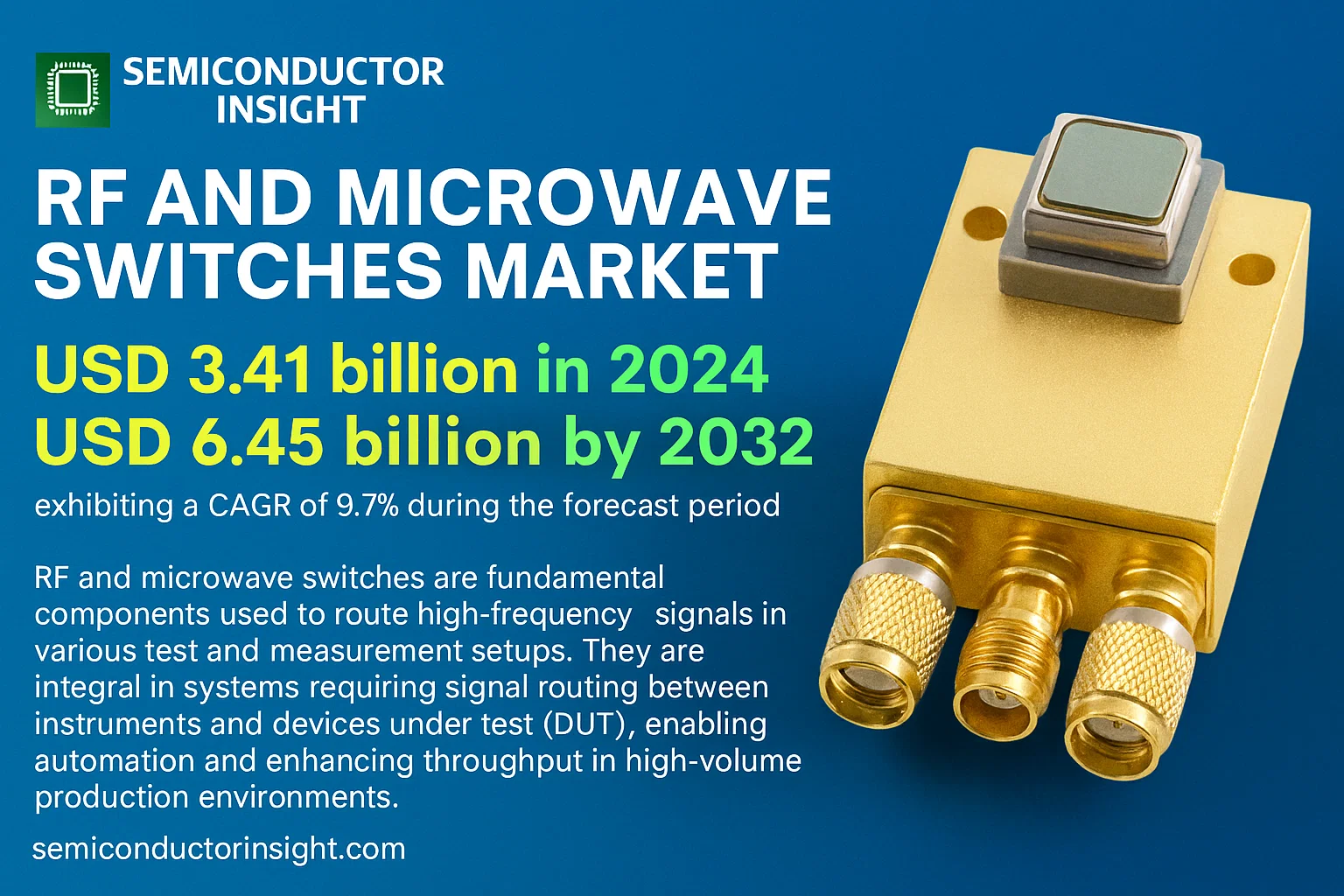
Global RF and Microwave Switches Market was valued at USD 3.41 billion in 2024 and is projected to reach USD 6.45 billion by 2032, exhibiting a CAGR of 9.7% during the forecast period.
RF and microwave switches are fundamental components used to route high-frequency signals in various test and measurement setups. They are integral in systems requiring signal routing between instruments and devices under test (DUT), enabling automation and enhancing throughput in high-volume production environments. The market’s growth is primarily driven by the rapid expansion of 5G infrastructure, the increasing adoption of Internet of Things (IoT) devices, and the continuous demand for high-speed data communication. Furthermore, advancements in aerospace, defense, and automotive electronics, which require robust and reliable switching solutions, contribute significantly to the demand.
The market is segmented based on frequency, with applications spanning across cellular communications, wireless communications, aerospace & defense, industrial & automotive, and consumer goods. Key players in this market include Skyworks, Qorvo, Murata, Infineon, NXP Semiconductors, Maxim Integrated (now part of Analog Devices), Analog Devices, NJR, API Technologies, Radiall, Mini-Circuits, MACOM, Keysight Technologies, Dow-Key Microwave (Dover), Peregrine, Atlantic Microwave (ETL Systems), JFW Industries, California Eastern Laboratories (CEL), Planar Monolithics Industries, and Vaunix Technology, among others.
MARKET DRIVERS
Proliferation of 5G Infrastructure
The global rollout of 5G networks is a primary driver for the RF and microwave switches market. The deployment of 5G requires a dense network of small cells and base stations, each utilizing multiple RF switches for signal routing and band selection. This demand is further amplified by the need for advanced switch technologies, such as GaN-based switches, which offer superior power handling and linearity essential for 5G’s high-frequency bands.
Increasing Demand in Aerospace & Defense
The aerospace and defense sector continues to be a significant consumer of high-reliability RF and microwave switches. These components are critical for electronic warfare systems, radar, satellite communications, and avionics. The need for switches that can operate reliably in harsh environments and offer fast switching speeds to handle complex signal intelligence missions is fueling market growth, with defense spending increases in several regions providing a stable demand base.
➤ Market analysis indicates the global RF switch market is projected to grow at a CAGR of approximately 6.5% over the next five years, largely driven by the telecommunications and defense sectors.
Furthermore, the expansion of the Internet of Things (IoT) ecosystem is creating substantial demand. Billions of connected devices, from smart home sensors to industrial monitors, rely on wireless connectivity, necessitating efficient RF front-end modules where switches play a vital role in managing multiple antennas and frequency bands.
MARKET CHALLENGES
High Design and Fabrication Complexity
A significant challenge in the RF and microwave switches market is the inherent complexity of designing and manufacturing these components. As operating frequencies push into millimeter-wave ranges for 5G and satellite applications, achieving desired performance metrics like low insertion loss, high isolation, and power handling becomes increasingly difficult. This requires specialized semiconductor processes, such as GaAs pHEMT or SOI, which involve high capital expenditure and sophisticated technical expertise.
Other Challenges
Intense Price Pressure
The market is highly competitive, particularly for consumer applications like smartphones, leading to intense price pressure. Manufacturers must continuously innovate to reduce costs while improving performance, a significant challenge given the expensive raw materials and complex fabrication processes involved.
Supply Chain Vulnerabilities
The reliance on specialized semiconductor foundries and rare materials creates supply chain vulnerabilities. Geopolitical tensions and trade restrictions can disrupt the supply of critical components, leading to production delays and increased costs for switch manufacturers.
MARKET RESTRAINTS
High Initial Investment and R&D Costs
The development of advanced RF and microwave switches requires substantial investment in research and development. Designing for higher frequencies, better linearity, and improved integration with other RF front-end components is a capital-intensive process. This high barrier to entry restricts the number of new players in the market and can slow the pace of innovation from smaller companies.
Technical Limitations at Higher Frequencies
As applications move into the Ka-band and above, physical limitations of semiconductor materials and packaging technologies become a major restraint. Issues such as signal loss, parasitic effects, and thermal management become more pronounced, limiting the performance and reliability of switches and restraining their adoption in cutting-edge applications like satellite communications and advanced radar systems.
MARKET OPPORTUNITIES
Emergence of 6G Research and Satellite Communications
Early research and development for 6G wireless technology and the rapid expansion of Low Earth Orbit (LEO) satellite constellations, such as Starlink, present significant growth opportunities. These next-generation systems will operate at terahertz frequencies and require a new class of RF switches with unprecedented speed and performance, opening a new frontier for innovation and market expansion.
Adoption in Automotive Radar and ADAS
The automotive industry’s push towards higher levels of autonomy is driving the adoption of advanced driver-assistance systems (ADAS), which rely heavily on radar sensors. Each radar module uses multiple RF switches for functions like beamforming and object detection. The increasing number of radars per vehicle creates a substantial and growing market for reliable, automotive-grade RF switches.
Advancements in Semiconductor Technologies
Ongoing advancements in semiconductor technologies, particularly Silicon-on-Insulator (SOI) and Gallium Nitride (GaN), are creating opportunities for higher performance and more integrated switches. These technologies enable the development of switches that are smaller, more efficient, and capable of handling higher power, making them suitable for a wider range of commercial and industrial applications.
RF and Microwave Switches Market Trends
Accelerated Market Growth Fueled by Wireless and Defense Sectors
The global RF and Microwave Switches market is experiencing robust expansion, with its valuation projected to surge from $3415 million in 2024 to $6450 million by 2032, reflecting a compound annual growth rate (CAGR) of 9.7%. This significant growth is primarily driven by increasing demand from the wireless communications and aerospace & defense industries. These switches are critical components for routing high-frequency signals in test systems, enabling automated testing and increasing throughput in high-volume production environments by eliminating frequent manual connections.
Other Trends
Frequency Segment Diversification
The market is segmented by frequency into low (up to 1 GHz), medium (1-20 GHz), high (20-40 GHz), and very high frequency (40 GHz+). Medium and high-frequency switches are seeing accelerated adoption to support the development of 5G infrastructure and next-generation radar systems. The diversification in frequency capabilities allows manufacturers to cater to a wider range of applications, from consumer cellular devices to sophisticated aerospace electronics.
Consolidated Competitive Landscape
The competitive environment is characterized by a high degree of consolidation, with the top four manufacturers—Skyworks, Qorvo, Murata, and Infineon—collectively holding approximately 50% of the global market share. This concentration drives intense competition and continuous innovation in product performance, reliability, and miniaturization. Other key players include NXP Semiconductors, Analog Devices, and MACOM, who are also investing heavily in research and development to capture market share.
Regional Production and Market Dynamics
From a regional perspective, North America and Europe are the dominant production hubs for RF and Microwave Switches, benefiting from strong aerospace, defense, and telecommunications sectors. However, Asia, particularly China, is emerging as a significant production and consumption region, fueled by massive investments in wireless communication infrastructure and a growing consumer electronics market. This geographic shift is influencing global supply chains and competitive strategies.
COMPETITIVE LANDSCAPE
Key Industry Players
A Consolidated Market Led by Established Semiconductor Giants
The global RF and Microwave Switches market is characterized by a high degree of consolidation, with the top four manufacturers—Skyworks Solutions Inc., Qorvo, Inc., Murata Manufacturing Co., Ltd., and Infineon Technologies AG—collectively holding approximately 50% of the total market share. These industry leaders possess extensive product portfolios, significant research and development capabilities, and strong intellectual property, which serve as substantial barriers to entry. Their dominance is reinforced by long-standing relationships with major customers across critical end markets such as cellular devices, wireless communications infrastructure, and aerospace & defense. Competition is intense and primarily based on technological innovation, product performance and reliability, and the ability to deliver at scale.
Beyond the leading quartet, the market includes a number of significant niche and specialized players that compete effectively in specific segments or applications. Companies like Analog Devices, Inc., MACOM Technology Solutions, and Mini-Circuits are prominent players with strong technical expertise. Additionally, firms such as Radiall, JFW Industries, and Keysight Technologies cater to specialized high-performance and test & measurement requirements. The competitive environment is further populated by companies focusing on specific technologies or regional markets, creating a dynamic landscape where established giants and agile specialists coexist.
List of Key RF and Microwave Switches Companies Profiled
- Skyworks Solutions Inc.
- Qorvo, Inc.
- Murata Manufacturing Co., Ltd.
- Infineon Technologies AG
- NXP Semiconductors N.V.
- Analog Devices, Inc.
- MACOM Technology Solutions
- Mini-Circuits
- Radiall
- API Technologies (a part of API Technologies Corp.)
- NJR Corporation/NJRC
- Keysight Technologies
- Dow-Key Microwave (Dover Corporation)
- Peregrine Semiconductor (now part of Murata)
- JFW Industries
Segment Analysis:
| Segment Category | Sub-Segments | Key Insights |
| By Type |
|
Solid-State Switches lead the market, favored for their exceptional reliability, fast switching speeds, and compact size, which are critical for modern high-frequency electronics. They are increasingly replacing traditional electromechanical types due to higher durability and lower power consumption, making them a cornerstone for automated test equipment and advanced communication systems. |
| By Application |
|
Wireless Communications represents the dominant application area, driven by the relentless global expansion of 5G infrastructure and the proliferation of IoT devices. The segment’s growth is fuelled by the critical need for robust signal routing in base stations and network equipment, alongside rising demand for high-speed data transmission capabilities that enable next-generation connectivity solutions across various industries. |
| By End User |
|
Electronics Manufacturers constitute the largest customer base, as they integrate RF and microwave switches into a vast array of finished products, from smartphones to automotive radar systems. Their leadership is underpinned by continuous product innovation and high-volume production requirements, which create consistent and substantial demand for reliable switching components to ensure optimal performance and miniaturization in consumer and industrial electronic devices. |
| By Technology |
|
Absorptive Switches are the leading technology due to their superior performance in handling signal integrity by terminating unused ports, which minimizes signal reflection and prevents damage to sensitive components. This characteristic is particularly valued in high-precision applications such as laboratory test equipment and advanced radar systems, where maintaining signal purity and system stability is of paramount importance for accurate measurements and reliable operation. |
| By Configuration |
|
Single Pole Double Throw (SPDT) switches represent the most prevalent configuration, offering a versatile and fundamental routing function that connects one input to one of two outputs. Their widespread adoption is driven by their essential role in numerous standard circuit designs for antenna switching, signal selection, and system redundancy across telecommunications, test instrumentation, and consumer electronics, making them a foundational component in modern RF system architecture. |
Regional Analysis: RF and Microwave Switches Market
The concentration of global consumer electronics production in countries like China and Vietnam creates a foundational demand for RF switches used in smartphones, Wi-Fi routers, and IoT devices. This high-volume manufacturing base drives innovation in miniaturization and cost reduction for switches.
Massive investments in 5G network infrastructure across the region necessitate sophisticated RF switches for base stations and network equipment. Governments and private entities are collaborating to build out next-generation networks faster than any other region.
National policies aimed at achieving technological independence and leading in areas like telecommunications and aerospace are funneling significant investment into domestic RF component development, creating a favorable environment for switch manufacturers.
The growing automotive industry, particularly for electric and connected vehicles, along with industrial automation, is integrating more radar and communication systems, which rely heavily on reliable RF and microwave switching components for signal routing.
North America
North America remains a critical and technologically advanced market for RF and microwave switches, characterized by high demand for premium, high-performance components. The region’s strength lies in its sophisticated defense and aerospace sectors, which require extremely reliable switches for radar, electronic warfare, and satellite communications, often pushing the boundaries of performance specifications. Furthermore, North America is a pioneer in the deployment of advanced telecommunications infrastructure, including 5G mmWave networks, which demand switches capable of handling very high frequencies with low loss. The presence of leading semiconductor companies and a strong culture of R&D fosters continuous innovation in switch technology, particularly for applications in test and measurement equipment and emerging fields like autonomous vehicles.
Europe
The European market for RF and microwave switches is defined by its strong automotive industry, significant aerospace and defense expenditures, and a concerted push for digital sovereignty. Automotive radar systems for advanced driver-assistance systems (ADAS) are a major driver, requiring robust switches that can operate reliably in harsh environments. The region’s space agencies and defense contractors demand high-reliability components for satellite and military communications systems. Additionally, European Union initiatives to bolster its semiconductor and telecommunications infrastructure are creating new opportunities, though the market growth is often more measured and focused on quality and regulatory compliance compared to other regions.
South America
The South American market for RF and microwave switches is emerging, with growth primarily fueled by the gradual modernization of telecommunications infrastructure. Countries like Brazil and Argentina are investing in expanding mobile network coverage and capacity, which generates steady demand for switches used in cellular base stations. The region also sees application in the growing oil and gas sector, where wireless communication and sensing equipment require dependable switching solutions. However, market growth can be inconsistent, influenced by economic fluctuations and the pace of infrastructure investment, making it a region of potential rather than established dominance.
Middle East & Africa
The Middle East & Africa region presents a diverse landscape for the RF and microwave switches market. The oil-rich Gulf Cooperation Council (GCC) countries are investing heavily in smart city projects, defense modernization, and telecom infrastructure, creating demand for high-end switching components. In contrast, other parts of Africa are experiencing growth driven by the rapid expansion of mobile connectivity to underserved populations, necessitating basic but reliable switch components for network equipment. The region’s overall dynamics are split between high-value projects in the Middle East and volume-driven, cost-sensitive growth in parts of Africa.
Report Scope
This market research report provides a comprehensive analysis of the RF and Microwave Switches Market , covering the forecast period 2025–2032. It offers detailed insights into market dynamics, technological advancements, competitive landscape, and key trends shaping the industry.
Key focus areas of the report include:
- Market Overview: The report begins with an overview outlining its current market scenario, key growth indicators, and industry transformation drivers. It discusses macroeconomic factors, demand–supply balance, regulatory landscape, and the strategic role of semiconductors in powering advancements across industries such as automotive, telecommunications, consumer electronics, and industrial automation.
- Market Size & Forecast: Historical data and future projections for revenue, unit shipments, and market value across major regions and segments.
- Segmentation Analysis: Detailed breakdown by product type, technology, application, and end-user industry to identify high-growth segments and investment opportunities.
- Regional Insights: Insights into market performance across North America, Europe, Asia-Pacific, Latin America, and the Middle East & Africa, including country-level analysis where relevant.
- Competitive Landscape: Profiles of leading market participants, including their product offerings, R&D focus, manufacturing capacity, pricing strategies, and recent developments such as mergers, acquisitions, and partnerships.
- Technology Trends & Innovation: Assessment of emerging technologies, integration of AI/IoT, semiconductor design trends, fabrication techniques, and evolving industry standards.
- Market Drivers & Restraints: Evaluation of factors driving market growth along with challenges, supply chain constraints, regulatory issues, and market-entry barriers.
- Stakeholder Insights: Insights for component suppliers, OEMs, system integrators, investors, and policymakers regarding the evolving ecosystem and strategic opportunities.
Primary and secondary research methods are employed, including interviews with industry experts, data from verified sources, and real-time market intelligence to ensure the accuracy and reliability of the insights presented.
FREQUENTLY ASKED QUESTIONS:
What is the current market size of RF and Microwave Switches Market?
-> RF and Microwave Switches Market was valued at USD 3.41 billion in 2024 and is projected to reach USD 6.45 billion by 2032, exhibiting a CAGR of 9.7% during the forecast period.
Which key companies operate in RF and Microwave Switches Market?
-> Key players include Skyworks, Qorvo, Murata, Infineon, NXP Semiconductors, Maxim Integrated, and Analog Devices, among others. The top four manufacturers hold a market share of about 50%.
What are the key growth drivers?
-> Key growth drivers include increased automation in testing processes, demand for high-volume production environments, and the extensive use of switches in microwave test systems for signal routing.
Which region dominates the market?
-> North America and Europe are the major producing regions, while China is a significant and growing market.
What are the emerging trends?
-> Emerging trends include the integration of switches into automated switch matrix systems and the development of solutions for advanced wireless communications and aerospace & defense applications.

Get Sample Report PDF for Exclusive Insights
Report Sample Includes
- Table of Contents
- List of Tables & Figures
- Charts, Research Methodology, and more...
 Download Sample Report PDF


