MARKET INSIGHTS
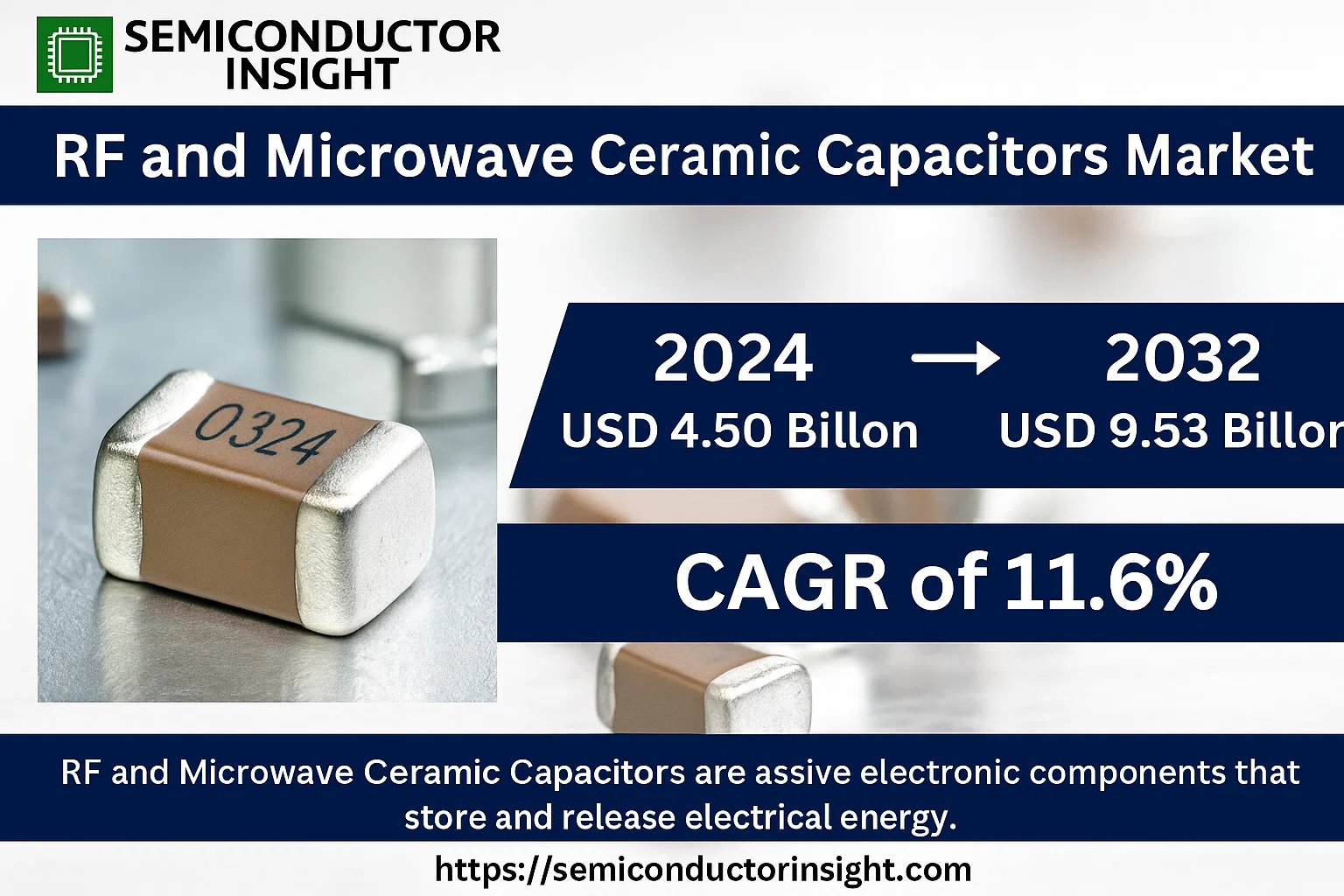
Global RF and Microwave Ceramic Capacitors Market was valued at USD 4.50 billion in 2024 and is projected to reach USD 9.53 billion by 2032, exhibiting a CAGR of 11.6% during the forecast period.
RF and Microwave Ceramic Capacitors are passive electronic components that store and release electrical energy. They are characterized by their high stability, low losses, and high Q-factor, making them essential for high-frequency applications. These components include Class 1 Ceramic Capacitors, known for their stability and low losses, and Class 2 Ceramic Capacitors, which offer higher capacitance values but with some trade-offs in stability and temperature performance.
The market growth is primarily driven by the proliferation of 5G technology, which demands high-frequency components for infrastructure and devices. The increasing adoption of the Internet of Things (IoT) and connected devices also fuels demand. Additionally, advancements in the automotive sector, particularly in electric vehicles (EVs) and advanced driver-assistance systems (ADAS), require reliable high-frequency components. The ongoing miniaturization of electronic devices further pushes the demand for compact, high-performance capacitors. However, the market faces challenges such as supply chain constraints for raw materials and the technical complexity of manufacturing high-performance ceramic capacitors.
Regionally, Asia Pacific dominates the market, holding a share of over 45%, due to the presence of major electronics manufacturing hubs in China, Japan, and South Korea. North America and Europe are also significant markets, driven by technological advancements and high adoption rates of new technologies.
MARKET DRIVERS
Proliferation of 5G Infrastructure and Mobile Devices
The global deployment of 5G networks is a primary driver for the RF and microwave ceramic capacitors market. These components are indispensable in 5G base stations, massive MIMO antennas, and smartphones, where they provide stable capacitance, high Q-factor, and low ESR at high frequencies. The need for capacitors that can operate reliably in the Sub-6 GHz and millimeter-wave bands is fueling demand for advanced ceramic formulations. The rollout of 5G is expected to continue driving double-digit growth in this segment for the foreseeable future.
Growth in Automotive Radar and ADAS
The automotive industry’s shift towards autonomous driving and advanced driver-assistance systems (ADAS) is creating significant demand. RF and microwave ceramic capacitors are critical components in automotive radar systems operating at 24 GHz and 77 GHz frequencies for applications like adaptive cruise control and collision avoidance. The increasing electrification of vehicles also requires robust capacitors for onboard electronics and battery management systems, contributing to market expansion.
➤ The market for RF and microwave ceramic capacitors is projected to grow at a CAGR of approximately 7.5% from 2024 to 2030, largely driven by telecommunications and automotive electronics.
Furthermore, the expansion of Internet of Things (IoT) and connected devices across industrial, consumer, and medical sectors requires compact, high-frequency components. RF ceramic capacitors are essential for wireless connectivity modules (Wi-Fi 6/6E, Bluetooth, LoRa), sensors, and RF power amplifiers, supporting the broader trend of digitalization and smart technology integration.
MARKET CHALLENGES
Material and Manufacturing Complexities
Producing RF and microwave ceramic capacitors with consistent high performance presents significant technical challenges. Achieving the precise dielectric properties, temperature stability (characterized by codes like C0G/NP0), and minimal losses at multi-gigahertz frequencies requires sophisticated material science and tight manufacturing controls. Variations in raw material quality, particularly for high-k ceramic powders, can lead to performance inconsistencies and yield issues, impacting cost-effectiveness and supply reliability.
Other Challenges
Miniaturization and Performance Trade-offs
As electronic devices become smaller, there is immense pressure to reduce the size of passive components. However, miniaturizing RF capacitors while maintaining high Q-factor, high self-resonant frequency, and adequate voltage rating is extremely difficult. This often forces designers to make difficult trade-offs between size, performance, and cost, limiting the adoption in space-constrained, high-performance applications.
Intense Price Competition
The market is highly competitive, with numerous global and regional manufacturers. This leads to significant price pressure, especially for standard product categories. Maintaining profitability while investing in research and development for next-generation materials and processes is a persistent challenge for established players and new entrants alike.
MARKET RESTRAINTS
Supply Chain Vulnerabilities and Raw Material Dependence
The production of high-quality ceramic capacitors is heavily dependent on specific raw materials, including precious metals like palladium and silver for electrodes, and specialized ceramic powders. Geopolitical tensions, trade restrictions, and fluctuations in the prices of these commodities can disrupt the supply chain and increase manufacturing costs. This dependency creates volatility and can restrain market growth, particularly for manufacturers without diversified sourcing strategies.
Competition from Alternative Technologies
While ceramic capacitors dominate many high-frequency applications, they face competition from alternative technologies. In some high-power RF applications, film capacitors may be preferred for their superior self-healing properties and higher current ratings. Additionally, the integration of passive components directly into semiconductor packages (IPD – Integrated Passive Devices) or printed circuit boards (embedded passives) poses a long-term threat by reducing the need for discrete capacitors in certain designs.
MARKET OPPORTUNITIES
Advancements in Satellite Communication and Aerospace
The low-earth orbit (LEO) satellite boom for global broadband internet (e.g., Starlink, OneWeb) represents a major growth avenue. These systems require highly reliable RF components that can withstand harsh environmental conditions. RF and microwave ceramic capacitors with enhanced reliability, radiation tolerance, and extended temperature ranges are critical for satellite transceivers and ground station equipment, opening a high-value market segment.
Development of Next-Generation Dielectric Materials
There is a significant opportunity for manufacturers who can innovate in dielectric materials. Research into new ceramic compositions, such as those based on barium titanate or titanium dioxide with novel dopants, aims to achieve higher capacitance density, better temperature and voltage stability, and lower losses at millimeter-wave frequencies. Breakthroughs in material science could enable new applications in 6G research, advanced radar, and quantum computing.
Expansion in Medical and Industrial Electronics
The growing use of RF energy in medical applications like surgical ablation, diathermy, and advanced imaging systems (MRI) requires specialized capacitors. Similarly, industrial applications such as plasma generation, RF heating, and wireless sensor networks in Industry 4.0 present opportunities for high-power, high-frequency ceramic capacitors designed for rigorous operational environments and long-term reliability.
RF and Microwave Ceramic Capacitors Market Trends
Accelerated Market Expansion Driven by Proliferation of High-Frequency Electronics
The global RF and Microwave Ceramic Capacitors market is experiencing robust growth, characterized by a valuation of approximately $4,505 million in 2024 and a projection to reach $9,535 million by 2032. This represents a compound annual growth rate (CAGR) of 11.6% during the forecast period. The primary driver of this substantial expansion is the increasing integration of RF capabilities in consumer electronics, automotive systems, and telecommunications infrastructure. The demand for components that offer high stability, low loss, and superior performance at microwave frequencies is at an all-time high, directly fueling the market for these specialized capacitors. The Asia-Pacific region, led by China, dominates the market with a share of approximately 33%, a testament to its massive electronics manufacturing base.
Other Trends
Consolidation of Market Share Among Top Manufacturers
A significant trend is the highly concentrated nature of the competitive landscape. The global market’s top three companies, namely AVX, Walsin, and Murata, collectively command over 68% of the total market share. This concentration drives intense competition focused on technological innovation, product miniaturization, and cost optimization. Manufacturers are heavily investing in research and development to enhance the performance characteristics of Class I and Class II ceramic capacitors, which are the two primary types segmented in the market. This competition is crucial for meeting the evolving demands for higher frequency applications and improved reliability.
Diversification of Applications Across Key Industries
The application landscape for RF and Microwave Ceramic Capacitors is broadening. While consumer electronics remains a dominant segment, there is significant growth potential in the automobiles and defense & military sectors. In the automotive industry, the rise of electric vehicles (EVs) and advanced driver-assistance systems (ADAS) requires robust RF components for radar and communication modules. Similarly, the defense sector demands high-reliability capacitors for radar systems, electronic warfare, and communication equipment. The medical industry also presents a growing application area for specialized diagnostic and therapeutic devices.
Regional Market Dynamics and Supply Chain Evolution
Following China’s lead, Japan and Europe hold significant market shares of about 18% and 13%, respectively. Regional dynamics are influenced by local manufacturing capabilities, technological expertise, and demand from end-use industries. A key trend is the ongoing evolution of the global supply chain, with manufacturers striving to ensure resilience and mitigate risks associated with geopolitical tensions and material availability. This involves strategic expansions, partnerships, and potential mergers and acquisitions to secure supply lines and strengthen market positions globally. The market’s future trajectory will be heavily influenced by how well companies navigate these regional and logistical challenges while capitalizing on the sustained demand from high-growth applications.
COMPETITIVE LANDSCAPE
Key Industry Players
A Highly Concentrated Market Led by Technological Titans
The global RF and Microwave Ceramic Capacitors market is characterized by a high degree of consolidation, with the top three players—Murata, AVX, and Walsin—collectively commanding over 68% of the market share as of 2024. This concentration is driven by significant barriers to entry, including the need for advanced ceramic material science expertise, stringent quality control for high-frequency performance, and established, long-term customer relationships in critical sectors like defense and telecommunications. Murata Manufacturing Co., Ltd. stands as the undisputed global leader, leveraging its extensive portfolio and innovation in multilayer ceramic capacitor (MLCC) technology to maintain a dominant position across consumer electronics and automotive applications.
Beyond the market leaders, a group of established international and regional players compete by focusing on specific niches and applications. Companies such as Vishay Intertechnology, Kemet (now part of Yageo Corporation), and Taiyo Yuden offer strong competition with specialized high-reliability products for the aerospace, defense, and medical industries. Other significant contributors include Johanson Technology, renowned for its high-Q and RF microwave capacitors, and Würth Elektronik, which has a strong presence in the European market. Regional manufacturers, particularly in China, such as Fenghua Advanced Technology and Hongyuan Electronics, are increasingly influential, competing aggressively on price and expanding their technological capabilities to capture a larger share of the growing domestic market, which accounts for approximately 33% of global demand.
List of Key RF and Microwave Ceramic Capacitors Companies Profiled
- Murata Manufacturing Co., Ltd.
- AVX Corporation
- Walsin Technology Corporation
- Vishay Intertechnology, Inc.
- Taiyo Yuden Co., Ltd.
- Kemet Corporation (Yageo Group)
- Johanson Technology, Inc.
- Würth Elektronik GmbH & Co. KG
- Hongyuan Electronics
- Fenghua Advanced Technology
- Dalicap
- Samwha Capacitor Group
- Holy Stone Enterprise Co., Ltd.
Segment Analysis:
| Segment Category | Sub-Segments | Key Insights |
| By Type |
|
Class I Ceramic Capacitors represent the leading segment due to their superior performance in high-frequency applications where stability and low losses are paramount. Their excellent temperature coefficient and minimal signal loss characteristics make them indispensable for critical RF and microwave circuits in communication systems and precision instruments. The segment benefits from consistent demand for reliable components in applications where signal integrity cannot be compromised. Class II capacitors, while offering higher volumetric efficiency, are generally employed in less demanding applications due to their inherent limitations regarding stability and performance at higher frequencies. |
| By Application |
|
Consumer Electronics holds a prominent position as the leading application segment, driven by the pervasive use of RF and microwave capacitors in smartphones, tablets, and wireless connectivity modules like Wi-Fi and Bluetooth. The relentless miniaturization trend and the push for higher data speeds in consumer devices continuously fuel the need for high-performance, compact capacitors. While the defense and military sector demands components with extreme reliability and ruggedness for radars and communication systems, and the automotive sector’s growth is linked to advanced driver-assistance systems (ADAS) and in-vehicle networking, the sheer volume and rapid innovation cycles in consumer electronics secure its leadership. |
| By End User |
|
Original Equipment Manufacturers (OEMs) constitute the most significant end-user segment, as they integrate RF and microwave ceramic capacitors directly into their final products for various industries. These manufacturers require a consistent and reliable supply of high-quality components to meet their production schedules and maintain product performance standards. The strategic partnerships between major capacitor suppliers and large OEMs drive technological alignment and innovation. Electronic Manufacturing Services providers are also key players, catering to brands that outsource production, while distributors serve a crucial role in the supply chain by providing accessibility and logistics support for a broader range of customers, including smaller manufacturers. |
| By Dielectric Material |
|
Paraelectric Materials (e.g., C0G/NP0) are the leading sub-segment by dielectric material, critically underpinning the Class I capacitor segment. Their primary advantage lies in exceptional stability, exhibiting minimal change in capacitance with temperature variations, voltage, and frequency. This makes them the material of choice for resonant circuits, filters, and other applications where predictable performance is non-negotiable. While ferroelectric materials offer higher capacitance values in smaller sizes for decoupling and bypass applications, they lack the precision required for core RF functions. Specialty high-k materials are developed for niche applications requiring unique performance trade-offs but do not challenge the dominance of paraelectrics in high-performance RF markets. |
| By Sales Channel |
|
Direct Sales is the leading channel for RF and microwave ceramic capacitors, particularly for high-volume purchases by major OEMs and large EMS providers. This channel facilitates strong supplier-customer relationships, enables collaborative development, ensures supply chain security, and often involves long-term agreements. The distribution network plays a vital role for medium and small-sized enterprises, providing inventory management, technical support, and access to a wide product portfolio from multiple manufacturers. Although online retail is growing for smaller, standard-component purchases and prototyping, it remains a secondary channel due to the technical specificity and the need for guaranteed quality and authenticity in professional electronics manufacturing. |
Regional Analysis: RF and Microwave Ceramic Capacitors Market
Asia-Pacific
The region’s dominance is rooted in its position as the world’s primary electronics manufacturing center. The high concentration of device assembly plants for smartphones, base stations, and networking equipment creates immense, consistent demand for RF and microwave ceramic capacitors, driving both volume production and localized supply chain development.
Aggressive deployment of 5G infrastructure is a key growth catalyst. The need for capacitors that offer low loss and high stability at microwave frequencies for 5G base stations and user equipment is particularly strong here, with national initiatives accelerating adoption and stimulating advanced capacitor development.
Leading manufacturers in Japan and South Korea are at the forefront of developing next-generation ceramic formulations, such as those based on paraelectric materials, to achieve higher Q factors and better temperature stability, catering to the demanding requirements of advanced communication and radar systems.
A highly integrated and efficient supply chain for electronic components reduces lead times and costs. Proximity to raw material processing for ceramic dielectrics and electrode metals, combined with robust logistics, gives regional manufacturers a significant competitive advantage in serving both local and global markets.
North America
North America remains a critical and technologically advanced market, characterized by strong demand from the aerospace, defense, and high-performance communications sectors. The presence of leading defense contractors and satellite communication companies drives the need for ultra-reliable, high-performance RF and microwave capacitors that can withstand extreme environments. Significant R&D activities, often funded by defense budgets, focus on pushing the performance boundaries for applications in radar systems, electronic warfare, and space-qualified equipment. The market is also influenced by the ongoing modernization of communication networks and the early adoption of advanced technologies like satellite internet constellations, which require components with exceptional quality and consistency.
Europe
The European market is distinguished by its strong automotive and industrial sectors, alongside reputable research institutions. The automotive industry’s shift towards electric vehicles and advanced driver-assistance systems (ADAS) generates demand for robust capacitors used in radar sensors and vehicle communication modules. Furthermore, established industrial automation and medical equipment manufacturers require high-frequency components known for their precision and long-term reliability. European capacitor suppliers often compete on quality and specialization, focusing on niche applications that demand specific certifications and adherence to stringent environmental and performance standards, rather than competing solely on cost.
South America
The South American market for RF and Microwave Ceramic Capacitors is developing, with growth primarily linked to the gradual expansion of telecommunications infrastructure and the consumer electronics sector. Countries like Brazil and Argentina are seeing increased investment in mobile network upgrades, which stimulates demand for basic to mid-performance capacitors. The market is largely served by imports from Asia and North America, with limited local manufacturing capability. Growth is steady but can be influenced by regional economic fluctuations and currency volatility, which impact investment in new technology deployments and capital equipment purchases that incorporate these components.
Middle East & Africa
This region presents a market with diverse and growing opportunities, particularly driven by investments in telecommunications and infrastructure projects in the Gulf Cooperation Council (GCC) countries. The rollout of 5G networks and investments in smart city initiatives are key demand drivers. There is also significant demand from the oil and gas industry for communication and sensing equipment used in remote and harsh environments. While the market is smaller compared to other regions, it is characterized by a preference for high-reliability components from established international suppliers, with potential for growth as digital transformation efforts continue across the region.
Report Scope
This market research report provides a comprehensive analysis of the RF and Microwave Ceramic Capacitors Market , covering the forecast period 2025–2032. It offers detailed insights into market dynamics, technological advancements, competitive landscape, and key trends shaping the industry.
Key focus areas of the report include:
- Market Overview: The report begins with an overview outlining its current market scenario, key growth indicators, and industry transformation drivers. It discusses macroeconomic factors, demand–supply balance, regulatory landscape, and the strategic role of semiconductors in powering advancements across industries such as automotive, telecommunications, consumer electronics, and industrial automation.
- Market Size & Forecast: Historical data and future projections for revenue, unit shipments, and market value across major regions and segments.
- Segmentation Analysis: Detailed breakdown by product type, technology, application, and end-user industry to identify high-growth segments and investment opportunities.
- Regional Insights: Insights into market performance across North America, Europe, Asia-Pacific, Latin America, and the Middle East & Africa, including country-level analysis where relevant.
- Competitive Landscape: Profiles of leading market participants, including their product offerings, R&D focus, manufacturing capacity, pricing strategies, and recent developments such as mergers, acquisitions, and partnerships.
- Technology Trends & Innovation: Assessment of emerging technologies, integration of AI/IoT, semiconductor design trends, fabrication techniques, and evolving industry standards.
- Market Drivers & Restraints: Evaluation of factors driving market growth along with challenges, supply chain constraints, regulatory issues, and market-entry barriers.
- Stakeholder Insights: Insights for component suppliers, OEMs, system integrators, investors, and policymakers regarding the evolving ecosystem and strategic opportunities.
Primary and secondary research methods are employed, including interviews with industry experts, data from verified sources, and real-time market intelligence to ensure the accuracy and reliability of the insights presented.
FREQUENTLY ASKED QUESTIONS:
What is the current market size of RF and Microwave Ceramic Capacitors Market?
-> Global RF and Microwave Ceramic Capacitors Market was valued at USD 4505 million in 2024 and is projected to reach USD 9535 million by 2032, exhibiting a CAGR of 11.6% during the forecast period.
Which key companies operate in RF and Microwave Ceramic Capacitors Market?
-> Key players include AVX, Walsin, Murata, Vishay, Taiyo Yuden, Kemet (Yageo), Johanson, Wurth Elektronik, Hongyuan Electronics, Fenghua Technology, and Dalicap, among others. The top three companies hold a combined market share of over 68%.
What are the key growth drivers?
-> Key growth drivers include advancements in telecommunications, increasing demand from consumer electronics and automotive sectors, and the expansion of 5G infrastructure.
Which region dominates the market?
-> China is the largest market, accounting for about 33% of the global share, followed by Japan (18%) and Europe (13%).
What are the emerging trends?
-> Emerging trends include miniaturization of components, development of high-frequency applications, and integration of advanced materials for improved performance and reliability.

Get Sample Report PDF for Exclusive Insights
Report Sample Includes
- Table of Contents
- List of Tables & Figures
- Charts, Research Methodology, and more...
 Download Sample Report PDF