Reticle Mask Particle Removers Market Insights
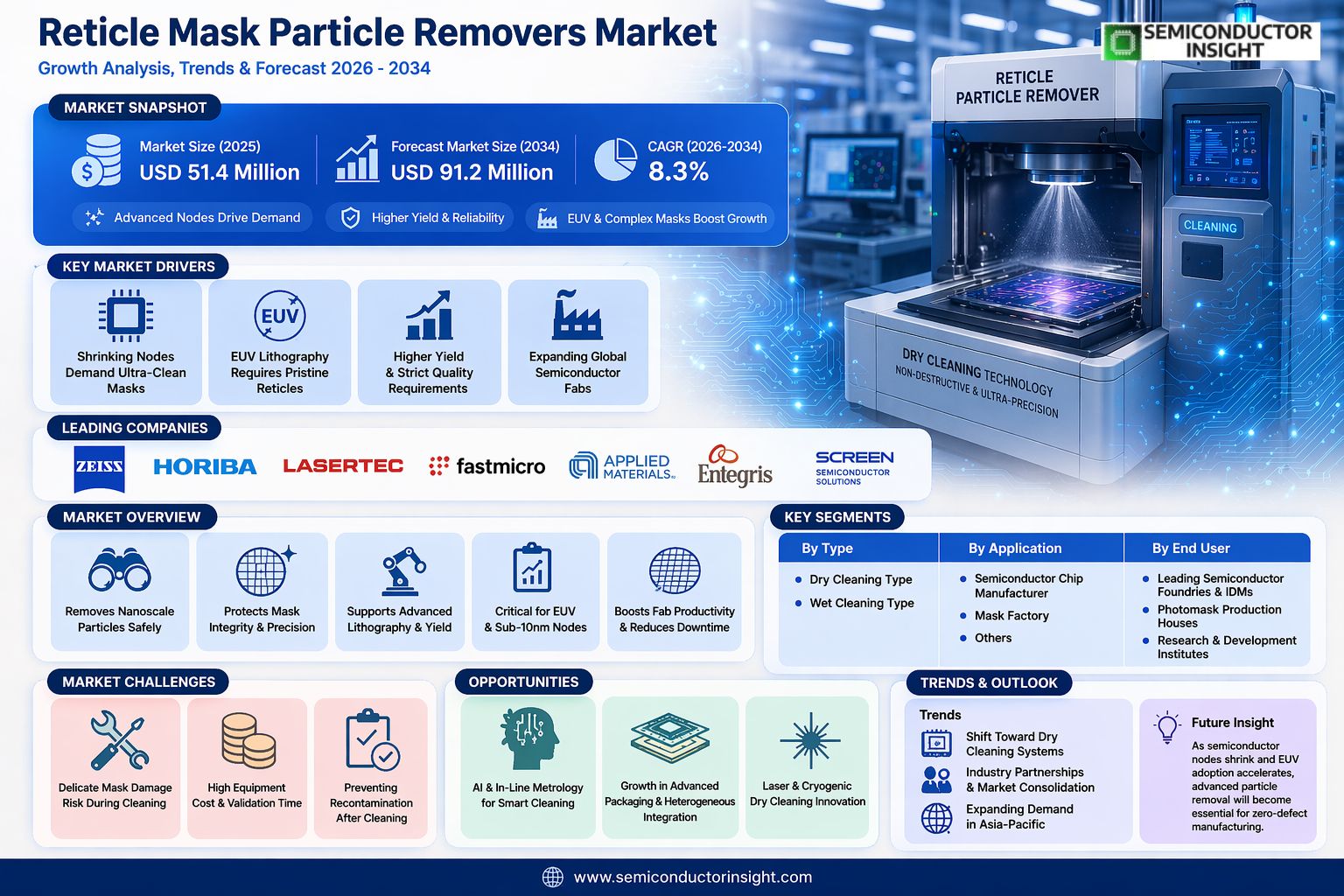
Global Reticle Mask Particle Removers market size was valued at USD 51.4 million in 2025. The market is projected to grow from USD 55.7 million in 2026 to USD 91.2 million by 2034, exhibiting a CAGR of 8.3% during the forecast period.
Reticle Mask Particle Removers are specialized tools or systems designed to remove particles, contaminants, or defects from photomasks (reticles) used in semiconductor manufacturing. These systems employ various non-destructive cleaning techniques, such as laser shockwave and cryogenic aerosol methods, to ensure the integrity of the mask and maintain high-quality lithography for advanced nodes below 10nm.
The market is experiencing steady growth due to several factors, including the relentless drive for miniaturization in semiconductors and the increasing complexity of EUV (Extreme Ultraviolet) lithography masks, which are exceptionally sensitive to particulate contamination. Furthermore, rising investments in new semiconductor fabrication plants globally and stringent yield management requirements are contributing to market expansion. Initiatives by key players in the market are also expected to fuel growth. For instance, leading companies continuously innovate their cleaning technologies to handle next-generation mask materials and smaller defect sizes. Zeiss, HORIBA, Lasertec Corporation, Fastmicro, and Applied Materials are some of the key players that operate in the market with a wide range of portfolios.
MARKET DRIVERS
Advancing Semiconductor Node Shrinks and Yield Demands
The relentless drive towards sub-3nm semiconductor manufacturing is the primary force propelling the Reticle Mask Particle Removers Market. At these extreme scales, even nanoscale contamination can cause catastrophic device failures, making the absolute cleanliness of photomasks non-negotiable. The economic imperative for higher wafer yields directly translates into stringent requirements for reticle inspection and cleaning protocols, fueling continuous investment in advanced particle removal technologies.
Adoption of EUV Lithography and Complex Mask Stacks
The industry’s shift to Extreme Ultraviolet (EUV) lithography represents a significant driver. EUV masks feature intricate multilayer structures and sensitive absorber materials that are highly susceptible to particle-induced damage. This complexity necessitates specialized, gentler cleaning methods to preserve the mask’s critical dimensions and phase-shifting properties, pushing the development of next-generation Reticle Mask Particle Removers beyond conventional techniques.
➤ The annual cost of wafer yield loss due to mask defects is estimated to run into billions of dollars industry-wide, making proactive particle control a high-ROI investment for leading fabs.
Furthermore, the increasing use of multi-patterning techniques, even alongside EUV, results in masks being handled and exposed more frequently. This elevated usage cycle heightens the risk of contamination, thereby driving higher frequency of cleaning and sustained demand for reliable, high-throughput particle removal systems within the semiconductor fabrication process.
MARKET CHALLENGES
Technical Hurdles in Cleaning Advanced Mask Materials
A core challenge for the Reticle Mask Particle Removers Market is the technical difficulty of removing stubborn sub-20nm contaminants without damaging the delicate mask topography. Traditional methods like megasonic or chemical sprays risk pattern damage or material degradation on advanced EUV masks. Developing processes that achieve perfect particle removal efficiency with zero impact on critical dimensions and zero added surface roughness remains a significant engineering barrier.
Other Challenges
High Cost of Ownership and Validation
The capital investment for state-of-the-art cleaning tools is substantial. Furthermore, the qualification and validation process for a new cleaning recipe or tool in a high-volume manufacturing line is extremely time-consuming and costly, requiring extensive defect inspection and yield correlation studies, which can slow adoption rates.
Contamination Control in Mask Storage and Handling
Particle removal is only one part of the equation. A persistent challenge is preventing recontamination after cleaning. This requires perfectly integrated solutions encompassing ultra-clean pods, advanced handling robotics, and mini-environments, adding complexity and cost to the overall reticle management ecosystem beyond the cleaning tool itself.
MARKET RESTRAINTS
Capital Intensity and Fab Investment Cycles
The cyclical nature of semiconductor capital expenditure acts as a key restraint. During industry downturns or periods of capacity digestion, chip manufacturers delay or reduce investments in new equipment, including advanced Reticle Mask Particle Removers. The high cost per tool means purchases are carefully timed with new fab construction or major technology node transitions, leading to uneven demand flows in the market.
Consolidation and Long Equipment Lifetimes
Market consolidation among both chipmakers and mask shops creates a smaller pool of potential customers with significant bargaining power, potentially squeezing margins for equipment suppliers. Additionally, the inherent durability and long operational life (often exceeding a decade) of core cleaning platforms suppress the replacement market, as fabs seek to extend the lifecycle of existing tools through upgrades and service contracts rather than new purchases.
MARKET OPPORTUNITIES
Integration of In-Line Metrology and AI-Driven Cleaning
The convergence of cleaning with in-situ metrology presents a major opportunity. The next generation of Reticle Mask Particle Removers Market tools will integrate real-time inspection capabilities to detect contamination and verify cleanliness post-process. Coupling this with AI and machine learning algorithms will enable predictive cleaning schedules and adaptive, recipe-less processes that optimize themselves for specific defect types, maximizing yield and tool utilization.
Expansion into Advanced Packaging and Heterogeneous Integration
Beyond front-end fabrication, the rise of advanced packaging (2.5D/3D IC, chiplets) and heterogeneous integration requires precise lithography on interposers and silicon wafers. These processes, often using legacy nodes but demanding high yields, create a secondary growth avenue for reticle cleaning solutions tailored to the specific contamination profiles and throughput needs of packaging and assembly facilities.
Development of Dry and Laser-Based Cleaning Technologies
Environmental regulations and the need for material-specific solutions are driving R&D into alternative cleaning methodologies. The commercialization of effective dry chemical, cryogenic aerosol, and selective laser-based particle removal techniques offers significant opportunities. These methods promise to reduce chemical usage, water consumption, and physical contact with the mask, appealing to manufacturers focused on sustainability and handling the most sensitive next-generation mask materials.
Reticle Mask Particle Removers Market Trends
Shift Towards Dry Cleaning Systems
A prominent trend within the Reticle Mask Particle Removers Market is the increasing preference for dry cleaning technologies over traditional wet cleaning methods. This transition is driven by the need to eliminate chemical residues and watermarks, which are critical contamination risks for next-generation photomasks. Modern dry cleaning systems utilize techniques such as laser irradiation and cryogenic aerosol sprays to dislodge sub-100nm particles without surface damage. This method is critical for advanced semiconductor manufacturing nodes, where even nanometer-sized contaminants can lead to significant yield loss.
Other Trends
Industry Consolidation and Strategic Partnerships
The competitive landscape is characterized by strategic integrations and partnerships as key players,including Zeiss, HORIBA, and Lasertec Corporation,aim to offer comprehensive solutions. Companies are actively engaging in mergers and acquisitions to integrate complementary technologies and expand their global service and support networks. This consolidation enhances R&D capabilities, enabling more robust and integrated cleaning solutions tailored for both semiconductor chip manufacturers and mask factories.
Demand Driven by Advanced Packaging
Beyond traditional lithography, the growth in advanced semiconductor packaging, such as 3D-IC and fan-out wafer-level packaging, is generating new demand for reticle maintenance. These complex processes use masks for multiple patterning and redistribution layers, increasing the frequency of cleaning cycles and necessitating more precise and reliable particle removal systems to ensure package integrity and performance.
Regional Market Expansion in Asia-Pacific
The Asia-Pacific region, led by semiconductor manufacturing hubs in China, Japan, South Korea, and Taiwan, is a primary driver for the Reticle Mask Particle Removers Market. Significant investments in new fab capacity and the localization of supply chains are accelerating the adoption of on-site and in-line cleaning equipment. Market suppliers are enhancing their regional presence with technical centers and direct sales operations to better serve the concentrated demand from mask factories and chipmakers in this geography.
COMPETITIVE LANDSCAPE
Key Industry Players
Market Dominated by Leading Precision Equipment Suppliers in High-Growth Semiconductor Equipment Niche
Global Reticle Mask Particle Removers market exhibits a competitive and technologically intensive structure, characterized by the dominance of established capital equipment vendors serving the advanced semiconductor lithography ecosystem. According to recent market analyses, Global top five players collectively commanded a significant share of revenue in 2025, indicating a consolidated leadership tier. Global leaders such as Zeiss and Applied Materials bring substantial scale and deep expertise in precision optics and integrated process solutions, respectively, to this critical mask cleaning segment. This market concentration is driven by high barriers to entry, including the need for extensive R&D in non-destructive cleaning technologies (both dry and wet types), stringent certification for use in leading-edge chip fabs, and the necessity to provide global service and support networks for tool uptime.
Beyond the top-tier incumbents, a cohort of specialized and niche players contributes to a diverse competitive landscape. Companies like Lasertec Corporation and HORIBA leverage core competencies in inspection, metrology, and laser technology to offer integrated solutions. Meanwhile, specialized entities such as Fastmicro focus intently on particle removal and surface conditioning technologies, competing on innovation, specialization, and responsiveness to specific process challenges. The market sees ongoing competition through technological differentiation in cleaning mechanisms, throughput, automation, and compatibility with increasingly complex EUV (Extreme Ultraviolet) mask architectures, with players vying for partnerships with major semiconductor chip manufacturers and independent mask factories.
List of Key Reticle Mask Particle Removers Companies Profiled
- Carl Zeiss SMT GmbH
- HORIBA, Ltd.
- Lasertec Corporation
- Fastmicro SA
- Applied Materials, Inc.
- Entegris, Inc.
- SCREEN Semiconductor Solutions Co., Ltd.
- KLA Corporation
- Advanced Dicing Technologies (ADT) Ltd.
- Shinkawa Ltd.
- Rudolph Technologies, Inc.
- MGI Group
- Taiyo Nippon Sanso (Matheson Tri-Gas)
- PSK Inc.
- Axcells Technologies
Segment Analysis:
| Segment Category | Sub-Segments | Key Insights |
| By Type |
|
Dry Cleaning Type is recognized as the technologically advanced and preferred segment, particularly as feature sizes shrink in semiconductor manufacturing. Its dominance is driven by superior non-destructive cleaning efficacy for sensitive photomasks and the elimination of liquid residue risks. The process is also valued for enhanced process control and repeatability, aligning with Industry 4.0 automation trends. Continuous innovation in techniques like laser-based and cryogenic cleaning is expanding its application scope, making it a critical enabler for next-generation lithography nodes requiring pristine mask quality. |
| By Application |
|
Semiconductor Chip Manufacturer application represents the primary and most demanding segment for particle remover systems. The critical need for flawless photomasks in high-volume fabrication (FAB) environments drives consistent adoption and re-investment. Chipmakers prioritize systems that minimize downtime and integrate seamlessly into sophisticated lithography tool clusters. This segment exhibits the most rigorous requirements for cleaning performance and reliability to prevent catastrophic yield loss, fostering strong partnerships between equipment suppliers and leading foundries and IDMs to develop customized cleaning solutions. |
| By End User |
|
Leading Semiconductor Foundries & IDMs constitute the dominant end-user segment due to their massive scale of operation and strategic focus on yield management. These entities drive market innovation by setting stringent technical specifications and demanding continuous equipment upgrades. Their purchasing decisions are heavily influenced by total cost of ownership, equipment uptime, and vendor support capabilities. The concentration of market demand among a small number of global technology leaders creates a high-barrier, relationship-driven competitive environment where suppliers must demonstrate proven field performance and robust global service networks. |
| By Technology Sophistication |
|
Advanced Node (Below 10nm) applications are the primary growth engine for the market, demanding the highest level of cleaning technology. The extreme sensitivity of EUV and multi-patterning masks to nanoscale contaminants necessitates ultra-precise, often dry-cleaning, solutions. This segment commands premium pricing and fosters intense R&D focus on defect reduction. Equipment for this node features sophisticated in-situ metrology and data analytics for predictive maintenance, making it a key differentiator for technology providers and creating a significant barrier to entry for new market participants. |
| By Integration Type |
|
Integrated Cluster Tool Modules are becoming increasingly vital within advanced semiconductor fabs, representing a leading integration trend. This approach enhances overall lithography cell efficiency by minimizing mask handling and transport, thereby reducing contamination risk and cycle time. Integration supports seamless data flow for process control and is essential for fully automated mini-environment fabs. The demand for these sophisticated, factory-automation-friendly solutions is strongest among tier-one manufacturers who prioritize streamlined workflow and maximum tool utilization over initial equipment cost. |
Regional Analysis: Global Reticle Mask Particle Removers Market
Asia-Pacific
The density of advanced semiconductor fabs in Taiwan, South Korea, and China creates an unparalleled demand cluster for reticle mask particle removers. This concentration drives continuous equipment upgrades and high-volume procurement cycles as fabs strive for maximum yield and tool utilization in competitive production environments.
Fabs in this region are often first to adopt next-generation lithography processes like EUV, which have significantly stricter particulate contamination tolerances. This positions the Asia-Pacific market as the primary testing and scaling ground for the most sophisticated reticle cleaning technologies in the Reticle Mask Particle Removers Market.
Proximity to equipment manufacturers and the establishment of extensive local service and R&D centers enable faster response times and solution customization. This integrated support system is critical for minimizing fab downtime and is a key competitive advantage for suppliers in the regional market.
Government-led initiatives and substantial funding aimed at achieving semiconductor self-sufficiency are accelerating fab construction and modernization across the region. These macro-trends guarantee a sustained, long-term pipeline of demand for critical supporting equipment like particle removers.
North America
North America remains a critical and technologically sophisticated region in the Reticle Mask Particle Removers Market, anchored by leading-edge logic and design-focused semiconductor companies, particularly in the United States. The market dynamics are characterized by a strong emphasis on R&D, prototyping, and the development of cutting-edge process technologies. Demand for particle removers is driven by the need to support advanced research in next-generation nodes, packaging technologies like chiplets, and specialized applications. While high-volume manufacturing is less concentrated than in Asia-Pacific, the region’s fabs and research facilities demand highly reliable, automated, and data-integrated cleaning solutions that offer superior process control and traceability, influencing global product development trends.
Europe
The European market for reticle mask particle removers is defined by its focus on specialized semiconductor segments, including automotive, industrial, and power electronics. Key manufacturing hubs in Germany, France, and Ireland support this demand. The regional market emphasizes precision, equipment longevity, and strict adherence to quality and environmental standards. Growth is underpinned by the continent’s strategic push to bolster its semiconductor manufacturing capacity, as outlined in the European Chips Act. This initiative is expected to drive investments in new and upgraded fabrication facilities, subsequently increasing the need for advanced contamination control equipment like particle removers to ensure the high reliability required for automotive and industrial-grade chips.
South America
South America represents an emerging and niche segment within Global Reticle Mask Particle Removers Market. Current semiconductor manufacturing activity is limited, focusing primarily on analog, power, and microcontroller chips for the regional consumer and industrial sectors. The demand for particle remover equipment is consequently modest and tied to the maintenance and occasional upgrades of existing fabrication lines. Market dynamics are influenced by regional economic conditions and industrial policies. Future growth potential is linked to any successful governmental efforts to develop a more robust local electronics manufacturing ecosystem, which would gradually increase the need for supporting semiconductor capital equipment.
Middle East & Africa
The Middle East & Africa region currently holds a minimal share of Global Reticle Mask Particle Removers Market. Semiconductor manufacturing infrastructure is in very early stages of development, with limited fab presence. Any existing demand is primarily for equipment servicing specialized research institutions or small-scale production facilities. However, the region presents a potential long-term horizon for market expansion, driven by ambitious economic diversification plans in several Gulf nations. Significant investments in technology and advanced industry sectors could, over the long term, lead to the establishment of semiconductor manufacturing, which would eventually generate demand for the full suite of fab equipment, including reticle cleaning solutions.
Report Scope
This market research report provides a comprehensive analysis of the Reticle Mask Particle Removers Market , covering the forecast period 2026–2034. It offers detailed insights into market dynamics, technological advancements, competitive landscape, and key trends shaping the industry.
Key focus areas of the report include:
- Market Overview: The report begins with an overview outlining its current market scenario, key growth indicators, and industry transformation drivers. It discusses macroeconomic factors, demand–supply balance, regulatory landscape, and the strategic role of semiconductors in powering advancements across industries such as automotive, telecommunications, consumer electronics, and industrial automation.
- Market Size & Forecast: Historical data and future projections for revenue, unit shipments, and market value across major regions and segments.
- Segmentation Analysis: Detailed breakdown by product type, technology, application, and end-user industry to identify high-growth segments and investment opportunities.
- Regional Insights: Insights into market performance across North America, Europe, Asia-Pacific, Latin America, and the Middle East & Africa, including country-level analysis where relevant.
- Competitive Landscape: Profiles of leading market participants, including their product offerings, R&D focus, manufacturing capacity, pricing strategies, and recent developments such as mergers, acquisitions, and partnerships.
- Technology Trends & Innovation: Assessment of emerging technologies, integration of AI/IoT, semiconductor design trends, fabrication techniques, and evolving industry standards.
- Market Drivers & Restraints: Evaluation of factors driving market growth along with challenges, supply chain constraints, regulatory issues, and market-entry barriers.
- Stakeholder Insights: Insights for component suppliers, OEMs, system integrators, investors, and policymakers regarding the evolving ecosystem and strategic opportunities.
Primary and secondary research methods are employed, including interviews with industry experts, data from verified sources, and real-time market intelligence to ensure the accuracy and reliability of the insights presented.
FREQUENTLY ASKED QUESTIONS:
What is the current market size of Reticle Mask Particle Removers Market?
-> Global Reticle Mask Particle Removers Market was valued at USD 51.4 million in 2025 and is projected to reach USD 91.2 million by 2034, growing at a CAGR of 8.3% during the forecast period.
What are Reticle Mask Particle Removers?
-> Reticle Mask Particle Removers are specialized tools or systems designed to remove particles, contaminants, or defects from photomasks (reticles) used in semiconductor manufacturing. These systems employ various non-destructive cleaning techniques to ensure mask integrity and maintain high-quality lithography.
Which key companies operate in Reticle Mask Particle Removers Market?
-> Key players in Global market include Zeiss, HORIBA, Lasertec Corporation, Fastmicro, and Applied Materials, among others.
What are the key market segments by type?
-> Global Reticle Mask Particle Removers market is segmented by Type, primarily into Dry Cleaning Type and Wet Cleaning Type.
Which are the major application areas?
-> Major applications include Semiconductor Chip Manufacturer, Mask Factory, and Others.
What are the key regional markets?
-> The market is analyzed across key regions including North America, Europe, Asia, South America, and the Middle East & Africa. The U.S. market is a significant part of North America. Asia, including major markets like China, Japan, and South Korea, is a crucial region for semiconductor manufacturing.

Get Sample Report PDF for Exclusive Insights
Report Sample Includes
- Table of Contents
- List of Tables & Figures
- Charts, Research Methodology, and more...