Respiratory Sleep Radar Modules Market Insights
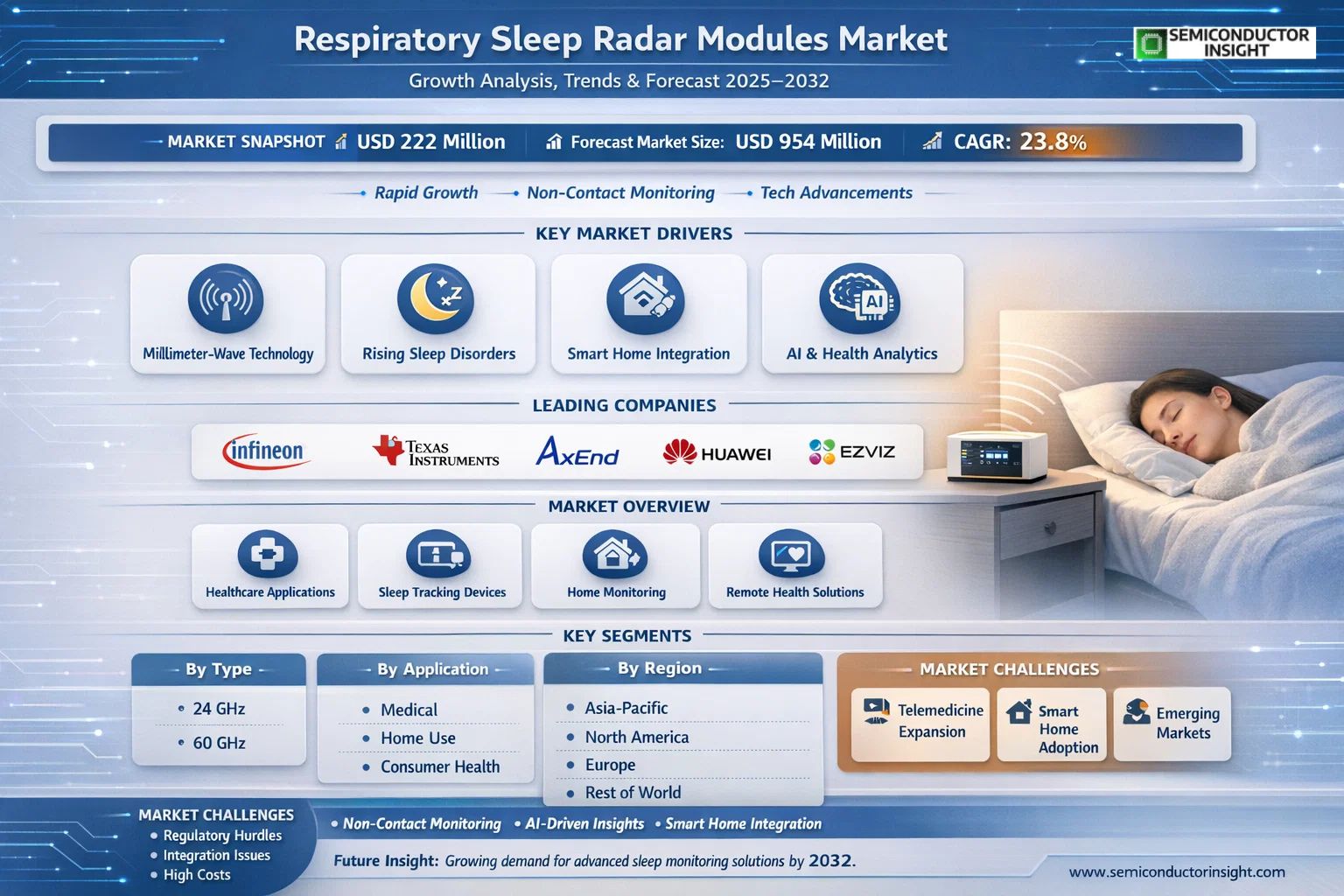
Global Respiratory Sleep Radar Modules market size was valued at USD 222 million in 2025. The market is projected to reach USD 954 million by 2032, exhibiting a CAGR of 23.8% during the forecast period.
Respiratory sleep radar modules are non-contact devices that use radar technology, typically in the millimeter-wave frequency range, to monitor breathing patterns during sleep. By emitting and detecting radar signals that bounce off the sleeper’s chest and abdomen, these modules can measure respiratory rate, depth, and rhythm with high sensitivity and accuracy. The radar’s ability to detect even subtle movements allows it to identify irregularities in breathing, such as apnea or shallow breathing, without the need for wearable sensors. Respiratory sleep radar modules are widely used in healthcare, sleep research, and consumer health products, offering a convenient and reliable means for tracking sleep-related respiratory health.
The market is experiencing rapid growth due to rising demand for non-contact monitoring solutions, advancements in millimeter-wave radar and AI analytics, and increasing awareness of sleep disorders like apnea. Furthermore, integration with smart home devices and remote healthcare trends are fueling expansion. Key players such as Infineon Technologies, Texas Instruments, Huawei, and Aqara are driving innovation with miniaturized radar chips and edge-computing capabilities, enhancing accuracy and interoperability while navigating regulatory standards.
MARKET DRIVERS
Technological Advancements in Radar Sensing
Respiratory Sleep Radar Modules Market is propelled by innovations in millimeter-wave radar technology, enabling precise non-contact monitoring of breathing patterns during sleep. These modules detect subtle chest movements with high accuracy, supporting applications in sleep apnea diagnosis and remote health monitoring. Advancements have reduced power consumption by up to 30%, making them ideal for wearable-free home devices.
Rising Demand for Home-Based Sleep Monitoring
Growing awareness of sleep disorders, affecting over 1 billion people worldwide, drives adoption of radar modules in consumer sleep trackers. The shift toward telemedicine post-pandemic has accelerated integration into smart mattresses and bedside devices, with the market expected to expand at a 14% CAGR through 2030.
➤ Increasing prevalence of obstructive sleep apnea (OSA) fuels demand for affordable, non-invasive solutions like radar modules.
Healthcare providers increasingly recommend these modules for continuous monitoring, reducing clinic visits and enhancing patient compliance in Respiratory Sleep Radar Modules Market.
MARKET CHALLENGES
Regulatory and Certification Hurdles
Navigating stringent FDA and CE approvals poses significant challenges for Respiratory Sleep Radar Modules Market, as modules must demonstrate clinical equivalence to polysomnography. Delays in certification can extend product launch timelines by 12-18 months, impacting smaller innovators.
Paragraph content here… Manufacturers face difficulties in standardizing radar signal processing across diverse body types, leading to variability in respiratory rate accuracy.
Other Challenges
Integration Complexity
Embedding radar modules into existing sleep tech ecosystems requires overcoming compatibility issues with IoT protocols, increasing development costs by 20-25% for OEMs.Supply chain disruptions for specialized radar chips further complicate scalability in this market.
MARKET RESTRAINTS
High Development and Manufacturing Costs
Premium pricing of radar components restrains widespread adoption in Respiratory Sleep Radar Modules Market, with unit costs averaging $50-100 higher than optical sensors. This limits penetration in price-sensitive emerging markets.Competition from established wearables like smartwatches, which hold 60% market share in consumer sleep tracking, caps growth for radar-based alternatives.Privacy concerns over radar’s ability to penetrate walls deter consumer acceptance, despite data encryption advancements.
MARKET OPPORTUNITIES
Expansion into Telemedicine and Smart Homes
Respiratory Sleep Radar Modules Market presents opportunities through integration with telehealth platforms, where real-time data sharing can improve OSA management for 400 million patients globally by 2030.Partnerships with smart home giants enable radar modules in ambient monitoring systems, tapping into a $150 billion IoT health sector.Emerging markets in Asia-Pacific offer untapped potential, with sleep disorder prevalence rising 15% annually amid urbanization.
Respiratory Sleep Radar Modules Market Trends
Shift Toward Non-Contact Monitoring Solutions
Respiratory Sleep Radar Modules Market is experiencing robust growth driven by the increasing preference for non-contact health monitoring technologies in both clinical and home environments. These modules utilize millimeter-wave radar to detect subtle chest and abdominal movements, accurately measuring respiratory rate, depth, and rhythm without wearable sensors. This approach enhances user comfort and compliance, particularly for long-term sleep tracking, while enabling detection of irregularities like apnea events. Healthcare providers and consumers alike are prioritizing these devices for their high sensitivity and reliability in capturing breathing patterns during sleep.
Other Trends
Advancements in AI-Driven Analytics
Integration of artificial intelligence with radar technology is a key trend shaping Respiratory Sleep Radar Modules Market. AI algorithms process radar signals to distinguish sleep stages, identify apnea types, and provide actionable insights into respiratory health. This enhances diagnostic precision, supporting remote patient monitoring and personalized sleep interventions. Manufacturers are focusing on edge-computing capabilities within radar-on-chip designs to deliver real-time analysis, reducing latency and dependency on cloud infrastructure.
Growing Integration with Smart Home Ecosystems
Miniaturization and interoperability represent another pivotal trend in Respiratory Sleep Radar Modules Market, as modules become seamlessly embeddable in smart mattresses, bedside devices, and home health hubs. Companies such as Infineon, Texas Instruments, and emerging players like Huawei and Aqara are developing compact 24 GHz and 60 GHz modules tailored for medical, home use, and research applications. This facilitates broader adoption amid rising demand for connected health solutions. However, challenges including semiconductor supply constraints and stringent data privacy regulations persist, prompting innovations in secure, low-power designs. Reimbursement policies for remote sleep diagnostics further bolster market expansion, positioning these modules as core enablers in next-generation respiratory and sleep health management across regions like North America, Europe, and Asia.
COMPETITIVE LANDSCAPE
Key Industry Players
Shaping Non-Contact Respiratory Sleep Monitoring Innovations
Respiratory Sleep Radar Modules Market, valued at US$222 million in 2025 and projected to reach US$954 million by 2032 with a CAGR of 23.8%, is characterized by a dynamic competitive structure blending established semiconductor leaders and agile tech innovators. Infineon Technologies and Texas Instruments lead the pack, commanding significant market share through their advanced millimeter-wave radar solutions tailored for precise respiratory rate and sleep apnea detection. These giants leverage proven expertise in radar-on-chip designs, enabling seamless integration into medical devices and home monitoring systems, while the top five players collectively dominate global revenues amid rising demand for non-contact sensors in clinical and consumer applications.
Emerging and niche players intensify competition by focusing on miniaturized, AI-enhanced modules for smart home ecosystems and remote care. Companies like Huawei and EZVIZ excel in interoperable radar tech for home-use segments, while startups such as AxEnd, Seeed Technology, WHST, and Shenzhen Ferry Smart target cost-effective 24GHz and 60GHz modules for broader accessibility. Specialized firms including Uniview, Tsingray, Chuhang Tech, Microbrain Intelligent, Innopro, and Aqara drive innovation in edge-computing analytics and regulatory-compliant designs, addressing challenges like supply chain issues and data privacy to capture growth in medical and other applications across regions like North America, Europe, and Asia.
List of Key Respiratory Sleep Radar Modules Companies Profiled
- Infineon
- Texas Instruments
- AxEnd
- Huawei
- EZVIZ
- Seeed Technology
- WHST
- Shenzhen Ferry Smart
- Uniview
- Tsingray
- Chuhang Tech
- Microbrain Intelligent
- Innopro
- Aqara
Segment Analysis:
| Segment Category | Sub-Segments | Key Insights |
| By Type |
|
60 GHz
|
| By Application |
|
Medical
|
| By End User |
|
Hospitals & Clinics
|
| By Integration |
|
Smart Home Integrated
|
| By Processing |
|
Edge Computing
|
Regional Analysis: Respiratory Sleep Radar Modules Market
North America
North America’s tech ecosystem fosters breakthroughs in radar module sensitivity and miniaturization, enabling seamless integration into wearables and bedsides for superior sleep tracking in Respiratory Sleep Radar Modules Market.
Strong ties between hospitals and radar tech developers drive clinical adoption, with radar modules enhancing remote monitoring capabilities within North America’s advanced telehealth networks.
Streamlined approvals and guidelines from key agencies expedite market entry for innovative Respiratory Sleep Radar Modules, ensuring safety and efficacy standards are met efficiently.
Heightened awareness of sleep disorders through public health initiatives propels demand, with radar modules gaining traction in consumer-grade sleep solutions across households.
Europe
Europe exhibits steady growth in Respiratory Sleep Radar Modules Market, underpinned by stringent medical device regulations that prioritize patient safety and data privacy. Countries like Germany and the UK lead with robust R&D investments, focusing on radar modules compatible with universal healthcare systems. Collaborative EU-funded projects advance interoperability with existing sleep labs. Rising prevalence of lifestyle-induced sleep issues drives demand for home-based monitoring. Manufacturers emphasize eco-friendly designs, aligning with sustainability goals. Partnerships with insurers promote wider accessibility, while digital health platforms integrate radar tech for comprehensive analytics. This region excels in cross-border standardization, fostering market expansion through harmonized guidelines.
Asia-Pacific
Asia-Pacific emerges as a dynamic hub in Respiratory Sleep Radar Modules Market, propelled by rapid urbanization and expanding middle-class populations seeking advanced sleep solutions. Japan and China spearhead manufacturing scale-up, leveraging cost efficiencies for affordable radar modules. Government initiatives in digital health accelerate adoption in densely populated areas. Local innovators customize modules for diverse ethnic sleep patterns, enhancing accuracy. Telemedicine growth integrates radar tech into remote diagnostics, addressing overburdened healthcare systems. Investments in AI-driven enhancements position the region for future dominance, with strong supply chains supporting global exports.
South America
South America shows promising potential in Respiratory Sleep Radar Modules Market, driven by increasing healthcare investments and awareness of sleep disorders in urban centers. Brazil and Argentina lead adoption, with local firms partnering international players for technology transfer. Economic recovery fuels demand for non-invasive monitoring amid rising chronic conditions. Public health campaigns highlight radar benefits, bridging gaps in traditional diagnostics. Emerging regulatory frameworks encourage innovation, while affordability remains key to penetration in diverse socioeconomic landscapes.
Middle East & Africa
The Middle East & Africa region witnesses gradual uptake in Respiratory Sleep Radar Modules Market, supported by oil-funded healthcare modernizations in Gulf states. Focus on smart city initiatives integrates radar modules into luxury wellness offerings. In Africa, pilot programs in South Africa target underserved areas with portable solutions. Collaborative ventures bridge technology gaps, emphasizing rugged designs for varied climates. Growing expatriate populations and medical tourism boost premium segment demand, laying foundations for broader expansion.
Report Scope
This market research report provides a comprehensive analysis of Respiratory Sleep Radar Modules Market, covering the forecast period 2025–2032. It offers detailed insights into market dynamics, technological advancements, competitive landscape, and key trends shaping the industry.
Key focus areas of the report include:
- Market Overview: The report begins with an overview outlining its current market scenario, key growth indicators, and industry transformation drivers. It discusses macroeconomic factors, demand–supply balance, regulatory landscape, and the strategic role of radar modules in powering advancements across industries such as healthcare, sleep research, consumer health products, and smart home ecosystems.
- Market Size & Forecast: Historical data and future projections for revenue, unit shipments, and market value across major regions and segments.
- Segmentation Analysis: Detailed breakdown by product type, technology, application, and end-user industry to identify high-growth segments and investment opportunities.
- Regional Insights: Insights into market performance across North America, Europe, Asia-Pacific, Latin America, and the Middle East & Africa, including country-level analysis where relevant.
- Competitive Landscape: Profiles of leading market participants, including their product offerings, R&D focus, manufacturing capacity, pricing strategies, and recent developments such as mergers, acquisitions, and partnerships.
- Technology Trends & Innovation: Assessment of emerging technologies, integration of AI/IoT, semiconductor design trends, fabrication techniques, and evolving industry standards.
- Market Drivers & Restraints: Evaluation of factors driving market growth along with challenges, supply chain constraints, regulatory issues, and market-entry barriers.
- Stakeholder Insights: Insights for component suppliers, OEMs, system integrators, investors, and policymakers regarding the evolving ecosystem and strategic opportunities.
Primary and secondary research methods are employed, including interviews with industry experts, data from verified sources, and real-time market intelligence to ensure the accuracy and reliability of the insights presented.
FREQUENTLY ASKED QUESTIONS:
What is the current market size of Respiratory Sleep Radar Modules Market?
-> Respiratory Sleep Radar Modules Market was valued at USD 222 million in 2025 and is expected to reach USD 954 million by 2032, at a CAGR of 23.8%.
Which key companies operate in Respiratory Sleep Radar Modules Market?
-> Key players include Infineon, Texas Instruments, AxEnd, Huawei, EZVIZ, Seeed Technology, among others.
What are the key growth drivers?
-> Key growth drivers include prioritization of non-contact health monitoring, AI-driven respiratory analytics, user comfort over wearables, and remote care trends.
Which region dominates the market?
-> Asia is the fastest-growing region, while North America remains a dominant market.
What are the emerging trends?
-> Emerging trends include miniaturized radar chips, edge-computing integration, millimeter-wave advancements, and smart home interoperability.

Get Sample Report PDF for Exclusive Insights
Report Sample Includes
- Table of Contents
- List of Tables & Figures
- Charts, Research Methodology, and more...
 Download Sample Report PDF