Market Insights
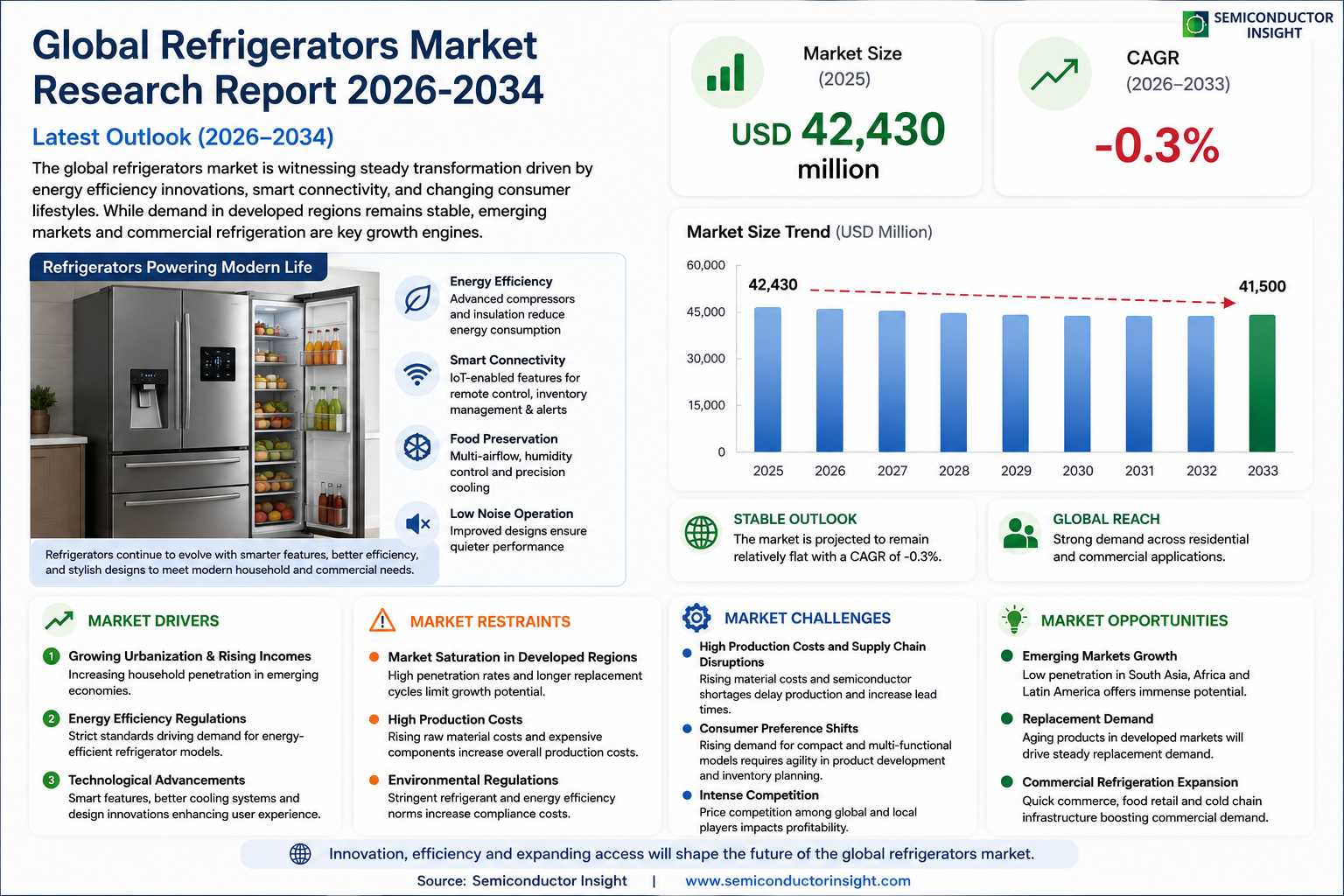
Global Refrigerators Market size was valued at USD 42,430 million in 2025 and is projected to reach USD 41,500 million by 2033, exhibiting a CAGR of -0.3% during the forecast period.
While the market shows marginal contraction, regional dynamics and technological advancements continue to reshape competitive landscapes.
Refrigerators are essential appliances designed to maintain low temperatures for food preservation and other perishable items. These devices utilize vapor-compression refrigeration systems, with variations including single-door, double-door, multi-door, and smart-connected models. The industry has evolved significantly with energy-efficient inverters, IoT integration, and sustainable cooling technologies.
Market growth is influenced by replacement demand in mature economies and first-time purchases in emerging regions. China dominates with over 50% market share due to high domestic production and consumption, while North America and Southeast Asia collectively account for 25%. Key players like Haier, Whirlpool, and LG leverage innovation such as Samsung’s AI-powered Bespoke refrigerators to capture premium segments despite pricing pressures. However, raw material volatility and stringent energy regulations pose challenges for manufacturers optimizing margins.
MARKET DRIVERS
Increasing Urbanization and Rising Disposable Income
Global Refrigerators Market is witnessing steady growth, driven by rapid urbanization and higher disposable incomes in emerging economies. As middle-class populations expand, demand for energy-efficient and smart refrigerators has surged by approximately 12% annually. Developing nations like India and China account for over 35% of total refrigerator sales globally.
Technological Advancements in Refrigeration
Innovations such as inverter compressors and IoT-enabled smart refrigerators are reshaping consumer preferences. The smart refrigerator segment alone is projected to grow at a CAGR of 15.7% through 2030, with features like voice control and food tracking gaining traction.
Brands are increasingly focusing on sustainability, with R600a refrigerant-based models capturing 28% of the market share in 2023.
MARKET CHALLENGES
High Production Costs and Supply Chain Disruptions
Refrigerators Market faces pressure from rising raw material costs, with stainless steel prices increasing by 23% since 2021. Semiconductor shortages have delayed production of smart refrigerator models by 8-12 weeks across major brands.
Other Challenges
Consumer Preference Shifts
Demand for compact refrigerators in urban areas is outpacing traditional large models, requiring manufacturers to adjust production lines and inventory strategies.
MARKET RESTRAINTS
Market Saturation in Developed Regions
Mature markets like North America and Western Europe show limited growth potential, with refrigerator penetration rates exceeding 98%. Replacement cycles have extended from 7 to 10 years as product durability improves, slowing market expansion.
MARKET OPPORTUNITIES
Emerging Markets and Replacement Demand
South Asia and Africa present significant growth opportunities, with refrigerator ownership below 40% in many regions. The commercial refrigeration segment is expanding rapidly, projected to reach USD 56 billion by 2027, driven by quick commerce and food delivery services.
Smart Technology Integration
Over 65% of consumers under 40 prefer smart refrigerators with app connectivity. Manufacturers investing in AI-powered inventory management systems are gaining competitive advantage in the premium appliance market
Refrigerators Market Trends
Declining Market Value Amid Shifting Consumer Demand
Global Refrigerators Market is experiencing a slight contraction, with projections indicating a decrease from USD 42,430 million in 2025 to USD 41,500 million by 2033, representing a -0.3% CAGR. This trend reflects changing purchasing patterns as consumers prioritize energy-efficient models with advanced features over frequent replacements. The market consolidation continues with the top five manufacturers holding over 35% combined market share.
Other Trends
Asia Pacific Dominance in Production and Consumption
China accounts for over 50% of global refrigerator market share, followed by Southeast Asia and North America at 25% each. Regional manufacturing advantages and growing middle-class populations drive this dominance. Double-door refrigerators remain the most popular type in developing markets, while multi-door models gain traction in premium segments.
Technology Integration Reshaping Product Offerings
Smart refrigerator adoption is growing steadily, particularly in residential applications which constitute 78% of the market. Manufacturers are focusing on IoT-enabled features, with Wi-Fi connectivity becoming standard in mid-range models. However, commercial refrigerator demand is slowing as food service industries optimize existing inventory through better maintenance practices.
Energy Efficiency as Primary Purchasing Driver
Regulatory changes and consumer awareness are pushing manufacturers to develop more energy-efficient models. The market shows increased preference for inverter compressor technology, which reduces power consumption by 30-40% compared to conventional units. This shift is particularly noticeable in European and North American markets with stringent energy standards.
Emerging Markets Fuel Premium Segment Growth
While the overall market contracts, premium refrigerator sales in developing nations are growing at 3-5% annually. Features like smart connectivity, advanced cooling technologies, and designer aesthetics are driving this trend. Major brands are establishing local production facilities in Southeast Asia and India to capitalize on these opportunities while reducing costs.
COMPETITIVE LANDSCAPE
Key Industry Players
Global Refrigerators Market Dominated by Asian and Western Giants
Global Refrigerators Market remains highly consolidated, with the top five manufacturers controlling over 35% market share. Haier Group Corporation leads the sector with a strong foothold in China, the world’s largest refrigerator market accounting for 50% of global sales. Whirlpool and Electrolux maintain robust positions in Western markets through premium product portfolios and technological innovations. LG and Samsung Electronics dominate the smart refrigerator segment with advanced IoT-enabled appliances.
Chinese manufacturers like Hisense and Midea are rapidly expanding globally through competitive pricing and energy-efficient models. Niche players such as BSH Hausgeräte and Arcelik cater to specialized commercial refrigeration needs, while Panasonic and Sharp focus on Japanese and Southeast Asian markets. Emerging players like Meiling and TCL are gaining traction through localized production and aggressive marketing strategies.
List of Key Refrigerators Companies Profiled
- Haier Group Corporation
- Whirlpool Corporation
- Electrolux AB
- LG Electronics
- Samsung Electronics
- BSH Hausgeräte GmbH
- Panasonic Corporation
- Sharp Corporation
- Arcelik AS
- Midea Group
- Hisense Group
- Hefei Meiling Co Ltd
- Xinfei Electric Co Ltd
- TCL Corporation
Segment Analysis:
| Segment Category | Sub-Segments | Key Insights |
| By Type |
|
Double-Door Refrigerators dominate the market due to:
|
| By Application |
|
Residential segment shows stronger demand driven by:
|
| By End User |
|
Households remain the primary end-users with key drivers:
|
| By Technology |
|
Inverter Refrigerators gaining momentum due to:
|
| By Distribution Channel |
|
Offline Retail maintains dominance because:
|
Regional Analysis: Global Refrigerators Market
Asia-Pacific
Local manufacturers are pioneering smart refrigerator technologies with IoT integration, voice control, and mobile app connectivity. Japanese and South Korean brands lead in premium innovations while Chinese firms focus on cost-effective smart solutions.
The region shows a balanced mix of traditional retail, specialty appliance stores, and growing online sales platforms. E-commerce accounts for nearly 25% of refrigerator sales in developed markets like Japan and South Korea.
Compact and multi-door designs gain popularity in urban areas, while rural markets prefer larger capacity models. Frost-free technology is becoming standard, and energy efficiency ratings significantly influence purchase decisions.
The region features intense competition between global brands (LG, Samsung) and domestic players (Haier, Hisense). Local manufacturers gain advantage through deep distribution networks and culturally adapted product designs.
North America
North America maintains a mature but stable Refrigerators Market with premiumization driving growth. The United States accounts for over 80% of regional demand, with consumers favoring smart, energy-efficient models with advanced food preservation features. French door configurations and built-in refrigerators dominate the premium segment. Manufacturers are integrating AI and smart home compatibility to differentiate products. Replacement purchases constitute over 60% of sales, supported by strong consumer financing options. The market is shifting toward sustainable refrigeration solutions with reduced environmental impact.
Europe
European demand focuses heavily on energy-efficient and environmentally friendly refrigerators, driven by stringent EU regulations. Germany and France lead regional consumption with preferences for built-in and designer models. The market shows growing interest in connectivity features and sustainable refrigerants. Eastern Europe presents emerging opportunities with rising appliance ownership rates. Energy labelling significantly influences consumer choices, with A+++ rated models gaining market share. The commercial refrigeration segment shows particular strength in Western Europe’s food retail sector.
South America
Brazil remains the largest Refrigerators Market in South America, with growth supported by economic recovery and expanding retail financing. Consumers prioritize affordability and durability, favoring no-frost technology and medium-capacity models. The region shows potential for smart refrigerators in urban centers, though price sensitivity remains a challenge. Local manufacturing benefits from regional trade agreements, while imports compete in the premium segment. Energy efficiency gains importance as electricity costs rise across the region.
Middle East & Africa
The GCC countries drive premium refrigerator demand in the region, favoring large-capacity and frost-free models suited for hot climates. Africa shows growth potential as electrification improves, with South Africa and Nigeria emerging as key markets. Manufacturers are adapting products for frequent power fluctuations common in some African markets. The commercial sector grows alongside hotel and food service industry expansion. Religious considerations influence product designs in Middle Eastern markets, with separate storage compartments gaining popularity.
Report Scope
This market research report provides a comprehensive analysis of the Refrigerators Market, covering the forecast period 2025–2033. It offers detailed insights into market dynamics, technological advancements, competitive landscape, and key trends shaping the industry.
Key focus areas of the report include:
- Market Overview: The report begins with an overview outlining its current market scenario, key growth indicators, and industry transformation drivers. It discusses macroeconomic factors, demand–supply balance, regulatory landscape, and the strategic role of refrigeration technology in household and commercial applications.
- Market Size & Forecast: Historical data and future projections for revenue, unit shipments, and market value across major regions and segments.
- Segmentation Analysis: Detailed breakdown by product type, door configuration, application, and end-user industry to identify high-growth segments and investment opportunities.
- Regional Insights: Insights into market performance across North America, Europe, Asia, Latin America, and the Middle East & Africa, including country-level analysis where relevant.
- Competitive Landscape: Profiles of leading market participants, including their product offerings, R&D focus, manufacturing capacity, pricing strategies, and recent developments such as mergers, acquisitions, and partnerships.
- Technology Trends & Innovation: Assessment of emerging technologies, energy efficiency improvements, smart refrigeration features, and evolving industry standards.
- Market Drivers & Restraints: Evaluation of factors driving market growth along with challenges, supply chain constraints, regulatory issues, and market-entry barriers.
- Stakeholder Insights: Insights for manufacturers, suppliers, distributors, investors, and policymakers regarding the evolving ecosystem and strategic opportunities.
Primary and secondary research methods are employed, including interviews with industry experts, data from verified sources, and real-time market intelligence to ensure the accuracy and reliability of the insights presented.
FREQUENTLY ASKED QUESTIONS:
What is the current market size of Refrigerators Market?
-> Refrigerators Market size was valued at USD 42,430 million in 2025 and is projected to reach USD 41,500 million by 2033, exhibiting a CAGR of -0.3% during the forecast period.
Which key companies operate in Refrigerators Market?
-> Key players include Haier, Whirlpool, Electrolux, Samsung, LG, BSH, Panasonic, Sharp, Arcelik, Midea, Hisense, Meiling, Xinfei, and TCL, among others. Global top five manufacturers hold a share over 35%.
What are the key growth drivers?
-> Key growth drivers include rising urbanization, replacement demand for energy-efficient models, and expansion of retail cold chain infrastructure.
Which region dominates the market?
-> China is the largest market with a share over 50%, followed by Southeast Asia and North America, both having a share over 25%.
What are the emerging trends?
-> Emerging trends include smart connected refrigerators, multi-door configurations, and sustainable refrigerant technologies.

Get Sample Report PDF for Exclusive Insights
Report Sample Includes
- Table of Contents
- List of Tables & Figures
- Charts, Research Methodology, and more...
 Download Sample Report PDF