Reed Switch Device Market Insights
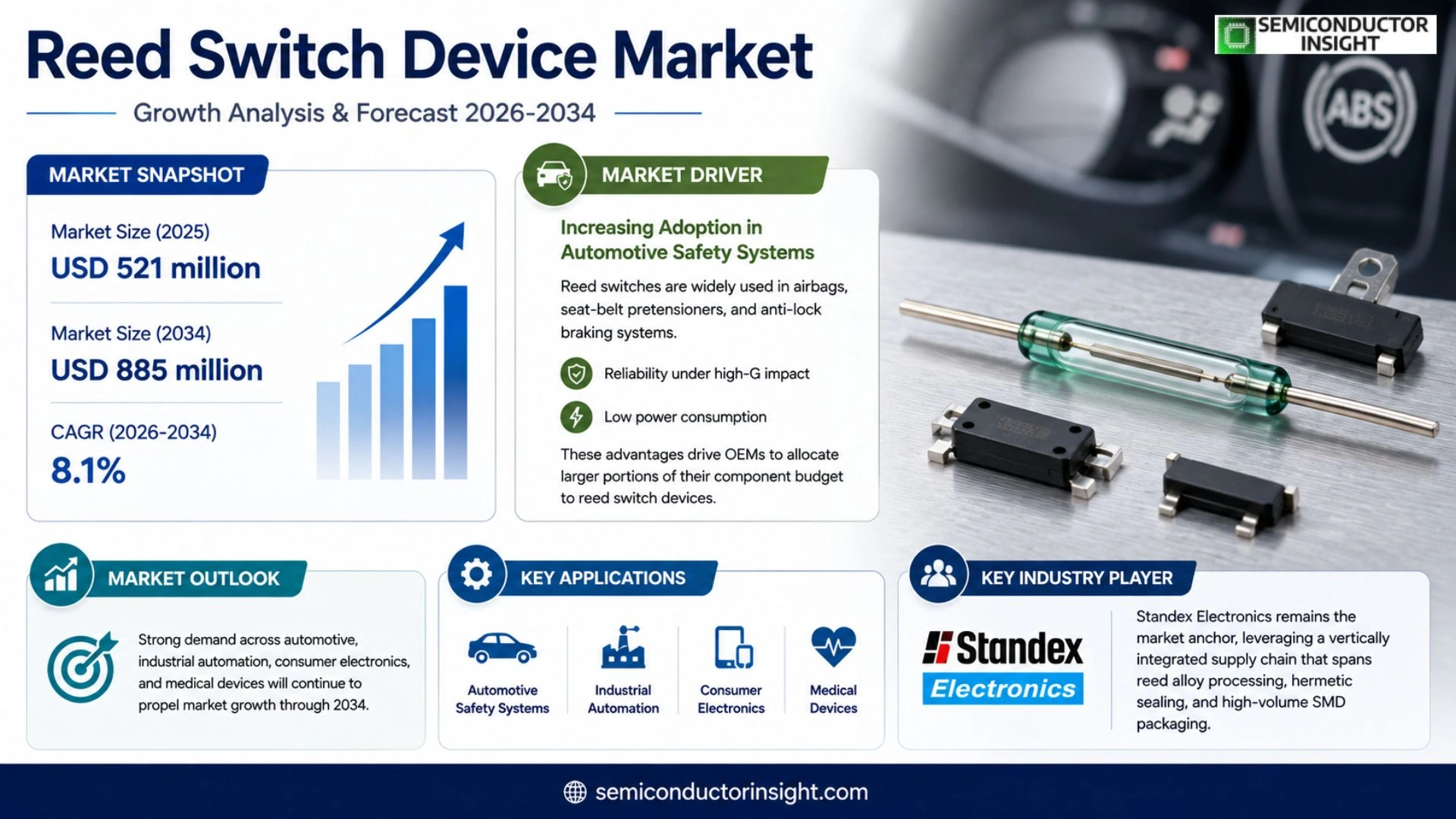
Reed Switch Device market was valued at USD 521 million in 2025. Forecasts show it will climb to USD 885 million by 2034, delivering an average annual growth of 8.1 %.
A reed switch device functions as a magnetically actuated electromechanical switch; two ferromagnetic reeds sealed within an inert‑gas‑filled glass capsule close or open the circuit when exposed to an external magnetic field. Core attributes include sealed reliability, near‑zero standby power, low contact resistance and minimal leakage. Typical configurations are Form A (normally open), Form B (normally closed) and Form C (changeover), offered in molded or SMD packages.
The sector gains momentum because smart‑home penetration expands demand for low‑power magnetic switching, industrial automation upgrades raise requirements for vibration‑resistant miniaturized components, and automotive electrification creates new interlock and state‑detection applications that favor certified reed switches.
MARKET DRIVERS
Increasing Adoption in Automotive Safety Systems
Reed Switch Device market is gaining traction as manufacturers embed reed switches in airbags, seat‑belt pretensioners, and anti‑lock braking systems. Reliability under high‑G impact and low power consumption make the technology a preferred choice for safety‑critical modules, prompting OEMs to allocate larger portions of their component budget to these devices.
Growth of IoT Edge Sensing
Edge devices in industrial IoT rely on miniature, hermetically sealed contacts to monitor fluid levels, proximity, and magnetic fields. The compact form factor of reed switches allows designers to integrate sensing directly on printed circuit boards, shortening time‑to‑market for new smart products. This functional advantage is translating into higher procurement volumes for Reed Switch Device market.
➤ “Design engineers cite reed switches as the go‑to solution when they need a fail‑safe, maintenance‑free sensor that can operate across a wide temperature envelope.”
Beyond automotive and IoT, renewable‑energy equipment,particularly wind‑turbine pitch control systems,are specifying reed switches for their non‑intrusive operation and longevity, reinforcing a multi‑segment demand base that stabilizes market growth.
MARKET CHALLENGES
Compliance and Certification Hurdles
Regulatory frameworks for safety‑critical applications differ across regions, and achieving certification for reed‑based assemblies can be time‑intensive. Manufacturers that lack a streamlined compliance pipeline encounter project delays, which erode cost advantages and diminish competitiveness in Reed Switch Device market.
Other Challenges
Supply Chain Vulnerabilities
The reliance on high‑purity nickel‑iron alloys and specialized glass encapsulation creates exposure to raw‑material price swings. Recent logistics bottlenecks have amplified lead times, forcing end‑users to hold larger safety stocks and reducing overall market elasticity.
MARKET RESTRAINTS
Material Cost Volatility
Fluctuating prices for nickel, iron, and specialty glass directly impact the bill of materials for reed switches. When component costs rise, system designers may substitute alternative sensing technologies, limiting the upside potential for Reed Switch Device market despite its technical merits.
MARKET OPPORTUNITIES
Emerging Applications in Renewable Energy
Wind‑farm technicians are increasingly adopting reed switches for blade‑pitch and gearbox‑position monitoring, where the contact‑free operation aligns with harsh outdoor conditions. As global renewable‑energy capacity expands, Reed Switch Device market stands to capture a significant share of new sensor deployments, especially in regions incentivizing clean‑energy infrastructure.
Reed Switch Device Market Trends
Shift Toward Miniaturized SMD Packages
The past decade has seen a steady migration from traditional axial glass‑capsule switches to surface‑mount and molded‑rebated formats. Manufacturers cite assembly line efficiency and the need for tighter vibration tolerance as the primary drivers. Because SMD versions occupy a fraction of the footprint of legacy parts, system designers can integrate reed switches into denser sensor arrays used in smart‑home hubs and automotive control modules. The price advantage,approximately $170 per thousand units in 2025,remains compelling even as the bill‑of‑materials for molded packages rises marginally. The net effect is a rise in unit shipments, with 3,300 million units produced last year, reinforcing the market’s scale while enabling new applications that demand both compactness and reliability.
Other Trends
Advances in Contact Plating and Reed Alloys
Recent improvements in nickel‑iron reed alloys and multi‑layer palladium plating have sharpened the balance between low contact resistance and long‑term corrosion resistance. These material upgrades directly address the high‑frequency switching requirements of industrial automation, where premature contact erosion can trigger costly downtime. By extending the life‑cycle of each device, suppliers reduce total cost of ownership for end‑users, a factor that is increasingly scrutinized in tightly regulated sectors such as medical equipment and aerospace. The resulting performance edge also allows niche players to command premium pricing for automotive‑grade parts that must survive harsh temperature swings and repeated shock events.
Regional Realignment of Production and Consumption
Asia‑Pacific continues to dominate both manufacturing capacity and end‑use demand, leveraging dense supply chains for security systems, household appliances, and consumer electronics. Meanwhile, North America and Europe are carving out a higher‑value segment focused on industrial control, precision instrumentation, and vehicle safety interlocks. The divergence stems less from differences in technology and more from the downstream mix; western customers prioritize qualification, traceability, and long‑term supplier reliability, prompting local OEMs to source from firms with established automotive‑grade certifications. This bifurcated landscape creates opportunities for tiered product strategies,high‑volume, cost‑effective SMD units for Asian markets and rigorously tested, higher‑priced variants for the western industrial base.
COMPETITIVE LANDSCAPE
Key Industry Players
Competitive Dynamics in Reed Switch Device market
Standex Electronics remains the market anchor, leveraging a vertically integrated supply chain that spans reed alloy processing, hermetic sealing, and high‑volume SMD packaging. Its breadth of Form A, B and C offerings, combined with an established automotive‑grade qualification program, allows the firm to serve both cost‑sensitive appliance manufacturers and premium automotive OEMs. The company’s ability to source raw glass components from its Asia‑Pacific hubs while maintaining a North‑American engineering base creates a pricing advantage that forces smaller rivals to specialize in niche form factors or value‑added plating technologies.
Beyond the leader, a constellation of midsize and specialist firms shapes the competitive texture. Littelfuse and PIC GmbH focus on ruggedized variants for industrial automation, emphasizing vibration resistance and extended temperature ranges. Nippon Aleph and HSI Sensing have carved out strong positions in the Asian security‑sensor segment through aggressive local distribution and customized AT‑rating libraries. European players such as STG GmbH and Coto Technology differentiate themselves with micro‑reed SMD designs that cater to compact IoT modules. Meanwhile, RMCIP, Comus International, Xurui Electronic, and several emerging Chinese manufacturers compete on price and supply reliability, often securing contracts for bulk reed‑relay assemblies in consumer‑electronics production lines.
List of Key Reed Switch Device Companies Profiled
- Standex Electronics
- Littelfuse
- PIC GmbH
- Nippon Aleph
- HSI Sensing
- STG GmbH
- Coto Technology
- RMCIP
- Comus International
- Xurui Electronic
- Vishay Intertechnology
- Yageo Precision Components
- TDK Electronics
- Allegro Microsystems
- Amphenol Advanced Sensors
Segment Analysis:
| Segment Category | Sub-Segments | Key Insights |
| By Type |
|
Form A (NO) continues to dominate because its straightforward operation aligns with cost‑driven volume applications. ‑ Provides reliable make‑break action with minimal leakage, ideal for security contacts and appliance door detection. ‑ Simplicity reduces packaging complexity, supporting high‑throughput SMD and molded production lines. ‑ Engineers favour its predictable magnetic pull‑in characteristics for basic sensing tasks. |
| By Application |
|
Magnetic Sensors are gaining traction as smart‑home ecosystems expand. ‑ Near‑zero standby power meets the demand for always‑on IoT devices. ‑ Hermetic sealing offers robustness against humidity, making them suitable for outdoor door and window monitoring. ‑ Their analog‑like response enables simple integration with micro‑controller firmware for threshold‑based alerts. |
| By End User |
|
Automotive represents a premium segment where reliability and vibration resistance are paramount. ‑ Reed switches enable interlock functions for safety‑critical systems such as seat‑belt pretensioners. ‑ Their low leakage supports battery‑sensitive circuits, extending vehicle range in electrified platforms. ‑ Automotive qualification drives demand for enhanced hermetic seals and robust contact plating. |
| By Function |
|
Monostable continues to be favored for applications requiring automatic reset, such as security contacts that must release when the magnet is removed. ‑ Simpler magnetic circuit reduces part cost and eases design verification. ‑ Provides predictable release timing, valuable in counting and position‐feedback loops. ‑ Designers balance AT value to avoid false triggering while maintaining sensitivity. |
| By Industry |
|
Industrial Automation drives a shift toward miniaturized, vibration‑tolerant packages. ‑ Reed switches are integrated into condition‑monitoring systems where ultra‑low leakage improves signal integrity. ‑ The demand for SMD and molded formats aligns with high‑speed assembly lines in factories. ‑ Robust hermetic sealing meets stringent IEC and ISO standards for harsh environments. |
Regional Analysis: Reed Switch Device Market
Europe
Recent updates to the EU Low Voltage Directive have tightened permissible leakage currents, prompting European manufacturers to refine reed switch geometries. This shift forces suppliers worldwide to align product specifications with European benchmarks, elevating overall quality expectations across the market.
European automakers are embedding reed switches in electric‑vehicle powertrain control units to achieve deterministic contact closure under high‑vibration conditions, a requirement that steers component selection toward suppliers with proven automotive‑grade certifications.
Factories modernising legacy PLC networks favour reed switches for their inherent resistance to electromagnetic interference, allowing smoother integration with modular safety circuits and reducing downtime during system upgrades.
Pilot projects in smart‑building HVAC controls are testing reed‑based position sensors as low‑cost alternatives to Hall‑effect devices, highlighting Europe’s experimental approach to cost‑effective, reliable switching solutions.
North America
In North America, Reed Switch Device market is heavily influenced by the automotive sector’s demand for high‑reliability components that can endure extreme temperature cycles. U.S. manufacturers have accelerated the adoption of surface‑mount reed switches to satisfy compact packaging constraints in advanced driver‑assist systems. Simultaneously, the industrial segment is prioritising switches that can operate within harsh chemical environments, a requirement driven by the region’s extensive chemical processing facilities. These preferences are nudging suppliers toward offering customized sealing options, which in turn reshapes procurement patterns across the continent.
Asia-Pacific
The Asia‑Pacific arena reflects a blend of rapid product iteration and cost‑sensitivity, shaping Reed Switch Device market’s competitive landscape. Chinese firms are capitalising on economies of scale to deliver volume‑priced reed switches for consumer electronics, while Japanese companies focus on precision‑engineered devices for aerospace and medical equipment. Regional trade agreements are easing cross‑border component flows, encouraging local assemblers to source from a broader supplier base. This environment fosters a dual strategy: high‑volume, price‑lean offerings coexist with niche, performance‑oriented designs targeting premium segments.
South America
South America’s industrial expansion, particularly in the energy and mining sectors, is creating a modest but steady demand for robust reed switches capable of operating under high‑dust and vibration conditions. Brazilian manufacturers are beginning to adopt locally sourced reed components to mitigate lead‑time challenges associated with overseas shipments. The market’s growth trajectory is further supported by government incentives aimed at modernising rail and utilities infrastructure, prompting a gradual shift toward more reliable switching solutions in legacy installations.
Middle East & Africa
In the Middle East & Africa, Reed Switch Device market is shaped by infrastructure projects that demand durable, low‑maintenance components for harsh desert climates. Oil‑field equipment manufacturers increasingly specify reed switches for safety‑critical shut‑off valves, valuing their proven resistance to corrosion and temperature extremes. Meanwhile, emerging smart‑grid initiatives in South Africa are exploring reed‑based sensing modules as part of distributed energy management platforms, indicating a nascent but promising application niche within the region.
Report Scope
This market research report provides a comprehensive analysis of the Reed Switch Device Market , covering the forecast period 2026–2034. It offers detailed insights into market dynamics, technological advancements, competitive landscape, and key trends shaping the industry.
Key focus areas of the report include:
- Market Overview: The report begins with an overview outlining its current market scenario, key growth indicators, and industry transformation drivers. It discusses macroeconomic factors, demand–supply balance, regulatory landscape, and the strategic role of semiconductors in powering advancements across industries such as automotive, telecommunications, consumer electronics, and industrial automation.
- Market Size & Forecast: Historical data and future projections for revenue, unit shipments, and market value across major regions and segments.
- Segmentation Analysis: Detailed breakdown by product type, technology, application, and end-user industry to identify high-growth segments and investment opportunities.
- Regional Insights: Insights into market performance across North America, Europe, Asia-Pacific, Latin America, and the Middle East & Africa, including country-level analysis where relevant.
- Competitive Landscape: Profiles of leading market participants, including their product offerings, R&D focus, manufacturing capacity, pricing strategies, and recent developments such as mergers, acquisitions, and partnerships.
- Technology Trends & Innovation: Assessment of emerging technologies, integration of AI/IoT, semiconductor design trends, fabrication techniques, and evolving industry standards.
- Market Drivers & Restraints: Evaluation of factors driving market growth along with challenges, supply chain constraints, regulatory issues, and market-entry barriers.
- Stakeholder Insights: Insights for component suppliers, OEMs, system integrators, investors, and policymakers regarding the evolving ecosystem and strategic opportunities.
Primary and secondary research methods are employed, including interviews with industry experts, data from verified sources, and real-time market intelligence to ensure the accuracy and reliability of the insights presented.
FREQUENTLY ASKED QUESTIONS:
What is the current market size of Reed Switch Device Market?
-> Reed Switch Device market forecasts show it will climb to USD 885 million by 2034, delivering an average annual growth of 8.1 %.
Which key companies operate in Reed Switch Device Market?
-> Key players include Standex Electronics, Nippon Aleph, Littelfuse, RMCIP, Comus International, HSI Sensing, PIC GmbH, PIT‑RADWAR, Xurui Electronic, STG GmbH, Coto Technology, among others.
What are the key growth drivers?
-> Key growth drivers include smart‑home penetration, industrial automation upgrades, and automotive electrification trends.
Which region dominates the market?
-> Asia‑Pacific is the dominant manufacturing and consumption hub, while Europe remains a significant market for industrial and automotive applications.
What are the emerging trends?
-> Emerging trends include migration to molded and SMD/micro‑reed packages, latching switch designs, and enhanced contact plating for higher reliability.
Get Sample Report PDF for Exclusive Insights
Report Sample Includes
- Table of Contents
- List of Tables & Figures
- Charts, Research Methodology, and more...
 Download Sample Report PDF