Real-Time Embedded AI Market Insights
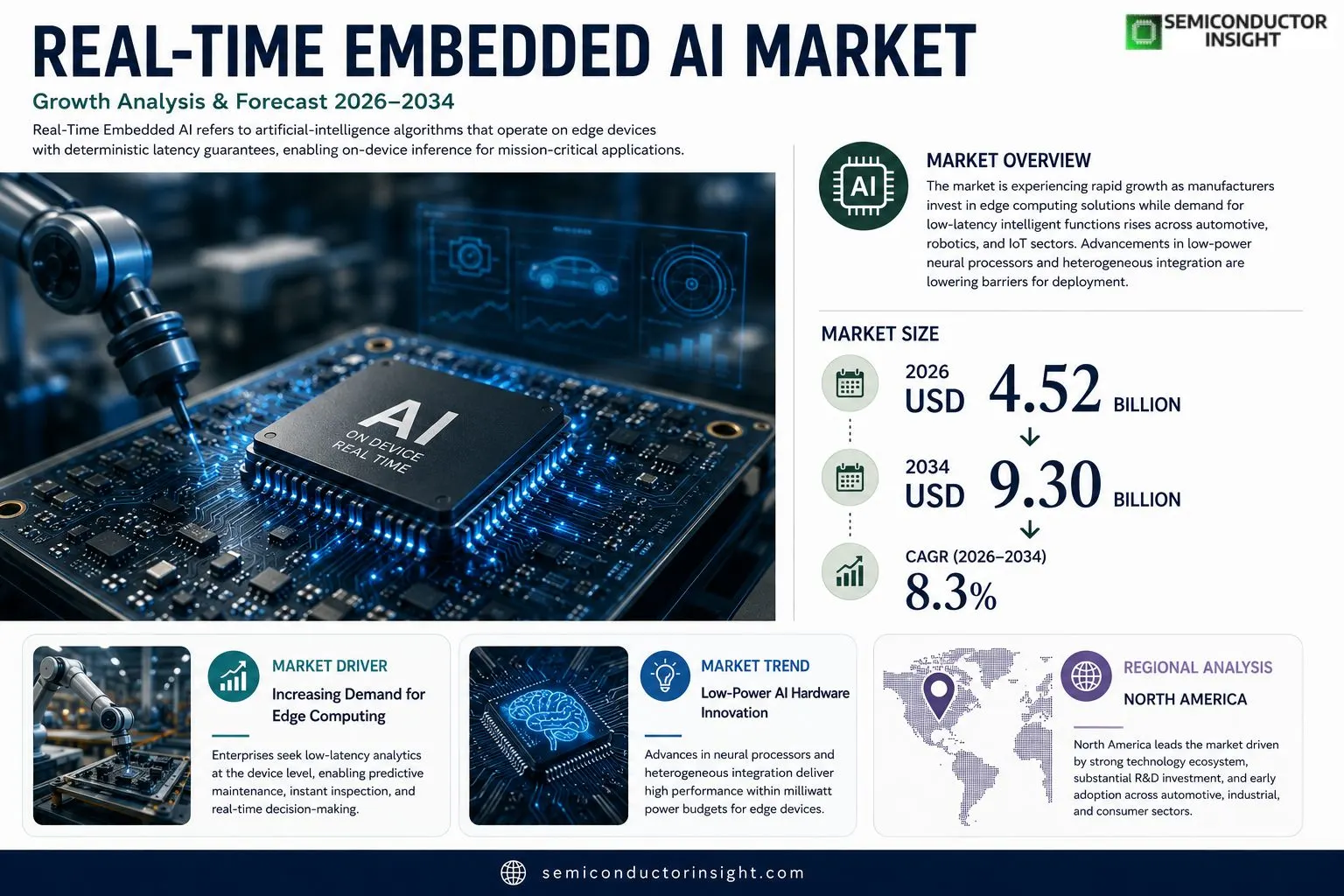
Real-Time Embedded AI market size was valued at USD 4.52 billion in 2025.The market is projected to grow from USD 4.52 billion in 2026 to USD 9.30 billion by 2034, exhibiting a CAGR of 8.3% during the forecast period.
Real-Time Embedded AI refers to artificial‑intelligence algorithms that operate directly on edge devices,such as microcontrollers, automotive ECUs, or industrial controllers,with deterministic latency guarantees.
This technology enables on‑device inference for tasks like sensor fusion, predictive maintenance, and autonomous navigation without reliance on cloud connectivity.The market is experiencing rapid growth because manufacturers are investing heavily in edge computing solutions while demand for low‑latency intelligent functions rises across automotive, robotics, and IoT sectors.
Furthermore, advancements in low‑power neural processors and heterogeneous integration are lowering barriers for deployment.
A notable development occurred in March 2024 when NVIDIA announced a strategic partnership with Bosch to co‑develop real‑time embedded AI platforms for autonomous driving.
Key players such as Intel (Mobileye), Qualcomm, Texas Instruments, and Arm Holdings continue expanding their portfolios through silicon innovations and software toolkits.
MARKET DRIVERS
Increasing Demand for Edge Computing
Real-Time Embedded AI Market is being propelled by enterprises seeking low‑latency analytics at the device level. As 5G networks expand, manufacturers can offload processing from central clouds, reducing response times and bandwidth costs. This shift enables new use cases such as predictive maintenance on factory floors and instant visual inspection on production lines.
Advancements in Low‑Power AI Chips
Recent breakthroughs in semiconductor design have yielded ultra‑efficient AI accelerators that operate within milliwatt budgets. These chips allow sophisticated inference models to run on battery‑powered devices without compromising performance, fostering adoption in wearables, drones, and automotive safety systems.
➤ Integration cycles are shortening as modular AI IP blocks become standard, accelerating time‑to‑market for new embedded solutions.
Combined, these drivers create a fertile environment for vendors that can deliver scalable, secure, and energy‑aware AI capabilities, positioning Real-Time Embedded AI Market for robust growth in the coming years.
MARKET CHALLENGES
Limited Availability of Certified Tools
Developers often face a scarcity of validated development kits that meet industry safety certifications. This gap forces longer verification phases and hampers rapid deployment, especially in regulated sectors such as medical devices and aerospace.
Other Challenges
Security Concerns
Embedded AI workloads increase the attack surface on edge devices. Ensuring real‑time protection against model extraction, adversarial inputs, and firmware tampering remains a critical hurdle for widespread acceptance.
MARKET RESTRAINTS
High Development Costs
Designing, training, and validating AI models for constrained hardware involves substantial R&D investment. Companies must allocate resources for data collection, algorithm optimization, and extensive field testing, which can deter smaller players.Additionally, the need for specialized talent,experts who understand both AI algorithms and embedded systems,drives up personnel expenses, further limiting market entry.The cumulative effect of these financial pressures can slow the pace of innovation and limit the speed at which new solutions reach customers.
MARKET OPPORTUNITIES
AI‑Driven Autonomous Systems
Autonomous vehicles, drones, and robotics are increasingly relying on on‑device AI to make split‑second decisions. Real-Time Embedded AI Market is uniquely positioned to supply the necessary low‑latency inference engines that enable safe and reliable autonomy.Another promising avenue is the rise of smart infrastructure, where sensors equipped with real‑time AI can monitor structural health, traffic flow, and energy consumption, delivering actionable insights without central cloud dependence.Finally, emerging standards for interoperable AI models across heterogeneous hardware platforms are creating a market for middleware and deployment frameworks, opening new revenue streams for software providers.
Real-Time Embedded AI Market Trends
Edge Computing Adoption Accelerates
Real-Time Embedded AI Market is being reshaped by a sharp rise in edge‑computing deployments across automotive, robotics, and broader IoT ecosystems. Manufacturers are prioritizing deterministic latency to enable on‑device inference for sensor fusion, predictive maintenance, and autonomous navigation without relying on cloud links. A notable milestone occurred in March 2024 when NVIDIA announced a strategic partnership with Bosch to co‑develop real‑time embedded AI platforms for autonomous driving, underscoring the sector’s momentum. Leading silicon providers,including Intel (Mobileye), Qualcomm, Texas Instruments, and Arm Holdings,continue to enrich their portfolios with specialized neural‑processing units and integrated toolchains, further lowering entry barriers for developers seeking low‑power, high‑performance solutions.
Other Trends
Hardware Innovation
Advancements in low‑power neural processors and heterogeneous integration are central to the market’s forward trajectory. Modern microcontrollers and automotive ECUs now embed dedicated AI accelerators that consume milliwatts while delivering real‑time inference. Heterogeneous system‑in‑package (SiP) designs combine digital, analog, and AI blocks, enabling compact form factors and improved thermal management. This hardware evolution supports a broader range of applications, from precision agriculture drones to industrial robotics, where deterministic response times are critical. As power‑efficiency metrics improve, OEMs are able to embed smarter functionality without compromising battery life or system cost.
Software Ecosystem Expansion
Parallel to silicon progress, the software layer is maturing through comprehensive SDKs, model‑compression pipelines, and standardized APIs that streamline deployment on constrained devices. Open‑source frameworks are being optimized for edge inference, allowing developers to port pretrained models with minimal latency overhead. Vendor‑specific toolchains now offer automated quantization, validation suites, and security hardening, ensuring that a single codebase can be securely deployed across diverse hardware families. This convergence of hardware and software reduces time‑to‑market and fosters a collaborative ecosystem where innovations can be rapidly transferred from research labs to production lines.
COMPETITIVE LANDSCAPEKey Industry Players
Real-Time Embedded AI Market Competitive Landscape
Real‑Time Embedded AI market is currently dominated by a handful of technology powerhouses that combine advanced silicon, robust software stacks, and strategic partnerships. NVIDIA leads with its Jetson line and the recent March 2024 alliance with Bosch, delivering high‑performance GPUs and dedicated AI accelerators for autonomous driving and robotics. Intel, through its Mobileye subsidiary, leverages vision‑focused processors and a mature safety‑critical ecosystem, positioning itself as a primary supplier for automotive ECU manufacturers. Qualcomm’s Snapdragon™ platforms extend low‑power neural inference to mobile and edge devices, while Texas Instruments offers a broad portfolio of microcontrollers and DSPs optimized for deterministic latency in industrial control. Arm Holdings supplies ubiquitous CPU IP that underpins many of these solutions, enabling scalable heterogeneous architectures across the market. Collectively, these leaders shape a tiered structure where high‑end GPU/FPGA solutions coexist with power‑efficient ASICs and microcontroller‑centric offerings, driving a CAGR of roughly 8 % through 2034.Beyond the marquee players, a vibrant cohort of niche innovators contributes specialized capabilities that broaden market reach. Bosch integrates its extensive automotive sensor suite with embedded AI to deliver turnkey perception modules. STMicroelectronics focuses on ultra‑low‑power MCUs for IoT gateways, while Renesas Electronics supplies automotive‑grade MCUs with built‑in security features. MediaTek and Samsung Electronics are expanding edge‑AI silicon for consumer electronics, whereas Microchip Technology provides cost‑effective 8‑bit and 32‑bit controllers for predictive‑maintenance applications. Xilinx (now part of AMD) offers reconfigurable FPGA solutions that meet stringent real‑time requirements, and Huawei’s HiSilicon delivers AI‑centric SoCs for smart cameras in the Asian market. These companies, though smaller in revenue, fill critical vertical niches and often serve as preferred suppliers for original equipment manufacturers seeking customized, low‑latency AI functionality.
List of Key Real-Time Embedded AI Companies Profiled
- NVIDIA
- Intel (Mobileye)
- Qualcomm
- Texas Instruments
- Arm Holdings
- Bosch
- STMicroelectronics
- Renesas Electronics
- MediaTek
- Samsung Electronics
- Microchip Technology
- Xilinx (AMD)
- Huawei HiSilicon
Segment Analysis:
| Segment Category | Sub-Segments | Key Insights |
| By Type |
|
Neural Processor Units
|
| By Application |
|
Autonomous Driving
|
| By End User |
|
Automotive OEMs
|
| By Technology |
|
Edge AI Accelerators
|
| By Deployment Model |
|
On‑Device Inference
|
Regional Analysis: North America
United States
The automotive sector is significantly driving the need for **Real-Time Embedded AI** for autonomous driving, advanced driver-assistance systems (ADAS), and in-vehicle infotainment. The push for safer and more efficient vehicles necessitates sophisticated real-time processing capabilities within embedded hardware.
The healthcare industry is leveraging **Real-Time Embedded AI** for applications like medical imaging analysis, patient monitoring, and robotic surgery. The ability to process data in real-time is crucial for timely diagnoses and interventions, creating significant market opportunities.
Industrial automation is experiencing a surge in the adoption of **Real-Time Embedded AI** for predictive maintenance, quality control, and process optimization. Real-time insights from embedded sensors enable proactive interventions, reducing downtime and improving operational efficiency.
Consumer electronics are increasingly incorporating **Real-Time Embedded AI** for features like voice assistants, gesture recognition, and personalized user experiences. The demand for seamless and intelligent devices is propelling market growth in this segment.
Europe
Europe represents a significant and evolving market for **Real-Time Embedded AI**. Driven by strong industrial foundations and a commitment to data privacy regulations, the region is witnessing steady growth. Key applications are emerging in manufacturing, transportation, and smart cities. Emphasis on edge computing and cybersecurity is shaping the market landscape. The European Union’s focus on digital transformation is further fueling investment in **Real-Time Embedded AI** solutions. Challenges include navigating diverse regulatory frameworks across member states and fostering standardization in embedded AI development.
Asia-Pacific
The Asia-Pacific region is poised for explosive growth in the **Real-Time Embedded AI Market**. Countries like China, Japan, and South Korea are investing heavily in AI infrastructure and applications. Strong manufacturing sectors, coupled with increasing adoption of IoT devices, are driving demand. The focus is on smart manufacturing, autonomous vehicles, and intelligent infrastructure. Government support for AI innovation and large domestic markets are key tailwinds. However, concerns about data security and geopolitical factors pose potential challenges to sustained growth.
South America
South America presents a burgeoning market for **Real-Time Embedded AI**, albeit at an earlier stage of development compared to North America and Europe. The increasing adoption of connected devices in agriculture, mining, and logistics is creating demand. Opportunities exist in optimizing resource management, improving operational efficiency, and enhancing safety. Challenges include limited investment in AI infrastructure and a relatively small skilled workforce. However, growing digital penetration and governmental initiatives are expected to accelerate market growth in the coming years.
Middle East & Africa
The Middle East and Africa represent a high-growth potential market for **Real-Time Embedded AI**. Significant investments in smart city projects, infrastructure development, and industrial automation are driving adoption. The focus areas include energy management, transportation optimization, and healthcare solutions. The region’s youthful population and increasing adoption of mobile technologies further contribute to market potential. Challenges include limited access to skilled talent and infrastructure constraints. However, strategic investments and government initiatives are expected to unlock significant growth opportunities.
Report Scope
This market research report provides a comprehensive analysis of the Real-Time Embedded AI Market , covering the forecast period 2026–2034. It offers detailed insights into market dynamics, technological advancements, competitive landscape, and key trends shaping the industry.
Key focus areas of the report include:
- Market Overview: The report begins with an overview outlining its current market scenario, key growth indicators, and industry transformation drivers. It discusses macroeconomic factors, demand–supply balance, regulatory landscape, and the strategic role of semiconductors in powering advancements across industries such as automotive, telecommunications, consumer electronics, and industrial automation.
- Market Size & Forecast: Historical data and future projections for revenue, unit shipments, and market value across major regions and segments.
- Segmentation Analysis: Detailed breakdown by product type, technology, application, and end-user industry to identify high-growth segments and investment opportunities.
- Regional Insights: Insights into market performance across North America, Europe, Asia-Pacific, Latin America, and the Middle East & Africa, including country-level analysis where relevant.
- Competitive Landscape: Profiles of leading market participants, including their product offerings, R&D focus, manufacturing capacity, pricing strategies, and recent developments such as mergers, acquisitions, and partnerships.
- Technology Trends & Innovation: Assessment of emerging technologies, integration of AI/IoT, semiconductor design trends, fabrication techniques, and evolving industry standards.
- Market Drivers & Restraints: Evaluation of factors driving market growth along with challenges, supply chain constraints, regulatory issues, and market-entry barriers.
- Stakeholder Insights: Insights for component suppliers, OEMs, system integrators, investors, and policymakers regarding the evolving ecosystem and strategic opportunities.
Primary and secondary research methods are employed, including interviews with industry experts, data from verified sources, and real-time market intelligence to ensure the accuracy and reliability of the insights presented.
FREQUENTLY ASKED QUESTIONS:
What is the current market size of Real-Time Embedded AI Market?
-> Real-Time Embedded AI Market was valued at USD 4.52 billion in 2025 and is expected to reach USD 9.30 billion by 2034.
Which key companies operate in Real-Time Embedded AI Market?
-> Key players include Intel (Mobileye), Qualcomm, Texas Instruments, Arm Holdings, NVIDIA, Bosch.
What are the key growth drivers?
-> Key growth drivers include heavy investments in edge computing, rising demand for low‑latency intelligent functions across automotive, robotics and IoT, and advancements in low‑power neural processors and heterogeneous integration.
Which region dominates the market?
-> The reference does not provide regional dominance information.
What are the emerging trends?
-> Emerging trends include low‑power neural processor development, heterogeneous integration, and strategic partnerships such as the NVIDIA‑Bosch collaboration for autonomous‑driving platforms.
Get Sample Report PDF for Exclusive Insights
Report Sample Includes
- Table of Contents
- List of Tables & Figures
- Charts, Research Methodology, and more...
 Download Sample Report PDF